May 13, 2008

Fiction with Fangs

...presented by TadMack and a. fortis for your reading pleasure.

a. fortis: I have to start off this post by saying that I am not a huge fan of vampire books. I’ve read some of the requisite classics like the Anne Rice quartet, as well as some modern-day popular series like the Twilight books. But there have really only been one or two vampire novels that had me jumping up and down, which is why I found :01 First Second’s recently-released books about bloodsuckers so…er…refreshing.

TadMack: I'm not much on vampires, either. First up, I came to the whole Joss Whedon thing late. As in, REALLY late. As in, I was in grad school and met a fellow Mills-ite who was doing her thesis on something like 'postmodern feminism, the transgressive woman warrior and the eradication of patriarchy in Buffy the Vampire Slayer.' And I thought, What? Seriously?

Yes. Seriously. And BTVS is a nuanced and multilayered – and completely ridiculous and humorous – piece of television history that was well worth her critical analysis. At her urging, I watched episodes (still not all of them yet) of the show, laughed at the dialogue, examined the themes, and got a kick out of the whole thing.

But tortured, bleached-blond, undead dudes aside, I still am not into vampires. Much.


a. fortis: Yes, all discussion of hotties aside…and pushing aside our biases…we thought we’d share with you what First:Second has been up to vampire-wise, along with a few other bloodsucker tales which have had us… uh…drooling.

Life Sucks, by Jessica Abel (of La Perdida fame), Gabe Soria, and Warren Pleece, introduces us to Dave. Dave works in an all-night convenience store, gets made fun of for being vegetarian, and has an enormous unrequited crush on Rosa, a cute Goth girl who hangs out at the juice bar next door. Doesn’t sound too abnormal…until you throw in the fact that he’s a vampire. Refusing to drink human blood makes him…well, a bit of a weenie in the vampire social circles.

Plus, his Romanian boss (and vampire master) is your typical convenience store mini-tyrant, shouting at his hapless employees in a thick accent and then going off to play cards with his old-country pals in a cigar-choked back room. But Dave’s coping, more or less, and his roommate, a childhood friend, is down with his alternative lifestyle. And then…Dave’s potential love interest catches the eye of Wes, a mildly homicidal, ultra-competitive, surf-crazy vampire with a taste for human blood. This book was nicely drawn, well-written, and has a great sense of humor. Don’t miss the hilarious debate about the logic of vampire myth vs. vampire reality—cracked me right up.

TadMack: Vlad Dracul Magnet School is the one the folks in New Sodom, Massachusetts, don’t talk about. It’s private, and the kids at Cotton Mather High and Our Lady of Perpetual Homework steer clear. Cody Elliot would like to steer clear of everyone in that state of Massachusetts, and make his way back to California, thanks. They’ve just moved to New Sodom, and his Mom hates it, he hates Cotton Mather, and the only one who’s happy is his Dad, who has the opportunity to be a partner in his new firm. Cody knows he has to do something to shake his father out of his blind happiness, so he devises a cunning plan to force his father to let them all go home. Though it takes a lot of work, he’s going to flunk every single class at Cotton Mather.

Wish that had worked. All it accomplishes is to encourage Mr. Elliot to pull his son out of public school… and at Vlad Dracul, boy do Cody’s grades improve. Fast. But…why?

Douglas Rees wrote Vampire High as a quick-paced satire that manages to be slyly funny while looking past the surface of human nature, honor and ambition, and what motivates us. It's all about high school -- really.


a. fortis: A book that’s sure to draw in younger readers and entertain older ones with its lush artwork and charming stories is Little Vampire, by Joann Sfar (a name some will recognize from this year’s Cybil award winner, The Professor’ Daughter). Little Vampire contains three short graphic stories starring, well, a little vampire boy, along with his flying red ghost dog Phantomato, his human friend Michael, and an array of silly, scary, and wonderfully drawn monster characters. The stories deal with simple, classic themes of childhood, and without being didactic, express ideas of family, friendship, loyalty, tolerance, and patience. But with monsters. It was honestly so funny and charming I wanted to cry. And there’s something very French about it, too. The artwork is fabulously cacophonous and perfectly suited to the stories. To tell you the truth—this might be the one I end up reading again and again.


I just re-read what is possibly my favorite vampire book (and one of my favorite books, too, though that’s a very long list)--Sunshine by Robin McKinley. I’ll let TadMack’s review speak for itself, but I’ll also add that this is the book that inspired me to try baking yeast bread for the first time. Strange, but true. (The main character, Sunshine, is a baker in a coffeehouse.) I love that the book’s setting is sort of an alternate version of our own world, only with magic and magical Others--like vampires, were-animals, and demons. And there’s been a war with the Others, so it’s not like everyone gets along fabulously. In fact, Special Other Forces exist to hunt down Dark Others and prevent them from harming humans. Of course, nothing’s really quite that simple, and when Sunshine meets a vampire under unusual circumstances, her view of the world changes completely. If you haven’t read this one, YOU HAVE TO. Period.

TadMack: Sunshine is really well-written, and Robin McKinley, as she expertly balances tension and momentum in her plotting, could make a grocery list sound swell, so there’s much to like. At heart, Sunshine is a very edgy romance, completely UN-run of the mill, and, well, perfect because it is not like the rest. I’ve read a lot of books that include vampires, and usually… well, there’s a lot of eye-rolling. They cater to the transitory wish that many people have to be on their backs (*ahem*) and helpless about their fate – thus being more readily able to accept and embrace someone else being in control. McKinley only briefly goes there – and then moves away, while most vampire storylines wallow. To which I say a hearty, “Yuck, maybe?” None for me, thanks. If I’m going down bleeding? There will be no passive quivering. I’m going down with a sharpened stake in my hand.

I have what is commonly called A Bad Attitude, which is why I’m so fond of novels in which humans resist vampires. And win.

Helpless? Us? No freakin’ way!

Vivian Vande Velde keeps the pace fast and the tension high, and the nightmarish insanity constant. Companions of the Night is an oldie but definitely a goodie.

Romance is de rigueur for vampire tales, but Kerry Nowicki is just going to the Laundromat – not the place where big romance happens, except in sitcoms. In Kerry’s case, it’s duty that brings her – her four year old brother, Ian, has had enough people let him down since their Mom left – and took the washer and dryer -- last year. Dad’s asleep, and Kerry has her Learner’s permit, so she drives to the Laundromat to pick the stuffed koala bear Ian left behind earlier that day. It’s a college town, so it doesn’t matter that it’s eleven o’clock – the Laundromat is open and the bear is there somewhere. It’s just that there are some other people there, too – adults. And they’ve got a college student tied up, beaten and bloody. They swear he's a vampire. Kerry takes a desperate gamble and helps him escape.

That should have been the end of the story.

But it never is, is it?. No good deed goes unpunished, and Kerry’s life turns into one long fall into the dark. I won’t give anything else away, except to note that this novel frames one of the fundamental questions of dealing with vampires: will befriending one find for you the love of your life? Or be the end of it? A novel about life, death, love -- and choice.

Oh, all right. I can see some of you rolling your eyes at my Attitude. Yes. Vampires, according to the lore, trump humans, every time. Outside of that weird counting tic they have (seriously. That dude on Sesame Street? Only resisted sucking all the other Muppets dry because he was forever counting. Think about it.) and the whole daylight/stake-in-heart/garlic/iron holy symbol thing, they’re unstoppable, and a modern vampire? Forget about it.


a. fortis: I totally agree about the Count, by the way. It's like smokers, when they quit smoking by turning to chewing gum. He's just channeling his bloodlust into a more acceptable OCD behavior. Anyway, back to TadMack's overarching question:

TadMack: What happens if vampires actually worked together, to take over? Would humans really win?

That's what happened in Terry Pratchett's twenty-third Discworld novel, Carpe Jugulum. King Verence of Lancre invites the vampires of Überwald to the christening of his daughter, in an effort of earnest goodwill which quickly backfires. The vampires mean to take over the kingdom, but the witches of Lancre won't stand for it. Sadly, they might have to: Granny Weatherwax has vanished, Magrat is Queen and just had a baby, and Nanny Ogg has fallen under the vampires' spell.

The only witch who can really make a difference is young Agnes Nitt. Agnes is an apprentice witch, unsure of herself, and in a constant state of internal conflict. There's something else odd about Agnes. The vampires can't quite put their finger on it, but her mind...intrigues them...

The young priest of Om who bungled his first christening is having a crisis of faith. Omnians have a history of burning witches, and now there's a war going on, between witches and vampires. Oats thinks he should maybe be on the side of the witches... but that can't be right, can it?

This novel -- which isn't marketed as YA but can easily be a crossover -- is a fast and funny patchwork of almost every vampire cliché you've ever heard, but with a thoughtful, Pratchett-ian twist that changes everything. Sink your teeth in and enjoy.


It's Vampire Month, and there's a whole lot of biting going on! Check out the :01 First Second blog for more vampiring genius.

May 11, 2008

Blurred Images

Snapshots
by Paul Buchannan

Even before she was gone, she was fading.
Like a Polaroid in reverse, Jimmy’s best friend is disappearing before his eyes. She’s been getting the kind of looks that girls get, but from strangers, boys and grown men, for years.
Jimmy still can pass for a twelve-year-old at the movies, and he’s fifteen.

She’s started to ask him favors… to lie for her. Jimmy knows he shouldn’t, knows that she’s meeting men she’s met on the internet. Jimmy also knows deep down how this story will end. But he can’t stop things. He’s not allowed close enough.

Jimmy loved her in every light, from every angle. His camera loved her, too, and some of the most beautiful shots he ever framed were of her. He would frame her up, stare at her, click the shutter, reaching…

And then, she was gone, and the world Jimmy knew when he looked at her vanished, too.

After the huge 12 acre blaze Jimmy started in the canyon, his mother is afraid of him. His psychologist doesn’t really seem to care what he thinks at all. Jimmy, unable to shoot film, unable to cope, finally hits bottom when somebody says he started the fire to cover up evidence that he killed her. But how could he have ever hurt his very best friend?

Wasn’t she already hurting herself enough?

Beautifully told in a quiet “snapshots” of the present in the past, this novel is a haunting and painful collage of a friendship, a love and an inconceivable, inconsolable loss. Without resorting to melodrama or a massive climactic scene, this is also a novel about gathering what is broken, and learning to survive what has gone.


This review was first published in the March/April '08 issue of The Edge of the Forest Children's Literature Monthly.

Having What She Wants

Everything You Want
by Barbara Shoup

“Can you lose a self you haven’t found yet? Do you have to find your true self to be able to let it go?”


High school was only kind of okay – it wasn’t the Best Years of Your Life like it was advertised, and Emma Hammond was fairly glad when it was over. Her freshman year of college isn’t turning out to be too cool, either. Emma’s only company, now that her former best friend Josh Morgan has gone AWOL, is her goose, Freud – well, it’s the Psych Department’s goose, but it was assigned to her. When she finds out Freud’s going to be destroyed after the psychology experiment, she’s got to take him home. He was hers, after all. Freud is all she’s got… now that Josh has punched her in the face and knocked her out. (Long story short: it was just that she was in love with him.

And told him.

It SO didn’t go well.)

When the goose lays a golden egg – almost literally – things change for the whole Hammond family, and it’s fifty million dollars worth of change. Her father’s dream of owning a Corvette – fulfilled. Her mother’s dream of having the art studio of her dreams – fulfilled. Emma wants something intangible, but she’s not sure what. Suddenly, all the things that are wrong with Emma seem …huge. And she’s got to do something about them. After all, money is no object anymore, right?

Who knew that money doesn’t really simplify… anything?

How can you decide what you need when you can have Everything You Want?

Barbara Shoup has written an angsty, funny, poignant novel about confusion and heartache and …life. Read it. Even if you don’t win Lotto Cash afterwards, you’ll be richer for it.


This review was first published in the March/April '08 issue of The Edge of the Forest Children's Literature Monthly.

The Bard's Boy

Spanking Shakespeare
By Jake Wizner

Luckily, Shakespeare Shapiro can write.

That’s kind of his saving grace, that and the really great assignments his English teacher, Mr. Parke, gives him. A talent mixed with his strange name give him the platform he needs to be crowned the constant class clown, cheerfully belittling himself with wildly exaggerated tales of his so-called life. Shakespeare, together with classmates and good buds Neil and Kate, is supposed to be writing his high school memoirs for the final English project of his senior year, but at the same time, he’s not sure he has anything to write about.

The last seventeen years of his life, according to him, have been a string of horrors and humiliations. His parents are oversexed nutjobs who gave him his name in a story because of a conception he would really rather never hear about; his mother is a passive-aggressive shrew, his father a drunk, his little brother, Gandhi, already has a girlfriend, has already smoked pot, and is just so much cooler than Shakespeare that he’s not even sure they’re really related.

In contrast, his life, which he renders humorously in ongoing glimpses of his memoir, consists of being caught with dirty magazines in junior high, being sent to spend time with his grandmother, who is certifiable, getting lost with his dead drunk father in Italy, and having to listen to blow by blow daily accounts of Neil’s bowel habits.

Shakespeare is forever going for the laugh, moaning about his virginity, and the fact that he’s just got to do something to break the mold before high school is over. The whole world is all about him, ad nauseum… until he becomes interested in someone whose life is so radically (and melodramatically) different than his own that it makes him stop and really… for once, shut up. And think.

Maybe it’s not that bad being Shakespeare Shapiro.

This novel is stuffed full of clever repartee and funny zingers – which, unfortunately, isn’t that much like real life in high school. Kind of a wish-fulfillment novel where the author got to turn back the clock and return to a much cooler high school alter ego, Spanking Shakespeare runs toward a slightly clichéd world view. Get past the loud, dumb, but cool jock, the kind of cute, spirited, poor girl, the basic blonde goddess and the funny guy and you’ll find yourself with a lightweight, amusing storyline that drags a little at times, but will keep you mildly amused all the way through. You can whip through this one in an afternoon on the lawn in the sunshine.


This review was first published in the March/April '08 issue of The Edge of the Forest Children's Literature Monthly.

To Be, Or... Not To

…Or Not?
by Brian Mandabach


“You have to love your whole life, Cassie. Each moment is the only thing that’s real. If you damn even one moment, you risk damning the whole thing. Think about it. Each moment arises and then slips away so quickly – if you’re not living in the present, if you’re living in the past or for the future, you’ll miss it, because now happens only once.”


It’s more than good advice. It’s the best advice Cassie Sullivan’s ever heard. Unfortunately, by the time she hears it, she’s already shot herself in the foot.

From her staunch refusal to listen to CD’s because ‘digital music sounds robotic,’ and isn’t real, to her strict vegan diet, to her hatred for suburban life and her longing to live alone in the woods, Cassie is an original. Brilliant, moody, perceptive and interested in truly thinking about world events, Cassie has gotten dangerously bored in school, especially since her defense of Darwin has gotten her labeled as the school antichrist, and her refusal to sing so-called “patriotic” songs for a September 11th Memorial assembly has gotten her nicknamed ‘Osama O’Sullivan’ and kicked out of show choir. In a fever of what they assume is patriotism, Cassie’s classmates react, and make her life a nightmare. Cassie withdraws into her journal, rereading Tolkien and the writing of Kurt Cobain, and writing stories which concern the adults around her.

Even if she’s the school outcast, she can survive the hundreds of notes shoved into her locker, the hazing the abuse, and losing her few friends. Even if the teachers don’t like her and her parents aren’t sure what’s up with her, she can survive, right? But the question ringing in Cassie’s head asks if anything is worth the hassle – if anything good remains to be saved, if anyone still has a conscience, a heart, and a brain in the hypersensitive, post-September 11th world around her.
To be, …or not? Suddenly, that’s the only question.

Though Brian Mandabach creates in Cassie a character very unlike the average middle school student, the voice is real. Sarcastic, self-righteous, and idealistic, Cassie struggles with becoming, and also with being brighter than everyone else and despising them – and herself – for various reasons. Themes of depression, prejudice, peer pressure and religious conservatism are familiar territory in YA fiction, but older readers may find that Mandabach allows Cassie and some of her detractors to get off a little too easily. While she has been brought up to be a critical thinker, Cassie is remarkably rigid and refuses to allow that others have reasons for their negative behavior – most notably, fear-- and immaturity makes her miss this – and her own fear, entirely. Still, solid writing and a nonconformist heroine may make Cassie a kindred spirit to other teens fighting toward maturity.


This review was first published in the March/April '08 issue of The Edge of the Forest Children's Literature Monthly.

Geeky Band Girl

Band Geek Love
By Josie Bloss

Her trumpet section thinks she’s scary. She screams a lot and constantly threatens them. She’s a COMPLETE obsessive control freak. Ellie Snow couldn’t care less. Ever since that day freshman year when she made such a fool of herself over her best friend’s older brother -- in front of everyone at band camp -- Ellie’s shut down the dating drama, said bye-bye to boys, and has been driven toward her goal –to shine as the best trumpeter in her high school history. She’s section leader of the trumpets and first chair in band, and after four years of avoiding the emotional chaos of the hell known as High School, she’s on her way out.

Marching band means everything to Ellie – the strict cadences, right angles, and creased, perfect uniforms have been an oasis of sanity in her life. It may be out of balance to be All Band, All the Time, but if you say anything to Ellie about it, she might just go upside your head with her instrument. This is her life the way she likes it. Her goal is to make her Senior year be perfect – down to her trumpet solo at Homecoming – and nothing and no one will get in her way.

Unfortunately, all of Ellie’s plans are about to go up in flames.

You can control the way you play the trumpet. You can how much you practice, and you can control the way you march. You can’t control your heart, and Ellie’s has just started racing.

Connor Higgins is tall and gorgeous and plays trumpet like a pro. He likes her. And he’s a …sophomore. And if that isn’t enough, the boy she made a fool of herself over is… back.

Ellie’s in way over her head, and everything is out of control.

Readers may want to throttle acid-tongued Ellie because her perfectionism and cluelessness can be tiresome and at times she’s simply flat out mean. She’s not the most sympathetic of narrators, but when four years worth of drama catches up with her, Ellie’s insecurities as she negotiates the new world of emotions are pathetic and realistic. Anyone who has tried to control what other people think of them will recognize the flailing and freaking out that Ellie does as she realizes that the world is what it is, and she’s not in control of anything.

Connor Higgins at times comes across at times as ridiculously well-rounded, mature and wise for fifteen, and Ellie’s parents are conveniently one-dimensional until the end of the novel, but taken all together, this is a bumbling, geeky little love story that may make you smile.


This review was first published in the March/April '08 issue of The Edge of the Forest Children's Literature Monthly.

The Mark of Solomon

If you haven't read Elizabeth Wein's The Lion Hunter, it's okay -- because the ending of the first in the duet titled The Mark of Solomon ended with such a cliffhanger that I don't know how readers made it through the year they had to wait until the sequel! Now that it's out, though, run don't walk, to your local library and bookstores and get started.

Telemakos, far from his home in the port kingdom of Aksum, is suspected of being a spy, caught listening at doors, and snooping through the desk of the king and federator of the Arabic lands. In this way, he has discovered that the najashi Abreha has been collecting all of the letters from home he's been receiving. Terrified that there's much going on that he doesn't know, and frantic that his life is forfeit should he be caught informing Goewin or his father -- and thus the Emperor of Aksum -- of the treasonous quarantine breakers which Abreha is harboring, Telemakos does not know what to do. The knowledge he has must get home, yet Abreha makes him read aloud every letter and signs it with his signet. He also carries in his sash a death warrant for Telemakos, with a lock of his silver-whitehair knotted in its wax seal. The line Telemakos must walk is very, very treacherous indeed. Yet he must warn his Emperor...

The Himyar mapmaker to whom Telemakos is apprenticed has set him at a task which betrays the Emperor and his own country, and now he must face the worst punishment of his life -- not seeing Athena, his sister, for three months. He hears her toddler screams from below his chamber for weeks, since the nursery is below his rooms. She is inconsolable, biting and scratching and tantruming all day. And Telemakos wakens from his sleep at night, terror and memory no longer held at bay. Only his training as a soldier and a warrior helps him keep his sanity, and training Abreha's lion. He is not allowed out without a guard, no longer has Abreha's confidence, and does not understand what the desert king could want from him. Why is he treating him in this way? What's behind it all?

When Telemakos' father, Medrut, finally comes, Telemakos realizes the depth of Abreha's duplicity. There sits his father, a scion of Britain, in chains! Why has he refused to allow his father to be the British ambassador? Why won't he allow Telemakos to communicate with anyone at all? When will someone come and let Telemakos and Athena, who is in grave danger, go home? Telemakos makes a sacrifice which seems to betray both his Emperor and himself -- but it will put his innocent little sister out of harm's way.

The Empty Kingdom is book two of Telemakos' tale of suspensful adventure in sixth century Ethiopia. Telemakos may have been a pawn in the game, but he makes the moves of a grandmaster, and in a single stroke, wins it all.

Many novelists write detailed novels of intrigue and beauty about ancient countries, but few remember that in the sixth century it wasn't only the Britain which had kingdoms and palaces and princes and rulers and intrigues. Far from portraying Ethiopia and Arabia as a collection of ignorant peoples in a dusty place, Elizabeth Wein has colored in the sepia-toned maps of history and produced a really great series. Pick it up -- you'll be glad you did!

Arthur in Ethiopia?

I'm not a big fan of Arthurian myth -- Knights of the Round Table, Holy Grails, faithless Lancelot, mysterious Merlin, evil Morgaine, the magical time of chastity and chivalry in the flowering of Britian has been done and done, and done to death. Thus it was not with any enthusiasm that I picked up Elizabeth E. Wein's The Lion Hunter. Why on earth would adding sixth century Ethiopia to the legend of the Britons make it any better? Whose idea was this? I remained unconvinced that this would be a worthwhile book -- until about the fourth page.

Telemakos is twelve, smart, and good with lions. He's a minor noble, because he is also Artos, King of Britain's half Ethiopian grandson. He doesn't live in Britain, but in Africa, where he's been serving the Emperor with his life and health. The Emperor owes him a debt of gratitude for stopping some black-market salt smugglers who broke quarantine laws and endangered the whole country. He was captured there, and tortured, and he's just happy to be home and safe, playing with the Emperor's lions and waiting for his new sibling to be born. But safety is a fleeting shadow over the desert, and soon, Telemakos, for his own safety, and the safety of his family, must leave his beloved Aksum again.


His father and mother send Telemakos and his infant sister, Athena, to Abreha, the Emperor's brother and ruler of Himyar, with a lion cub in tow. The cub is a gift from the Emperor to Abreha. Himyar is a land on the edge of the Red Sea which was once at war with them, but with whom they have now brokered a fragile peace, and the cub should be a gift of great honor, if Telemakos can get him there in one piece. It should be safe in Himyar -- there are treaties and friendships in place, but Telemakos' aunt Goewin warns him that peace is sometimes only seen in words and on paper. Goewin is the Emperor's British mentor and queen of spies, and she should know. Abreha is tricky, Goewin says and bears watching, and in those words, Telemakos knows what he must do. He's been the Emperor's sunbird before, and knows the duties of a spy for the kingdom. But he doesn't realize how easily a sunbird can be snared.

Details of the dusty and ancient are suffused with life as The Lion Hunter unfolds. Elizabeth Wein has combined research and vivid imagination to create an Africa which vies with ancient Britain in majesty and glittering intrigues. The reader is reeled into a tale of tautly strung danger and deep suspicion that encircles Telemakos and share in his painful struggles to mend and master his mind, to overcome terror, and be the Bright One najashi Abreha names him to be. As he cares for his difficult but beloved little sister and begins to feel a tentative kinship with the stern and brooding Abreha and the salt-rich kingdom where he is, the trap that has been set for Telemakos draws in closer and closer...

After All of Our Chat...

...about The Artist's Way, poet Sara chimed in with a nice defense of it. (If you missed her original post about it, please go read - I feel a little guilty now for blowing it off as "yet more work to prove I'm an artist!") Today's Wordswimmer has a great quote from the book in question, and more on writing through our doubts about our talent.

Happy Sunday

May 10, 2008

Just Popping In...

...for a brief moment while the thunder growls outside and the rain pours down. Hope you're having a restful weekend wherever you are. It's quiet -- except for natural sounds -- no backhoe, only thunder. Today's a day for quiet reading and baking zucchini bread. *sigh*


Our favorite graphic novelist gets some more ink at SFGate. Go, Gene!

What if real life were like Facebook? No, seriously. Hat tip to mental_floss blog for this wee reminder to choose one's friends wisely.

I'm mere pages away from finishing my last Elizabeth Wein book. I'm desolate! But there's more on the stack!

Cheers!

May 09, 2008

Poetry Friday: No Poetry Here

No poetry here today, kids. I haven't got room left in my soul. Today there is no meter and rhyme and carefully paced words, only room left for a lament.

I'm in the middle of a construction zone, since the roof to our building is being replaced, and across the street they're tearing down a bowling alley and replacing it with probably another high rise. D. is trying to write his final papers before embarking on his dissertation and I'm trying to finish revising a novel by June.


With the drilling and the cutting torches and the fourteen stories of scaffolding and the workmen and the hardhats and the backhoe and all, none of this is going very well.

Apartment hunting can be fun -- if you're watching it on TV. The reality of trekking through tons of flats when you're relying on buses and cabs for transportation is -- flat out -- hard. And being cheek-by-jowl with my fellow man has my introverted soul twitching, and has renewed my fierce hatred for all things urban.

I just want this to be over.

The poet asks, "What's wrong with the human race?" If you've asked that question this week, here's a bit of solace for you. No poetry, just tea and sympathy here.

Urban Law

Rush hour and the urban outflow pours

across the Million Dollar Bridge. I wait

for the walk-light, cross-traffic slight but

caution's the rule when the city roars

toward all its separate homes. I get


the sign, little electric man, and step

into the street. A woman turns into

my lane, bearing down, eye-contact,

and still she guns it until I stare and

shake my head in disbelief at her

ferocity. She slows begrudged to let

me pass, runs down the window of her Saab

and shouts, "Why don't you wait for the light?"

and flips me the bird. I feel weepy like


a punished child, mind sinking to lament,

What's wrong with the human race? Too many

of us, too crowded, too greedy for space—

we're doomed, of course, so I head for coffee

and a muffin, walking sad and slow on

the return. I'm waiting again to cross,

picking fingersful of muffin from the

paper sack and watching the phalanx of

cars race by, not even a cell of a


thought in my mind that I might jump the change,

when a man who's got the green stops,

an executive wearing a crisp white

shirt and shiny red tie, and he raises

his palm to gesture me safely across,

making all the cars behind him wait while

I walk, and together at rush hour that

man and I redeem the whole human race.


by Alison Hawthorne Deming from Genius Loci. © 2005, Penguin Poets.


A Mother's Day flavored Poetry Friday is hosted by Writer2B (aaaargh! That's one more thing I've forgotten with this insane last two weeks), and don't miss the return of Norbert at Big A little a who asks, i kan haz books 2 shredz?...

May 08, 2008

Toon Thursday: Back to the Writing Grind


Now that you've suffered with me through all seven Stages of Rejection, we're back to normal (-ish) around here at Toon Thursday. Though I do have a quick question for all of you toon fans: If I were to make the Stages of Rejection available printed on, say, mugs from CafePress, and that sort of thing, would you be willing to purchase them for your favorite writing buddies? How about writing notebooks with the "So Where Do You Get Your Ideas" toons printed on the cover? Just an idea I'm playing around with. I'll keep you posted...


In other news, some congratulations are in order--congrats to Readergirlz Diva and Fire Escapee Mitali Perkins, who won a 2008 Jane Addams Children's Book Award (via Jen Robinson's Book Page). Also, congrats to Disco Mermaid Jay Asher for receiving a California Book Award for Young Adult Literature for Thirteen Reasons Why. Ying Chang Compestine was also honored for her novel Revolution Is Not a Dinner Party. Hooray for everyone!


On a totally different topic, check out Gurney Journey for the charming story of the mysterious origami cranes. Lastly, this past Nonfiction Monday, Sara H. featured The Artist's Way on Read Write Believe. I haven't tried The Artist's Way myself, though a few friends have and found it a valuable experience. I'm always interested in what people think of this, if they've tried it. Beth Lisick had an amusing take on it in her book Helping Me Help Myself. I'm intrigued by The Artist's Way, but I have to admit to getting a weird vibe from the website. Could just be a personality thing...Anyone else have opinions on The Artist's Way?

Book Envy

Behold, the web, where you can...

Read about The Adventurous Deeds of Deadwood Jones,

Explore a review -- way before ordinary humankind can read it -- of Octavian Nothing: BOOK TWO!!!!!!,

Long for the awesomely cover-illustrated Clockwork Heart and Magic Bites,,

Sigh over Paper Towns, and the sequel to The Green Glass Sea,

Plot a way to read every last one of Colleen's YA mystery suggestions at Booksluts (in Training). Rock on, Enola!!

And look up four must-read books for writers.

The number one, absolutely hardest thing about being in the UK some days is being away from American libraries. Waiting. For books. Not something I do well.

I can't complain about being in the UK otherwise; there are some great books being published here, and some awesome (red wine, hot chocolate or coffee serving) libraries.

I just had to whine and have book envy.

Okay, back to work.

May 06, 2008

2-4-6-8! Whom Do We Appreciate?

The month of May is made of awesome! Aside from the eventual cessation of rain and the appearance of fields of flowers, the requisite birds and pollen-loaded bees, fuzzy chickies and wobbly-legged lambs, it's filled with fun stuff like Jules' birthday (woot!), the Byron Carmichael Promotion at Flamingnet.com, well-dressed vampires (Coming soon!), blog tours, and INDEPENDENT BOOKSTORES.

Today, I want to give my shout-out to the grrlz at Shrinking Violets who have dedicated themselves and their blog to making some noise for our favorite Indies every day this month.

Why, you ask, are we celebrating only independent bookstores? Because indies, with their smaller stock, usually more attentive staff and neighborhood clientèle are the wind beneath many an author's career wings. Community and culture can be nurtured in the smaller venues, as readers come in, linger, and stay. Independent bookstores can be less intimidating place for authors to read their work, find out about their audience, and connect.

Supporting independents may seem an affectation to some -- a way of striking back politically against the idea of superstores and big-box retail, but it's not an urban myth that often the bookstore staff in smaller stores have a working knowledge of literature and a genuine love of books. To a lot of people who work at indies, their job is not just a job. So, we're celebrating their efforts and their integrity. Sure, B&N and other places exist and have lots and LOTS of books, but this month, we're celebrating the right to buy our books in small shops too, and the bookistas at Shrinking Violets have taken the time to share some really cool alternatives to mall bookstores. Viva las choices! Let's get loud in our support of indies! They're almost as good as the public library!


WOWZA, being a librarian (and/or a parent) is hard, hard, hard. Check out what Mr. Hornbook is talking about at the Massachusetts Library Association. When does a kid have civil rights? I'm really *very* interested in this conversation as I was not allowed to read fiction as a kid -- but my mother went to the library with me. She didn't trust my book choices to another adult, she was the one raising me. But for others, should a librarian guide kids to only type of books of which their parents would approve? Where does their responsibility end and a child's right to read begin? GREAT topic.

Via Shaken & Stirred, Carrie Jones is talking about class and dialogue in writing. This is a huge topic, and Carrie opens it up beautifully.

It's kind of a trip to read about ...other people who grew up poor. Neither of my parents went to college, while A.F.'s mom teaches college. My parents have taken a bunch of JC courses, but for a long time it made me cringe to think how I was the first in my family with a Master's. (And then my sister went and got two. *sigh*) My grandmother only got through third grade, and then the Depression came, and she had to take care of her siblings while both her parents looked for work. Books and reading and education are still held to be precious in many families like ours, but those with education speak differently, which opens up a wide rift between themselves and the rest. Where does language fit in? Can it bridge the gap and close it? Or can it only make it wider? Stay tuned throughout this week as Carrie "breaks it down" at Through the Tollboth.


Man, I just finished reading Elizabeth E. Wein's The Lion Hunter (stay tuned for review), and may I just say that this woman writes like Gosh, Golly and Wow!? I cannot understand how I didn't hear screaming from around the world at the way this book ended, and waiting the year it took for the sequel to emerge must have been NERVE WRACKING. Fortunately, Sharyn November graciously sent me both books at once, but now it's on me to go back and find every single other book she's ever written and read them ALL. And can you believe SHE LIVES AN HOUR FROM ME: ANOTHER AMERICAN WRITER HERE IN SCOTLAND!? I TOTALLY call Elizabeth Wein for Winter Blog Blast Tour. I'm just sayin'.


Mildred Loving, a woman whose name is part of history, died last week. Loving Day, a day held in her honor, comes from Loving v. Virginia (1967), the landmark Supreme Court decision that legalized interracial marriage in the United States. Loving Day celebrations commemorate the anniversary of the Loving decision every year on or around June 12th, and celebrates interracial families. People have tried to make this an official holiday for years, and though Ms. Loving never lived to see it, I hope this year's celebration is extra special, in her memory.

May 05, 2008

Wicked Cool Overlooked Books: Frayed Threads

I write fantasy because it's there. I have no other excuse for sitting down for several hours a day indulging my imagination. Daydreaming. Thinking up imaginary people, impossible places.


--from "Faces of Fantasy" by Patti Perret, Tor Books ©1996
Via Creative Quotations.

Patricia A. McKillip is made of awesome.
I love her old books, like The Forgotten Beasts of Eld, and I love her newer books like The Alphabet of Thorn.. I adored Od Magic and I thought I had her style down: enigmatic plots, lyrical language, well-paced, arresting, and absorbing stories that often surprise or anger, the reader enters them so thoroughly. What I loved about her was that her writing was fully in the make-believe past. Which is why Solstice Wood completely knocked me on my backside.

It's a modern faerytale from the queen of mythical and medieval.

Sylvia Lynn has always meant to get back home, but it's only when her grandfather dies that she makes the journey. She has lived with her grandparents -- the kindest people in the world -- since her mother died, but then she graduated and went away for college, and somehow, things just happened -- time lapsed, there were books and studies and tests and jobs and now years have passed -- and her grandfather has, too, and Sylvia is heartbroken.

She's also more than a little scared.

See, there's something about the dark and scary trees in Solstice Wood, and something about Sylvia that her grandparents, who raised her, don't know... and it's the reason she's stayed gone all these years. It's the reason she knows better than to stay at the house near Solstice Wood for very long. And no matter that her grandmother insists she stay and be introduced to the sewing circle, her group of loyal old friends in the Fiber Guild who sit in the parlor and stitch away their lives with her, Sylvia has no plans to stay. She can't. What her grandmother doesn't realize is that some things in life are more than they seem.

The story in this novel is told from various angles -- we hear Sylvia's bewildered and angry voice, her grandmother Iris's grieved and determined voice, the voice of a family friend, Owen, and the voice of Sylvia's teen aged cousin Tyler's -- and more. Slowly the world of Solstice Wood unravels, as the bright threads of Sylvia and Iris' quiet existence are torn apart. Sylvia is furious to learn things her mother kept from her, secrets about the father she's never met. Tyler is just trying to stay out of the way -- and failing. Slowly, the reader is brought to the understanding that it's not just Sylvia who's been keeping secrets all this time.

This book isn't strictly YA in that the protagonist is a recent college graduate, but that she is young and being bossed by a very determined grandmother helps to bridge this to YA readers. Also, Tyler, and later an alter ego of Tyler's -- is a perfect teen voice -- a little clueless, right in the middle of things, and changing everything.

An almost completely G-rated urban fantasy for those who aren't quite as comfortable with some of the darker elements of fey, this is really well told and ends with a lot of open doors -- anything can happen next.

Don't miss Bookslut's review of Solstice Wood, with an additional McKillip review as well.


Wicked Cool Overlooked Books originated at Chasing Ray's place, which features Cherie Priest and the freakiest book covers ever. The great reads continue with Little Willow talking up a new Tara Altebrando, and more will pop up throughout the day. Happy reading!

May 02, 2008

Poetry Friday: Farmer, Poet, Soldier

The Black Spot
by Ellis Evans (Hedd Wyn), 1887 - 1917

We have no right to the stars,
Nor the homesick moon,
Nor the clouds edged with gold
In the centre of the long blueness.

We have no right to anything
But the old and withered earth
That is all in chaos
At the centre of God's glory.

(English translation by Jim Finnis, found here.) Original Welsh below:

Y Blotyn Du

Nid oes gennym hawl ar y ser,
Na'r lleuad hiraethus chwaith,
Na'r cwmwl o aur a ymylch
Yng nghanol y glesni maith.
Nid oes gennym hawl ar ddim byd,
Ond ar yr hen ddaear wyw;
A honno sy'n anhrefn i gyd
Yng nghanol gogoniant Duw.


Hedd Wyn (the "dd" is pronounced like the hard "th" in "this"), meaning "white peace," was the bardic name of Ellis Humphrey Evans, the winner of the 1917 Welsh National Eisteddfod. He was also known as the Armageddon Poet, perhaps because of his often spare, unflinching use of the reality of war as a subject for his poetry; but perhaps also because he was awarded his prize posthumously--he had died in the trenches in Ypres six weeks prior. The event is now referred to as the "black chair Eisteddfod" because the chair he would have won was displayed draped in black.

More info about Hedd Wyn is available here, and you can read another translated poem here. There is also an Oscar-nominated (and horribly depressing) film about his life from 1992, in Welsh with English subtitles. I highly recommend seeing it even if just to hear the sound of the poems read in the original Welsh. Many of them are written in a strict metrical form called cynghanedd (brief description here), a challenging poetry form of incredible beauty. Dylan Thomas, though he composed poems in English, used some echoes of this form--but I'll save that for another Friday!

Find more Poetry Friday below and on Big A little a.

Poetry Friday: The Name of the Rose

XXVII
I’m nobody! Who are you?

Are you nobody, too?

Then there ’s a pair of us—don’t tell!

They ’d banish us, you know.


How dreary to be somebody!

How public, like a frog

To tell your name the livelong day

To an admiring bog!

-- The Belle of Amherst

We've had a ridiculous amount of fun this week with names -- pen names, Hobbit names (shout out to Pansy Danderfluff, yo!), blues names, and other silliness. Thinking about how eagerly we entered into this got me thinking about names in general.

When I was small, my sisters played 'Jean and Patsy (!)', which was their version of playing House (why didn't we ever play 'Home?' Anyway.). I loved the names they used, but struggled to find a name of my own, and without a name, I was told I couldn't play. (Ah, the gullibility of childhood. Now I know I would never be allowed to play ANYWAY, on account of being four years younger than "Jean," Queen Bee and Rulemaker, but I lived in hope back then, didn't I? *sigh*) 'Jean and Patsy' were the COOLEST NAMES EVER (!!!), and they were TAKEN, alas. So, I dubbed myself Stephanie -- who always ended up the "babysitter" of the dolls, i.e., the one left holding them when Queen Bee decided she and my other sister would be playing something else. I changed my name multiple times in the game, but I could never change my low status. Eventually, I began to imagine stories for Stephanie that were better than anything Jean and Patsy ever did. In time, my imagination trumped my feeling of being left out.

Emily Dickinson hits the nail on the head when she says, "I'm nobody, who are you?"
After learning to deal with not being asked to play, writers and introverts sometimes forget how to enter into the game. Privacy is a privilege, and being Somebody is a dreary prospect, as is being obliged to keep croaking one's status and importance to an 'admiring bog.' How much a luxury it is to sink into namelessness. What's in a name, after all? If you can put an invisible identity in front of your real name, isn't it still you, by any other name, and still just as sweet?

When I was a kid, I thought it hilarious that I had an uncle named 'Bookie.' No, not bookie, like someone who takes bets, Boo-key. My uncle's real name is Robin, but does anyone call him that? Nope. That regrettable name was sculpted by the fingers of admiring relatives pinching his toddler cheeks, poor man.

Baby names, family names, names you only answer to when your mother calls you by them -- those are the insulations -- the mac and wellies, to extend the metaphor -- that though you may whine about having to wear them, protect you from the cold and wet of the bog. They can be magic talismans to take with you into the real world.

The poet Traci Dant has the right of it in 'Twice Named.'

A Twice Named Family


I come

from a family


that twice names


its own.

One name

for the world.


One name

for home.

Lydi, Joely, Door,


Bud, Bobby, Bea,

Puddin, Cluster, Lindy,

Money, Duddy, Vess.


Yes,

we are

a two-named family

This poem is printed in its entirety at The Writer's Almanac. Click through (will open in a new window) and scroll down to Thursday to read the rest.

Maybe you didn't have a nickname given to you in love (most of mine were hideous and derisive - all part of being the little sister of The Queen Bee and Rulemaker), but you can still have an alter ego who animates your hidden side, and has adventures of their own (Vivianna Isabella Tentadore lives!!).

By any other name, you will still be who you really are.


Poetry Friday is at Big A, little a, where the ball is rolling down the long aisle toward graduation -- minus a few late papers and that sinking feeling that not everybody is graduating and moving on! More poetry of all kinds awaits you. Dive in!

May 01, 2008

Stages of Rejection #7: Lather, Rinse, Repeat.


Oh, the irony. The horrible, horrible irony.


As today's cartoon brings us to the final stage of coping with rejection, and our cartoon writer finally gets on with her writing life, our cartoonist turned on the computer this morning to find...yet another novel rejection! So, since the Seven Stages of Rejection are always out there and waiting, I'll once again become a traveler on that path. Like some horrible writerly version of the Stations of the Cross. Go back to Stage One. Do not pass Go. Do not collect $200 (though, again ironically, I just did collect $200 for a freelance gig--really). And, to add insult to injury, Snoop Dogg is joining the ranks of celebrity children's book authors (via SCBWI's online newsletter). SIGH.


To view all the stages of rejection together (but in reverse order, so you'll have to start from the bottom up), click here.

BACA Buggin' and Some Other Stuff

Ah, yes, that cheeky, funny Spice Girl, Geri. She feels "much more comfortable writing books."

Yeah, well, I feel much more comfortable drinking hot chocolate and scarfing pizzas in bed all day, but that doesn't mean I should, does it? Good grief. I guess money means you don't have to hear the word 'no,' but seeing how many other good writers are rejected, I hope she's REALLY GOOD to make up for her receiving an opportunity few others would receive so easily.

Meanwhile, The Lonely Doll is completely freaking me out. That strange, blank-eyed -- yet somehow dismayed -- stare... the black and white photography... ugh. I would never have picked that up as a kid, I can tell you that. This book and a bunch of other kids' titles have struck trauma and terror into the hearts of readers. Even Minh has gotten into it -- seriously, I always thought there was something weird about Eric Carle...

May Day Meme Magic

Happy May Day!
In the past, today one got up early and bathed one's face with the dew in order to beautify oneself. Today also traditionally included maypoles dances and anonymously left flowers, but in Scotland, the first of May kicks off... Labor Day Weekend! Still, I think we all deserve flowers today -- we're working, right? At least working hard to avoid work...


This meme has been ricocheting around the YAlit blogosphere for awhile, and I've been tagged by a food blogger friend, Holler. It's the book meme: you know the one. You:
1. Pick up the two nearest books.
2. Open to page 123.
3. Find the fifth sentence.
4. Post the next three sentences.
5. Tag five people and acknowledge who tagged you

I always wonder at the random nature of these things. Surely it makes more sense to pick the fourth sentences after page 123? And then post sentences five, six and seven? Oh, well, who am I to argue? I have a massive stack of books littering the area around my desk, as I am finishing up SBBT questionnaires (Yay! Summer Blog Blast Tour, May 19-23: Authors and Illustrator interview extravaganza, coming soon to a web of blogs near you!) and working on my pile of Flux reviews for The Edge of the Forest, so this will be easy. And, it will offer a tantalizing glimpse into books not yet available!

No spoilers, here -- that's my only rule. If my three sentences are something that might give away the plot, I'll set the book aside and choose another from my TBR list.

So now, to fish into the big pile...


My first pull is one you'll see from Flux in August of this year. These three sentences are ...interesting:
"What?" (No whining. That's a single word sentence.)
"It's just so funny. Back in sixth grade, he asked me to this CCD dance."


That was the teensiest glimpse into Carrie Jones' latest novel, Girl, Hero, in which high school freshman, Lili, writes letters to John Wayne in hopes of figuring out how to be her own hero. That's the short description -- it's way more than that, including Mom's freakish boyfriend, a witchy ex-best friend, a sister in trouble, and more. This one looks really good. Stay tuned for my review on Readers' Rants.

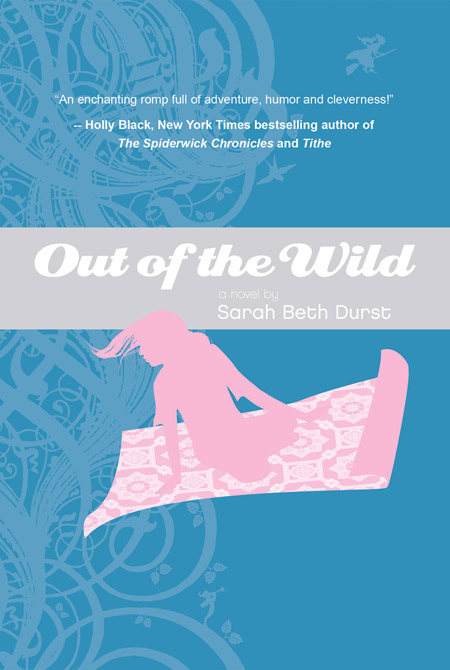
Okay, my second pull brings out one I've recently finished, Sarah Beth Durst's Out of the Wild. Eisha and Jules if you're not to page 123, LOOK AWAY.

She thought of Gillian's story. She thought of the tourists at Graceleand. What if, instead of fleeing from the Wild, people actually flocked in?


If you've read Into the Wild, then you know what the danger is here. If you haven't -- run, don't walk, to your library or bookstore. It's an MG novel enjoyed by YA's, and well worth the read. I launched myself into both the novel and its sequel in the space of a weekend and wanted to see more of the author's work. It was that fast-paced, realistic, and great!

Out of the Wild is available from Razorbill in June!

Also, stay tuned for an awesome TRI-REVIEW of Out of the Wild with Jules and Eisha at Seven Impossible Things Before Breakfast. Yes, I now join the ranks of Betsy Bird and Mr. Horn Book in being invited to a tri-review. Color me excited!!

Since this meme's been around for awhile, I won't tag anyone new -- unless you haven't played, then consider yourself tagged! Happy May Day! This month will be full of vampires, interviews, searches for political reads, new graphic novels, cartoons, and other book-madness on Wonderland. Enjoy!

April 30, 2008

Pen Name Post Script

After all that talk below about pen names, I couldn't help thinking of a wonderful tradition of pen names dating back to...well, at least the Victorian era, when it was reinvented: the Welsh tradition of the Eisteddfod (history here). This annual event--which would have made the perfect subject for a National Poetry Month post, if I hadn't been god-awfully busy--allegedly dates back to at least the Renaissance if not the Middle Ages. Traditionally, an Eisteddfod was a literary competition for bards. Today, the National Eisteddfod is much more of an inclusive event, with musical performances, choir and literary competitions, displays of local artwork, numerous booths offering wares for sale...but the highlight is still the Chairing of the Bard--the winner of the competition for strict-meter poetry. The competitors submit their entries under a pen name, and when the winner is selected, their pen name is announced to the crowd and the winner stands up and reveals him- or herself. They receive a full-sized, artisan-carved wooden chair as a prize, awarded by the Gorsedd of Bards. Similarly, a Crowning takes place for the winner of the free-verse competition.

This picture shows an American version of the Eisteddfod, with the Gorsedd of Bards (aka the teaching staff in bedsheets) of Cymdeithas Madog's annual Welsh language course marching out into the crowd. The prize there is a miniature version of a real Eisteddfod chair which the winner gets to take home for a year; winning names are engraved onto a plaque on the back side. I had the honor (and surprise) of winning the mini-Eisteddfod one year for a short story I wrote in Welsh (you can read the translation here, as well as view my pen name). I still find it strange that I can win a major prize for writing something not in my first language--in fact, in a language I'm arguably still struggling with--but I feel like I can't get very far writing in my first language...oh well. I still have a piece out there with an agent looking at it, so my fingers are crossed.

More about the Eisteddfod on Poetry Friday--I'll feature a Welsh poet and winner of the BIG Eisteddfod!

Schatzi Francis & Other Work (Avoidance) Names

There is a...thing we did in junior high. We took the name of our first pet and paired it with our mother's maiden names, and voilà, -- we had a "professional" name. You know, for that euphemistic "oldest profession?"

No one knows why we did that, but, Gwenda found something better -- a pen name generator. Who hasn't wanted to write something anonymously? I sometimes wish I'd chosen to do that -- but apparently it's something writers do when their careers are flagging -- who knew? If I ever break the mold and start writing SF bodice rippers (Of course, in space, would your bodice rip?) you can bet I'll come up with a suitably spicy nom de plume like Vivianna Isabella Tentadore. (Be on the lookout for that one!)

Amusingly Kelly's pen name turned out to sound like she'll be a writer of historical romance -- at which we both shudder -- and I turned out to sound like someone who writes very dry treatises on naval history -- A.M.S. Marchen. Try it yourself, if you can settle on a single favorite author and character.


Via SF Signal, the somewhat elusive Ursula K. LeGuin reads from her latest novel, Lavinia, and talks about how she decided that she really ought to "get to it" if she was ever going to learn Latin in her lifetime. NPR interviewed this author last week, and revealed the preparation and research she undertook to write this novel. First, she retaught herself Latin. Then, she read The Aeneid -- in the original Latin. You can read an excerpt of the book there, and another one at The Wall Street Journal's Art section.

This book has received a starred review from PW, and the reviewer says, "It's a novel that deserves to be ranked with Robert Graves's I, Claudius." Our Lady LeGuin is seventy-eight.

Were you planning on learning Latin, too? Get to it, then.


Okay, this is also high in the category of Work Avoidance: Extreme Makeover for Spiders. Via Mangesh @ mental_floss, we see an artist collaborating with spiders on web decor. They mostly unraveled her efforts and threw them on the ground (likely with looks of disgust in all eight of their eyes) but it's kind of cool. The idea that the spiders came back to what looked like abandoned webs and basically Just Said No to her artistic license is my favorite part! I wonder if it was merely territorial, or they just didn't approve of red thread?

"It is unlike any maternity clothes on the market." Another entry for the Most Egregious Misuse page? Yes, but it's not the only one. Via Fritinancy, the naming blog, I've discovered Acne Jeans. Yes, people: acne. As in spots, zits, or any other name for the embarrassing and life-altering facial eruptions that stalk our adolescence, and if you're like me, your very, very, VERY late second adolescence-also-known-as-adulthood. Are we forgetting the basic meanings of words, in the quest for advertising dollars? Why yes, as a matter of fact, yes, we are... Acne Jeans. Wear them, and go right back in time to the worst days of your life. Whoo! Fun!

All right, enough malingering. Back to what seems like the sixteenth revision of this particular tale. Cheers!

April 29, 2008

Treasures from All Over

There's a television show in the UK called "Are You Smarter than an 5th Grader" or something like that -- I've never watched it because I have a sister in the sixth grade who assures me that the answer to that is an unequivocal "No." I'm cheered by the fact that she's still not smarter than eighth graders in 1895. Via the mental_floss blog, we're privileged to see the 1895 final exam presented to 8th-graders in Salina, Kansas... and boy howdy are those questions hard. FIVE HOURS were allowed for the final test. Five.

Remember that many young adults decided to teach school after graduating from the 8th grade in those days -- and honestly, if they know how to respond to such questions as:

A wagon box is 2 ft. deep, 10 feet long, and 3 ft. wide. How many bushels of wheat will it hold? 3. If a load of wheat weighs 3942 lbs., what is it worth at 50cts/bushel, deducting 1050 lbs. for tare?

... then they had the chops to at least teach fifth graders... check out the whole exam here.

Imagine treasure-hunting with your granddad -- looking for old cannon balls on a site of a battlefield -- and actually finding treasure. Nine year old Alex found 4,600 silver coins dating from the 13th century -- then archaeologists uncovered almost three thousand more. Hands down, best day out with Granddad, EVER.

Via the Guardian blog -- Shakespeare is being revised -- again -- into "yoofspeak." "Dere was somefing minging in de state of Denmark." Okay, so it's accessible to some -- readable, even, if you're in the know, but the beauty and power of the original language is what makes Shakespeare, isn't it? This isn't an issue for some, because the language tripped them up... Once again, people use the argument that if the Bard were writing now, he'd be writing in "the vernacular" as it were -- but whose? I dunno. I find this a bit patronizing. We're assuming that people who don't choose to participate in the dominate culture only don't because they can't? Hm.

"Smart, funny and cheery, Meyer does not seem noticeably undead in person." Not "noticeably." Well, that's a relief, anyway.

Time Magazine is trying to figure out just what the heck is up with Stephanie Meyers -- how did this 34-year-old observant stay-at-home Mormon mother and housewife turn into a woman being hailed as the next JK Rowling? Seriously, HOW did this happen?! Hat tip to Original Content for the link.


May looks to be a month stuffed with all kinds of fun, games, blog blasts, contests, fluffy bunnies and chickies and ...vampires. Don't forget it's also National Independent Bookseller Month -- if you haven't dropped off the name of your favorite Indie to the ladies at Shrinking Violets, DO SO NOW!

April 28, 2008

Changing...For Better and For Worse

The title of Barbara Shoup's recently re-released novel Wish You Were Here is just so incredibly right on. With it printed on a tape cassette on the cover design, it brings to mind the lyrics to the Pink Floyd song of the same name: "How I wish you were here / We're just two lost souls swimming in a fish bowl year after year." And this book is about a lost soul: Jackson Watt, about to start his senior year, is still having trouble coping with the divorce of his parents--an immature father who's a roadie and stage crewman for countless classic rock bands, and a mother who's about to get remarried and throw a new stepdad and two new stepsisters into his life.

Then his best friend Brady takes off. And doesn't come back. Jax knows he's probably off trailing the Grateful Dead around the country (the book was originally released in 1994, before Jerry Garcia died), but Brady doesn't bother to get in touch with him or even his own parents. Jax is left to deal with senior year and his new stepfamily, his father's accident, a long-distance girlfriend, a clingy and troubled short-distance girlfriend, you name it--all on his own.

Brady would have told him to just forget about all the bullshit. But Brady isn't there. And Jax is starting to wonder if he really ever knew his friend at all. Wish You Were Here is a wrenching and very realistic story about a nice guy who ends up with a rather long playlist of life's problems suddenly dumped on him. Most people wouldn't cope too well, and Jax makes his share of mistakes, but ultimately this is a story of losing oneself in order to find oneself. It does not pull punches. And contrary to what it says on Amazon in terms of age recommendations (12 and up for PW; Grade 8 and up for SLJ), I'd probably say that 14 and up/Grade 9 and up is a bit more appropriate, considering the sex, drugs, and rock 'n' roll.

Instant Karma Is Going to Get You

Horace Carpetine is almost fourteen, and his dream is to become a practitioner of the relatively new (in 1872, that is) science of photography. When he's apprenticed to Mr. Middleditch, he hopes to do his parents proud, but Mr. Middleditch isn't quite the reputable and upstanding society photographer that he claims to be. Still, Horace decides to make the best of it, and do his best to learn the finer points of photography.

One day, however, a strange servant girl appears at the offices of Enoch Middleditch, inquiring about a photography session that her mistress has requested. But when Horace and his employer meet with Mrs. Von Macht--in mourning for her recently deceased daughter--they sense that all is not well in the household. The servant girl, Pegg, implies as much to Horace. They soon become friends, and Horace realizes that there's far more to the Von Macht family than appears on the surface. And things REALLY start to get creepy when Horace's photographs reveal the ghostly image of Eleanora Von Macht.

I'd never read anything supernatural by the versatile Avi, but his latest book, The Seer of Shadows, shows that he's not only a master of bringing past history to life (we already knew that!), but also skilled at evoking suspense and mystery. I enjoyed the level of detail he invests in helping the reader visualize the New York of the past--not just the sights and sounds but also the very flavor of the language. This is a fast-paced and deliciously thrilling ghost story, with an underlying theme of friendship nicely woven in.

April 26, 2008

Can't Stay Long -- The Sun Is Shining!!!


In Brief

I was immeasurably cheered last week when Galleycat reported that my hometown (when in the US) newspaper, The San Francisco Chronicle, had expanded their book coverage. People have been sighing about newspapers cutting reviews, and The Chron sometimes has two a day, plus their Sunday Book section. GO CHRON!

They've got a pretty decent children's book coverage going, but my favorite thing of theirs is a new feature where they ask kids about books. Today's question: What Book Turned You Into A Reader? Some creative answers -- and the girls might surprise you.

You've all heard me whining for the last eight months about how cold I've been -- well, I'll have you know, I took off my coat today. It's finally hit sixty degrees! And now I'm off --

Glorious weekend to you.

April 25, 2008

Poetry Friday: Poetic Virtue and Dr. Hardcastle

A man once said that conservation was a sign of "personal virtue," and when he said this, 'virtue' quickly lost points for some -- and gained points for others. It's an old-fashioned word, virtue is, and seems to imply in modern times a sort of do-gooder attitude of scrupulous perfectionism. But once upon a time, a virtuous person was merely one of the best sort -- thoughtful and helpful and not given to excess -- the kind of person everyone wanted to have around.

I remember my high school English teacher Dr. Hardcastle reciting this poem from memory with perfect, crisp diction. (Sweet day! So cool, so calm, so bright! was actually a line he was apt to declaim on nice mornings, when the rest of us were gazing longingly out of the windows.) He taught us that George Herbert had been a priest, and this poem part of a liturgical tradition. Knowing this, it is easier to see the poem as both a celebration of seasons and consonants, as well as a dark reminder of a priest's ever present knowledge of judgment and death. It is balanced in contrasts: dawn and dusk, blooming and withering, sweet spring, and its close, a soul and its 'vertuous' reward - life, when all else may be turned to coal.

Dr. Hardcastle was in his early sixties when he was my teacher in high school, and I expect that the fatal refrain of this poem has come to him. Still, every new, dew-bright day in Spring reminds me of this poem, and of him -- a virtuous man gone to his reward, as they say, whatever that might be.

The Temple (1633), by George Herbert:

  
Vertue


Sweet day, so cool, so calm, so bright,
The bridall of the earth and skie:
The dew shall weep thy fall to night;
                                        For thou must die.

Sweet rose, whose hue angrie and brave
Bids the rash gazer wipe his eye:
Thy root is ever in its grave
                                        And thou must die.

Sweet spring, full of sweet dayes and roses,
A box where sweets compacted lie;
My musick shows ye have your closes,
                                        And all must die.

Onely a sweet and vertuous soul,
Like season’d timber, never gives;
But though the whole world turn to coal,
                                        Then chiefly lives.


Poetry Friday graces the blog of The Miss Rumphius Effect today; gather round and bring your verses.