Welcome to Book City! (Do you not LUUURRRVE that graphic? Tanita made it! It's awesome, isn't it?)
London is one of those cities that will always be particularly meaningful in my life. It's where my parents met and lived for two years before I was born; it's where my dad first immigrated from Pakistan and made his home for more than fifteen years; it's where I spent a memorable summer working various random jobs between my junior and senior year of college. It's where I learned how to mix a gin and tonic, where I got hit on by a Scottish soccer hooligan, where I ran gleefully through a hedge maze and rode my first subway. It was the first overseas place I ever visited, as a baby and then as a four-year-old toddling around after my parents; again as a sullen thirteen-year-old, with my mother. It's a place where I have friends, where I have extended family, where I feel like I have invisible roots, however tenuous.
Maybe that's why books set in London always appeal to me, and as a fantasy fan, I'm particularly drawn to books about alternate Londons—past, present, or future. In this post, though, I wanted to focus on present-day alternate Londons, and take a quick look at two books that bring to life the world that lies just beneath or beside the London we know. If you're a fan of Philip Pullman's His Dark Materials books and their version of alternate Oxford, then you'll want to take a look at these.
One of them I've reviewed on this blog in the past: Un Lun Dun by China MiƩville. In this book for younger YA/older MG audiences, twelve-year-old Zanna and her best friend Deeba accidentally stumble upon a secret entrance to UnLondon, a fantastical alternate version of the city they know and inhabit: "UnLondon is full of quirky magic, sly humor, and engaging, imaginative personages from the outlandish to the silly--reanimated rubbish that has seeped across the barrier from London, giant flies manned by crews of air-pirates, people with pincushions or diving helmets or occupied birdcages for heads." (from my earlier review) And, one of the things that I loved most about this book was not just that one of the main characters, Deeba, is South Asian, but also that she ends up being the sidekick who steals the show and has to save the day. Readers who've grown up with Wonderland and the Phantom Tollbooth, with Roald Dahl's zany scenarios, are sure to enjoy this one.
For older readers comes a book that's not specifically for YA audiences but will definitely appeal: Neil Gaiman's Neverwhere, which is actually a novelization of a BBC miniseries from the mid-90s. Having watched the miniseries as well as read the book, my opinion is that the book is superior, although that might be because I read the book first. In any case, this is another tale of a London that exists beside—in this case, beneath—present-day London. But in London Below, as Richard Mayhew discovers, there are new and unbelievable dangers as well as wonders, and if Richard can't navigate his way through and out (helping the mysterious young woman Door in the process) he may never be able to return to his regular life. What I loved most about this one was how Gaiman takes the old and intriguing names of well-known London locations, like Blackfriars, Knightsbridge, Seven Sisters, and Old Bailey, and gives them lives of their own with magical provenance: the Black Friars are actually a group of friars who hold a key that Richard must retrieve; Knightsbridge becomes the harrowing Night's Bridge. It's imaginative and fun, the kind of setting that you end up wishing really existed somehow.
Books like these end up adding another wonderful layer of story to a place that is already alive and bristling with centuries upon centuries of history and tales. For me, they enrich and inform the way I think about London, the way I experience it each time I'm fortunate enough to find myself there.
Bonus Reads:
Fantastical Past Londons: Jonathan Strange and Mr. Norrell by Susanna Clarke, The Anubis Gates by Tim Powers, Black Book of Secrets by F.E. Higgins (the first two are written for adult readers, but would be fine for older YA)
Imagined Future Londons: Carbon Diaries by Saci Lloyd, How I Live Now by Meg Rosoff
Also, be sure to check out Jackie's post at Interactive Reader on historical London as well as Tanita's post on Terry Pratchett's truly zany city of Ankh-Morpork. The full One Shot schedule is available and updated throughout the day at Chasing Ray.
Showing posts with label One Shot World Tour. Show all posts
November 16, 2011
One Shot World Tour: Book City - Ankh-Morpork
Atlantis. Brigadoon. El Dorado. Camelot.These cities either sink beneath the waves, remain hidden under shrouds of mystery, or melt into the ether. Lost cities - fabled, fantastical hideaways that people go to war over and lose, then spend blood, sweat and tears trying to find again.
Mordor. Charn. R'lyeh.
Perhaps the loss of these places is deliberate. Perhaps it's safer that they remain unseen. Heere Ther Bee Dragonnes. Cthulhu. Sauron.
The cities are lost, all right? Maybe it's better to leave well enough alone.
Right, then, that's decided. We'll leave those places to sink into darkness and obscurity -- after all, who doesn't love a tale of a lost city that stays safely lost? We shall relish the mystery and obscurity... and turn our attention to the all-too-present city-states of Ankh and Morpork, which are now governed together as Ankh-Morpork.
No mystery there.
Just a strangely sludgy river, completely ridiculous inhabitants, and its own peculiar, stunning stink.
"Poets have tried to describe Ankh-Morpork. They have failed. Perhaps it is the sheer zestful vitality of the place, or maybe it's just that a city with a million inhabitants and no sewers is rather robust for poets, who prefer daffodils and no wonder. So let's just say that Ankh-Morpork is as full of life as an old cheese on a hot day, as loud as a curse in a cathedral, as bright as an oil slick, as colourful as a bruise and as full of activity, industry, bustle and sheer exuberant busyness as a dead dog on a termite mound." MORT, by Sir Terry Pratchett
(The city mottos above and below the hippos are "Merus in pectum et in aquam" [Pure in Heart and Water] and, less straightforwardly,"Quanti canicula ille in fenestra" [How Much is That Doggie in the Window], again proving the theorem that anything said in Latin sounds obscure and intelligent.) Occasionally known as The Big Wahoonie (A fruit the color of earwax with the reek of sick anteater), the combined city-states of Ankh-Morpork are the home of the mildly tyrannical Patrician (who leads the city in a "one man, one vote" type of democracy, only he's the one man with the vote) the City Watch, Death (and his skeletal rat sidekick), and a cast of characters which have carried readers of Terry Pratchett's Discworld novels through eight creative and sharply humorous City Guard episodes. Ankh-Morpork is essentially the hub of a wheel in the Discworld universe -- everyone wants to live there, and everything that happens there has some reverberation throughout the Disc.
What is it about Ankh-Morpork that I love? Well, I love its character. It has a vast opera house, on the swanky Ankh side of town, cobblestones you can feel through the (cheap) soles of your shoes in the Shades; it has rains and mists with their own personalities, and stenches which rise up from the river almost bodily. It has -- is -- character. It practically owns its own lines in any of the novels. It has crazy street names like Treacle Mine Road, where you could once dig up real treacle (something which could only excite people who like it, eg., Brits). The city has strange hippos on its bridges, who allegedly will run away if the city is ever threatened by water (which would be a neat trick, since the river is so muddy it's mostly solid). The City has crazy buildings, like The Tower of Art on the campus of Unseen University, which throws off so much ambient thaumatology (aka magic) that it changes the pigeons roosting on its rooftop into somewhat more than nature intended pigeons to be... and explains the talking dog (any of the region around the tower is called Unreal Estate for a reason). Ankh-Morpork has texture and a certain je ne sais quoi that makes it remarkable and distinctive and home to about a million inhabitants - human, dwarf, troll, vampire, gnome, gnoll, werewolf, and "others," including zombies and the monsters that live under the bed and the Tooth Fairy. And Corporal Nobbs. That's the kind of city which simultaneously makes you feel at home, and makes you wonder how the heck you got there.
I would live there - on the Ankh side, but near the University, I think - in a heartbeat.
Ankh-Morpork is allegedly based on the cities of Tallinn (Estonia) and central Prague, but has elements of 18th century London, 19th century Seattle and modern New York City. Since I've been everywhere but Prague thus far (only in our time period... although, with Tallinn, who can be sure), maybe this is why the place feels so comfortable? Ankh-Morpork is a semi-medieval city that... works. Mostly. Except for incursion by the odd dragon, the City Watch does their job, the Patrician ...votes, and the rest of the rabble falls in line. More or less.A favorite of the early City Guard novels is Men at Arms which begins with a diversity drive for watch...men. "Be a MAN in the City Watch! The City watch needs MEN!" the posters blare. Well, "men" may not be the right word, because the city watch has found a.) a troll, b.) a dwarf, c.) a girl, and d.) incidentally, a werewolf. On top of all of that diversity, there's a serial murderer on the loose, the beginnings of a romance, semi-real pork, and a talking dog. Plus, the watch is going to be stood down and put on leave at noon the following day, for a wedding. As usual, things are a hair away from being ruined for good. Fortunately, the city of Ankh-Morpork doesn't breed timid men. Or, timid talking dogs, assassins, fools, or City Watch personnel, either.
If you've never read any of the Discworld novels, and this just sounds like a geek-ramble to you... well, it is. Other than providing you with story lines, almost anything I say about these books will contain spoilers - which is no fun. The Discworld novels are an acquired taste, but the thing is, it's an easily acquired taste, if you're in a slightly punchy mood and have studied philosophy (which describes half of the British people I know). It crosses easily into American readership because in spite of everything, the characters in the novels really love their city, and make you love it, too. There's patriotism and pride, as the Watchmen defend their city, and when trouble lurks (which really, is every other five minutes), the head of the city watch snarls, "Not in my town!"
I love all of the Watch novels, and to prepare myself for this city salute (and, for no really good reason otherwise except I reread these things about once a year), I started reading Men at Arms. It's a book which includes visits from Death, an invention of Leonard da Quirm (who is obviously a parody of Leonardo da Vinci), a scary clown from The Fool's Guild called Dr. Whiteface, and a visit with the head of The Assassin's Guild.
(Ironically, the clown is the scarier one in this scenario. Certainly he's scarier than Death, which tells you something about clowns.)
This book is one of the many which has modern technology stuck into a semi-Renaissance city. Because of this, it is well-received by its audience, and is one of the Watch books which most often gets written into a play (the one with the dragon might be a bit harder to stage). This poster is from a summer festival play in Wellington, New Zealand.(This still sounds like a geek-ramble, doesn't it? Oh, well. The nice thing about this geek-ramble is that I'm not alone. Author Sir Terry Pratchett, together with a television personage have gotten together to make a City Watch TV Show. Soon, the geekery will spread...)
These novels are especially fun because they're marketed in Britain to adults - and teens. They cross-over perfectly for a people who have a lot of common experiences (like being required to take philosophy), but they cross the pond just as well, and if you enjoy the Tiffany Aching novels, these will crossover well for you, too.
You could start your foray into the Discworld by getting to now this famed city. Start your reading with the City Watch books (Guards! Guards!, Men at Arms, Feet of Clay, Jingo, The Fifth Elephant, Night Watch, Thud! and Snuff) which will give you a feel for the city which is so beloved - and bedeviled - by so many. It will also give you a taste of Death (an anthropomorphic personification who talks in unquoted small caps), zombies, black-ribboner vampires ("Not one drop! Don't be a stupid sucker!") time travel, and C.M.O.T. Dibbler's sausage-inna-bun (which you should spit out immediately, you don't know where that's been). If you begin now, you can read through the Watch series and then get on with The Hogfather by Christmas...
Whatever cover you choose, you'll find in these books a fabulous city with hidden streets, bizarre people, and a fascinating cast. Enjoy! And please enjoy more Book City salutes today!
August 12, 2009
One Shot World Tour: Southeast Asia
Nations of Southeast Asia--Thailand, Laos, Cambodia, Vietnam, Singapore, Malaysia, Indonesia, and the Philippines--are the focus of today's One Shot World Tour. And can we just say how difficult it is to find YA literature that specifically focuses on these regions? Clearly there is a rich area of experience that readers are missing out on--and readers of Southeast Asian heritage aren't seeing their experiences reflected as often as they could be.One of the few times we've featured a significant Southeast Asian author was our review of Town Boy by well-known Malaysian cartoonist Lat. This 2007 Cybils Graphic Novel nominee is the sequel to Kampung Boy; both are available from First Second Books. "The reader really feels like they're getting a glimpse of what life was like growing up in the Malaysia of the '60s," we wrote in our review. But what about the Thailand of today, or the Philippine-American experience? Resources seem sparse, but we've tried to compile a handful of helpful links that might lead interested readers in the right direction.
- Cynthia Leitich Smith has a list of books and resources on children's and YA lit with Asian American themes.
- Pacific Rim Voices is a series of projects devoted to promoting "books and reading as a means to encourage greater understanding of and among the peoples and nations of the Pacific Rim and South Asia."
- One of Pacific Rim Voices' projects is Papertigers.org, which highlights children's and YA literature focusing on the Pacific Rim and South Asia. Explore the site to find resources, book lists, and other goodies such as this list of great reads about Southeast Asia.
- There's a huge list of Asian-American images in picture books at Kay Vandergrift's website.
- Read a few children's books online from Malaysia, Philippines and Singapore at the International Children's Digital Library.
- More specific to YA, there are a handful of not-to-be-missed posts over at The YA YA YAs dealing with Asian-Americans in YA lit, including a fun guest post by author Cherry Cheva whose novel She's So Money is about a high school senior who also happens to be Thai-American.
So what we've got is: go check out these links. Read books by Lat, Cherry Cheva, and anyone else you can find on any of the booklists above or in the many fabulous posts today for One Shot Southeast Asia. And--don't just read them today, this week, this month. Read them whenever you can.
Labels:
AF,
Ethnicity and YA Literature,
One Shot World Tour,
Views
July 27, 2009
From Art to Cover Art...and More
I know I've mentioned it before, but don't miss the excellent contributions to the Readergirlz Art Saves project, which you can view at Bildungsroman. There are some fabulous ones already posted, and each one is so different. Keep checking back this month for more interpretations of how Art Saves.
The ongoing discussion about the cover depiction on Justine Larbalestier's book liar has overflowed from the kidlit world and entered the mainstream(-ish)--prompting some very thought-provoking discussions about depictions of non-white characters on book covers. My favorite post in all this so far is at the YA YA YAs, where Trisha has done some interesting research into Asian-Americans on YA book covers (thanks go to Tanita for the link). Notwithstanding the noticeable trend to use stock photos that lop off heads and limbs (regardless of race), there are not only not NEARLY enough books featuring Asian-American protagonists (in my opinion), but for 2009, there are very few with images of Asian-Americans on the cover.
I find this all very interesting to think about, because when I was quite a bit younger (i.e., in high school) I thought I might want to be a book cover artist. Of course, the field of book cover design has changed so much, with most genres going with stock photos and photo manipulation or even simple text design as opposed to work by illustrators, but I spent enormous amounts of time copying Michael Whelan fantasy book covers (like this one--I did a very time-consuming pencil copy) and that was the image in my mind of what a cover artist did. Now, it seems to be a lot more focused on overall design and layout--at least, most of the time, unless it's a children's book.
Anyway, in her post, Trisha lists a number of excellent books (many of which I need to put towards the top of the TBR list!--anyone read Skunk Girl yet?? I have to try to find that...), and she also mentioned the upcoming Color Me Brown Book Challenge at Color Online. In August, read and review books by people of color, and you'll be entered into a prize drawing. I'll definitely make a point of seeing what I can find at my library, and we'll also be participating in the One Shot Southeast Asia day that Colleen is organizing, also in August. So stay tuned for much reading goodness.
The ongoing discussion about the cover depiction on Justine Larbalestier's book liar has overflowed from the kidlit world and entered the mainstream(-ish)--prompting some very thought-provoking discussions about depictions of non-white characters on book covers. My favorite post in all this so far is at the YA YA YAs, where Trisha has done some interesting research into Asian-Americans on YA book covers (thanks go to Tanita for the link). Notwithstanding the noticeable trend to use stock photos that lop off heads and limbs (regardless of race), there are not only not NEARLY enough books featuring Asian-American protagonists (in my opinion), but for 2009, there are very few with images of Asian-Americans on the cover.
I find this all very interesting to think about, because when I was quite a bit younger (i.e., in high school) I thought I might want to be a book cover artist. Of course, the field of book cover design has changed so much, with most genres going with stock photos and photo manipulation or even simple text design as opposed to work by illustrators, but I spent enormous amounts of time copying Michael Whelan fantasy book covers (like this one--I did a very time-consuming pencil copy) and that was the image in my mind of what a cover artist did. Now, it seems to be a lot more focused on overall design and layout--at least, most of the time, unless it's a children's book.
Anyway, in her post, Trisha lists a number of excellent books (many of which I need to put towards the top of the TBR list!--anyone read Skunk Girl yet?? I have to try to find that...), and she also mentioned the upcoming Color Me Brown Book Challenge at Color Online. In August, read and review books by people of color, and you'll be entered into a prize drawing. I'll definitely make a point of seeing what I can find at my library, and we'll also be participating in the One Shot Southeast Asia day that Colleen is organizing, also in August. So stay tuned for much reading goodness.
Labels:
AF,
Ethnicity and YA Literature,
One Shot World Tour,
Views
March 25, 2009
One Shot Over the Fence: The Geek Wins Again
When Colleen of Chasing Ray had the idea to organize us into a community of over-the-back-fence book-sharing neighbors, I was torn, of course, as to what book to pass on to the neighbors.
Book choices are so... telling. I mean, there's a copy of The Thornbirds the people in the pink house across the street have been passing back along since the seventies. The cover is taped, and there are parts underlined. The couple in the house next door have been forcing How Things Work into the hands of anyone under five for ever. Should I pull out my Muriel Spark, and nudge Memento Mori through the back fence for the older man back there batting around croquet balls and chuckling on the phone to his cronies in the mystery club? Or is that too English major-y? Should I peer over at the neighbor to my left, who is staring morosely at a picture of his ex, and hand him my copy of The Shipping News, which I must read every single year when it gets foggy and stormy, and I need a story of imperfect redemption?
Or, should I just ...give up and out myself yet one more time as the big geek I really am?
Look: it's not my fault. My mother watched Star Trek. The original one. My great-grandmother loved the Monkees. Geek happens. If I can identify the sound of the doors on the Enterprise in my sleep, so be it. If I can watch (and rewatch) episodes of Babylon 5 (until that last season) and weep, and wish they had chosen to revive it instead of Battlestar Galatica, so be it. We know who we are. We are geeks, and we live large, with our fanfic and our cons, our cosplaying and our filking... or, we live undercover, in our closets with our lamps and our stacks of paperbacks and Mystery Science Theater 3000 marathons, and our microwaved popcorn. Whichever. Whatever.
I know what I am, and as such, the only books I can pass across the fence or tuck in through the boxwood hedge for the girl next door are the ones I really, really love... ancient, sexist science fiction.
Yes, I had to get the sexist right out there.
I'm rereading Justine Larbalestier's The Battle of the Sexes in Science Fiction, and boy, there's a history of misogyny for you! In spite of that, though, even as far back as the forties, women were reading science fiction, and loving it. So I join a proud tradition of not seeing myself in the work, and imagining myself there anyway -- don't we all do that? Today I'm passing a stack of James White's Sector General novels over the fence to you. You'll see in a moment there's more than one reason you might not see yourself right off in the cast of characters.
James White's Sector General books combine my love of Other Worlds with a very concrete link into humanity -- doctors. Nurses. Hospitals. Sector General is a hospital station, floating through space (cue the music for General Hospital, the other show my mother watched.) administered by a stern human doctor, and staffed by...
Aliens.
Yep. Humans are just another classification in the universe - one head, four mobile appendages, unfurred, except for strategic points. Humans are DGDB -- bipedal, oxygen breathing, warm-blooded. You'll find plenty of DGDB types at work at Sector General, but they aren't, by any means, the only people -- er, beings -- who have lives and cultures and traditions. These books explore xenophobia, racism, sexism and classism in surprising ways, always with a pacifist angle, to which the Belfast-born White was committed. Sexism amongst the humans isn't exactly turned on its head, but the most important human female in the books is the head of nursing... who has an exceptional bust and stunning blonde hair, but we'll consider the time and be grateful that girls show up at all.
The first chapter of the first novel, published in 1962, begins this way:
It's the babysitting job from hell. O'Mara is accused of causing the accident which killed the huge being's parents, and so he is forced to share living space with this creature, feed it every few hours, and figure out how to bring it -- alive -- to its destination, or face consequences.
O'Mara is not at all a likable character, to begin with. One of his coworkers, a victim of an accident aboard a space-going vehicle has a nervous system which was shattered by radiation, and so he twitches and stammers. O'Mara mocks him, teases him about his stammer, and needles him, much to the disgust of all the other workers. In the beginning, readers might wonder why White chooses someone like O'Mara as a main character -- he's certainly not sympathetic. And yet...
O'Mara is young, muscular and was gorgeous, but now is disabled, very bitter, and seems angry. No one on board likes him, and now there's no one who will believe his story about how the accident happened. O'Mara knows next to nothing about Hudlars, but he's got a First Aid book of sorts... and that will have to do. Of course, while he's figuring out how not to let the baby die, he's got to see the Monitor, who is investigating the accident, and determining whether or not O'Mara still has a job and his freedom.
You will no longer find these books for sale as single editions unless you aver very lucky indeed, they are way out of print. All of the novels in the series appear in omnibus form, as you can see to your left, and were reprinted by popular demand. (Yay! Geek power!) The Sector General novels have compelling characters and storylines which are by turns playful and serious. The drama of meeting all new beings -- classifying them so that the hospital knows what kind they are, and what will work with them -- the medical staff keeping their own prejudices under wraps -- the frustration of seeing patients die because of what you don't know -- all of this creates memorable, eminently readable books. The political undertones of these novels came from White's frustration with the years of violence in Belfast, and the great lengths to which the ambulance personnel, xenobiologists, doctors and medical staff go to avoid having to injure or kill in the field or back at the station -- even when under attack -- speak of his deep desire for the world he knew to work a little harder at preserving lives.
These books remind me of the 1957 Murray Leinster Med Ship series, which is less like General Hospital, and more like M*A*S*H. The Sector General series has also been compared with Alan Nourse's 1959 YA novel Star Surgeon, which I'm still tracking down. If you like S.L. Viehl's StarDoc books, you may like these, but Sector General includes less relationship stuff than Viehl does, less violence, but definitely more weird aliens.
So, at the next block party, look for the absent geeky girl with the massive, sun-defying straw hat and dark sunglasses, lounging with pillows and blanket in a shady back corner of her own backyard. She's the one with the stack of paperbacks and she doesn't actually hear you when you walk up to her and ask her what she's reading. As long as you bring a plate of brownies or something to go with her bottle of lemonade, you're welcome to sit down, pick up a book, shut up, and read.
There are other fences and other neighbors and other books going by. Grab a few from:
The new neighbors we might not know, but don't let that stop you from grabbing a book from them. Check with Chasing Ray for the full lineup.
Buy the Sector General omnibuses from an independent bookstore near you!
Book choices are so... telling. I mean, there's a copy of The Thornbirds the people in the pink house across the street have been passing back along since the seventies. The cover is taped, and there are parts underlined. The couple in the house next door have been forcing How Things Work into the hands of anyone under five for ever. Should I pull out my Muriel Spark, and nudge Memento Mori through the back fence for the older man back there batting around croquet balls and chuckling on the phone to his cronies in the mystery club? Or is that too English major-y? Should I peer over at the neighbor to my left, who is staring morosely at a picture of his ex, and hand him my copy of The Shipping News, which I must read every single year when it gets foggy and stormy, and I need a story of imperfect redemption?
Or, should I just ...give up and out myself yet one more time as the big geek I really am?Look: it's not my fault. My mother watched Star Trek. The original one. My great-grandmother loved the Monkees. Geek happens. If I can identify the sound of the doors on the Enterprise in my sleep, so be it. If I can watch (and rewatch) episodes of Babylon 5 (until that last season) and weep, and wish they had chosen to revive it instead of Battlestar Galatica, so be it. We know who we are. We are geeks, and we live large, with our fanfic and our cons, our cosplaying and our filking... or, we live undercover, in our closets with our lamps and our stacks of paperbacks and Mystery Science Theater 3000 marathons, and our microwaved popcorn. Whichever. Whatever.
I know what I am, and as such, the only books I can pass across the fence or tuck in through the boxwood hedge for the girl next door are the ones I really, really love... ancient, sexist science fiction.
Yes, I had to get the sexist right out there.
I'm rereading Justine Larbalestier's The Battle of the Sexes in Science Fiction, and boy, there's a history of misogyny for you! In spite of that, though, even as far back as the forties, women were reading science fiction, and loving it. So I join a proud tradition of not seeing myself in the work, and imagining myself there anyway -- don't we all do that? Today I'm passing a stack of James White's Sector General novels over the fence to you. You'll see in a moment there's more than one reason you might not see yourself right off in the cast of characters.
James White's Sector General books combine my love of Other Worlds with a very concrete link into humanity -- doctors. Nurses. Hospitals. Sector General is a hospital station, floating through space (cue the music for General Hospital, the other show my mother watched.) administered by a stern human doctor, and staffed by... Aliens.
Yep. Humans are just another classification in the universe - one head, four mobile appendages, unfurred, except for strategic points. Humans are DGDB -- bipedal, oxygen breathing, warm-blooded. You'll find plenty of DGDB types at work at Sector General, but they aren't, by any means, the only people -- er, beings -- who have lives and cultures and traditions. These books explore xenophobia, racism, sexism and classism in surprising ways, always with a pacifist angle, to which the Belfast-born White was committed. Sexism amongst the humans isn't exactly turned on its head, but the most important human female in the books is the head of nursing... who has an exceptional bust and stunning blonde hair, but we'll consider the time and be grateful that girls show up at all.
The first chapter of the first novel, published in 1962, begins this way:
"The alien occupying O'Mara's sleeping compartment weighed roughly half a ton, possessed six, short appendages which served both as arms or legs and had a hide like a flexible armor plate. Coming as it did from Hudlar, a four-G world with an atmospheric pressure nearly seven times Earth normal, such ruggedness of physique was to be expected. But despite its enormous strength the being was helpless, O'Mara knew, because it was barely six months old, it had just seen its parents die in a construction accident, and its brain was sufficiently well developed for the sight to have frightened it badly.
It's the babysitting job from hell. O'Mara is accused of causing the accident which killed the huge being's parents, and so he is forced to share living space with this creature, feed it every few hours, and figure out how to bring it -- alive -- to its destination, or face consequences.O'Mara is not at all a likable character, to begin with. One of his coworkers, a victim of an accident aboard a space-going vehicle has a nervous system which was shattered by radiation, and so he twitches and stammers. O'Mara mocks him, teases him about his stammer, and needles him, much to the disgust of all the other workers. In the beginning, readers might wonder why White chooses someone like O'Mara as a main character -- he's certainly not sympathetic. And yet...
O'Mara is young, muscular and was gorgeous, but now is disabled, very bitter, and seems angry. No one on board likes him, and now there's no one who will believe his story about how the accident happened. O'Mara knows next to nothing about Hudlars, but he's got a First Aid book of sorts... and that will have to do. Of course, while he's figuring out how not to let the baby die, he's got to see the Monitor, who is investigating the accident, and determining whether or not O'Mara still has a job and his freedom.
You will no longer find these books for sale as single editions unless you aver very lucky indeed, they are way out of print. All of the novels in the series appear in omnibus form, as you can see to your left, and were reprinted by popular demand. (Yay! Geek power!) The Sector General novels have compelling characters and storylines which are by turns playful and serious. The drama of meeting all new beings -- classifying them so that the hospital knows what kind they are, and what will work with them -- the medical staff keeping their own prejudices under wraps -- the frustration of seeing patients die because of what you don't know -- all of this creates memorable, eminently readable books. The political undertones of these novels came from White's frustration with the years of violence in Belfast, and the great lengths to which the ambulance personnel, xenobiologists, doctors and medical staff go to avoid having to injure or kill in the field or back at the station -- even when under attack -- speak of his deep desire for the world he knew to work a little harder at preserving lives.These books remind me of the 1957 Murray Leinster Med Ship series, which is less like General Hospital, and more like M*A*S*H. The Sector General series has also been compared with Alan Nourse's 1959 YA novel Star Surgeon, which I'm still tracking down. If you like S.L. Viehl's StarDoc books, you may like these, but Sector General includes less relationship stuff than Viehl does, less violence, but definitely more weird aliens.
So, at the next block party, look for the absent geeky girl with the massive, sun-defying straw hat and dark sunglasses, lounging with pillows and blanket in a shady back corner of her own backyard. She's the one with the stack of paperbacks and she doesn't actually hear you when you walk up to her and ask her what she's reading. As long as you bring a plate of brownies or something to go with her bottle of lemonade, you're welcome to sit down, pick up a book, shut up, and read.
There are other fences and other neighbors and other books going by. Grab a few from:- Kelly@Writing & Ruminating,, who has a new one to share,
- Betsy @ Fuse#8,, whose book has awesome art,
- Little Willow @ Bildungsroman,
- MotherReader,
- and Liz at A Chair, A Fireplace, & A Tea Cozy. with a bit of nonfiction that sounds really good.
The new neighbors we might not know, but don't let that stop you from grabbing a book from them. Check with Chasing Ray for the full lineup.
Buy the Sector General omnibuses from an independent bookstore near you!
March 26, 2008
A One Shot World Tour: "O, CANADA!"
I absolutely adore Canada.
My favorite college professor -- who introduced me to the works of my favorite Canadian adult author, Margaret Atwood -- is Canadian. My first time sitting in a neck-deep spa-tub was in Canada (and trust me -- that was enough to gain the country my undying love). And my very first piece of fanfiction at age 9 was set on the magical grounds of Prince Edward Island. Despite the whole Red Green thing (!), Canada gets some serious love from me.
Like many books published outside of the U.S., books published by Canadian authors aren't always readily available in American bookstores, which is a serious shame. This is why, until this last Cybils Season, I'd never even heard of Canadian author K.V. Johansen whose novel, Nightwalker, is not, in fact, her debut work. No, it's one of nine novels she's written!
NINE novels!? Where have I been?!
K.V. Johansen holds a Master's Degrees in Medieval Studies and in English, which gives her work great details and historical depth. Her nonfiction book on children's fantasy literature, Quests and Kingdoms: A Grown-up's Guide to Children's Fantasy Literature, is one that I would dearly like to own. It is a chronological overview of fantasy which received rave reviews from diverse audiences, including history teachers, the Mythopoeic Society, and librarians. It's a great teaching tool or reference, and the style makes it appropriate for young adults, too.
K.V. Johansen's Nightwalker was added to VOYA's Year's Best Science Fiction, Fantasy, and Horror list for 2007, and you can find out more about her writing in these interview clips and on her very informative website. The videos of her reading portions of her work only whets your appetite to read more!!! Some great stuff here!
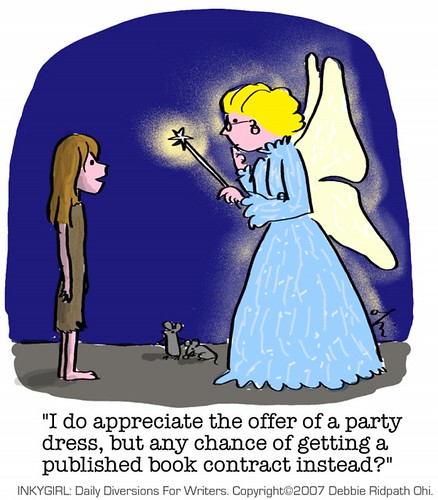
(Psst! Treason in Eswy, the second book in the Warlocks of Talverdin series, hit Canadian bookshelves March 1st. Has anyone else read it yet?? I'm looking for it in the UK -- no such luck yet...)
And now, a BONUS Canadian for Writers:
However thin the stream of books flowing between writers and readers in our two countries, there has been one steady stream of writing wisdom coming from Canada in the form of Debbie Ridpath Ohi. Debbie kept me company those years after college when I was pretty sure I had a Great Novel Within Me, but kept getting in the way of my own prose. Inkspot was an amazing discovery, a writing resource that made sense. I avidly read the marketplace pieces, which kept me going between my Writer's Market subscriptions. It was deeply ironic that my first major sale coincided with Xlibris buying out Inkspot -- running Debbie into the ground, and then closing the site down. I must admit that I shed a few tears of rage, as this was a bummer of major proportions. There were other writing sites, pulled together by great people, but it just wasn't the same.
Of course, it isn't like Debbie herself vanished or anything. This multi-talented Canadian was interviewed last year at Women on Writing. You can also find her blogging and drawing her quirky, amusing work at Inkygirl: Daily Diversions for Writers, which is where I also go to find Will Write for Chocolate. A favorite spot also is Debbie's list of writers who were rejected repeatedly before they hit the big time. Read it, peeps. It'll give you courage.
The One Shot World Tour concept rose fully formed from the fertile mind of our organizer, Colleen. The O, Canada! round-up at Chasing Ray includes the really adorable Daisy Dawson the CUTE ALERT monsters drawn by illustrator Kean Soo, and more. There's still plenty of Canadians where these came from! (Um... Canada?) Enjoy the literary goodness from Our Neighbors to the North all day today!
(Props to Little Willow for the flag logo!)
My favorite college professor -- who introduced me to the works of my favorite Canadian adult author, Margaret Atwood -- is Canadian. My first time sitting in a neck-deep spa-tub was in Canada (and trust me -- that was enough to gain the country my undying love). And my very first piece of fanfiction at age 9 was set on the magical grounds of Prince Edward Island. Despite the whole Red Green thing (!), Canada gets some serious love from me.
Like many books published outside of the U.S., books published by Canadian authors aren't always readily available in American bookstores, which is a serious shame. This is why, until this last Cybils Season, I'd never even heard of Canadian author K.V. Johansen whose novel, Nightwalker, is not, in fact, her debut work. No, it's one of nine novels she's written!NINE novels!? Where have I been?!
K.V. Johansen holds a Master's Degrees in Medieval Studies and in English, which gives her work great details and historical depth. Her nonfiction book on children's fantasy literature, Quests and Kingdoms: A Grown-up's Guide to Children's Fantasy Literature, is one that I would dearly like to own. It is a chronological overview of fantasy which received rave reviews from diverse audiences, including history teachers, the Mythopoeic Society, and librarians. It's a great teaching tool or reference, and the style makes it appropriate for young adults, too.
K.V. Johansen's Nightwalker was added to VOYA's Year's Best Science Fiction, Fantasy, and Horror list for 2007, and you can find out more about her writing in these interview clips and on her very informative website. The videos of her reading portions of her work only whets your appetite to read more!!! Some great stuff here!(Psst! Treason in Eswy, the second book in the Warlocks of Talverdin series, hit Canadian bookshelves March 1st. Has anyone else read it yet?? I'm looking for it in the UK -- no such luck yet...)

And now, a BONUS Canadian for Writers:
However thin the stream of books flowing between writers and readers in our two countries, there has been one steady stream of writing wisdom coming from Canada in the form of Debbie Ridpath Ohi. Debbie kept me company those years after college when I was pretty sure I had a Great Novel Within Me, but kept getting in the way of my own prose. Inkspot was an amazing discovery, a writing resource that made sense. I avidly read the marketplace pieces, which kept me going between my Writer's Market subscriptions. It was deeply ironic that my first major sale coincided with Xlibris buying out Inkspot -- running Debbie into the ground, and then closing the site down. I must admit that I shed a few tears of rage, as this was a bummer of major proportions. There were other writing sites, pulled together by great people, but it just wasn't the same.
Of course, it isn't like Debbie herself vanished or anything. This multi-talented Canadian was interviewed last year at Women on Writing. You can also find her blogging and drawing her quirky, amusing work at Inkygirl: Daily Diversions for Writers, which is where I also go to find Will Write for Chocolate. A favorite spot also is Debbie's list of writers who were rejected repeatedly before they hit the big time. Read it, peeps. It'll give you courage.
The One Shot World Tour concept rose fully formed from the fertile mind of our organizer, Colleen. The O, Canada! round-up at Chasing Ray includes the really adorable Daisy Dawson the CUTE ALERT monsters drawn by illustrator Kean Soo, and more. There's still plenty of Canadians where these came from! (Um... Canada?) Enjoy the literary goodness from Our Neighbors to the North all day today! (Props to Little Willow for the flag logo!)
Fantastical Fiction from Two Northern Neighbors
In honor of One Shot World Tour: Canada, I thought I’d tip my hat to one familiar writer and one relatively unfamiliar one from our neighbors to the north. Firstly, the familiar: I’ve been a fan of Ottawa-based author Charles De Lint’s writing since I was in high school, even though the books I read weren’t strictly YA. At the time I devoured as much urban fantasy I could find, though it wasn’t as plentiful back in the early '90s; and Charles De Lint was a natural match, with his fictional city of Newford and its motley population of artists, intellectuals, vagabonds, as well as assorted mythical and mystical creatures inhabiting parks, streets, abandoned buildings...
Newford is a place where imagination comes alive in a fantastical blend of Western European and Native American mythologies. I’m not sure which book was my first introduction to De Lint—it was either Moonheart, The Little Country, or Jack the Giant-Killer—but I was captivated by the vividness of Newford as a setting and the spunky, brave, sensitive, creative heroines that usually narrate De Lint’s novels and short stories. The past few years, he’s begun writing books specifically for a YA audience—The Blue Girl, Little (Grrl) Lost, and the newly-released Dingo.
Though so far my preference remains with the books he wrote for an adult audience, I’m glad that he’s reaching out to younger readers, and I also think that his YA books might be good for reluctant readers as well—eventually drawing them into his delicious and dark world of urban fantasy. To read more about this multitalented man and find a full booklist, visit his website.This is sort of embarrassing, but back in 2004, I actually made a writing-related pilgrimage to one of the favorite hangouts of Charles De Lint and his wife--an Ottawa pub that happened to be quite close to where I was staying to attend a conference. I figured, since I was in the neighborhood, I’d just stop by, have a pint, and soak up the good writerly vibes. Unfortunately, he was out of town at the time, but I still checked it out, stayed for a spell, and wrote notes for my own novel. It really just made me wish I had a nearby pub I could sit in to write and peoplewatch...
Another Canadian author who primarily writes fantasy and supernatural fiction is Margaret Buffie, originally an artist, who began writing in the mid-1980s. Though she’s known for writing many ghost stories as well as an unusual and creative fantasy trilogy, the first book I encountered of hers was Out of Focus, a novel of realistic fiction and dramatic family tension that I reviewed for The Edge of the Forest. It seems to reprise some of the tense family situations that characterize her first novel, The Haunting of Frances Rain (published in Canada as Who Is Frances Rain?), which was also a ghost story.
Her fantasy trilogy, The Watcher’s Quest (The Watcher, The Seeker, and The Finder) are quite different—fast-paced, original fantasy in which Buffie creates an entire set of worlds interlaced with threads of Celtic myth. The trilogy tells the story of Emma Sweeney, who, at sixteen, has long known that she’s not quite like anyone in her family. She’s also felt a near-compulsion to watch out for her sickly sister and somewhat flighty parents. Now, as her artist father builds a sort of modern henge out in the fields of their bee farm, she senses a gathering danger and doesn’t know why. When odd new neighbors the Maxims move to a nearby farm, she takes a summer job caring for the elderly father and realizes they aren’t who they seem—or what they seem. I’m always interested in novels about parallel worlds, and I haven’t read anything quite like this trilogy, populated with a fascinating cast of characters ranging from selkies and mer-people to leaf-creatures and walking, creaking mechanical men. A very creative and very visual tale. To find out more, visit Margaret Buffie’s website.August 15, 2007
Subscribe to:
Posts (Atom)