Showing posts with label Happenings. Show all posts

May 25, 2018

SAVE THE DATE: KidLitCon 2019 in Providence, RI

It's hard to believe, but I don't think we've posted about this yet--the next Kidlitosphere Conference is already well into the planning stages, spearheaded by our own Charlotte Taylor of Charlotte's Library and Mia Wenjen of Pragmatic Mom. It'll be in Providence, RI on March 22-23, 2019, and it's got its own nifty website!

The latest awesome news about the conference is that Charlotte applied for and GOT a sizeable grant from the Providence Tourism Council, which means we can stretch our small budget and make the conference an even more memorable experience for everyone. This next con promises to be bigger and better than ever, too, with Charlotte and Mia at the helm. Reaching Readers is the theme, and there's already an incredible list of attending bloggers and authors who have plans to come.

If you've been to KidLitCon before, you'll know that it offers a far more intimate and less formal opportunity for bloggers, authors, librarians, teachers, illustrators, and other devotees of kidlit to come together and discuss current and ongoing issues, as well as sharing our areas of knowledge and expertise for the benefit of the kids (and, let's face it, adults) who read and enjoy books for young people. Speaking personally, it's at KidLitCon that I "found my tribe," so to speak--I've made lifelong friends with fellow book lovers who might be writers, readers, or both, but regardless of our actual job titles, we share that same passion.

I'm planning to attend (although there's a possibility I might be traveling elsewhere at the time, I'm hoping to make it all happen!) and look forward to meeting even more members of the tribe--so if you're interested, go check out the programming notes and get involved in a panel!

May 08, 2018

2♦sdays@the treehouse: Challenge Five: May

Welcome back to our monthly Second Tuesday writing challenge!

From January - June, every second Tuesday of the month, we're going to post an image here on Wonderland of a Creative Commons licensed Flickr picture to which you can respond - with poetic, prose, or whatever kind of writing - and hopefully, you'll share a link in the comments below, so that we can visit your site, read your work and respond. No genre or style limit - just come and join the fun!

Welcome to May!


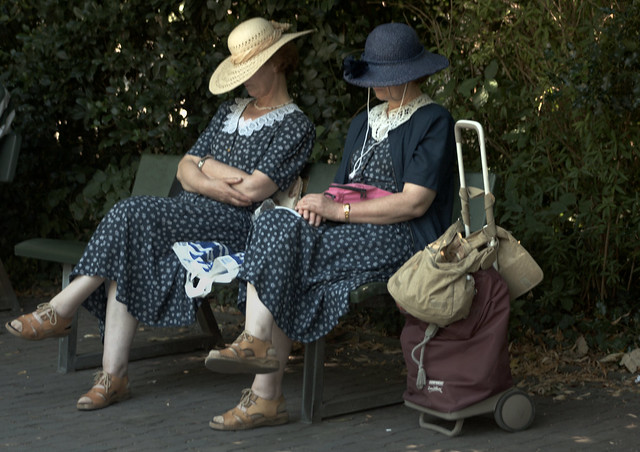
I think we're over it with the May showers, but we're just getting started with Asian Pacific Heritage Month, and Mental Health Awareness Month. This month, it's time to celebrate National Salad Month, which, likely, features women laughing. Alone. With Salad. As they so often do. Additionally, May is National Bike and Barbecue Month as well, and extra points if you can celebrate these holidays simultaneously. This month's image comes from Flickr user Stefano Arteconi of Bologna, Italy:

Untitled>

I have... so many questions, don't you? Just leave your link in the comments below, and we look forward to reveling in your inspiration! Happy writing!

March 13, 2018

2♦sdays@the treehouse: Challenge the Third: March

Welcome back to our monthly Second Tuesday writing challenge!

From January - June, every second Tuesday of the month, we're going to post an image here on Wonderland of a Creative Commons licensed Flickr picture to which you can respond - with poetic, prose, or whatever kind of writing - and hopefully, you'll share a link in the comments below, so that we can visit your site, read your work and respond. No genre or style limit - just come and join the fun!


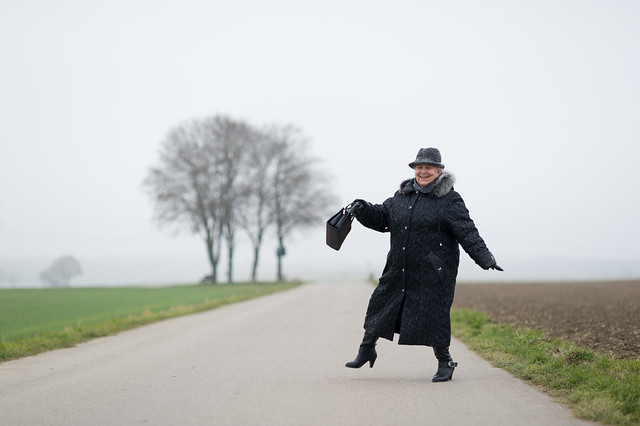
Welcome back, it's March, which brings with it, famously, National Irish American Heritage Month (WHO KNEW), Purim, and the National Bubble Week celebration, which, I'm sure, is all the rage where there's still snow and ice crystals to photograph attractively over their surfaces. This month's image comes from Flickr user Philipp Rein of Augsburg, Germany. I'm intrigued by the stories which will come from this image, so without further ado:

20131213_DSC8849.jpg

I'm not going to bother with Inlinkz this month; just leave your link in the comments below, and we look forward to reveling in your inspiration! Happy writing!

February 14, 2018

CYBILS AWARD ANNOUNCEMENT

Congratulations to all of the winners! We're especially thrilled about...

Elementary/Middle Grade Speculative Fiction: THE DRAGON WITH THE CHOCOLATE HEART, by Stephanie Burgis

MG Fiction: REFUGEE, by Alan Gratz

YA Graphic Novels: SPILL ZONE, by Scott Westerfeld

YA Fiction: PIECING ME TOGETHER by Reneé Watson

See the entire list of excellent books with a little plot write-up on the Cybils Award website. And cheers to all those who nominated and participated!

February 13, 2018

2♦days@the treehouse: Challenge February

Welcome back to our monthly Second Tuesday writing challenge!

From January - June, every second Tuesday of the month, we're going to post an image here on Wonderland of a Creative Commons licensed Flickr picture to which you can respond - with poetic, prose, or whatever kind of writing - and hopefully, you'll share a link in the comments below, so that we can visit your site, read your work and respond. No genre or style limit - just come and join the fun!


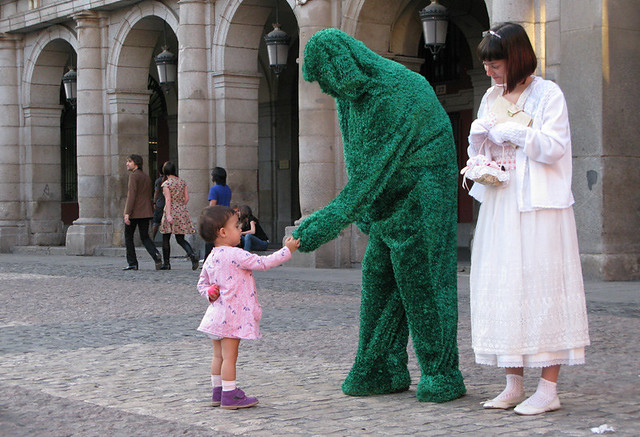
Welcome back, it's February, which brings with it, famously, Black History Month, Groundhog Day, that Presidential birthday weekend which translates to "Monday off," and, of course, who can forget Valentine's Day... or, less memorably, National Grapefruit Month, and I am here for THAT, despite myself. This month's image comes from Flickr user Left Hand Rotation of Madrid, Spain, presenting us with Los hombres de Musgo de Béjar. I'm intrigued by the stories which will come from this image, so without further ado:

MOSS MEDIA (Acción Urbana)

I'm not going to bother with Inlinkz this month; just leave your link in the comments below, and we look forward to reveling in your inspiration! Happy writing!

February 09, 2018

Cybils Countdown

Pssst! There's just five more days....

Every single year, the Caldecott, Printz, Newberry, and other awards come up with tons of wonderful titles that... most people have already heard of. And, that's not awful. These books are well-read, widely reviewed, and often touted by major reviewing bodies for their literary impact. But, sometimes "literary" doesn't take into account "beloved."

In 2006, the Children’s and Young Adult Bloggers’ Literary Awards were founded to address that particular issue. The Cybils Awards accepts nominations from hundreds of ordinary people - young adults and kids, librarians, teachers, and parents - so that the year's panel of judges can read and discover books that might not be famous or popular, but which have both literary merit and kid appeal. Over the years, the nominations have expanded to include self-published books, audio books, and book apps, as well as the usual general categories of for younger and older readers.

Though there are still hundreds of books released each year which get lost in the shuffle, there's been a slight decline in the last year in nominations. Is the gap between books awarded and books beloved finally closing? Or, were we all so distracted with politics in the last year that we forgot to read? We at Finding Wonderland are going to do our best to be more vocal about our support for the Cybils Awards, and remind each other to read widely - and wildly - and to recommend books as hard as we can. We want to see new book vloggers and avid book bloggers, readers, audio-book junkies, reader's advisory librarians, and everyone, really come together to keep young adults and children - and the adults who can't get enough of their wondrously literary books - talking books, swapping books, and best of all, reading.

To that end: in just five days, the 2017 Cybils Awards will be revealed. Watch. This. Space!

January 09, 2018

2♦sdays @ our treehouse - 1/18 Challenge!

A few years back, B&N's Teen blog put up a post about which anthologies, in their opinion, had gotten the art of the young adult short story right. Their list included some headlining authors as well as smaller lights in the field. YA collections have always been useful for introducing lesser-known writers, which is why a couple of smart people in the industry, Nova Ren Suma and Emily X. R. Pan, have kicked off FORESHADOW. "FORESHADOW: A Serial YA Anthology is to offer a unique new online venue for young adult short stories, with a commitment to showcasing underrepresented voices, boosting emerging writers, and highlighting the beauty and power of YA fiction." This monthly anthology is the opportunity that many writers have been waiting for.

To that end, our writing group thought it would be fun to do a little exercise of our own. Through the first (technical) half of 2018, January - June, every second Tuesday of the month, we're going to post an image here on Wonderland of a Creative Commons licensed Flickr picture to which you can respond - via short story (potentially something to be polished for subbing to Foreshadow or elsewhere), poem, or just a scene polishing up dialogue, setting, characterization, or anything else you'd like to work on. Maybe you're doing Morning Pages, and writing three pages first thing. You can certainly come up with some thoughts on this image, and even some thoughts which might spur some deeper creativity. For two weeks, you can join the fun by posting a link to share. We'll keep the momentum going the following month by posting another image the second Tuesday of February, the 13th, and so on, until we take a breather for summer. We hope this will be the little kick in the pants you need to get writing, keep writing, or polish up your skills.

And without further ado, this month's image:

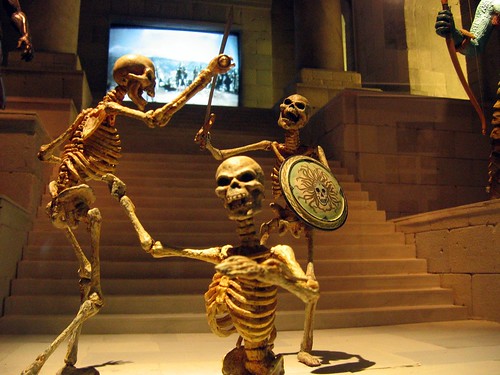
Harryhausen Skeletons

Harryhausen Skeletons, by Flickr user Jürgen Fauth of Berlin.

Happy Writing! Please consider sharing your link!

December 08, 2017

Coming Soon to a Blog Near You

If you haven't yet had a chance to grab Sara Lewis Holmes' newest book The Wolf Hour the following posts and her various guest post/interviews around the web will raise this book on your TBR list.

Sara's talking music with picture book writer Liz Garton Scanlon. Calling it a "musical novel by a lyrical poet," Liz's interview arrives just in time for Poetry Friday. Liz asks Sara questions which are both deep and broad, and, frankly, Sara says, have her learning more about her book post-publication than she knew going in! That sort of interest and scrutiny is what we can all only hope for in our book interviews!

Sara's earlier interviews on THE WOLF HOUR can be found at Laura Purdie Salas' site, where she also talks of the music in poetry; at Charlotte's Library where she unpacks some of the deeply intriguing quotes from the book; Maureen Eicher's review at 'By Singing Light' and our interview here at Wonderland, which kicked off this slowly perambulating blog tourback in September.

Cheers, and happy reading!

November 02, 2017

Happy NaNoWriMo 2017!

Hey, it's November, and that means it's National Novel Writing Month! As per usual for me lately, I don't even have a wisp of a dream of a hope of participating--but that doesn't mean I don't LOVE NaNoWriMo. I've been a participant (and a completer) a handful of times in the past, and I'm here to encourage you to GO FOR IT if you can. You never know what greatness might occur; what jewels in the rough; what bezoars in the poo, or whichever metaphor you prefer.

Don't believe me? Well, two of my three PUBLISHED novels started during NaNoWriMo. I wouldn't necessarily describe myself as either a panster or a plotter, but the evidence seems to tip me into the former category, doesn't it? When you let the words flow, sometimes that's what you need to find your voice and loosen your imagination.

So. No excuses (unless you're like me and have enough work this month for at least two months' worth of stress)--grab your computer and get going!

October 27, 2017

Don't Miss...!

If you haven't yet had a chance to grab Sara Lewis Holmes' newest book The Wolf Hour the following posts and her various guest post/interviews around the web will raise this book on your TBR list.

This week, Sara's talking music with poet Laura Salas. Interestingly, the poetry in THE WOLF HOUR is something that Sara, a poet herself, excels at -- but isn't something you'd ordinarily expect in a fairytale, which is what makes it significant and fun.

Sara's interviews elsewhere can be found at Charlotte's Library where she unpacks some quotes from the book; Maureen Eicher's review at 'By Singing Light' and our interview here at Wonderland, which kicked it all off is right here.

Cheers, and happy reading!

October 09, 2017

Monday Miscellanea: A Blog Tour, the Cybils, and More...

...not MUCH more. But more!

First of all, today is the second day of the blog tour for Sara Lewis Holmes' newest book The Wolf Hour--go check out her guest post/interview at Charlotte's Library for a peek at some favorite quotes from the book. Edited to add: Also don't miss Maureen Eicher's post at By Singing Light - reposted today - as well! (And if you missed our interview with Sara, you can read it right here.)

Next, if you haven't nominated books for the Cybils Awards yet, there's still plenty of time! Nominations are open through the 15th for the general public, and after that there's a submission window Oct. 16-25 for authors, publishers, and publicists--check out the info on that here.

Lastly, have you registered for Kidlitcon yet? I'll be on vacation with my mom, but YOU could be there--and the program is amazing with a stellar lineup of authors and bloggers, and panels on topics as diverse as Children's Books for Reading Development, Sports Books for the Unathletic, and Immigrants and Refugees in Kids' and YA Books. 

That's it for this fall Monday...and fall is definitely in the air, bringing cooler breezes and wafting pollen into my sinuses. But it's still my fave season, sneezes and all.

September 25, 2017

Starring Sara Lewis Holmes

It's Day One of The Wolf Hour blog tour!


Welcome, my little lambs, to the Puszcza. It's an ancient forest, a keeper of the deepest magic, where even the darkest fairy tales are real. Here, a Girl is not supposed to be a woodcutter, or be brave enough to walk alone. Here, a Wolf is not supposed to love to read, or be curious enough to meet a human. And here, a Story is nothing like the ones you read in books, for the Witch can make the most startling tales come alive. All she needs is ...
      A Girl from the village,
            A Wolf from the forest,
               & A Woodcutter with a nice, sharp axe.

So take care, little lambs, if you step into these woods. For in the Puszcza, it is always as dark as the hour between night and dawn -- the time old folk call the Wolf Hour. If you lose your way here, you will be lost forever, your Story no longer your own. You can bet your bones.


And with a bit of a shiver, come in! We bid you Welcome!

Sara Lewis Holmes has been a very dear friend since 2007, when Tanita joined she and five other women in a year-long poetry challenge which culminated in a National Poetry Month Crown of Sonnets way back in 2008. This poetry effort then turned from a trial experiment for one poem into a yearly, year-long delight of poetry and wordplay. We expected good things when we reviewed Sara's second book, and when Sara joined our writing group, we were pleased to indulge ourselves in talking craft and sharing stories. Today, we celebrate the release day of Sara's fourth book, and we're excited to tell you all about it! Well... all about it within reason, anyway. We're focusing on writing details, and the craft of fiction today, and working hard to present NO SPOILERS here, so you may find this interview vague on points of plot. -- No worries, though! You'll have all the plot you'd like when you pick up your own copy. So, without further introduction, we're thrilled to welcome author and poet Sara to the Wonderland Treehouse!


Finding Wonderland: Hi Sara! Let's get right into it - THE WOLF HOUR is a "Once upon a time" type of tale, but stories don't always actually start that way for writers. What was the starting point of this story for you? What initially inspired you to write this book, and which character(s) sprang to mind first?

Sara Lewis Holmes: I’m more like a magpie than a spider when it comes to story. I don’t spin a carefully symmetric web of plot and character out of my guts, as much as I would love to say I do. Rather, I collect shiny baubles over the years, hoarding and obsessing over them until I figure out how to make a story out of all the strange beauty.

For THE WOLF HOUR, those glittering pieces included: a conversation with a stranger about why some stringed instruments howl when played, the image of a child clinging to a tree rather than be forced to lessons, a rotund china pig given to me by my mother-in-law, and a former piano teacher whose entire house bloomed with pink.

Those elements were in my magpie’s nest of a journal but it took an encounter with a wolf to set them free. Not a real wolf, although I’d seen one, in a carefully fenced wolf park, and listened to one howl in a chilling YouTube video, and read about many in both fairy tale and fact—-but one whose voice stole into the forest of words crowding my head, and told me that if I wanted to write about wolves, he would be my guide. His name was Martin, and he had been raised by books, and knew everything about everything—-except the human heart. I could not help but love him, and be terrified for his future, too.

Finding Wonderland: Okay, we LOVE that you based this story on actual items that you were GIVEN! Story magpies! How cool a concept! So, let's talk readers --

Despite their often bleak or violent content, fairytales are traditionally seen as stories intended for children. What's the optimum age of your target reader for THE WOLF HOUR? Who is this book for? Who, if anyone, is it not for?

Sara Lewis Holmes: Age and readership questions are hard. Do you like to shiver and chew your lip ragged as you read? Do you like a story that twists and turns and doesn’t go where you expect it to? Do you enjoy a story that KNOWS it’s a story, and might even challenge you to think about your own Story and whether you like your place in it? If you do, even if you aren’t in the 8-12 age range for this book…read on!

Finding Wonderland: Ah. So, what books are for you? What are a few of your favorite fairytales, and why do you love them?

SLH: East of the Sun and West of the Moon has to be the most lovely title ever for a fairy tale. And in it, the girl rescues her prince, instead of the other way round. Also, there’s a princess with a nose that is “three ells” long! I’m also fond of works that focus on the told nature of stories, such as William J. Brooke’s three part TELLER OF TALES book series, as well as the 2000 American/British TV miniseries, ARABIAN NIGHTS, adapted by Peter Barnes. Like a hall of mirrors, these “stories within stories” crack open my view of the world. Finally, I’d add that all fairy tales are, to a fault, weirdly defiant of the world’s conventions. They are like poetry in that way, and I love their wildness.

Wonderland: I'm going to have to look up what how long an 'ell' is!

Often, setting is itself a character in a novel, acting as an active metaphor. Would you say that you consciously, or unconsciously used THE WOLF HOUR'S setting to speak to the reader? Do you consider this novel a "fairytale mashup”?

SLH: The Wolf Hour, in legend, is the hour between darkness and dawn; it’s the hour more people are said to be born into this world and more people leave it than any other —-and, if you are like me, you are often awake then, wondering if you will ever get your Story right. So I would say that part of the “setting” of my novel deals with such fairy tale time—-how twisty it is, and how “once upon a time” can stretch to many, many days and nights, and how being in charge of your own time means being in charge of your own story. Easy to say, difficult beyond measure to do.

The other part of the setting is the deep, dark forest. In Polish, the word for such a place is “Puszcza,” and yes, I absolutely wanted the reader to feel that such a place was both desirable and dangerous. I wanted the reader to feel its call, as Magia does, and to discover the Stories that dwell there. I think it’s those various Stories that make me say THE WOLF HOUR is not a re-telling but “a fairy tale mashup.” It’s a story about the power of stories, and how everyone tries to cast you in the story that is easiest for them to hear—-but not necessarily the one you want to live in. How do you fight that?

Wonderland: How one combats someone trying to recast their Story is something few tales look at quite so directly, so this is very interesting.

Those of us who know you through your work know that you delight in Shakespearean stories, and acting as a tool for self-understanding. How did your appreciation for the Bard and your interest and skill in theater help to shape this novel?

SLH: Reading Shakespeare taught me that disguise is uncommonly common, death is a persistent beast, and love is found in unexpected places. His plays are filled with a more than a touch of unbelievable—-a trait I admire in novels such as COSMIC by Frank Cottrell Boyce, THE WHITE DARKNESS by Geraldine McCaughrean, and NATION by Terry Pratchett—-not to mention most fairy tales. The Bard was also a master of the “story within a story” trope, which I find irresistible, as I mentioned earlier, and he absolutely inspired me to make up words as needed, and to not be afraid to pair utter despair with low comedy. (I think of the pigs in THE WOLF HOUR as a villainous take on his “rude mechanicals.”)

Finally, I am ever grateful to the brilliant artists at the American Shakespeare Center in Staunton, VA, who hold a Shakespeare camp for adults every summer and stage the most compelling theater I know. Their work informs mine in ways I cannot explain, but I do know that they remind me that Magic Happens. Every Day.

Wonderland: All hail the magic, indeed. We never quite know how it works... but sometimes, it's enough that it does.

So, softball question: If you could write yourself into a fairytale, which one would it be? Would you prefer a role which gave you Power or Guile?

SLH: Puss in Boots is a master class in Guile, or How to Make Something from Nothing. As a writer, I identify. However, if I had to pick some boots to fill, I prefer seven-league boots. The power to travel great distances without burning carbon fuel would be both practical and fun.

Wonderland: Ooh, good answer. Definitely, we writers must use all we've all got to get ourselves as far along as we can!

So, while you studied the Bard, my studies were in 19th c. British and American lit... and the 19th century canon uses a lot of intrusive narrator/direct address authorial comment to help readers gain a deeper understanding of the characters, but authorial insertion is largely absent from modern novels. What prompted you to use that 'Dear reader' sort of narrative technique in THE WOLF HOUR? Do you think more novels would benefit from that sort of "breaking the fourth wall" technique, in order to allow readers to come closer to the action?

SLH: My editor, Cheryl Klein, and I talked at length about the challenge of signaling to a reader HOW to read this story. I needed to convey that all was not going to proceed as normal, and that the path ahead would be scary and often double-back on itself before coming to a conclusion. After all, the novel is ABOUT how to find and live in your own story…and how unbelievably hard that can be. So we decided that a direct reader address would set the right tone for the three-stranded tale that would follow, and that the voice would re-occur at the beginning of each section, to both invite the reader forward, and to chillingly warn them of the darkness ahead. This is a choice, obviously, that most novels don’t need, so I wouldn’t recommend it often. (I found it enormously fun to write, however.)

Wonderland: Many American kids have never heard of Scottish author Andrew Lang's 12-volume "Coloured" Fairy Books. Which one is your favorite? Do you own them all? How were you introduced to them?

SLH: The only one I own is The Green Fairy Book, and it sits on my desk along with my other favorite fairy/fantasy books. I was introduced to the Lang Fairy Books by finding them mysteriously lined up in the non-fiction section of the children’s room of Lawson McGee Library in Knoxville, TN. I mostly went to the non-fiction section to hunt down books on magic tricks and codes and secret languages, so it was a surprise to find stories here, too. Especially stories that couldn’t be true: tales of iron shoes that tortured their owners; of Winds who offered you soaring rides along with their down-to-earth advice; and of children who were loved less than coin shine and left to die. Casual cruelty and stunning beauty lived side by side. Animals and people fought and slept and morphed from one form to the other. Nothing made sense, and everything did. And most of all, these tales seemed to offer a glimpse into the dangers of “adult” life. I was utterly fascinated.

Wonderland: I can see why! So, from language hints, we can tell The Wolf Hour takes place in a specific geographical setting, in a fairytale Poland. First, what prompted your fairytale Eastern European setting, especially now? Additionally, how did you select the stories that you used, and what prompted you to choose them?

SLH: Originally, the humans in the novel were a default English family, but I questioned if that was laziness on my part. Stories are everywhere, and even though most of our American fairy tales come to us filtered through Western European tellings, stories such as Little Red Riding Hood and The Three Little Pigs are told the world over. So why not draw on my Polish heritage and research and feature a fairy-tale Polish family encountering these tales instead—-although perhaps in a form they hadn’t seen before? (Miss Grand, however, DOES retain her English name, which might tell the reader a thing or two about the specific tellings of the Stories she controls.)

Additionally, when I chose the Stories to “mashup,” I was looking for those tales which featured a Wolf. (To my surprise, there were not as many as you would think.) And then I let those stories “live” in the forest—-in the Polish Puszcza—-where they could cause trouble for Magia and the townfolk of Tysiak—-at least until they could confront those tales, and face up to their own hunger in creating them. Hunger, by the way, is a big theme in the book—-hunger for what you can’t have, hunger for the truth, hunger for safety, and hunger for home. (You see now why I needed stories in which a Wolf swallows people and Pigs employ a giant cooking pot?)

Wonderland: Ah! What a fun way to explore your own heritage and metaphor at the same time. SO, to wrap up our time with a cheater question - and I'm kind of cheating, because AF and I are in your writing group... but, every writer comes to the end of the first (few hundred) drafts with bits of the story that end up on the cutting room floor. What were the bits of THE WOLF HOUR which you needed to cut that you wish you could have kept?

SLH:In an early draft, I had one more fairy tale that was active in the Puszcza—-that of the Little Lambs whose Mother tells them to keep the door locked while she is away. Then the Wolf comes to their cottage, and to fool the wooly wee ones into letting him in, he dips his paws in white flour and pretends to be her. Holy Horrors, that fairy tale scared me when I was a kid! I still remember the picture of the rangy wolf with his snowy paws on the door’s transom to this day. But…the novel didn’t need another cast of characters, so those Lambs only make a teeny-tiny appearance now---for when the Story voice addresses the readers, this is its endearment for them: my Little Lambs. I hope we will all be frightened (and saved) together.


"Fairy tales are precarious places for girls and wolves. In a brash, dazzling break with tradition, Sara Lewis Holmes arms a woodcutter's daughter and a sensitive wolf pup with a means of defense against the old familiar roles that threaten to swallow them whole. The story of how they come together to rewrite fate is bewitchingly delicious; you'll gobble it up." -- Christine Heppermann, author of Poisoned Apples: Poems for You, My Pretty

Thank you, Sara, for your quirky, funny, thoughtful comments, and thank you, Readers, for joining us on the first stop of The Wolf Hour tour!

Friends, you do not want to miss this dreamy, scary, funny, unusual retelling of Little Red Riding Hood and the Three Little Pigs, all tied up in a very Sara sort of collision. Readers who enjoyed last year's THE GIRL THAT DRANK THE MOON may find this is right up their alley. Stay tuned for more chat with Sara Lewis Holmes through October at Charlotte's Library, with Maureen at By Singing Light, with Laura at Writing the World for Kids, with Tricia at The Miss Rumphius Effect & Liz Scanlon's blog.

Images used in this interview courtesy of the author. You can find THE WOLF HOUR by Sara Lewis Holmes at an online e-tailer, or at a real life, independent bookstore near you!

July 03, 2017

Call for Presenters: KidLitCon 2017, Hershey, PA

Just popping my head up from my imminent deadline to remind you that the Kidlitosphere Conference has released its official Call for Presenters!

You don't have to put together anything too formal (unless you want to), and any topics related to children's/YA literature, and/or blogging about said literature, are welcome. From the official post:
Repeat visits to past topics are welcome alongside new ideas. A few thoughts—we’ve never talked specifically about historical fiction (is there such a thing as “getting it right?”) or religion (books written for a specific audience, books specifically addressing social and cultural topics related to religion). There’s always room for conversations about class, race, disability, sex. gender, politics, and pictures!
Contact the organizers by August 1 with your ideas, and check out this post for more details. 

June 22, 2017

Have You Saved the Date for KidLitCon 2017?

Attention, bloggers! The 2017 Kidlitosphere Conference is going to be held November 3rd and 4th in Hershey, PA! The Land of Chocolate! Who would want to miss that? I don't want to miss it, although I might have to, due to some unforeseen travel this summer that has cleaned out my conference savings. (Don't feel too sorry for me...I'm visiting my husband while he attends a fellowship in Hawaii.)

The call for session proposals is going to be open any day now on the Kidlitosphere website, so start brainstorming. Sessions on diversity are always welcome, along with other topics of interest to kidlit bloggers and blogging writers. And, as always, we'll have some special author guests--see flyer at right!

April 21, 2017

WRITERS' RITES: Creation In Color


Things have changed, in children's literature. Historically, our posts have been alerting people to what's going on in smaller corners of a small world, and most of our time has been spent in talking about book deals, books, classroom visits, and young readers. Most of our time has been spent in earnestly seeking to understand and communicate both the trends and the ebb and flow of the market, sometimes in personal reference to us, but most often in reference to the whole world of children's lit. More personally, AF and I were both in on the big "multiculturalism" wave of the 90's. [AF: Compared to the limited range of stories available in the 80s, when we were growing up, it was a hopeful trend.] We attended conferences and listened to the talk about expanding stories and being inclusive. We hoped it meant something, that narratives about mixed kids would become more prominent, and that identity and ethnicity wouldn't stand out as hot-button "trend" books, but part of a normalized, homogenized whole. We've both listened in as the conversation has shifted to "diversity" and then away from that to the idea of "writing from the margins" and the use of "own voices" as part of the narrative.

We've mostly been pretty quiet. By nature and personality, neither Sarah nor I are scrappers and thus have been mostly observers in the growing pains of this brave new world of children's lit. But, recently I participated more directly in a Twitter conversation about being both a woman writer and a woman of color writing. A simple comment with a hashtag bloomed into a six+ hour outpouring of snark and pain and rage -- and it shocked a lot of people, galvanized others into trying to make it a "movement," offended a few, and infuriated others.


No one needs to explain to anyone (because if you have to explain it, that person to whom you're speaking likely is predisposed to disagree, and then explanations will not assist) that this country has a problem with institutionalized, ingrained, implicit bias, or more directly with racism. If you're new to this idea, welcome. The rest of us have known for some time. What might have previously been harder to see is that something ingrained infects everything, everything. EVERY. THING. Even children's lit, a place where we previously insisted all was happiness, rainbow unicorns, and fluffy bunnies. "But, it's a happy, close-knit community!" people insisted. Which it is, unless you challenge the status quo and bring in new thinking - and then you'd be surprised by the fury. I know I have been. "All this talk just stirs up bitterness," some have said in response to the conversation. Yes. Not everyone is happy, even though they are in the field, because the field of children's lit is not yet what it could be, what it needs to be. And, that unhappiness is also okay. It's all part of the process.

Stepping aside from the daily misunderstandings, slights, overlooking and misdirecting, there are those in children's lit taking on the work of changing it, and I once again have to give them respect. Reading While White is the first blog I've ever seen written by people who are doing something specific about implicit bias in the children's lit field. And it's not easy for them; there is push-back against their every blog post, even as their stated purpose is to learn for themselves how to listen and hold themselves accountable for how their privileged whiteness impacts the way they see the world. It's as if every thing they write is a personalized rebuke to someone else, and there is a lot of bitterness.

We're mostly observers here, as I've said. I have a raging anxiety which causes me hives at the thought of the constant emotional labor and combat it takes to make inroads in the conversation around visibility and authenticity. This is not work I can do. [AF: And, as a mixed person, visibility and authenticity are huge issues--sometimes, those of us of mixed descent are racially or ethnically ambiguous, and if you aren't recognized as a "something," it's easy to feel like you're a nothing. Invisible. Not enough of one, not enough of the other, and authentic enough for neither.] 

And yet, even as we don't all work directly for this change, we are a part of it. As we usher greater visibility, accommodation, accuracy and accountability into young adult and children's literature, these changes will become a part of the world for those who come after us. AF is more thoughtful and articulate, and neither of us are quick with a comeback - we both prefer to think slowly and write and the conversations have at times been boiling along furiously. We've both stepped back from those -- but yesterday, it was really nice to be heard. It was cathartic to express the stupid things which have been said. It was nice not to feel crazy, exceptional, isolated. It is validating to feel that you are not alone. [AF: It is eye-opening to see certain types of comments in a new light, too--as well as to bear witness to some of the comments that I've been fortunate enough not to experience firsthand. It enhanced MY understanding of what fellow women writers and writers of color experience.] And that's why yesterday's conversation was most important.

It is hard being a woman writing in this day and age. It is hard in different ways being a woman of color writing. In many cases, people hear these sentences and assume the voices which say them are merely angry - that these microaggressions came with rejections, and that these people saying "this is hard, this is what I hear," are just victims lashing out. Not true. Sometimes the slights are said by well-meaning people who work with the women of color in question to produce their work. This is borne out by the fact that some very successful authors popped by to bring things up in these discussions. But, again, I sense a strange, slim thread of comfort in the furor, in the stories held private, and then shared -- we are moving, slowly, a troubled industry, one step at a time, toward what it should be.
Small comfort. But as long as life remains, we are the hope.

January 31, 2017

Reading In Tandem: FRED KOREMATSU SPEAKS UP by LAURA ATKINS & STAN YOGI


Boy, talk about TIMING being EVERYthing. Heydey Books could have had no idea how vital and timely their new "Fighting for Justice" series could be, in view of ...well, basically everything lately.
With Sunday, Feb. 19, 2017 being the 75th anniversary of the signing of Executive Order 9066, which began Japanese Internment, with Google taking Fred Koramatsu Day as an opportunity to create a special Doodle just for him, and with threats active against Muslims, immigrants, refugees, women, people of color, and LGBT people, the scene couldn't have been better set to release this first book in the series about freedom fighters and speaking up - encouraging our younger generation to get in there as well.
Kirkus, in its starred review, says, “Atkins and Yogi raise good questions…that will inspire a new generation of activists. This first book in the Fighting for Justice series is a must-read for all civics classrooms.” Elizabeth Partridge, award-winning author of MARCHING FOR FREEDOM: WALK TOGETHER, CHILDREN, AND DON'T YOU GROW WEARY," simply called it, “Brilliant.” We found ourselves in the curious position of reviewing a MG social studies book/novel. Not our usual neighborhood, when our specialty is diverse YA fiction, but full disclosure, the author, Laura Atkins, is a friend, and we’re excited about her involvement in what we see as a really worthwhile project. So without further ado:
Welcome to another edition of In Tandem, the read-and-review blog series where both A.F. and I give on-the-spot commentary as we read and blog a book together. (Feel free to guess which of us is the yellow owl and which of us is purple ...we're not telling!)
We are...
Two writers,
     & Two readers,
            Exploring one book...

In Tandem.


Fred Korematsu liked listening to music on the radio, playing tennis, and hanging around with his friends—just like lots of other Americans. But everything changed when the United States went to war with Japan in 1941 and the government forced all people of Japanese ancestry to leave their homes on the West Coast and move to distant prison camps. This included Fred, whose parents had immigrated to the United States from Japan many years before. But Fred refused to go. He knew that what the government was doing was unfair. And when he got put in jail for resisting, he knew he couldn't give up.

Inspired by the award-winning book for adults Wherever There's a Fight, the Fighting for Justice series introduces young readers to real-life heroes and heroines of social progress. The story of Fred Korematsu's fight against discrimination explores the life of one courageous person who made the United States a fairer place for all Americans, and it encourages all of us to speak up for justice.
We received copies of this book courtesy of the publishing company. You can find FRED KORAMATSU SPEAKS UP by Laura Atkins & Stan Yogi at an online e-tailer, or at a real life, independent bookstore near you!


tanita: Remember the hashtag on social media called #MGGetsReal? Its intention was to highlight some really great middle grade fiction but boy, do I think this one belongs on the list. So, Laura, why Fred Koramatsu? Why his story, out of the many stories of injustice?
Laura: Fred Korematsu’s story is important in many ways. He stood up during one of the worst civil liberties infringements in our nation’s history. It was a time of war and many people were afraid to speak up. He lost so much – his girlfriend, the support of his family and many in his community, and after his conviction, the ability to get certain kinds of work. It took enormous courage to continue to fight Japanese American incarceration, but he stood strong.
Fred didn’t start out meaning to be an activist, but he knew that was right. As my coauthor Stan Yogi says, Fred wasn’t a big man, or a tall man, or a loud man. But that didn’t stop him from having a powerful impact. He’s a hero and model of our time, and not enough people know about his story.
tanita: Truly - most of us, even those of us living in California - had still never heard of Fred Koramatsu, even though there's been Koramatsu Day since 2010!
sarah: So, technical question -- how did you get involved in this project? And, what was your process like, moving from editing to authoring? What were the new challenges and rewards of the journey, as contrasted with your recent picture book?

Laura: I feel incredibly lucky to have been brought into the series. The idea for it was hatched between Stan and the then-publisher at Heyday Books, Malcolm Margolin. Stan had co-written a book for adults called Wherever There’s a Fight, which gives a history of civil liberties fights in California. Malcolm and Stan felt that kids should also learn about people who have stood up for their rights, and they decided to do so through a series of biographies.
tanita: ::Makes note to check out Stan's other book::
Laura: I was brought in first as a developmental editor (I’ve spent over twenty years working in children’s book editorial jobs, at Children’s Book Press, Orchard Books and as an editor at Lee & Low, then freelance). Eventually, we decided that with my children’s book background, and Stan’s personal experience, writing background and social justice orientation (his parents were incarcerated in the prison camps, and he previously worked for the ACLU), we could create a fantastic book together.
In this case, we decided to follow a format that includes Fred’s biography in verse, written to engage readers directly and emotionally with his experiences. I took the lead on that section. And then we have insets which extend themes from Fred’s life, such as talking about discrimination, explaining historical events such as the bombing of Pearl Harbor, and giving more details about Fred’s legal battle, including the role of the Northern California branch of the ACLU. We were able to include lots of images, drawings, photos, and also definitions of key words, a timeline, and questions for kids to consider in their own lives. Stan took the lead on that section. And our editor, Molly Woodward, carried a huge part of the load as we had to pull everything together in a short period of time. Molly was a key person in bringing the book and the series to life.

It was a big challenge. Tons of information, research, and sending emails between all three of us. Sometimes it was hard to keep track. But I love that it was so collaborative, and with so many voices, including Stan’s, which comes from a first voice perspective. This was a story that spoke to his family’s experiences, his experiences, and which was personal. For me, I come from an activist background, and so it gave me a chance to talk to kids about the importance of their voices. They can speak up and make a difference, just like Fred.
tanita: Okay, and now I have to sneak in another technical book question in here as well. Speaking of research, many YA writers right now are petrified of historical fiction, because research can be a serious rabbit hole – and especially right now, we’re really big on authenticity in the YA community, so there's a ton of pressure to Get It Right. Can you describe your research process for this book? What was the most interesting discovery you made about Fred's story?
Laura: There was a lot of research here, but it was mostly fun! We were lucky that Lorraine Bannai has a book for adults about Fred Korematsu, Enduring Conviction. Lorraine was one of Fred’s lawyers when he challenged his conviction and she directs the Fred T. Korematsu Center for Law and Equality and professor of legal skills at Seattle University School of Law. We also had fantastic reference sources such as the Densho archive, which exists to educate about Japanese American incarceration during WWII. Stan brought a lot of background from having written about Fred before. And we had the collaboration and input from Karen Korematsu, Fred’s daughter who also directs the Fred Korematsu Institute. There are also a couple of documentaries made about Fred’s life. Especially helpful was Of Civil Wrongs and Rights.
That said, there was still plenty of additional research to do, plus keeping track of dates, and figuring out which elements to choose to tell the story. I started out speaking to the fantastic Betsy Partridge to get her advice. She was one of my advisors when I did the MFA in Writing for Children at VCFA, and an incredible resource. She was the one who suggested we start with the story of Fred trying to get a haircut and being turned away for being Japanese American. She said that all kids would be able to relate to getting a haircut, so it could be an effective way to draw them into the story.
There were so many details to research, between his biography and the stories extended in the insets. One of my favorites is of the story of Ralph Lazo. He was a high school student in Los Angeles, of Mexican American and Irish ancestry. He had many friends who were Japanese American, and was so outraged by the mass incarceration that he went to live with his friends in the Manzanar prison camp. To me, this is an incredible example of someone standing in solidarity during a difficult time. I had never heard of Ralph Lazo before, and think this will be true for many people who encounter the book. I love that we can use this book, and the series, to focus not just on individuals, but many people who have been involved in speaking up for justice and equality. Activism requires many people speaking out and working together, as we can see today.
tanita: Ralph Lazo was hardcore. Now I have to go and research him - I imagine he must've been quite a guy, just living by his gut and by his principles. The book's little historical details are just what MAKES it for me - you can read it over again and find new details.
sarah: While this looks like a middle grade textbook, it has a lot of scope as a book to engage adults as well... but who’s the target audience for this series in particular?
Laura: We were thinking of a fourth grade audience since that is when young people study California history in this state. I think it works solidly up through the end of middle school, and maybe could work in a high school with people reading below age level. Really, it’s middle grade.
sarah: And, what, to you, is the single most important takeaway from Fred’s story?
Laura: We can look to Fred Korematsu’s story to see that any one of us can speak up and make a difference. Speaking up can mean protesting and speaking out publicly. It can also mean creating art, as many people did in the prison camps, and some of which we include in the book. People can sing, write, be allies to their friends. Any ordinary person can be part of changing the world and making it more equitable and fair for everyone.
tanita: And taking this to be a part of a social studies curricula in elementary school makes that idea accessible earlier. I like that.
So, what’s next for this series? Will you be involved, either as author or editor?
Laura: The next book will be about Biddy Mason, an enslaved woman who won her freedom through the courts in Los Angeles. She went on to save money she made as a midwife and doctor’s assistant, buy property, and become wealthy. She used her money to support the community, including helping to establish the first AME Church in Los Angeles and paying for groceries for people displaced by flooding.
Stan decided to step back after the first book. He’s got other books he wants to focus on and felt that his expertise was more directly related to the Fred Korematsu story. So with Heyday, we decided to have me go forward as project manager, and to find a different coauthor for each book whose lived experience connects to the story being told. I’ve been working with Arisa White, a queer Black woman poet in Oakland who has written for adults. We are honing the biography as we speak, and finding out ways to collaborate on the project. It’s challenging and also so exciting. The Biddy Mason book brings very different challenges from the Fred Korematsu one, and we are learning how to co-write as we go along. It feels so important right now to have first voice writing, and for publishers to be transparent about the process. I love that Heyday was open to taking this more risky and unknown path. And that we are exploring more collaborative ways to talk about our nation’s very troubled history, especially when it comes to telling stories, power and voice. More important now than ever. Watch this space…
tanita: WHOA. I can't even tell you how excited i am about Biddy Mason. I don't think I've ever read a book about her, but I'd heard tangentially of her in reference to her work with the AME. Wow, this is going to be so great! Laura, we're so glad you came to share your project with us, and that you're roaring forth after your MFA project with such power! You're doing amazing work.
sarah: This is fantastic, Laura! Thank you so much, and Happy Book Birthday!!

Bay Area peeps might just catch up with Tanita and Laura at the free and open to the public Fighting For Justice FRED KORAMATSU SPEAKS UP book launch celebration on Sat, February 4, 2017 2:00 PM – 4:00 PM PST at J-Sei in Emeryville. Click to find out details, come buy a book, and talk to the authors!

January 26, 2017

Happy MULTICULTURAL CHILDREN'S BOOK DAY! WHISPER OF THE WOODS by D.G. Driver

Finding Wonderland is happy to participate in today's awesome online kidlit event, Multicultural Children's Book Day—read more about it on their website, and don't forget to download goodies like the free Classroom Kindness kit. And make sure you visit the big Linky tomorrow (Friday) for a plethora of reviews of multicultural children's books, and come to the Twitter party, too! (And keep an eye peeled for a couple of reviews of my own books--yay!) Thank you so much to Becky Flansburg, Valarie Budayr, and Mia Wenjen, the genius bloggers who made it all happen. It's such a great way to connect with other diversity-minded readers and bloggers. Scroll down below the book review for more info about this great event!

Synopsis: Whisper of the Woods is the sequel to Cry of the Sea, which is the first book featuring narrator Juniper Sawfeather. Fortunately, there was plenty enough in this book to get me up to speed on Juniper's adventures—all you really need to know is that she saved mermaids from an oil spill and now is known as kind of being "that girl"—which could be good or bad, depending on whether you actually believe in mythological creatures. In most cases, unfortunately for Juniper, it's bad.

Her latest supernatural encounter doesn't promise to make her any less…um….famous around town. It starts off with an activist protest (topical!) against the logging of some old growth forest. Juniper's parents are environmentalists, and they're butting heads this time not just with corporations, but with family. Her uncle works for the logging company, but some of the forest is on reservation land. Trouble is, her uncle, who is also American Indian, might convince the reservation officials to cede the rights to that part of the forest. And then things get a little…magical. Juniper falls asleep at the base of one of the oldest, largest trees—and wakes up on a branch in midair. Turns out there's a spirit inside the tree…and the spirit wants company.

Observations: The book I was matched up with for this year's MCCBD was a great pick. A paranormal/mythological fantasy with a half American Indian protagonist, it was up my alley in multiple ways. Firstly, I appreciated seeing another addition to the realm of books with mixed race main characters. Secondly, of course, you know we love us some spec fic around here.

I also am happy every time I get to read a good quality indie book. Published by Fire and Ice (an imprint of Melange Books), this was a solidly well-written fantasy with a unique premise, with my only minor complaints having to do with production/layout (for instance, I'm weirdly picky about books whose margins seem too narrow to me). I appreciated the environmental themes (again, topical!) and thought they were incorporated into the plot well, without being heavy-handed.

I am not particularly qualified to address how the depiction of American Indian culture was handled, but as far as I can tell, the author did appropriate outreach and research to address issues of ethnicity, and most importantly, all the characters of color (American Indian or otherwise—there was also "my" sort of Indian in there, too! Heh) were fully fleshed-out individuals. There weren't any "magical Indian" stereotypes to be found—which is the kind of thing I worry about in a fantasy that has mythological elements. Here, the Other isn't exoticized; rather, it's a story about real people with real concerns…and a girl who is just a bit magical, and can see the magic in the world and in her own culture(s).

Conclusion: I'm glad I got the opportunity to read this book. I wouldn't hesitate to recommend it to fans of mythological fantasy—Charles de Lint readers would enjoy it, I think.


I received my copy of this book courtesy of the author/publisher. You can find WHISPER OF THE WOODS by D.G. Driver at an online e-tailer, or at a real life, independent bookstore near you!


Multicultural Children’s Book Day 2017 (1/27/17) is its fourth year and was founded by Valarie Budayr from Jump Into A Book and Mia Wenjen from PragmaticMom. Our mission is to raise awareness on the ongoing need to include kid’s books that celebrate diversity in home and school bookshelves while also working diligently to get more of these types of books into the hands of young readers, parents and educators. 
Despite census data that shows 37% of the US population consists of people of color, only 10% of children’s books published have diversity content. Using the Multicultural Children’s Book Day holiday, the MCBD Team are on a mission to change all of that.

Current Sponsors:  MCBD 2017 is honored to have some amazing Sponsors on board. Platinum Sponsors include Scholastic, Barefoot Books and Broccoli. Other Medallion Level Sponsors include heavy-hitters like Author Carole P. Roman, Audrey Press, Candlewick Press,  Fathers Incorporated, KidLitTV, Capstone Young Readers, ChildsPlayUsa, Author Gayle Swift, Wisdom Tales Press, Lee& Low Books, The Pack-n-Go Girls, Live Oak Media, Author Charlotte Riggle, Chronicle Books and Pomelo Books


We’d like to also give a shout-out to MCBD’s impressive CoHost Team who not only hosts the book review link-up on celebration day, but who also work tirelessly to spread the word of this event. View our CoHosts HERE.
MCBD Links to remember:
MCBD site: http://multiculturalchildrensbookday.com/
Free Multicultural Books for Teachers: http://bit.ly/1kGZrta
Free Kindness Classroom Kit for Homeschoolers, Organizations, Librarians and Educators: http://multiculturalchildrensbookday.com/teachers-classroom-kindness-kit/
Free Diversity Book Lists and Activities for Teachers and Parents: http://bit.ly/1sZ5s8i
Hashtag: Don’t forget to connect with is on social media and be sure and look for/use their official hashtag #ReadYourWorld.