Showing posts with label Fantasy/Sci-Fi. Show all posts

June 11, 2018

Monday Review: THE STONE GIRL'S STORY by Sarah Beth Durst

Synopsis: It's hard to resist a story about stories. We are the stories we tell about ourselves—that's the theme that shines through in Sarah Beth Durst's newest middle grade fantasy, The Stone Girl's Story. The stone girl is Mayka, just like a twelve-year-old girl in most respects except that she was carved out of stone by her father, a Master Carver. He gave her life, as he did with so many other stone creatures with whom she shares her cottage, and he carved her story onto her stone skin.

The story has a rather sad, poignant beginning, though. It's been a long time that Mayka has been caring for the cottage and its inhabitants on her own—stone lives longer than flesh, after all. We join the story long after Father has gone, but Mayka is saying goodbye to another longtime companion, Turtle. His marks have faded, and he has slowed to a stop. Mayka, determined to find another Master Carver who can recarve the marks and save her friend, leaves her remote mountain for the first time and ventures in the direction of the city of Skye, where she's sure to find someone skilled enough. She also, of course, finds adventure.

Observations: There's a classic quality to Mayka's journey—a quest that brings danger, new friends, and surprises, and ultimately ends in Mayka realizing (minor spoilers – highlight to read) that what she seeks lay within her all along. At the same time, she'd never have experienced that empowerment without going on her journey. The friends she meets along the way, and the wondrousness of the setting and its magical stone creatures, provide a nice counterpoint to the notes of sadness and urgency that are inherent to Mayka's situation.

The story itself, as I mentioned earlier, is really ABOUT stories, and the idea that our experiences carve themselves upon us and make us who we are. It's a gorgeous idea, and one that is echoed in the idea of tattooing, which for many people does tell a story of who they are, and who they might be. But don't be deceived into looking only at the surface--this book is also about power, who wields it, and who has the right to tell someone else's story. As in all of Durst's books written for younger readers, the simplicity is deceptive, and along with the whimsy are complex ideas shining through.

Conclusion: I feel like this is one of Durst's strongest middle grade books yet. Its starred reviews are well deserved, and I wouldn't be surprised if it's an award contender—but whether it is or not, I highly recommend it for fantasy fans and fairy tale enthusiasts of all ages.


I received my copy of this book courtesy of the author and publisher (thank you!!). You can find THE STONE GIRL'S STORY by Sarah Beth Durst at an online e-tailer, or at a real life, independent bookstore near you!

May 01, 2018

Turning Pages Reads: SONG OF BLOOD AND BONE by L. Penelope

Welcome to another session of Turning Pages!

Synopsis: Earthsinger Jasminda ul-Sarifor has always wished she things were diferent - that she had greater magic, a better relationship with the xenophobic Elsiran village in which she lives, and fewer Lagrimaran features than her father's ancestry has left her. But, alas, things are as they are, and she stubbornly persists in ekeing out a living on the side of the magical barrier that separates these two very different kingdoms, in a place that doesn't love her... until one day, a beaten scrap of a man falls into her path, and everything changes.

It's easy to want to trust Jack, because he's clearly honest - he's in dire straits, and not afraid to say so. It would be stupid to help Jack -- he's an Elsiran spy who was dropped into the midst of Lagrimaran soldiers. There's no real reason for Jasminda to help him - it looks better if she doesn't, after all - but what Jasminda sees of his treatment, and later, what Jack has to say about his mission leaves Jasminda horrified. The barrier - the wall that keeps the kingdoms apart - is about to fall. And when it does, the Lagrimaran religious zealot called True-Father who began the violence between these two countries will come roaring through, in full power, and begin a 'cleansing' of Elsira, and millions of innocent will die...

Jasminda doesn't want to believe this - doesn't want to change her whole world... but it's already changing. Refugees are flooding through in places where the barrier is thin, and it is clear that there is nowhere for them to go -- there's destruction and murder on both sides. Jasminda can't just sit around wishing things were different and better anymore - things aren't, they won't be, and she cannot simply hide. Furthermore, Jack is becoming way too important to her, and Jasminda is beginning to have a fearfully important reason ti want the world to continue...

Observations: Isn't this a beautiful cover?

It's always delightful when a self-pubbed book is picked up by a traditional publishing house. (Or, it's delightful to me, anyway; it might be really fraught and scary for the author, but my joy is more readers for that book.) L. Penelope is a black writer who majored in film AND computer science and who first published this book in 2015.

This book was described in marketing materials as "Romeo & Juliet meets The Return of the King," which is an awkward juxtaposition, to my mind (it read more like a rewritten piece of Greek mythology to me), but it is very high fantasy, with the romance of danger and heightened everything - and also features star-crossed lovers, insofar as Jack and Jasminda are from warring countries and do not share a skin color. Readers will enjoy this novel not because of the love story - which I didn't entirely need, but they will enjoy that this is "just" a fantasy story, of the sort which has a big, sweeping cinematic drama between warring nations, and doesn't attempt to parallel any true history, or anything else. It's actually a bit of a quiet story, for all of its scope, and readers who go in looking for a major war or magic being thrown around will at first have to adjust their expectations.

This is a new volume in the Heroine's Journey, and while the path is somewhat familiar, this is such a beloved tale that many readers will be sucked right in. The first volume in L. Penelope's duology is mostly scene-setting and lining up allies v. enemies. I look forward to how it all ends.

Conclusion: A sweeping romance of warring nations, a mysterious Queen Who Sleeps, and a black girl poised to save the world through her personal brand of magic - which she believes to be insufficient and unimportant. A good starter book for young fantasy readers who aren't as familiar with the genre, the writing is clear, and the pacing is at times a little slow, but engaging.


I received my copy of this book courtesy of the publisher. As of TODAY, May 1, 2018, you can find SONG OF BLOOD AND BONE by L. Penelope at an online e-tailer, or at a real life, independent bookstore near you!

April 30, 2018

Monday Review: THE QUEEN OF SORROW by Sarah Beth Durst

Synopsis: I loved the first two books in Sarah Beth Durst's Queens of Renthia trilogy, so I was thrilled to have the opportunity to read a review copy of the upcoming third book, The Queen of Sorrow (out on May 15th). If you haven't read the first two, you might want to skip this review in case of spoilers!

Right, on to the good stuff. In this last installment of the trilogy, we pick up where the second book, The Reluctant Queen (reviewed here), left off. The forested land of Aratay is settling into having two queens: the young Queen Daleina, left in power after the violent slaughter of the other potential heirs; and Queen Naelin, a mother of two who possesses more raw power over the land's spirits than just about anyone. But while the two queens of Aratay have been figuring out how to rule in tandem, the ambitious Queen Merecot of Semo, to the north, has been making some plans of her own in order to deal with her country's excess of spirits. When two strange, foreign spirits swoop in and steal Queen Naelin's children, Merecot is the natural suspect…

Observations: Fans of the first two books will find this a satisfying conclusion to the trilogy, continuing the complex and believable character development of the first two as well as the action, adventure, and intriguing setting. Naelin and Daleina are both very relatable characters, with flaws and quirks that balance out their strength and power. They have love lives and families, feelings and interests beyond the paths that have been chosen for them, and they struggle to maintain normality and humanity in the face of challenges ranging from the everyday to the wondrously, frighteningly magical.

There was also a twist toward the end of the book that I loved. I could sort of see it coming, but not in the sense that it was predictable—just in the sense that that was the choice *I* would have made if I'd been writing, and it was what I really WANTED to see happen. It felt very RIGHT. As someone currently struggling with some plot dilemmas, I really appreciated seeing the story build toward what felt like a natural, inevitable conclusion.

Conclusion: What more can I say? A strong, exciting, page-turning conclusion to the trilogy, and another wonderfully unique world from an always imaginative author.


This review is based on the advance review copy, which I received courtesy of the author and publisher. Starting on May 15th, you can find THE QUEEN OF SORROW by Sarah Beth Durst at an online e-tailer, or at a real life, independent bookstore near you!

April 16, 2018

Cybils Review: DIESEL: IGNITION by Tyson Hesse

Synopsis: Well, first off, now I'm really glad I decided to change my WIP's title away from its working title of Ignition, because it suits this steampunk-inspired book much better. "Dee" Diesel is a somewhat troublemaking young woman who lives on the airship-city of Peacetowne, in a world above the clouds populated by humans and fanciful animal-people. All is going somewhat according to plan when suddenly a Teppan army ship full of birdmen appears out of nowhere and then disappears, leaving a strange broken engine behind. Dee, a budding gearhead, decides to try to repair it, which plunges her and her robot sidekick onto a strange adventure that brings them from the sky world to the earth below, and brings back some long-lost figures from the past to boot…

Observations: Diesel has an irresistible mix of fantasy and steampunk that is intriguing from the very start—part-animal/part-human characters like Bull, who is a sort of minotaur kid, and the Teppan, who are bird-people, as well as robots and flying cities and airships. The plot is full of continuous action and adventure, and the setting is incredibly cool—at the same time, the characters have problems with family and friends and responsibilities that are relatable. There's also plenty of humor and a super cute robot sidekick who talks in little lines, like Woodstock talking to Snoopy.

Click to embiggen. Also, check out a chapter preview
at Comics Alliance.
The themes brought in here give weight to the fantastical story and setting: the meaning of family, the types of trust issues that arise when someone is betrayed, the clash of personalities and goals that is inevitable in life but has to be dealt with. Thematically, this one will resonate with older teens, while younger ones will enjoy the overall action of the story. The art, too, is really wonderful, combining the fantastical with cute and funny touches, and a dash of manga influence—unsurprising, since the author/artist is also an animator who worked on a Sonic the Hedgehog game.

Conclusion: I'm really glad the Cybils brought this one to me as part of this year's YA Graphic Novels finalists—I don't know how well-known it is, but I was intrigued by both the unique twist on steampunk and the fun characters. Book 1 also ends on a bit of a cliffhanger, so I'm hoping to read more.


I received my copy of this book courtesy of the publisher for Cybils judging purposes. You can find DIESEL: IGNITION by Tyson Hesse at an online e-tailer, or at a real life, independent bookstore near you!

March 22, 2018

Cybils Review: PASHMINA by Nidhi Chanani

Synopsis: This was such a charming, delightful story about the many questions that come up for kids whose families have in some way crossed cultures. I found a lot to relate to personally here, as the daughter of an immigrant from India/Pakistan. I also really enjoyed the fantastical twist. From the jacket copy:
Priyanka Das has so many unanswered questions: Why did her mother abandon her home in India years ago? What was it like there? And most importantly, who is her father, and why did her mom leave him behind? But Pri’s mom avoids these questions―the topic of India is permanently closed.

For Pri, her mother's homeland can only exist in her imagination. That is, until she find a mysterious pashmina tucked away in a forgotten suitcase. When she wraps herself in it, she is transported to a place more vivid and colorful than any guidebook or Bollywood film. But is this the real India? And what is that shadow lurking in the background? To learn the truth, Pri must travel farther than she’s ever dared and find the family she never knew.

Observations: Pashmina is a wonderful and colorful rendition of growing up Indian-American, with all the cultural baggage (sometimes literal baggage) that entails. Children of immigrants in particular will see a lot they recognize here, and those who aren't children of immigrants will catch a vivid glimpse of what it's like to have that relationship with the "old country," its traditions and religion and even cultural mores. The shock of what it's like to visit India for the first time is also nicely rendered.


The book is nicely pitched to appeal to a wide range of ages. The cute animal characters in the world revealed by Priyanka's shawl are adorable and mysterious, and the elements of darkness in this tale are thought-provoking without being scary. I loved the deceptively simple, appealing style of the artwork, too. The drawings of places in India contrasted well with America, and the images were easy to read.

In terms of the language used, the use of Hindi and "Hinglish" was really well done, and provides not just a particular "flavor" for non-Indian readers but is accurate and recognizable for those American-Born Confused Desis among us. The glossary is a great addition, too, although the visuals make it possible to figure out vocabulary from context.

Conclusion: This is one of those books I wanted to hug (but I couldn't, because it was a digital review copy!). There still aren't enough stories about and/or featuring 2nd-generation Indian-Americans—it's such a complex and multilayered and varied experience—so I was happy to see one that not only covers the topic an a thought-provoking and satisfying way, but also doesn't limit itself to being a particular "type" of story. (Priyanka draws comics, and has an identity that isn't just about being South Asian.) I look forward to seeing more from this author!


I received my copy of this book courtesy of the publisher for Cybils. You can find PASHMINA by Nidhi Chanani at an online e-tailer, or at a real life, independent bookstore near you!

March 20, 2018

Turning Pages Reads: DREAD NATION by JUSTINA IRELAND

Welcome to another session of Turning Pages!


NB: Readers will be glad to know that this is a story with a clear beginning, middle, and end, but be aware that said ending has left a clearly marked door open for a sequel. This is a duology, so weather this battle, and keep your powder dry/your scythes sharp to win the war.

While it can be difficult to present an unbiased review of the work of an acquaintance whose intellect the reader deeply respects, I believe I have achieved it; your opinion may vary.


Synopsis: The Battle of Gettysburg has had a vastly different conclusion than any battle before; the dead have risen and... are eating both friends and foes. Two days later, Jane McKeen is born on the plantation at Rose Hill, as the North and South join forces to combat the newest threat to the States. The Native and Negro Reeducation Act, which forces African American and Native children to enroll and learn to fight, is at the forefront of protecting the world. However, in Baltimore, it is believed that the threat is receding. Jane, who was taken from Rose Hill to be trained to fight zombies at Miss Preston's school, is almost ready to graduate into being an Attendant, but for her sharp tongue and quick temper - and who can blame her, really? Katherine Devereaux is entirely too light-skinned, snotty and pretty for her own good. So, Jane's not so much what you'd call a model student. She's wanted to leave Miss Preston's school pretty much for the moment she arrived. Other than goading Katherine, and wandering around outside at night, there have been...a few other, er, missteps... one of whom is called Jackson Keats.

No matter that Jackson a.) doesn't love Jane and b.) is a low-down, fast-talking, redbone con man, c. and is too pretty by half, Jane remains a loyal and faithful ...frenemy. No matter that her head tells her that the world is harsh and bitter and full of awful people, her heart remains curiously, humanly, tender. When Jack's sister, Lily, vanishes, along with the white family with whom she lives, Jane's curiosity - and loyalty to Lily - urges her to look into some of the oddities at the Mayor's house. Predictably, Jane's prying gets her in trouble - and sent to a shockingly bleak Survialist colony in Kansas called Summerland. Now on essentially the very front lines of the war against the undead, Jane has new obstacles between herself and Rose Hill. She'll have to dodge zombies and Survivalists and all kinds of insanity -- as well as find new allies and combat her own tender heart to see herself back where she belongs.

"It's a cruel, cruel world. And the people are the worst part."

Observations: I grew up with family from near New Orleans, consequently, I grew up with a childhood of tales associated with 'haints, Marie Laveau, and a distorted depiction of "voodoo." Zombie books, for me, are generally a very hard pass -- but the truthful voice and keen gaze of Jane McKeen, and the determination and fury which drives her survival will hook even zombie-averse readers and draw them in for the, um, kill.

The pettiness of shade-ism and class at Jane's school where she's learning to be a zombie-killing Attendant to white ladies is emphasized by the (mostly) well-meaning teachers whose insistence on manners and appearance at a school where they do scythe drills are amusingly reminiscent of the oddly misplaced pride Victorian ladies held for their finishing schools. Readers meet Jane's classmates, and judge her education, manner, bearing, and her teachers, while childhood memories of Rose Hill are revealed. When they finally arrive, the zombies loom large, but after the other monsters which readers encounter, they become almost background characters.

Primarily, DREAD NATION is a Reconstruction-era zombie novel, but merely skim the story's surface, and readers will discover that it is equally about the true costs of and the inhumanity and injustice of racism. The narrative grapples with the idea of who owns the rights to The Good Life, and at what cost we sell each other into the fell dark for a chance to reach it. Significantly, in DREAD NATION, former Confederates twist their poisonous ideology into a new belief system. "Survivalist" beliefs twist older Manifest Destiny ideas with Latter Day Saints theology about black and brown people to create a new horror. In Biblical literature, Noah's son, Ham, was cursed, and 18th century reasoning used this to explain why Africans are dark - because they were "blackened" by their sins, and by distant being relatives of Ham. This sin/salvation framework for race "allows" the Negro and Native peoples the "opportunity" of propitiation for their sins by giving their lives in the service of fighting zombies for their "betters." Readers will shudder at the Preacher, the single most creepy character in the Survivalist's colony for me, as I am well versed in religious ideology, and throughout World History (not to mention American) it is very clear how the devious and morally bankrupt can twist religious ideology and belief to suit their needs.

Conclusion: Star-studded reviews of this book use the word "subversive" to describe it, as well as "suspenseful" and "sinister." This novel is all of that, plus lively storytelling, as well as sharp-edged and clear-sighted critique of inequality and injustice. All of this is folded into a fast-paced, exciting, and (somewhat) fictional package. There are more monsters in this narrative than those shuffling along the Kansas prairies - and readers will be drawn to reevaluate the presence of the monsters lurking in their own society.

The best truths are wrapped in parable - Ireland takes the bitter pill of racist reality and wraps it into a blood-tingingly exciting adventure. It's better than I could have even hoped, and there are cinematic elements lying around all over the place. Dare we hope the novel gets a film treatment? For this reader, hope springs eternal...


I received my copy of this book courtesy of the publisher. After April 3 - less than fifteen days! - you can find DREAD NATION by Justina Ireland at an online e-tailer, or at a real life, independent bookstore near you!

March 14, 2018

Surveying Stories: Separating Fears and Identifying Heart's Desires in T. Kingfisher's SUMMER IN ORCUS

1. Don't worry about things that you cannot fix. 2. Antelope women are not to be trusted. 3. You cannot change essential nature with magic.

In the stressful days of last summer, Ursula Vernon, through the pen of T. Kingfisher, started a twice-weekly fantasy serial about an eleven-year-old girl. It was not, she informed her Patreons, for middle graders, despite the title character's age.

In time, the series became the highlight of a rather lackluster few months, and patrons hugely supported a Kickstarter to have it printed in hardback with illustrations by Lauren "Luve" Henderson. I chose to wait for the bound book to arrive, instead of finishing the serial, and frequently wondered exactly what in the conclusion of the book would prove it wasn't for middle graders... would it be Baba Yaga, and her scary dual nature as cranky grandmother type and periodic sales person carnivore? Would it be tragic Donkeyskin, or the frog tree? Could it be the deceit of Antelope Women everywhere? Or, the warlike legacy of Zultan Houndbreaker and the Queen-in-Chains? No - as Tech Boy and I read the finished copy, I reconfirmed that these are deliciously scary and delightfully fanciful elements which are a hook, drawing the reader onward.

So, where might the problem lie? In the journey.

As we've discussed before, middle school is an immense time of change and pressure, and in Summer's case, her main adversary in her journey to maturation is not her peers - they barely cause a blip in Summer's mind. It is instead her mother who is her adversary, jealous of her personal thoughts, encroaching on her personal space, and unable to allow her daughter a moment's peace without her smothering hopes and terrors, all in the name of love. Like a too-small pot causing roots to be knotted and unable to take in sufficient nutrients, Summer's mother isn't allowing her to grow.

Very few contemporary middle grade novels tackle the grinding, long-term phenomenon of the parental bullying/emotionally diminishing parent and the caretaker child (maybe the last one I read was by Cynthia Ryland in the 90's). This subject seems limited to YA readership, but for many children fulfilling the complex needs of a damaged parent begins in elementary school and morphs into something burdensome and strange well before high school. Summer's needy, hyperprotective mother and the journey which Summer undertakes into another world to find a similar issue isn't something every middle grader will be able to relate to, but the way the novel is written, with excitement and danger and wry humor, I believe that plenty of tweens will relate well enough not to be bored by Summer's fear, or the lack of major battle scene. SUMMER IN ORCUS is an excellent older middle grade novel with familiar tropes and portal novel elements. Summer's quest was to find her heart's desire... and in her search, we discover the desire of the hearts of most of us. With all that being said,

Let's survey a story!


When the witch Baba Yaga walks her house into the backyard, eleven-year-old Summer enters into a bargain for her heart’s desire. Her search will take her to the strange, surreal world of Orcus, where birds talk, women change their shape, and frogs sometimes grow on trees. But underneath the whimsy of Orcus lies a persistent darkness, and Summer finds herself hunted by the monstrous Houndbreaker, who serves the distant, mysterious Queen-in-Chains…

From the Hugo and Nebula award winning author of "Digger" and "Jackalope Wives" comes a story of adventure, betrayal, and heart's desire. T. Kingfisher, who writes for children as Ursula Vernon, weaves together a story of darkness, whimsy, hope and growing things, for all the adults still looking for a door to someplace else.

Baba Yaga is as ambiguous as she is terrifying. In Slavic folklore, she's almost seen as a trickster, at times being revered as a Crone of great wisdom and insight, and in other moments, an antagonistic threat parents use to frighten their children into submission. Baba Yaga might eat you. She might beat you about the head with her pestle. She might just pat you on the head, and go away. Really, you never know. The day Summer meets Baba Yaga is one of Baba's good days, according to the skull door knocker on her chicken-legged house...which speaks to anyone unwise enough to encounter Baba Yaga's door. Summer wisely checks the lay of the land via the skull - which proves to stand her in good stead later on.

Beginning a portal fantasy with the entrance of Baba Yaga is a clear signal to readers that chancy times are ahead - things could go perfectly well, and the story wind up with a significant HEA, or ... it could all go straight down the loo pretty much immediately, with lots of lumps and bruises from a well-wielded stone mortar. I loved that Baba Yaga both begins and ends this novel, which provides a perfectly satisfying story arc, and informs us that LIFE in the real world is just as chancy as a summer's day in Orcus... Baba Yaga introduces herself to Summer for the sole purpose, she says, of offering Summer her heart's desire. Summer doesn't go looking for this boon, nor does she ask for it, nor does she know what that could possibly be. And yet, when Baba Yaga offers you something... well, if you don't know if she'll suck your marrow or send you on your way, you take it... right? Or don't you? Summer's first lesson is quickly apparent, and repeats itself through the many traveling days, Be careful what you wish for.

Through the machinations of a lit candle and an opened door, Summer is plopped into another world without a map or much of a guide but a weasel in her pocket. Surprisingly, she does have instructions of a sort - three, guiding principles by which she must view life in Orcus... and possibly elsewhere. In the real world, we often encounter guiding principles framed by persons or institutions like churches, and if we're wise, we can understand and apply them. More often, in the high chaos and noise of the world we cannot and they're true things we remember after the fact, or which echo upon reading, but are soon forgotten. Summer mainly holds onto one of the rules, 1. Don't worry about things that you cannot fix. This serves her well both in Orcus and will when she's back home again.

As Summer is ostensibly in Orcus to locate her heart's desire, she is soon confused about why she has been sent to a land which has been once torn by war, and is now not quite healed and in so much need. How is it that human hearts are meant to find their truest voice in a world so filled with other things which are broken and leaking chaos and dying? With the addition of a nattily dressed gent called Reginald (of the Almondsgrove Hoopoes) and a splendid cottage wolf to their party, readers are reminded that the world isn't all bad, and that company along the road can make most things bearable.

The world is still broken, and grows darker - and this is where Kingfisher's novel may speak more to adults. Summer is still, in spite of everything, meant to be finding her heart's desire, as we often are called on to carry on with fixing things while on a personal level we're trying hard to shut out the noise and listen for ourselves. While it might be difficult for a tween to articulate, what we want, and who we want to be is at the beating centers of all of our hearts. The worst thing about having a mother like Summer's is that Summer cannot hear her own heart - she hears her mother's. She feels her mother's worries and frequent weeping fears. She bears her mother's burdens, and her grief. Summer has to deny her own self in favor of her mother, and it is a burden both unfair, unjust, and unwieldy. What Baba Yaga does for Summer in giving her Orcus, more than anything, is give her a time away from everything she has had to carry for so long, and lets her know that it has strengthened her enough to carry a cheese knife for someone else's sake. This resonated strongly with me.

This is where the magic lies -- in T. Kingfisher's book, and in all books which carry us away, in portal fantasy in particular, which allows us to believe that things could be different, if we opened the correct wardrobe, and in Orcus in specific, where Summer finally discovers that she can be all she thought she might be when she isn't bent double under an inheritance of anxiety and depression that isn't hers to own. Summer is, by Baba Yaga's observation, "dangerously ignorant," and it's not just of the world outside of her backgarden gate -- Summer is dangerously ignorant of herself. But, it's not wholly her fault - unless she refuses to do the work of looking within to know herself. This is subtly conveyed throughout the story - Summer makes several mistakes from sheer innocence, and it nearly costs her her life in the end - but after every flub, she learns to listen to herself, to hear, and to act on her own advice. At journey's end, you cannot imagine that Summer is still the same innocent, "sweet summer child," as it were. She Knows Things. She knows herself a little better. And that cannot help but change her, for the better.

In the larger world, family is imperfect - and entangled familial relationships often a burden, to be blunt. Our world is messy, dying, and packed full of the deceitful and unkind. And yet, the journey to find one's heart's desire can still be an adventure worth taking. The act of saving one tiny part of the dying world is still an action worth taking. One frog tree, alive and well, is worth all the bruises and terror, and deceptive antelope women in the world.

Afterward, when all has been said and done, Baba Yaga is there to grant you entrance back into the world from which you came - with its insults and burdens, and deceptions and degenerations. You are home. You may not have your cheese knife, but you can manage the battles in the real world, the battles between someone else's concerns, and the ones which concern you. And knowing that, more than anything, is the summation of any heart's desire, middle grader or adult.


I received my copy of this book courtesy of a Kickstarter purchase. You can find T. Kingfisher's SUMMER IN ORCUS in ebook form on Amazon, possibly in print via Sofawolf Press or as a freebie read on the Red Wombat Studio website. Enjoy.

March 06, 2018

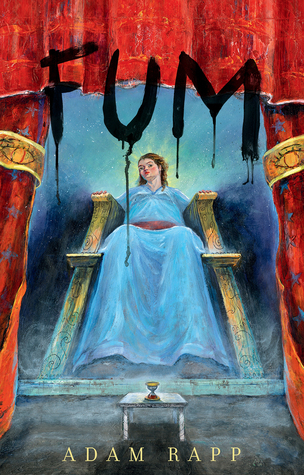
Turning Pages Reads: FUM, by ADAM RAPP

Welcome to another session of Turning Pages!

NB: This is not going to be the average review; I finished this novel despite my better judgment, hoping for some twist in the narrative that I wasn't expecting, to make it work. I picked it up this book because of the title... and the fact that on the cover is a female. In fairytales, all the giants are male, and we have very few newer characterizations of tall girls in young adult literature, though the too-tall girl at the school dance was an ongoing trope for a lot of the earlier years of young adult lit. As this book was listed under fantasy, I thought it would be more of a fairytale. Last warning: It's not.

Synopsis: After a pituitary tumor changes her body at age eleven, Corinthia Bledsoe emerges as 7'4" and 287 pounds. She uses a special desk, and a special toilet, because she's broken two. Her vision of a terrible triumvirate of tornadoes - and her subsequent loud, panicked warning of the entire school - is treated as some kind of violent dysfunction worthy of her being tackled by grown men, one of whom fantasizes as he does so about her bodily strength, and the kind of impact that she'd have on the gridiron. While Corinthia is already famous for her size and special-built desk, and for having a custom-built bathroom on campus, having broken two toilets since freshman year, she becomes terrifyingly infamous when the tornadoes come.

The story spins between Corintha's increasingly disturbing relationship to the school and community to the tale of Billy Ball, who, struggling with gastrointestinal problems and reeling from the death of his father, is enacting unexplained racist cliché "red face" rituals and obsessing on Native Americans. Not fitting in at the same school, he comes up with a list of students and faculty with whom his path has crossed, and seems to be preparing himself for violence. He seems vaguely aware of Corinthia, but they only meet once, and it doesn't propel the narrative in any direction. The third subplot returns to the Bledsoe household, and to a closer focus on Corintha's mother, who believes herself to be somehow tragically martyred for being Corintha's mother, and whose adult desires seem to be more important to her than her children's struggles.

Despite being a junior, Corinthia doesn't seem to have much of a view of the future, something which her ineffectual guidance counselor tries to elicit from her constantly, though her good-natured father seems prepared to accept whatever she'd like to do. Instead of a future, Corintha is mired in the present, as her brother disappears, and her mother goes into crisis. In possibly the oddest story thread in the entire book, Corinthia takes a road trip with one of the workmen fixing the school post-tornado, a man called Lavert. Corinthia's friendship with him, a grown man with a criminal past, and her understanding of his mortality is definitely unexpected, and strains the credulity of the reader past bearing.

Observations: Grotesquerie is a 20th century literary convention which, according to Wikipedia, can be linked with sci-fi and horror. For me, this novel falls squarely under grotesquerie, simply because Adam Rapp seems to be thoroughly disgusted with everyone in the entire book, and in his disgust, renders them... disgusting. From the names of the characters and their ill-fitting, cacophonous names to the description of Corinthia herself beginning from page one - "woodsplitter's hands," and the "great caves of her nostrils." Descriptions of her menstruation and nosebleeds, and comparisons between the two are a lovingly-depicted gross-fest.

The narrative never takes off, as it is heavily weighted with an abundance of cloying description, producing a plodding plot in a claustrophobic storyline which draws in the unsuspecting reader with the idea of a real giantess and instead confronts them with body dysphoria juxtaposed with an awkwardness masquerading as intimacy. No one seems to grow or change; the bizarre incidents simply crowd together, threaded with domino-sized teeth and Together, this creates one of the most unkind and body-averse narratives I've ever read, and an alleged YA book which focuses less on the young adult, her challenges and changes than on her body, and the bodies of everyone around her.

The body-consciousness remains central to the novel. At 287 pounds, Corinthia is said to be pretty, but every other word out of the narrative disregards that, and paints her as disgusting and vile. She's said to be third in her class - but every other description has her acting in bizarre and outlandish ways designed to repel the reader. Finally, Corinthia is alleged to have destroyed two toilets, once emerging covered in toilet water and swamping the girl's restroom...which is ...ludicrous, ignorant, and insulting.

FACT: People heavier than 287 use toilets on the daily. FACT: Nothing happens. Toilets - regular old public restroom toilets, and certainly the floor-mounted, vitreous china sort used in public schools - are rated to bear the weight of a THOUSAND vertical pounds, and yes, I am the big nerd who looked that up, but this jarring falsehood stands out. 287 pounds is just a number, and anyone who weighs that is just - still - a person. These scenes felt like a badly set-up, dehumanizing fat joke rather than a story detail filling in the blanks about who Corinthia is and what she's about. Kids in high school are this weight on a regular basis, and stand to be hurt and insulted by this abhorrent characterization. Reader beware.

Corinthia - her family - her school - basically her entire corner of the State seems very white... yet the teens in the story are obsessed with people of color, to very significant degrees. Billy puts arrows in his hair and paints some racist cliche of warrior marks on his face. As her family dissolves, Corinthia begins to pal around with a grown man who is also a face-tatted, do-rag wearing cliché of a prison-release workman who, early in their relationship, refers to himself as "nigga"... For a novel which, up to that point, had displayed a casual lack of empathy for any of its characters, this white-guy-included racism wasn't entirely surprising, but still reveals very poor taste.

Conclusion: I normally consider it a waste of time to review a novel which I vehemently dislike, but I made an exception for this because I walked into it unaware of its topic, or of any reputation with regard to its author. I won't make the same mistake again. While some will assign this novel as an example of satire, or may find within it deep literary meaning, or even feel that it is merely misplaced in terms of audience, and would crossover well with adults, for me, there is too much left unexplained, and what may have been a brilliant venture does not pan out in its execution. My main thought is that it is disturbing, written with a specific distaste and aversion for the body, doesn't have a discernible story arc, and is not especially respectful of the challenges and changes of adolescents, especially female adolescents. With its comparisons to people as animals and its basic disrespect for the teen body or mind, this novel seems to be an experiment with a broad scope which failed.


I received my copy of this book courtesy of the publisher. After March 20, you can find FUM by Adam Rapp at an online e-tailer, or at a real life, independent bookstore near you!

March 01, 2018

Cybils Review: THE DAM KEEPER by Robert Kondo and Dice Tsutsumi

Synopsis: I found out during Cybils deliberations that The Dam Keeper originated as an Oscar-nominated short animation, which makes me sad that I missed it. While I was growing up, I was a big fan of the Spike and Mike Festival of Animation, which introduced me really early on to faves like Nick Park/Aardman Animation and Pixar, now a household name. I'm guessing The Dam Keeper would've been right at home in that arena—and, in fact, both of the authors have worked for Pixar, so there you go.

Pig, who lives in Sunrise Valley, has a really important job he inherited from his father: he's the Dam Keeper, and he's responsible for keeping back the deadly black fog that threatens from outside the valley's walls. Unfortunately, he's been alone for a while—ever since his father inexplicably left and walked right out into the fog. And now, there's a huge wave of black fog on the horizon, and it's up to Pig, his best friend Fox, and the bully Hippo to figure out how to stop it.

Observations: This story's very cute animal characters will appeal to younger readers, but the touch of darkness to the storyline will broaden its age range—there's a depth of emotion here that doesn't shy away from difficult challenges like the departure of a parent or, I suppose, imminent death by scary black fog. The story and setting is unique and interesting—I love the touch of steampunk-type technology with the dam and its fog-busting fans—and the characters, while young, have plenty of agency as they set off on their quite possibly dangerous adventure.


While the story and characters are fun and strange, they deal with a variety of familiar themes that are of interest to elementary-aged readers: friendship and friendship conflicts; understanding bullies (Hippo is obnoxious, but Fox is there to tamp down his bullying and bring out his better side); who is safe to trust; missing parents. The art (which is digitally done, I think) is really striking, though I'm not necessarily into this particular style of cute animals personally. The artistry in terms of panels and pages was amazing, as was the use of atmosphere in depicting the fog and the darkness.

Conclusion: I can see this appealing to a generation of readers who have grown up with the style of digital art that's everywhere now—but it definitely transcends the mass-market stuff with its sense of artistry and intriguing story.


I received my copy of this book courtesy of my library. You can find THE DAM KEEPER by Robert Kondo and Dice Tsutsumi at an online e-tailer, or at a real life, independent bookstore near you!

February 27, 2018

Turning Pages Reads: THE RADICAL ELEMENT, edited by JESSICA SPOTSWOOD

Welcome to another session of Turning Pages!

Synopsis: Women who persist aren't a recent innovation. A history of intolerance, which led to insistent female resistance is not an uniquely American story, but one which nonetheless has heralded seismic shifts within our national history. After the success of A TYRANNY OF PETTICOATS, editor Jessica Spotswood brings together twelve new tales of women who were upstarts and outsiders. From the 1830's through the 1980's, these stories, some based on actual events, others fictionalized accounts of historical periods, regale readers with young women who stood up and out as radically different, and in doing so, changed the way the world related to them. Contributors to this collection include young adult authors Jessica Spotswood, who also edited; Dahlia Adler, Mackenzi Lee, Erin Bowman, Megan Shepherd, Anne-Marie McLemore, Marieke Nijkamp, Dhonielle Clayton, Sarvenaz Tash, Stacey Lee, Meg Medina, and Sara Farizan.

Observations: Claiming an identity -- stepping outside of the role and voice assigned -- can be uncomfortable and awkward, intimidating, to downright dangerous and life-threatening. Without a clear idea of how things will end, each of the young women depicted in these stories sets out on a personal journey -- whether its to use her brown hands in the service of her country, when only paler hands are sought, or to make her escape from abuse, or to take her chances in a traditionally masculine world, playing a man's role. Readers will pause thoughtfully to discover these nuanced angles of history -- taking readers out of the realm of mere nostalgia into the realities of the difficulties and challenges of history through the voices of the traditionally excluded and silenced.

The women's outsider status is significant, as most of these voices are from women in the margins, due to issues of race, religion, sexuality, disability, gender, or professional desire. I appreciated the voices from early in our national history into more recent times. Some of my favorites were the story of the young Jewess, longs to study the Torah, and the Mormon girl who tries to find ties between her new country, and her faith. A Latina drains herself of pigment with the family's magic to bleach herself into the faded shades acceptable for silent films, while brilliant and neurodivergent young woman keenly watches court proceedings to determine the reproductive rights of the mentally unfit. Elsewhere, a half-Japanese girl braves 1950's xenophobia to compete to be the next Miss Sugar, while a young Cuban dons her first pair of go-go boots. The perspectives are fresh, the stories are original, and the anthology is a joy to read.

Conclusion: If you're not a short story aficionado, I think there's still plenty in this novel which will appeal. There's room to read and hop around, and then return to longer stories from time periods which you may not believe will hold your interest. You will be surprised!

In the editor's note, Spotswood outlines the purpose of this collection, and her wish that readers will be able to find themselves within these pages. Even as not a particularly radical individual, I found myself in the bravery and dauntlessness of these heroines, and I believe this book will work well for older middle graders, young adults, and adult readers.


I received my copy of this book courtesy of NetGalley. After March 13, 2018, you'll find THE RADICAL ELEMENT edited by Jessica Spotswood at an online e-tailer, or at a real life, independent bookstore near you!

February 23, 2018

Turning Pages Reads: THE RULES AND REGULATIONS FOR MEDIATING MYTHS AND MAGIC by F.T. LUKENS

Welcome to another session of Turning Pages!

Synopsis: Hungry to inhabit his true self, Bridger Whitt will do anything to find a job to help him finance attending college out of state. He’s desperate enough to take a Craigslist interview with a weird entrance exam... no, a seriously weird entrance exam, as in, "Will you enter the office via the window?" He's determined enough to ignore any… little oddities about his magically-everywhere boss (exactly what was Pavel doing out at Lake Michigan when Bridger was there and just happened to be being drowned... by... Things with sharp teeth and cheerfully malicious expressions?!), and has almost entirely tuned out the disembodied voices he sometimes hears around the office. Despite discovering his boss’s true identity, regardless of learning that his crush, Leo, may actually crush on him right back, despite all signs lining up for a HEA, Bridger still can’t find a reason to stay home. After all, there’s nothing to do, and nowhere to grow in the provincial, conservative small town of Midden, Michigan. You can only discover what's real, if you go away and pursue it. Real life can only be magical elsewhere… right?

Observations: Truly, there's no place like home - and this novel brings that theme fresh life, by examining the presupposition that a.) our high school and college years are The Best Years of Our Lives (TM), and b.) that those Best Years can only happen well away from the familiar, known, and loved. This book talks about coming out and Becoming in a way which allows it to be a process that happens internally, and externally, with constant course corrections and revelations along the way. The romance, while not central to the plot, is just squeezable.

However swoon-worthy the romance is, however, what I most appreciate is how much this is a family story. In the best and most inclusive, expansive of ways, F.T. Lukens reminds us that family CAN mean a long-suffering mother who works her butt off for you, and is hopeful she's making up for you not having a Dad, but also it can additionally mean a tough-as-nails Harriet-the-Spy type who loves you, spies on you, then kicks your butt for keeping secrets - like the sister you never knew you needed, a boss and a mentor who both challenges you to rise up, but holds you as you fall apart, and pixies who cheer for you in tiny, tinny, high-pitched, annoying voices, but come on, at least they're not laughing while unicorns try to kill you this week. Or, whatever.

With endless dry humor and plenty of quirky charm, this book never tries too hard, or goes for the easy laugh. It removes itself from some of the stereotype of YA lit with a tight, loving relationship between teen and parent, and allows older people and younger people the respectful, reliant relationships they sometimes have in real life. And the humor just gives the difficulties and subtleties Bridger has while navigating the real world even more life. There's magic. There's mythos. There's a really cranky Sasquatch. While the novel is YA in spirit, it also crosses over for to be enjoyable for other ages, and could be appropriate for adults through older middle grade. While Bridger is definitely moving along toward adulthood - but this doesn't mean he's making all adult decisions - definitely not in the thriving metropolis that is... Midden(and I can't even tell you how much I love that name).

Conclusion:F.T. Lukens brings a joyfully charming innocence into this endearing adventure of a snarky, fearful boy who thinks he is fleeing toward the big, real world — when THE RULES AND REGULATIONS FOR MEDIATING MYTHS & MAGIC reveal that there is more wonder, magic, love, — and terrifying unicorns — in the known world he knows than he could have ever imagined. While I try to review without bias, this was one of my all-time FAVORITE Cybils books of 2018, I have zero chill discussing it, and I want you to read it, too.


I received my copy of this book courtesy of Duet Books, for the Cybils Awards, for which this book was a finalist. You can find THE RULES AND REGULATIONS FOR MEDIATING MYTHS AND MAGIC by F.T. Lukens at an online e-tailer, or at a real life, independent bookstore near you!

February 22, 2018

Cybils Review: NEW SUPER-MAN VOL. 1: MADE IN CHINA

Synopsis: Reboots seem to be the story fad du jour when it comes to comic franchises, and while there have been some reboots of Superman, I doubt you've seen one like this before. Brought to you by the writing talents of our own local NorCal comics genius Gene Luen Yang, along with illustrator Viktor Bogdanovic, one of this year's Cybils finalists for Young Adult Graphic Novels was New Super-Man Vol. 1: Made in China.

This "DC Universe Rebirth," as DC is calling it, posits a brand-new origin story for your rebooted Superman, one steeped in DC universe lore as well as more recent traditions in Chinese comics. This time, the would-be Superman starts off as a blustering teenage bully from Shanghai named Kong Kenan. After accidentally saving his own bullying victim from a marauding supervillain, Kenan attracts the eye of a super-secret group trying to build a homegrown Chinese Justice League—they need a Superman, and they think Kenan's perfect for the part. Kenan is stoked: he has fancy powers and his new friends include Chinese Wonder Woman. What could possibly go wrong?

Observations: This is a really fun, international/multicultural take on the Superman comic adventures—kudos for diversity and for introducing new characters and storylines to a classic (some might even say old-fashioned) franchise. And, of course, Gene Yang's writing is always stellar, so this one has a good balance of entertainment and deeper themes, such as politics, family, and, naturally, good vs. evil. Readers will catch a glimpse of some ongoing sociopolitical issues in China through the lens of popular culture—both shared pop culture AND some stuff that will be new to readers, such as some homegrown Chinese superheroes that are not too thrilled with this new Justice League homing in on their crime-fighting turf.

click to embiggen


Not every reader is into superheroes, but those who are will surely enjoy this one. Effort has been put into making Kenan a relatable teen character with regular human storylines, while still packing the story with superhero adventure and humor. That extends to the artwork, too, which was well done: solid and not overly exaggerated superhero-style character design, good flow to the layout, and fast, exciting storytelling.

Conclusion: Pushing diversity to the forefront of comics makes some stodgy grouches go a little nuts, but personally, I'd rather read this new take over the old chestnut. Sorry, dudes. More variety in stories is always good. And I think this one is also being marketed in China, which is, I hope, a success.


I received my copy of this book specifically for the Cybils, courtesy of the publisher. You can find NEW SUPER-MAN VOL. 1: MADE IN CHINA by Gene Yang and Viktor Bogdanovic at an online e-tailer, or at a real life, independent bookstore near you!

February 15, 2018

Cybils SpecFic Bookmark: THE HEARTS WE SOLD by Emily Lloyd-Jones

The Cybils Speculative Fiction Bookmark:

As a panelist for Cybils YA Speculative Fiction, Round 1, I'm going to be briefly writing up some of the hundreds of book I read as part of the award. As panelist conclusions are not for public consumption, the purpose of these write-ups is to keep track of what I'm reading, and will mostly touch on plot synopsis, with minimal comments on thematic tropes.


Synopsis:Deirdre Moreno would like to just be the kind of girl who does well in school, makes her way in the world, and never looks back, but she can't be. For one thing, anxiety stalks her like a rabid beast. For another thing, she's got reasons for that anxiety; it's been carefully cultivated by her father for years. She's been "damned if you do, damned if you don't" for so long that when her merit scholarship to her boarding school is revoked, it's enough to send her seeking what she never, ever, ever thought she'd be looking to find: a demon, to make a trade. They'll take body parts. You see people with prosthetics all the time, and you wonder if they're happy, if they got what they paid for...

Dee finds the answers to many of her questions, when she meets a bunch of weird kids who call themselves "the heartless," and the daemon who traded for their...hearts. She gets what she needs, to stay in school, but the possibilities for fortune and loss suddenly are much, much bigger than she'd ever imagined. There's another world, just beyond a thin curtain of reality... and it's incursions into this world are a terror Dee's not ready to face. All she can do is hunker down and remember that the choices she made are what have gotten her this far -- and all she has to do is choose to keep going. As things get more and more surreal, it's one of the hardest choices she's ever had to make.

Observations: This is a tricky novel to discuss without presenting spoilers, however, much of the narrative arc is obvious: girl meets demon, girl makes deal with demon, girl realizes she's been a.) duped, b.) got what she didn't think she wanted, c.) fades off into the unfinished lore of folktale history. Most readers have heard the phrase "selling one's soul to the devil," and read for English Lit the requisite cautionary lore from Faust, but this is an unique reimagining of devils, and those deals and exchanges. While most of the story is spent with Dee doing what she's told, fulfilling expectations, the real story begins when she discovers how much one doesn't have to lose, without a heart. How buoyed and lightened one's decisions can be. Once she and her troop of "the heartless" are freed from the normal constraints of humanity, no one - including the daemon - can predict who they'll become... or what they'll do.

Conclusion: Collecting souls, to a demon, one would imagine has some point, but why would anyone want a heart? The answer of what one can do with a heart, that hopeful, deceitful, unpredictable, emotion-centric thing - and what or who we are as humans when we give ours away make for an absorbing narrative that will leave readers thoughtfully considering the state of their own vibrant, living, beating centers - and possibly leave them with an excuse to take up knitting again.


I received my copy of this book courtesy of the public library. You can find THE HEARTS WE SOLD by Emily Lloyd-Jones at an online e-tailer, or at a real life, independent bookstore near you!

January 29, 2018

Monday Review: IN SOME OTHER LIFE by Jessica Brody


Synopsis: I've finally been able to get back to some pleasure reading after a long stint of Cybils reading (which has now slowed down), and I picked up Jessica Brody's In Some Other Life for a bit of fun escapism—and I was not disappointed. As you might know, I enjoy fiction about parallel universes; this one follows high-achieving Kennedy Rhodes, superstar of the student newspaper at Southwest High. Her life seems great: cute longtime boyfriend, supportive family, ever-loyal best friend, and high hopes for getting into the Columbia journalism program. Her only secret regret is that she didn't attend the prestigious Windsor Academy, which sends 89 percent of its graduates to Ivy League schools.

Then, the disasters start piling up, culminating in one fateful moment: Kennedy takes an accidental fall down the steps and wakes up….in the life of some alternate version of herself: an alternate version that DID end up at Windsor Academy. As you might guess, at first it seems amazing and incredible, but looks can be deceiving…

Observations: This book was, above all, tongue-in-cheek funny. In some ways it felt like something I'd pair with my book The Latte Rebellion in terms of tone and style, as well as underlying theme—a well-meaning, earnest, but flawed main character gets caught up in circumstances beyond her control, and has to own up to her decisions in order to truly make good. While Kennedy isn't perfect, sometimes to the point of being annoying, her imperfections are completely relatable, and are in fact necessary for her overall growth.

I did end up guessing the big story twist relatively early on: the clues were clear and it seemed fairly obvious that alternate-Kennedy was up to something, and so I assume the reader is meant to realize what's going on before the narrator does. That was my only quibble with the story, though. The way everything wraps up was very satisfying, and I enjoyed how the various loose ends are dealt with, leaving things just a bit open-ended. And, as a bonus, the chapter titles were really fun.

Conclusion: This was a highly enjoyable story, with good pacing that kept me wanting to read it even when I probably should have been reading more Cybils finalists. Recommended for fans of paranormal and/or spec fic with a humorous twist.


I received my copy of this book courtesy of my library's ebook collection. You can find IN SOME OTHER LIFE by Jessica Brody at an online e-tailer, or at a real life, independent bookstore near you!

December 21, 2017

Thursday Review: THE BOOK OF DUST by Philip Pullman

Synopsis: This was one of my "waiting on" titles of 2017—the His Dark Materials trilogy is one of my favorites (and one I wish I'd read as an actual young adult), and I've enjoyed other books by Pullman as well. The Book of Dust: La Belle Sauvage is the first in another trilogy, it seems, and it's a prequel to the adventures of Lyra in His Dark Materials. To my mind, it was worth the wait.

This story also concerns Lyra, but she isn't the main character this time. In fact, she's just a baby—a mysterious baby, as it turns out, who is being cared for by the nuns of a village priory outside Oxford. In that village lives our main character: a boy named Malcolm, whose parents run an inn. Malcolm lives at the inn, so all kinds of interesting gossip reaches his ears, and thus it is perhaps not such a huge surprise that he witnesses the unfortunate death of a spy and ends up with the spy's secret message in his very own hands…

Observations: I don't want to give away too much of the story, because it's too delightful to watch it unfold (plus you can always read the cover blurb). I will say that I was happy to return to this alternate world very like our own, and root for a hero with curiosity, tenacity, and an innate sense of right. Malcolm is truly good, and his love for the baby Lyra and determination to keep her safe drive the story and keep the reader hanging on every word.

Of course, any story that involves good vs. evil would be incomplete without a truly bad baddie, and Pullman has a talent for pushing just the right buttons to make the reader really uncomfortable—the enemy here takes the form of a truly frightening individual, and the philosophical underpinnings of WHY he is evil are possibly even more frightening.

Conclusion: I can safely say that, despite a few quibbles here and there with the style, I enjoyed this almost as much as the original trilogy, and sank gratefully and willingly back into the vivid world of Lyra's Oxford. Now I'm anxious for the second book…


I received my copy of this book courtesy of my library's ebook collection. You can find THE BOOK OF DUST: LA BELLE SAUVAGE by Philip Pullman at an online e-tailer, or at a real life, independent bookstore near you!

December 19, 2017

Cybils SpecFic Bookmark: IN 27 DAYS by ALLISON GERVAIS

The Cybils Countdown Continues!

The Cybils SpecFic Bookmark: As a panelist for Cybils YA Speculative Fiction, Round 1, I'm going to be briefly writing up some of the hundreds of book I read as part of the award. As panelist conclusions are not for public consumption, the purpose of these write-ups is to keep track of what I'm reading, and will mostly touch on plot synopsis, with minimal comments on thematic tropes.


Synopsis: One melancholy feeling day, Hadley Jamison arrives at school to hear that a boy she'd been in Freshman English with has committed suicide. The feeling of melancholy she feels quickly swells to true grief. She hadn't spoken with Asher Morales in years. Really, she only stared at him in Freshman English and blushed a lot... but it seems wrong that he's dead, wrong that someone who had such obvious depths - even if he never spoke to her to share them with her - could have thought his life wasn't worth living. Seeking closure, Hadley lurks at the back of the church where his funeral service is being held. She lingers at his casket, wondering what she could have said to change things. She meets his family, and, on the way home, is accosted by the most terrifying man she's ever seen. Parchment white skin, knife-edged cheekbones, and the most insinuating smile. He takes her to coffee, and she's powerless to escape him. He has a proposition for her - a little job he'd like her to do. If she'll just sign a contract to help out, he'll drop her back twenty-seven days in time. She'll have a chance to save Archer, and right a little wrong in the Universe.

The guy says some vague things about danger and trouble, but Hadley's only hearing that there's a chance to bring Asher back to his family. Her parents are on yet another business trip, and the last person she talks to every night is the doorman. What else does she have to do with the next month, anyway?

But Asher is not easy. He's rude. He's abrupt. He's closed off and cold. Hadley's doing everything she can to get close to him, but if someone doesn't want you as a friend, you won't be friends. Is it worth it to keep trying? Is it worth caring for someone who doesn't care for you, especially if it looks like it might cost you your life?

Semi-Spoiler-y Observations: Originally published on WattPad, this is a fast-paced, emotionally engaging adventure which leaves the reader little time to do anything but hang onto their hat and be dragged into the narrative. A dominant culture girl with a cast of mostly white friends (Asher is Italian) Hadley is a very regular, ordinary girl who is suddenly thrust into a cosmic tug of war essentially between death and chaos. While she is chosen to take a stand against chaos, I found myself with a tiny question of "Why?" I kind of wished for a little bit of ...mystery or backstory to give her character some depth. Her parents are workaholics with money and impeccable tastes, but how did the Universe know that Hadley was worthy of taking on this huge task? Does this second chance business happen for anyone else?

Most people won't worry with nagging questions like this one, however, and will race into the story. As an adventure, giving a human being the power to fight on the side of life, it is compulsively readable.

Conclusion: For anyone who has wished that they could have a second chance to make things right, this story will be the best of wish-fulfillment catnip. A slow burn romance, a boisterous Italian family, and a chance to tally one up for the side of good vs. evil makes this a light, fun, vacation read.


I received my copy of this book courtesy of the publisher. You can find IN 27 DAYS by Allison Gervais at an online e-tailer, or at a real life, independent bookstore near you!

December 15, 2017

Cybils SpecFic Bookmark: SHE MYSELF AND I by EMMA YOUNG

The Cybils Countdown Continues!

The Cybils SpecFic Bookmark: As a panelist for Cybils YA Speculative Fiction, Round 1, I'm going to be briefly writing up some of the hundreds of book I read as part of the award. As panelist conclusions are not for public consumption, the purpose of these write-ups is to keep track of what I'm reading, and will mostly touch on plot synopsis, with minimal spoiler-y comments and thematic tropes.


Synopsis: Rosa is young, British, and has had a debilitating nerve disease which has taken her freedom. Quadriplegic and feeling like a burden on her family, she is eager and excited when a controversial "cure" emerges - the chance to swap her brain into the whole and healthy body of a comatose American girl named Sylvia who was also white and young. The family flies to America, and the surgery is done... but Rosa's doubts begin. Is she still... herself? Is she now someone else, too? Is she also carrying Sylvia's soul? Is it fair to go on if Sylvia - whom Rosa is now convinced is a resident somehow in her body - is unhappy? An unhealthy obsession with Sylvia begins, as Rosa researches her, stalks her family, and eventually attempts to insert herself into the life of the girl who is gone. With the help of a journalist with whom she becomes entangled, Rosa escapes from the medical facility where she's meant to be healing, and walks away from her own life to immerse herself in Sylvia's - hurting her own family, and ultimately herself. As she struggles to come to grips with who she is now, and who she's supposed to be, now that she's inhabiting Sylvia's body, Rosa falls in love and finds that the questions she had matter less than living her very best life, and being happy.

Observations: Speculative fiction has been debating the merits and demerits of brain swaps since the first very amusing black and white science fiction films. It's one of the last Big Questions about consciousness and the soul and the "you-ness" of a person. Rosa feels a lot of guilt after the surgery - guilty for being excited that she's attractive, guilty that she is attractive to others, guilty that she is just who she is, and not someone better or more deserving. She is conflicted and spends a lot of time in her head, coming to various conclusions about whether or not Sylvia is a reluctant rider in their shared body, or if Sylvia should take over and Rose should step back. She had a lot of questions, and I was dissatisfied with the conclusions Rosa came to, because she was derailed by her romance. Rosa watches a movie with a friend about a man who chooses to die rather than live with a disability... and especially since Rosa has lived with a disability, one that had really hit her from the ages of ten to eighteen, that seemed an odd choice, and I expected her to react differently to the film.

The author doesn't give us much information about Rosa's disease or the nature of its progression, or enough backstory to help us understand what what her life was really like, before having her brain swapped. Rosa's disability is framed against her parent's anxieties and her concern with not being a burden to them, but that tells us nothing about how she lived and what she did - which argues that the life of a quadriplegic person is of so little interest that the reader wouldn't have wanted to know anything about it. Which isn't true. This was one of the biggest quibbles I had with the novel.

Conclusion: An interesting and time-honored concept in speculative fiction, the brain swap remains one of the last bits of "undiscovered country" in our physiology. Rosa deals with questions and worries to that many a teen will relate. The idea of turning into a whole new person with a whole new brain, and finding a whole new attractiveness and a lightning fast romance will also resonate with many in an entertaining way - but readers seeking something with a deeper and more realistic look at disability might look to Sharon Draper's OUT OF MY MIND or Chelsie Hill's PUSH GIRL for more.


I received my copy of this book courtesy of the publisher. You can find SHE MYSELF AND I by Emma Young at an online e-tailer, or at a real life, independent bookstore near you!

December 12, 2017

Cybils SpecFic Bookmark: BROKEN CIRCLE by J.L. POWERS & M.A. POWERS

Happy December! The Cybils Countdown Continues!

The Cybils SpecFic Bookmark: As a panelist for Cybils YA Speculative Fiction, Round 1, I'm going to be briefly writing up some of the hundreds of book I read as part of the award. As panelist conclusions are not for public consumption, the purpose of these write-ups is to keep track of what I'm reading, and will mostly touch on plot synopsis, with minimal comments on thematic tropes.


Synopsis: Adam just wishes he could sleep. That's what normal people do: see their fathers. Sleep. Go to school. Talk to people they might kind of crush on. Normal would be great, but it's just not in the cards. First, Adam's mother vanished when he was four, and his dad is always gone, and never around when he needs him... except Adam sometimes sees him in his dreams. Adam instead lives with his cranky, paranoid grandfather, who believes everyone is out to get him. Adam's next challenge is that he can see... shadows on people. He knows when they're going to die, and no matter what he does to try and tell them... they die anyway, even if he's changed their path. Finally, speaking of dreams, there's this kind of... monster who basically hugs him to death when he dreams, and then he wakes when his dream-Dad saves him. Lacking sleep and overdosed on coffee, Adam fights monsters in a waking dream at school one day. Unfortunately, he wakes up with everyone believing he's had a nasty psychotic break. In the name of getting him "help," his father enrolls him in a residential school... which isn't for kids with psychiatric problems at all. It's for kids with the power to be soul guides. Adam finds opening to him a world he could never have imagined in his deepest, scariest dreams. He finds a place to belong, which surprises him, and feeds his soul. He also finds out about his mother - who disappeared in mysterious circumstances - and the whys and wherefores of his parents' relationship. He also finds himself going up against a shadowy organization which is bent on destroying him, and maybe his school, too. Adam's going to need to accept a few key things before he can move his story further - and unravel the unknowns between him and his goal of being normal... well, as normal as a guy who can drop into Limbo can be.

Observations: In many ways this story is familiar - there have been myriad other Secret Identity novels in which the Lost Prince or Boy Who Lived is unaware of a birthright world just on the other side of a bland retaining wall. He twists in the wind in a world where he doesn't belong until, voila, the hidden door opens, the wall vanishes, and the world, with its thousand shades of gray, opens. Nothing is pure good or pure bad anymore, the character stumbles and drifts until he meets a band of plucky outliers, and together they navigate this new plane. There are PLENTY of Potter elements in this book, but it is not about the new-things-per-page lovely whimsy which drive the earliest Potter novels. This book is dark and grim and Adam's existence is both snarkily amusing and realistically painful. While there have been other YA novels riffing on the idea of the Grim Reaper, and while the cover with the elegant scythe on it is a dead giveaway of some of the narrative elements, there is a lot of difference here to be discovered. Readers will rejoice in the brother-and-sister team's worldbuilding, which is rich and detailed, and while the twists in this book are mostly known before the character knows them, the characterization and remix of mythology will keep readers reading. Adam's self-effacing, sarcastic voice will work well for many readers.

Conclusion: Come for the sarcasm and the familiarity, stay for the unknown and the yet undiscovered! While this book wrapped up nicely in an "episode" fashion, there are some unanswered questions which leave room for a sequel - stay tuned.

"The Powerses' worldbuilding and writing will keep [readers] hooked. They will find themselves questioning what is fact and what is fiction and cheering Adam on as he journeys in this new, strange world. A gripping, philosophical paranormal thriller." --Kirkus Reviews


I received my copy of this book courtesy of the publisher. You can find BROKEN CIRCLE by J.L & M.A. POWERS at an online e-tailer, or at a real life, independent bookstore near you!