The city of Medina, Minnesota, that is. I hadn't thought of going to a conference this year, but You're at the Helm! The Business of Writing of Writing and Illustrating For Children, a conference put on by The Children's Literature Network sounds like it has got some good nuts-and-bolts information about how to manage your writing as a business. The conference is mid-week, Wednesday and Thursday, July 26 and 27, 2006, and if you register before May 31st it's a lot less expensive. There's a huge emphasis on marketing -- which is something that always makes me feel a bit uneasy -- so it might be worth checking out! And somewhere in Minnesota, there's bound to be a hotel with air conditioning for all that humidity...
Statistics Lie?Bowker, which tracks book publishing in the United States says that publishing books for YA and children is down fifteen to twenty percent since 2004. Of course, School Library Journal is quick to point out that it's because 2004 was a banner year in children's books. Sales have increased, despite fewer books published overall.
Speaking of marketing, wouldn't it be great if you could simply market your book by having a treasure hunt? Oh, someday I've got to write a fantasy novel that takes advantage of that! Philanthropist and author Michael Stadther is a man who likes whetting the appetites of his readers. His treasure hunt, which celebrates the completion of his second fantasy novel, is meant for whole families to get involved in -- and the jewels are really hidden. The maps are real. This man has a lot of money, and a lot of fun planning and executing these hunts, and people really love playing. The next worldwide treasure hunt begins this September!
It doesn't seem possible, but the cute little aardvark with the glasses and his bratty little sister, DW, is turning THIRTY this year. Author Marc Brown's character, now with his own PBS series, has been around forever, even though he's still only eight. This all goes to show that if you write a really good series of books that are well loved, even if you're never "famous,' you'll be around to touch the lives of a generation. Or two! And what a 'wonderful kind of day' that makes!

May 22, 2006
Viva la Rogers! Or, El Rogers, anyway...
Not really a writing item: Since I was thinking recently about Mr. Rogers, I thought you might want to know that today in 1967, his show debuted, and started us all on the path to being ...good neighbors and cool people. Of course, there is a tribute album for his songs... but can anything involving Jon Secada and string orchestras be entirely good!?
Anyway. Here's to being good neighbors...
Anyway. Here's to being good neighbors...
May 17, 2006
The Genius of Terry Pratchett: Of Invisible Hats
With a start like the one she had with the little blue men, heroine Tiffany Aching sets out on the road to being a witch thinking that life is going to be a lot of the stern work of Setting Things Right in the World. It is time to leave the Chalk, the highland world where the very bones of the earth are a beloved and familiar history beneath her feet, but where no one can teach her what she needs to know. Or so Tiffany thinks.
In A Hat Full of Sky Tiff is apprenticed to the uniquely twinned Miss Level, befriended (sort of), by the other apprentice witches, there can't help but in spite of herself, she expects excitement around every corner. But, there's not so much to be had. Tiffany ends up kind of being a servant. She beat the Queen of the Fairies. She's a witch in training! She's treated like... a servant, helping take care of stupid people! That can't be right. Where's the respect? And there are so many stupid people in the world who need help...
It's only to be expected that young Tiffany gets sick of her world as it is. Even the Nac Mac Feegle, who are charged with watching over "the young hag" can't stop what's stalking her. When Something Wicked This Way Comes, Tiffany's pride leaves her open to its invasion. And nobody can save her, not Esme Weatherwax, the greatest witch in the Discworld, not Miss Level, not the Wee Free Men. This time, Tiffany has to save herself.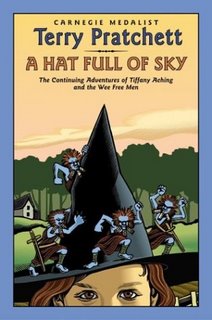
The novels of Terry Pratchett all share one commonality in that they delve into deeper philosophical issues ...stealthily. The heroes and heroines are not perfect by any means, yet the Bad Child Gets Punished motif is not at work here. Pratchett reveals to YA readers the silliness of some of the way things are, but provokes readers to closer examinations about their beliefs on the nature of ethical behavior, popular myths and religious beliefs, and widely-held beliefs about science and the nature of the universe. He injects a strong shot of doubt into the unexamined life, and kicks contempt prior to investigation right out the door. Readers will want to read his work again and again, just to think through the thoughts behind the stories. Getting readers to think of and learn what is really true is of real importance to Pratchett, and it shows in all of his novels.
Pratchett has quite a few reoccuring characters, which endear his readers to him, and we can expect more from Tiffany, I have no doubt.
In A Hat Full of Sky Tiff is apprenticed to the uniquely twinned Miss Level, befriended (sort of), by the other apprentice witches, there can't help but in spite of herself, she expects excitement around every corner. But, there's not so much to be had. Tiffany ends up kind of being a servant. She beat the Queen of the Fairies. She's a witch in training! She's treated like... a servant, helping take care of stupid people! That can't be right. Where's the respect? And there are so many stupid people in the world who need help...
It's only to be expected that young Tiffany gets sick of her world as it is. Even the Nac Mac Feegle, who are charged with watching over "the young hag" can't stop what's stalking her. When Something Wicked This Way Comes, Tiffany's pride leaves her open to its invasion. And nobody can save her, not Esme Weatherwax, the greatest witch in the Discworld, not Miss Level, not the Wee Free Men. This time, Tiffany has to save herself.
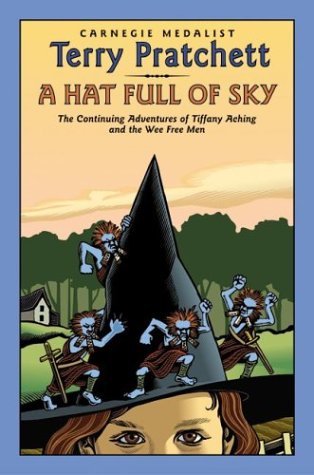
The novels of Terry Pratchett all share one commonality in that they delve into deeper philosophical issues ...stealthily. The heroes and heroines are not perfect by any means, yet the Bad Child Gets Punished motif is not at work here. Pratchett reveals to YA readers the silliness of some of the way things are, but provokes readers to closer examinations about their beliefs on the nature of ethical behavior, popular myths and religious beliefs, and widely-held beliefs about science and the nature of the universe. He injects a strong shot of doubt into the unexamined life, and kicks contempt prior to investigation right out the door. Readers will want to read his work again and again, just to think through the thoughts behind the stories. Getting readers to think of and learn what is really true is of real importance to Pratchett, and it shows in all of his novels.
Pratchett has quite a few reoccuring characters, which endear his readers to him, and we can expect more from Tiffany, I have no doubt.
The Genius of Terry Pratchett: Little Blue Men
When you imagine yourself surrounded by monsters in your worst nightmares, are you armed with a frying pan? The Wee Free Men heroine Tiffany Aching is. She's ten years old, and very sure of the world. Mostly, she's very sure that people don't listen, are basically stupid, and that there's not much of a life for girls in the rural village where she lives, unless she wants to be a mother. Oh, and she also knows that her little brother will do anything for candy.
Tiffany has the world pretty well figured out until she sees Something Nasty kidnap her soggy and annoying little brother Wentworth. Trouble is, Mam told her to watch over her brother. Tiffany, a witch-to-be, knows her duty. She sets out to find him.
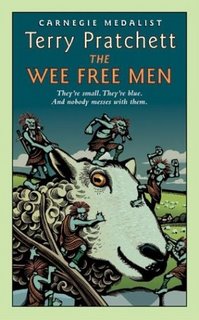 There's trouble in the Chalk high country where Tiffany lives. There's a hole in the world, into which all the monsters who had been banished by reassuring things like modern times and sanity, are reappearing. The unofficial village witch, Miss Tick, is aging and out of town, so there is no one to stop them... no one, but Tiffany. And on her side, are the little blue men.
Nac Mac Feegle, they're called, a sheep-stealing, bare-knuckled, hard-drinking, fierce lot of Highlander Pictsies -- NOT pixies, if you don't want a head butt to the bridge of your nose. Nothing stardusted and spry or milk drinking and cute about this lot. They're bright blue, six inches tall and wear little kilts, but don't let that worry you. They're out to bash some heads and preserve their world. Fortunately, they're part of the Good Guys.
In this fractured fairytale, where myth and folklore collide, fairies aren't sweet bewinged things bringing happiness, the hound of hell with razor teeth and burning eyes is called a grimhound, and the Queen of Elves is an absolute horror. There's nothing good out of a fairytale, and it's up to those with common sense to bring the world back into order.
Tiffany has the world pretty well figured out until she sees Something Nasty kidnap her soggy and annoying little brother Wentworth. Trouble is, Mam told her to watch over her brother. Tiffany, a witch-to-be, knows her duty. She sets out to find him.
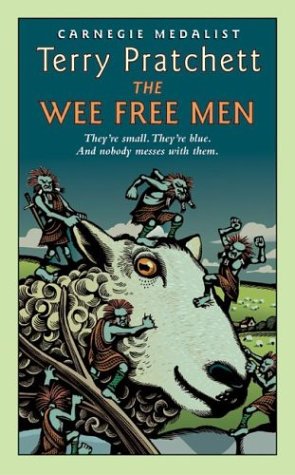 There's trouble in the Chalk high country where Tiffany lives. There's a hole in the world, into which all the monsters who had been banished by reassuring things like modern times and sanity, are reappearing. The unofficial village witch, Miss Tick, is aging and out of town, so there is no one to stop them... no one, but Tiffany. And on her side, are the little blue men.
Nac Mac Feegle, they're called, a sheep-stealing, bare-knuckled, hard-drinking, fierce lot of Highlander Pictsies -- NOT pixies, if you don't want a head butt to the bridge of your nose. Nothing stardusted and spry or milk drinking and cute about this lot. They're bright blue, six inches tall and wear little kilts, but don't let that worry you. They're out to bash some heads and preserve their world. Fortunately, they're part of the Good Guys.
In this fractured fairytale, where myth and folklore collide, fairies aren't sweet bewinged things bringing happiness, the hound of hell with razor teeth and burning eyes is called a grimhound, and the Queen of Elves is an absolute horror. There's nothing good out of a fairytale, and it's up to those with common sense to bring the world back into order.
The Genius of Terry Pratchett: Oh, RATS!
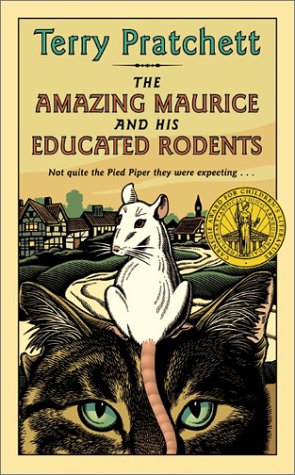 YA Fiction has rules, and one of them is that the protagonist in the story must be a young person, or the story has to have at least one central character who is between the ages of eleven to, oh, say, eighteen. If this weren't the case, many more of Terry Pratchett's books would be considered YA Fiction. There is a certain wonderful wryness about them, a certain skewed perspective which causes young and old, who 'get' his many sly jokes, to spew their coffee (or milk) right out of their noses most of the time. Funny? You bet. Seriously thought provoking? Entirely.
Winner of the 2001 Carnegie Medal, an ALA Best Book for Young Adults and a New York Public Library Book for the Teen Age, 2002, and more, The Amazing Maurice and His Educated Rodents is a madly tilted story of the Pied Piper of Hamelin, only this time distressingly reset in... the Discworld. (A quick run-up to the Discworld would be that it is a world... that is disc-shaped. And riding on the back of four elephants, who are, in turn, riding on the back of a giagantic tortoise, swimming through the stars. Well, you asked.) Strange things happen on the Discworld, including talking cats, which is what the aforementioned Maurice happens to be: a cat. He is accompanied by a rather dim boy, and a host of rats. They also talk... It's the perfect setup for a scam.
Maurice has been running the scam of -- "Ooh, the town is overrun with rats, what shall we do, what shall we do?" and "Call the Piper!" and then the Piper leads the rats out of town with a sort of ceaseless tootling on his little pipe -- for quite some time. And they've run out of towns closer to home where they're not in trouble with the law, so they're moving on. They've found a town called Bad Blintz, and everybody there hates rats. There are traps in every cellar. But something else is going on in Bad Blintz. Something worse than just non-talking rats... There are voices that get into people's heads. There is Big Evil at work. And it's making everyone kind of crazy...
Pratchett is witty, wry and snarky and his prose is quick. The jokes are quicker, so beware the laugh-out-loudness of this novel and don't slip it into someplace you're supposed to be reading quietly - it won't work. There's something weighty and thought-provoking in Pratchett's satire, teaching some big truths quietly; and it won't be hard for YA readers to find and identify with the hypocrisy of humanity and the silliness of the world at large that pretty much leaps off the pages. But don't worry -- not too much of that kind of thing. Mostly, Maurice & Co. are just a lot of fun.
Pieces Highlights for Children would like to see:
Those interested in trying to hone your craft of short stories or try your hand at writing for children's magazines should perk up: you're needed. This was sent in an open post to members of our list serv:
The editors at Highlights have created a wish list of manuscript needs. If you're in need of a little inspiration, maybe this will help. Below you will find our special needs in addition to the regular submissions we always like to receive.
If you know someone who might find this information useful, please feel free to pass it along...
Enjoy,
George Brown, Assistant Editor
Highlights for Children
570-251-4510
The editors at Highlights have created a wish list of manuscript needs. If you're in need of a little inspiration, maybe this will help. Below you will find our special needs in addition to the regular submissions we always like to receive.
If you know someone who might find this information useful, please feel free to pass it along...
Enjoy,
George Brown, Assistant Editor
Highlights for Children
570-251-4510
From Kim Griswell, Coordinating Editor
Travel and Adventure (I imagine stories about CHINA might work here, A.F.!)
Articles that feature adventurous travel. Not the "family vacation" kind of thing, unless your family goes to study turtles in the Galápagos Islands, as does the author of "Stars and Sea Lions" (June 2006). We prefer articles that feature kids in some way. Publishable-quality photos are almost essential for these kinds of articles, since it would be difficult (or impossible) for us to acquire photos if the writer couldn't provide them. Please remember that even travel and adventure articles need a focus—not simply "We went here and did this," but something that reveals the meaning behind the travel or the reason for the adventure, etc. 750 words maximum.
From Marileta Robinson, Senior Editor
Fiction for Young Readers
We need fun, lively stories as well as quiet, thoughtful stories for young readers at first- and second-grade reading levels. I would like to see more stories with boy appeal, like "Training Wheels" in September 2005 and "Fox and His Halloween Tail" in October 2005. 500 words maximum.
From Carolyn Yoder, Senior Editor
World Cultures
· Intimate looks at other peoples and their traditions—particularly in northern and southern Africa, Asia (other than India), Europe, Canada, the Caribbean, and the Pacific (articles on children)
· Holidays—first person
· U.S. History
· Modern history (20th century), particularly the Civil Rights movement
· Holidays, particularly Christmas and Thanksgiving
· Articles that touch on the diversity of people in the United States
· Biographies of U.S. subjects as children
· Anecdotal articles on George Washington and Abraham Lincoln
· Articles on patriotic themes
· HUMOROUS articles on U.S. history (review back issues for articles on Lincoln and humor, Washington and his teeth, Jefferson getting his life mask, and Ben Franklin and his love of exercise)
From Judy Burke, Associate Editor
Sports
We're interested in sports articles that focus either on a known athlete (a squeaky-clean one), on the development of specific skills(for example, fielding a grounder), or on the challenges faced by athletes of any kind (for example, being smaller than your teammates). Successful articles often include quotes gained from personal interviews with athletes or experts and useful tips for readers who play that sport. 800 words maximum.
From Andy Boyles, Science Editor
Science and Nature Articles
Our guidelines state that our word limit is 800, but articles that are even shorter (350–400 words) are especially welcome as possible one-page features. We put a high value on articles that show science as a process—articles that follow a scientist or group of scientists as they try to solve one of nature's mysteries.
We are always looking for science articles about animals that are of high interest to kids. An article might follow researchers who study such animals. The article may tell the adventures of only one day, but information about the animals and the research will arise naturally in the course of the action, so our readers will learn
something about both.
We currently have enough articles about birds, reptiles and amphibians, insects (especially bees), and volcanoes.
From Joëlle Dujardin Kirkland, Associate Editor
Crafts: Crafts with boy-appeal, games, holiday crafts, and crafts from other cultures (with background included)
Younger Nonfiction: First-person accounts of fieldwork; arts stories; biographies with interesting slants; kids living in other cultures; ancient history; animals; details from urban life(workers, transportation, etc.). These stories should have a clear focus and should be written at a first- or second-grade reading level. 450 words or fewer.
Gallant Kids: Leads (or articles) on kids under thirteen years old doing service in their communities. 350 words
From Linda Rose, Assistant Editor
Full-Page Puzzle Activities
On the inside-back cover, we like to take advantage of the cover-stock surface by using a large illustration or incorporating photos in the puzzle. Often, this is the page on which we can do several activities within one (for example, using one illustration for a number of activities). Submissions to this area ideally include
detailed art directions/notes, as well as succinct and easily understood activity directions for the reader. (Artwork or photos do not need to be submitted with the manuscript.)
Careers Articles
We are always in the market for fresh and interesting articles that take an in-depth look at a career. Our hope is that a career profile will provide kids with information that they cannot easily get elsewhere, such as in a typical "careers" book or in an encyclopedia. Instead, we want our career pieces to be intriguing reads that just happen to be about a person's career.
As our guidelines point out, "We prefer biographies that are rich in anecdotes." Substantive and "insider" anecdotes are often critical to the success of these articles; we want kids to feel that they are getting a "behind the scenes" or inside glimpse into the subject.
Focusing on one individual (or, in some cases, a few) often helps to make the manuscript feel more personal. Career pieces that focus on a person within a career tend to be more appealing. We prefer research based on firsthand experience, consultation with experts, or primary sources.
From George Brown, Assistant Editor
Short Activities
We're looking for short puzzles, activities, teasers, and interesting tidbits to go on our mixed pages—those four or five pages per issue with a variety of short activities. These activities, which can be almost anything, have to be powerful to
pull readers into the magazine. However, we do not publish word searches, crossword puzzles, or fill-in-the-blank activities.
Highlights recommends reviewing the magazine's submission guidelines, available at www.highlights.com, found in the About Us section. Back issues can be found at most local libraries.
Please send submissions to the specific editor listed above, or
Manuscript Coordinator
Highlights for Children
803 Church Street
Honesdale, PA 18431
May 15, 2006
The manuscript is away! And now the pacing continues apace...
Because whenever I have to wait more than four minutes for something, I start to unspool mentally, I shall regale you with more news from the publishing world. After all, it's something to do while I'm waiting*, which, I'm assured, is the best way to make the time pass between S.A.M. and the Editor E. hashing out my manuscript for what one hopes is the blessedly last bloody time before it passes inspection...
I came across the story of an amazingly arrogant person who got first an MFA and then a Ph.D in children's literature, and was so angry that he couldn't find a university job that he wrote a book about it. Yes, this is what America wants to read. Strange, but I think anyone observant about collegiate life knows that professors have way too much to do to get much publishing done unless they retire for awhile. I look at my brilliant and favorite ex-Mills professor, Dr. Kahn - she had to leave teaching in order to really research and write, because she gave all of her time to us on a daily basis. While I wish this author the best of luck with his work, I suggest he just teach high school for awhile and write -- and see if he has any better luck with being brilliant and publishing and being an amazing teacher!!
Publishers Weekly reports that 'tween' publisher B*tween Productions is doubling their list this year. B*tween publishes "wholesome" reading for the preteen girls set, and began the popular Beacon Street Girls series in 2004. Admittedly, the word 'wholesome' makes my teeth ache, but what that really means is that these books are girl-positive and made to foster independence and action in girls. Their mission statement says "The mission of the company is to provide the kind of positive role models and empowering messages that help girls believe in themselves whatever their challenges. The BSG brand crosses socio-economic barriers and provides problem-solving tools within an entertaining format that girls can apply to their own lives." Sounds worthwhile to me.
Meanwhile Chronicle Books has expanded their picture book and board book lines into middle grade series. The company expects to move further into older reader categories, and has expressed a desire to expand its list of titles for middle-grade readers to include stand-alone novels and nonfiction as well as series pieces. Their beautifully produced adult books make Chronicle Books a notable local publisher - hopefully one of us will get onto their lists.
Is it just me, or are we seeing more YA books by Australian authors than ever? It's a trend, and Markus Zusak's The Book Thief has helped cement the presence of the Australian voice in the American YA pantheon (and Markus being cute and nice and easy to listen to hasn't hurt, either). I hope this means more books from Jaclyn Moriarty!!
I haven't read many good girl-friendly Westerns, have you? This looks like it's going to be a lot of fun, and I can't wait to put it on my Summer Reading List!
Well, I've gotten the flyer in the mail for the 35th Anniversary SCBWI Summer Conference and found out that Our Lady Jane is speaking!! And now I have to decide between new ceiling fans and new flooring in my house, or a week in LA and getting to hear her. It's 87, and the fans and cool wood floors are winning out at present, but oh! - Lady Jane is the patron saint of Fantasy! It's a tough choice.
*Isn't it scary the places your brain reverts to when you're nervous?!
I came across the story of an amazingly arrogant person who got first an MFA and then a Ph.D in children's literature, and was so angry that he couldn't find a university job that he wrote a book about it. Yes, this is what America wants to read. Strange, but I think anyone observant about collegiate life knows that professors have way too much to do to get much publishing done unless they retire for awhile. I look at my brilliant and favorite ex-Mills professor, Dr. Kahn - she had to leave teaching in order to really research and write, because she gave all of her time to us on a daily basis. While I wish this author the best of luck with his work, I suggest he just teach high school for awhile and write -- and see if he has any better luck with being brilliant and publishing and being an amazing teacher!!
Publishers Weekly reports that 'tween' publisher B*tween Productions is doubling their list this year. B*tween publishes "wholesome" reading for the preteen girls set, and began the popular Beacon Street Girls series in 2004. Admittedly, the word 'wholesome' makes my teeth ache, but what that really means is that these books are girl-positive and made to foster independence and action in girls. Their mission statement says "The mission of the company is to provide the kind of positive role models and empowering messages that help girls believe in themselves whatever their challenges. The BSG brand crosses socio-economic barriers and provides problem-solving tools within an entertaining format that girls can apply to their own lives." Sounds worthwhile to me.
Meanwhile Chronicle Books has expanded their picture book and board book lines into middle grade series. The company expects to move further into older reader categories, and has expressed a desire to expand its list of titles for middle-grade readers to include stand-alone novels and nonfiction as well as series pieces. Their beautifully produced adult books make Chronicle Books a notable local publisher - hopefully one of us will get onto their lists.
Is it just me, or are we seeing more YA books by Australian authors than ever? It's a trend, and Markus Zusak's The Book Thief has helped cement the presence of the Australian voice in the American YA pantheon (and Markus being cute and nice and easy to listen to hasn't hurt, either). I hope this means more books from Jaclyn Moriarty!!
I haven't read many good girl-friendly Westerns, have you? This looks like it's going to be a lot of fun, and I can't wait to put it on my Summer Reading List!
Well, I've gotten the flyer in the mail for the 35th Anniversary SCBWI Summer Conference and found out that Our Lady Jane is speaking!! And now I have to decide between new ceiling fans and new flooring in my house, or a week in LA and getting to hear her. It's 87, and the fans and cool wood floors are winning out at present, but oh! - Lady Jane is the patron saint of Fantasy! It's a tough choice.
*Isn't it scary the places your brain reverts to when you're nervous?!
Patricia Polacco's Pen
Woe to those who cross a writer, for they shall find that writers have big mouths, fast typing speeds and a long, long reach.
At least, that's what SRA/McGraw-Hill should have realized when they decided to take on children's writer Patricia Polacco. A Bay Area resident, Polacco has a Ph.D in Art History with an Emphasis on Iconography. After years of thinking that her art lay in other directions, she began writing in her early 40's, and got her start with SCBWI. A prolific author, she has opened her heart and home to the writing community and is an avid speaker and teacher about the writing process.
Recently, she was asked by what she assumed was simply a booking group, to take part in the International Reading Association Conference in Chicago on May 2 and 3, 2006. The booking group asked Polacco's staff for a specific outline and information about her talks, and grew more insistent as the date approached.
Polacco wondered why. She was told, "They requested my written outline because their "client" wanted to make sure that I would not discuss my deep concern about the "No Child Left Behind" mandate ... as well as my concern that there is a link between this mandate and the SRA/McGraw Hill Company, which manufactures, prints, and profits from the sale of these tests to school systems all over our country." Polacco, reasonably concerned, did a little deeper digging - and found that the Buchanan Associates are not a booking or advertising firm, they represent... SRA/McGraw-Hill.
Questions as to why SRA/McGraw-Hill would want to invite this woman and pay her to speak... well, they because she is well known, and outspoken and well respected among teachers and writers and librarians. They thought to put her under tremendous pressure to say "upbeat, positive, non-political" things. About them. And then un-invited her when she wouldn't cave in.
She responded in kind, with lawyers.
And then t r u t h o u t got involved, and reported on a link between the current presidential administration, which implemented the No Child Left Behind laws, and the publishing company.
And because the 'pen' is now a mighty fast keyboard, the world passed the word, and now you know, too.
I guess, if fair is fair, these folk had the right to un-invite Polacco because her content disagreed with their requirements, especially since this was a paid gig, but it's pretty tacky to have invited her and then tried to write her speeches. More questionable is that a publishing company is so sold on trying to promote the flawed No Child Left Behind as a good thing, when it has been described at best as 'incomplete' by countless teachers and other educational professionals -- the very people with whom SRA/McGraw-Hill wants to work and support -- that they were unwilling to allow Polacco to speak if she even referred to the legislation. Possibly a Reading Association Conference was the wrong venue for such flashpoint topics... but then, why would a company representing SRA/McGraw-Hill ask the outspoken Polacco in the first place? Strange.
At least, that's what SRA/McGraw-Hill should have realized when they decided to take on children's writer Patricia Polacco. A Bay Area resident, Polacco has a Ph.D in Art History with an Emphasis on Iconography. After years of thinking that her art lay in other directions, she began writing in her early 40's, and got her start with SCBWI. A prolific author, she has opened her heart and home to the writing community and is an avid speaker and teacher about the writing process.
Recently, she was asked by what she assumed was simply a booking group, to take part in the International Reading Association Conference in Chicago on May 2 and 3, 2006. The booking group asked Polacco's staff for a specific outline and information about her talks, and grew more insistent as the date approached.
Polacco wondered why. She was told, "They requested my written outline because their "client" wanted to make sure that I would not discuss my deep concern about the "No Child Left Behind" mandate ... as well as my concern that there is a link between this mandate and the SRA/McGraw Hill Company, which manufactures, prints, and profits from the sale of these tests to school systems all over our country." Polacco, reasonably concerned, did a little deeper digging - and found that the Buchanan Associates are not a booking or advertising firm, they represent... SRA/McGraw-Hill.
Questions as to why SRA/McGraw-Hill would want to invite this woman and pay her to speak... well, they because she is well known, and outspoken and well respected among teachers and writers and librarians. They thought to put her under tremendous pressure to say "upbeat, positive, non-political" things. About them. And then un-invited her when she wouldn't cave in.
She responded in kind, with lawyers.
And then t r u t h o u t got involved, and reported on a link between the current presidential administration, which implemented the No Child Left Behind laws, and the publishing company.
And because the 'pen' is now a mighty fast keyboard, the world passed the word, and now you know, too.
I guess, if fair is fair, these folk had the right to un-invite Polacco because her content disagreed with their requirements, especially since this was a paid gig, but it's pretty tacky to have invited her and then tried to write her speeches. More questionable is that a publishing company is so sold on trying to promote the flawed No Child Left Behind as a good thing, when it has been described at best as 'incomplete' by countless teachers and other educational professionals -- the very people with whom SRA/McGraw-Hill wants to work and support -- that they were unwilling to allow Polacco to speak if she even referred to the legislation. Possibly a Reading Association Conference was the wrong venue for such flashpoint topics... but then, why would a company representing SRA/McGraw-Hill ask the outspoken Polacco in the first place? Strange.
May 11, 2006
More Work Avoidance
Short of pacing and biting my nails, I haven't gotten much done the past hour, so I may as well let you in on something Beverly Cleary said that's been on my mind. Cleary, 90, is facing the option of her very first novel going to celluloid. Her novels have, since 1950 when she published the first, stayed steadily in print. She's never been a millionaire, but she's written good books, steadily. (Oh, how I want someday for someone to say that about me!!)
Moviemakers are now looking at Ramona and Her Father for a film. Instead of being gleeful about a Ramona Quimby movie, Cleary is...thoughtful. She's not sure it's a good thing. She said she understands why people have toys and such as tie-in to children's books, but she's "not interested in making kids into consumers."
Can I get a witness, here?
Mrs. Cleary says she is making sure that this Ramona movie is done properly so she "doesn't turn into a plastic miniature inside a kid's fast-food restaurant meal."
As our friend Seren might say, "Word to Mrs. Cleary." Down with marketing to kids! Up with great books they can get from the library.
And now back to ...work
Moviemakers are now looking at Ramona and Her Father for a film. Instead of being gleeful about a Ramona Quimby movie, Cleary is...thoughtful. She's not sure it's a good thing. She said she understands why people have toys and such as tie-in to children's books, but she's "not interested in making kids into consumers."
Can I get a witness, here?
Mrs. Cleary says she is making sure that this Ramona movie is done properly so she "doesn't turn into a plastic miniature inside a kid's fast-food restaurant meal."
As our friend Seren might say, "Word to Mrs. Cleary." Down with marketing to kids! Up with great books they can get from the library.
And now back to ...work
May 09, 2006
Timing, Timing
Can I just whine to the universe at large that A.Fortis chose the most awful time EVER to go on vacation!? I'm in a final edit! I need someone to hold my hand and bring me adverbs! How could A.F. leave me for some wall!?
Whinging aside, Locus has announced the winner of the first year for SFWA's Andre Norton Award, created to honor young adult SF/F novels and named in honor of the late SFWA Grand Master. While not technically a Nebula Award, it is voted on by members in the same way the Nebula Awards are, and the winner this year was Holly Black, one of the coolest YA SF writers I know. I really enjoyed her previous book Tithe, which I haven't written up for our sister site, and look forward to reading her latest.
Cross fingers for me - I'm hoping to send a mss. back to the editor this week for a final run-through. I'll let you know what happens next...

Whinging aside, Locus has announced the winner of the first year for SFWA's Andre Norton Award, created to honor young adult SF/F novels and named in honor of the late SFWA Grand Master. While not technically a Nebula Award, it is voted on by members in the same way the Nebula Awards are, and the winner this year was Holly Black, one of the coolest YA SF writers I know. I really enjoyed her previous book Tithe, which I haven't written up for our sister site, and look forward to reading her latest.
Cross fingers for me - I'm hoping to send a mss. back to the editor this week for a final run-through. I'll let you know what happens next...
May 07, 2006
Insult to Injury
Not only have I been relatively inactive posting lately, but I will be on hiatus for the next two weeks due to going on vacation...to China.
I hope to find access to the internet while I'm there, and if I do, I'll try to post to my personal blog with news about our adventures.
I also wanted to note that I went back and re-read my post about momentum because, as it turns out, I needed to give myself that pep talk. My novel was finally sent back (after a polite reminder) by Margaret K. McElderry Books with a polite no, thanks. Sometimes, though, you need the rude kick in the pants of a rejection to give you that little extra bit of momentum to, say, think about yet another revision. Which is what I'll be thinking about during the 13-hour plane flight.
Adieu, and more anon.
I hope to find access to the internet while I'm there, and if I do, I'll try to post to my personal blog with news about our adventures.
I also wanted to note that I went back and re-read my post about momentum because, as it turns out, I needed to give myself that pep talk. My novel was finally sent back (after a polite reminder) by Margaret K. McElderry Books with a polite no, thanks. Sometimes, though, you need the rude kick in the pants of a rejection to give you that little extra bit of momentum to, say, think about yet another revision. Which is what I'll be thinking about during the 13-hour plane flight.
Adieu, and more anon.
May 05, 2006
LAST comments on Kaavaya Viswanathan
The SF Chronicle's Mark Morford had some deep and good words on Ms. Viswanathan, and the Incident that got me thinking. Indulge me to underscore one tiny idea of his: my success does not depend on someone else's failure.
Just a tiny thought, world.
I'm done with this story, which has by turns depressed and disgusted me. I wish this girl the best - a new start somewhere else, not having to prove anything to anyone but herself. May the next big Incident in the writing world be a story of someone doing so well that we are inspired to greater heights ourselves.
Just a tiny thought, world.
I'm done with this story, which has by turns depressed and disgusted me. I wish this girl the best - a new start somewhere else, not having to prove anything to anyone but herself. May the next big Incident in the writing world be a story of someone doing so well that we are inspired to greater heights ourselves.
May 04, 2006
An Alloy is a Mixture... in this case one poorly put together
I don't want to add to the breast-beating and blaming going on in the Viswanathan-a-thon. I think we all have our own opinions on the incident - deliberate plagiarism, privileged-girl stupidity, "perfect minority" myth teen manipulated by adults, etc. - Truly, we'll never know what really happened. There's a detail in all of this that is interesting to me, however. I want to explore the idea of "packagers" in YA lit, what they do, and why they exist.
As I'm going through the process of getting published by a major imprint, I find that there are a lot of things behind the scenes that I didn't realize existed. There is a huge machinery of movie tie-ins, product tie-ins, and marketing that stands ready to swoop on anything in your book that looks like it'll help it sell. Publishers are in the business of making money, and they're good at it; so good they're kind of scary. (I honestly do not trust that they have my best interests at heart. This is business.) Some of the editing comments I received early on have to do not so much with the book or strolling, but how it will be perceived, and ideas on how to market it.
The American Book Producers Association explains that book packagers are responsible for some of the best "high profile" book projects and that they exist to make sure that "complicated" projects can go forward. Complicated, in that these books often are compilations among authors and researchers, involve non-print materials (apparently the publishing company has nothing to do with the coffee cup, canvas tote and CD that comes with your new novel) and labor are intensive to the point of involving more hours and work than may be worthwhile to the publishing house. Often packagers are brought in to flesh out in-house projects.
Alloy Entertainment, the self-professed "most successful marketers and merchandisers to the youth market" already had a checkered past before it met with Viswanathan. According to the New York Observer, Jodi Anderson, a member of the editorial staff at Alloy had an idea for a novel. She put together a book proposal, and pitched it to her fellow editors. It was well received and it was group-thinked - but then sent out to writers other than the editor, and when all was said and done, there was a novel - and the originator of the idea had her name appearing in the "special thanks" page of The Sisterhood of the Traveling Pants. Ann Brashares was co-editor at that time. Jodi Anderson's departure for her own novel and work in other companies is understandable.
How much is any writer willing to pay for "success?" (What is that, exactly?)
I want my novel to sell. I want it to be read. I want to make enough money to live on, at some point, or else to support my small family. I guess the question comes down to how much of your artistic input you're willing to give up to editors, agents, book packagers and others. Do you want action figures, coffee mugs, tank tops, stickers, and tote bags along with that movie contract? Do you want your readers to be "merchandised" with more stuff? Are you willing to do what it takes to be Harry Potter-huge? Does it any longer have anything to do with how good your story is??
It's certainly something to think about before the contract gets put on the table in front of you.
As I'm going through the process of getting published by a major imprint, I find that there are a lot of things behind the scenes that I didn't realize existed. There is a huge machinery of movie tie-ins, product tie-ins, and marketing that stands ready to swoop on anything in your book that looks like it'll help it sell. Publishers are in the business of making money, and they're good at it; so good they're kind of scary. (I honestly do not trust that they have my best interests at heart. This is business.) Some of the editing comments I received early on have to do not so much with the book or strolling, but how it will be perceived, and ideas on how to market it.
The American Book Producers Association explains that book packagers are responsible for some of the best "high profile" book projects and that they exist to make sure that "complicated" projects can go forward. Complicated, in that these books often are compilations among authors and researchers, involve non-print materials (apparently the publishing company has nothing to do with the coffee cup, canvas tote and CD that comes with your new novel) and labor are intensive to the point of involving more hours and work than may be worthwhile to the publishing house. Often packagers are brought in to flesh out in-house projects.
Alloy Entertainment, the self-professed "most successful marketers and merchandisers to the youth market" already had a checkered past before it met with Viswanathan. According to the New York Observer, Jodi Anderson, a member of the editorial staff at Alloy had an idea for a novel. She put together a book proposal, and pitched it to her fellow editors. It was well received and it was group-thinked - but then sent out to writers other than the editor, and when all was said and done, there was a novel - and the originator of the idea had her name appearing in the "special thanks" page of The Sisterhood of the Traveling Pants. Ann Brashares was co-editor at that time. Jodi Anderson's departure for her own novel and work in other companies is understandable.
How much is any writer willing to pay for "success?" (What is that, exactly?)
I want my novel to sell. I want it to be read. I want to make enough money to live on, at some point, or else to support my small family. I guess the question comes down to how much of your artistic input you're willing to give up to editors, agents, book packagers and others. Do you want action figures, coffee mugs, tank tops, stickers, and tote bags along with that movie contract? Do you want your readers to be "merchandised" with more stuff? Are you willing to do what it takes to be Harry Potter-huge? Does it any longer have anything to do with how good your story is??
It's certainly something to think about before the contract gets put on the table in front of you.
B.utt I.n C.hair -- it's not that hard. Really.
I have many friends who write, and they either swing from one extreme to the other; from those who feel like they have no control over their characters, and that the characters must "speak" to them to move the story along, to those who are leery about that whole metaphysical metaphor, and feel like you just need to stick with your B.I.C. and get things done. Garrison Keillor's little screed in Salon yesterday was both amusing and revealing -- Mostly because I realized that I've never felt comfortable with admitting that writing is easy.
Okay, it's not so very easy every day; some days there are lawn mowers outside, and there are sinus headaches and small children screaming or cats miaowing and climbing on the keyboard. Some days there are spouses and grandkids and classes and deadlines and time clocks, but on the whole, the words are in there, our lives are a great reference, and it's not that hard to pluck out the words.
I whine about finding the right word. I whine about lackluster prose and dull dialogue. I whine about revisions. Everyone whines about revisions, especially when one has a contract so close they can smell it, but there are those last four hoops to jump through, and they're not sure they have any more elasticity in their knees - everyone whines then. Some of us whine because we have to remake the bed every day, it's just a personality quirk, and we refuse to sleep on the floor. But this job truly is not that hard. As Keillor says, "It does nothing for the reader to know you went through 14 drafts of a book, so why mention it?" We are lucky to have this job. We are not breaking rocks. We are not shoveling. We are not flipping burgers and sucking up grease through our very pores.
We are simply chained to our keyboards.
It's a Good thing.
Okay, it's not so very easy every day; some days there are lawn mowers outside, and there are sinus headaches and small children screaming or cats miaowing and climbing on the keyboard. Some days there are spouses and grandkids and classes and deadlines and time clocks, but on the whole, the words are in there, our lives are a great reference, and it's not that hard to pluck out the words.
I whine about finding the right word. I whine about lackluster prose and dull dialogue. I whine about revisions. Everyone whines about revisions, especially when one has a contract so close they can smell it, but there are those last four hoops to jump through, and they're not sure they have any more elasticity in their knees - everyone whines then. Some of us whine because we have to remake the bed every day, it's just a personality quirk, and we refuse to sleep on the floor. But this job truly is not that hard. As Keillor says, "It does nothing for the reader to know you went through 14 drafts of a book, so why mention it?" We are lucky to have this job. We are not breaking rocks. We are not shoveling. We are not flipping burgers and sucking up grease through our very pores.
We are simply chained to our keyboards.
It's a Good thing.
May 03, 2006
Two Stories, One Troubled World
N.M. Browne has given us a taste of our own history in her novels Warriors of Alavna and its sequel Warriors of Camlann. In her latest book, The Story of Stone, Nela lives in a world quite different from the one we're used to—slaves who are part of an ancestrally bonded race; shaven-headed non-women who have sworn themselves to celibacy and therefore are able to enter "men's" professions. Nela herself is a young non-woman—she dreams of becoming a Findsman like her father, locating and researching fragments of past history, despite the seizures she has suffered since childhood.
As in Browne's other books, Nela finds herself abruptly drawn into history; on a research expedition with her father, his creepy colleague, and a slave, Nela touches the surface of a smooth stone artifact they find and sees a vision of the past. But it's not just history in general—it's a specific person's past. She's seeing someone's memories.
Nela's story in the present, dealing with the unexpected problems presented by an unwanted marriage proposal and a surprisingly handsome and knowledgeable bonded slave, alternates with the story of Jerat, a boy from the past, who lives with his clan in a Tier House. In the Tier House live the chieftain—Jerat's father, his four wives, the Brood Trove—all the children of the chieftain, and assorted warrior types. In Jerat's world, there is a race of people known as the Night Hunters, reputed to be dangerous and evil, connected with the moon goddess. But if you keep one captive, legends say, they will wish with their entire being to be free, and in so doing, change the very fabric of the world. In that moment, claim the legends, the captor's deepest wish will also come true.
The two stories are cleverly alternated so that the reader is constantly wondering who the mysterious memories in Nela's stone belong to, and how they are connected to the story of Jerat. As tension builds in the past with Jerat becoming a warrior while taking care of two of his young brothers, tension also builds in the story's present. Nela finds that her non-woman status is invalid and her father has agreed to marry her to his colleague, dashing her dreams of becoming a Findsman. The only person on their expedition who listens, who seems to care, is the increasingly mysterious slave. But how can a slave help her?
As it turns out, both of them help each other—but I don't want to spoil the story. This was such a well-built world, with so many fascinating elements drawn from what seemed to be Celtic or Pictish or otherwise ancient British and European history. I was absorbed right away by the level of detail that was accomplished with relatively few words. Browne's writing has a crispness to it; she builds a fully realized world without bombarding the reader with wordy description, and this amazes me. I enjoyed her Warriors books, but I really fell in love with this one.
As in Browne's other books, Nela finds herself abruptly drawn into history; on a research expedition with her father, his creepy colleague, and a slave, Nela touches the surface of a smooth stone artifact they find and sees a vision of the past. But it's not just history in general—it's a specific person's past. She's seeing someone's memories.
Nela's story in the present, dealing with the unexpected problems presented by an unwanted marriage proposal and a surprisingly handsome and knowledgeable bonded slave, alternates with the story of Jerat, a boy from the past, who lives with his clan in a Tier House. In the Tier House live the chieftain—Jerat's father, his four wives, the Brood Trove—all the children of the chieftain, and assorted warrior types. In Jerat's world, there is a race of people known as the Night Hunters, reputed to be dangerous and evil, connected with the moon goddess. But if you keep one captive, legends say, they will wish with their entire being to be free, and in so doing, change the very fabric of the world. In that moment, claim the legends, the captor's deepest wish will also come true.
The two stories are cleverly alternated so that the reader is constantly wondering who the mysterious memories in Nela's stone belong to, and how they are connected to the story of Jerat. As tension builds in the past with Jerat becoming a warrior while taking care of two of his young brothers, tension also builds in the story's present. Nela finds that her non-woman status is invalid and her father has agreed to marry her to his colleague, dashing her dreams of becoming a Findsman. The only person on their expedition who listens, who seems to care, is the increasingly mysterious slave. But how can a slave help her?
As it turns out, both of them help each other—but I don't want to spoil the story. This was such a well-built world, with so many fascinating elements drawn from what seemed to be Celtic or Pictish or otherwise ancient British and European history. I was absorbed right away by the level of detail that was accomplished with relatively few words. Browne's writing has a crispness to it; she builds a fully realized world without bombarding the reader with wordy description, and this amazes me. I enjoyed her Warriors books, but I really fell in love with this one.
May 02, 2006
Golden Kite Award Update...
We've been waiting and SCBWI has announced the changes to its Golden Kite Award.
The biggest change? Money. And it's about time, too. Books for children and young people have been low on the totem pole of book awards forever, and it's been a two-party system (Newbury and Caldecott) for quite awhile. This isn't to say that there aren't other great book awards, including some regionals and some for specific age groups (like the Michael Printz) but recognition has been slow and limited and YA and children's writers can toil in relative obscurity because the marketing money just hasn't been behind something as mundane as books. And then you get random hyped examples of people who get half a million dollars for a book they haven't even written yet... (well, I would give Ms. Viswanathan a break today, but there is new evidence. Anyway, my point was that nobody gets rich off of writing).
Happily, that looks to be changing. Beginning with the 2006 competition, Golden Kite participants can win $2,500 in four categories: Fiction, Nonfiction, Picture Book Text, and Picture Book Illustration. And the fun is including the backstage people, too. Editors of winning books will receive $1,000, and for the winning book in the Picture Book Illustration category, an additional $1,000 will be given to the book's art director. That surprises me a lot, and I'll need to think about what that means to the industry... do we get more "superstar" editors who are that much harder to get books to...? No offense intended, but don't we have enough of those!? Hm. Anyway, what may be the best perk is that winners get an expense-paid trip to Los Angeles to attend the award ceremony at the Golden Kite Luncheon at SCBWI's Summer Conference in August. Since we all know that the Summer Conference can be a spendy little venture, that was thoughtful on the SCBWI board's part.
This is all part of a move to get the Golden Kite Award national recognition, and in turn to promote books and quality literature. Cheers!
The biggest change? Money. And it's about time, too. Books for children and young people have been low on the totem pole of book awards forever, and it's been a two-party system (Newbury and Caldecott) for quite awhile. This isn't to say that there aren't other great book awards, including some regionals and some for specific age groups (like the Michael Printz) but recognition has been slow and limited and YA and children's writers can toil in relative obscurity because the marketing money just hasn't been behind something as mundane as books. And then you get random hyped examples of people who get half a million dollars for a book they haven't even written yet... (well, I would give Ms. Viswanathan a break today, but there is new evidence. Anyway, my point was that nobody gets rich off of writing).
Happily, that looks to be changing. Beginning with the 2006 competition, Golden Kite participants can win $2,500 in four categories: Fiction, Nonfiction, Picture Book Text, and Picture Book Illustration. And the fun is including the backstage people, too. Editors of winning books will receive $1,000, and for the winning book in the Picture Book Illustration category, an additional $1,000 will be given to the book's art director. That surprises me a lot, and I'll need to think about what that means to the industry... do we get more "superstar" editors who are that much harder to get books to...? No offense intended, but don't we have enough of those!? Hm. Anyway, what may be the best perk is that winners get an expense-paid trip to Los Angeles to attend the award ceremony at the Golden Kite Luncheon at SCBWI's Summer Conference in August. Since we all know that the Summer Conference can be a spendy little venture, that was thoughtful on the SCBWI board's part.
This is all part of a move to get the Golden Kite Award national recognition, and in turn to promote books and quality literature. Cheers!
**************************** **************************** *************************
Meanwhile,the brave YALSA/ALA folks are going to have their annual conference in New Orleans. In June. In hurricane season. They're already looking for volunteer opportunities as well. Good for them.
May 01, 2006
It was FATED...
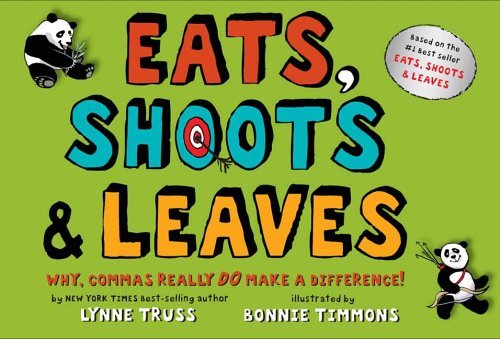 It had to happen. One of my favorite nonfiction adult books has been made... into a children's book. Publisher's Weekly reports that Eats, Shoots & Leaves is going to make the 4-8 year old set grammar-savvy once again. Toning down her 'zero tolerance approach to grammar,' author Lynne Truss teams up with cartoonist Bonnie Timmons (made famous by NBC's long-ago Caroline in the City and numerous quilting toilet paper commercials) and pairs amusing pictures with funny sentences to help kids understand what they're really saying when they neglect commas, or add them in the wrong place. I can't wait to get this one for my little brother - and a copy for me, too, because my literal mind simply cannot get enough of such silliness as "Becky walked on, her head a little higher than usual" vs. "Becky walked on her head, a little higher than usual." Now, imagine that with pictures! Meanwhile, Fast Food Nation, retitled as Chew On This, is also being turned into a YA book... and here's hoping that stocks in all fast food places plummet! Doubtful, but hope springs eternal...
Meanwhile the Random House/WaldenMedia marriage is already bearing fruit; Carl Hiaasen's brilliant book Hoot is opening as what looks to be a brilliant movie on May 5. More children's/YA novels look to be coming into movie form this year include Where the Wild Things Are, a few Nancy Drew mysteries, the His Dark Materials trilogy, the Spiderwick Chronicles, The Tale of Despereaux, A Bridge to Terebithia, The Giver, Charlotte's Web (I'm a bit sad about, because with Dakota Fanning, it looks like a remake of Babe. Again. And Oprah is Gussie the goose!?) How to Eat Fried Worms, and more. Can movies really make readers? We'll find out...
April 27, 2006
Momentum, after a long hiatus.
I was looking at the list of postings and realized that, jeez Louise, I haven't posted in a really long time. What a slacker I am! Sometimes life, work, sleep, etc. just seem to get in the way, repeatedly and with a vengeance. I've been meaning to post something for ages--ironically, about how important it is to keep working on your craft in order to maintain momentum--but I've been a blog absentee.
So anyway, there's no time like the present, while I'm waiting for a cup of tea to steep, and while I'm between two of the many busy little tasks that seem to breed like dust bunnies in my house.
I've been thinking a bit about momentum lately, both on a project level and on the larger scale of writing or art in general. It can be surprisingly easy to lose momentum, even for something you love. It causes me sincere heartbreak to admit this, but because I decided to change focus for grad school and study creative writing, I lost my momentum with visual art. I had to devote all of my time and energy to writing (and commuting).
When I got out of school, I was too burned out to do either for a while. Then, I was obsessed with having to earn some sort of income. Now, despite having spent four undergraduate years and one post-baccalaureate year studying visual art--two to three more years than I spent studying writing--I do about a tenth as much visual art as I do writing. If I'm lucky. And I'm sorry to have to say it, but that pretty much relegates it to hobby status. I'm not satisfied with that state of affairs. Even though I'm still pursuing some kind of creative endeavor, it's not quite the same.
It's very hard to maintain momentum as a fine artist, regardless of whether your pencil creates words or images. I don't know how exactly I'm going to manage to regain momentum with visual art while also maintaining a grip on writing, without somehow adding more hours in the day (or managing to make a living at one or the other).
But I have had some luck, at least, in maintaining momentum with my writing. I've discovered that sometimes a sudden standstill in one project means that I have to put it aside for a bit. However, it's important not to stop writing altogether. I switch to another project, maybe a short story that can be used as a pleasant diversion, something I can have fun with or that's been in the back of my mind for a while. Then I find my motivation and inspiration are both revitalized for the first project. If they aren't, then maybe it has to be set aside for a longer period of time.
I don't want to advocate abandoning anything, because frankly, as an artist, you should always save everything you ever did that has any potential in case you regain interest in it later. I firmly believe this. If you stole it from yourself, and it hasn't been published already, then it's not plagiarism, it's revision.
The ultimate message I want to convey here is that it's important just to keep going, no matter what. If you've stopped, then either something has superseded your art in importance and it has ceased to become a priority, or maybe you need to start a completely different project in order to keep writing/painting/whatever. Maybe what you were last working on isn't where your head is right now.
And as for me, maybe my head hasn't been in a visual place for a while. But it will be. I already have some ideas, and my sketchbook has seen some activity lately. Now if I could only find the time...
So anyway, there's no time like the present, while I'm waiting for a cup of tea to steep, and while I'm between two of the many busy little tasks that seem to breed like dust bunnies in my house.
I've been thinking a bit about momentum lately, both on a project level and on the larger scale of writing or art in general. It can be surprisingly easy to lose momentum, even for something you love. It causes me sincere heartbreak to admit this, but because I decided to change focus for grad school and study creative writing, I lost my momentum with visual art. I had to devote all of my time and energy to writing (and commuting).
When I got out of school, I was too burned out to do either for a while. Then, I was obsessed with having to earn some sort of income. Now, despite having spent four undergraduate years and one post-baccalaureate year studying visual art--two to three more years than I spent studying writing--I do about a tenth as much visual art as I do writing. If I'm lucky. And I'm sorry to have to say it, but that pretty much relegates it to hobby status. I'm not satisfied with that state of affairs. Even though I'm still pursuing some kind of creative endeavor, it's not quite the same.
It's very hard to maintain momentum as a fine artist, regardless of whether your pencil creates words or images. I don't know how exactly I'm going to manage to regain momentum with visual art while also maintaining a grip on writing, without somehow adding more hours in the day (or managing to make a living at one or the other).
But I have had some luck, at least, in maintaining momentum with my writing. I've discovered that sometimes a sudden standstill in one project means that I have to put it aside for a bit. However, it's important not to stop writing altogether. I switch to another project, maybe a short story that can be used as a pleasant diversion, something I can have fun with or that's been in the back of my mind for a while. Then I find my motivation and inspiration are both revitalized for the first project. If they aren't, then maybe it has to be set aside for a longer period of time.
I don't want to advocate abandoning anything, because frankly, as an artist, you should always save everything you ever did that has any potential in case you regain interest in it later. I firmly believe this. If you stole it from yourself, and it hasn't been published already, then it's not plagiarism, it's revision.
The ultimate message I want to convey here is that it's important just to keep going, no matter what. If you've stopped, then either something has superseded your art in importance and it has ceased to become a priority, or maybe you need to start a completely different project in order to keep writing/painting/whatever. Maybe what you were last working on isn't where your head is right now.
And as for me, maybe my head hasn't been in a visual place for a while. But it will be. I already have some ideas, and my sketchbook has seen some activity lately. Now if I could only find the time...
April 24, 2006
Kaavya Viswanathan: Too Good To Be True?
Eeeeouch! Last April I mentioned the story of a very lucky girl who got into Harvard just about the time she got a very lucrative two book deal. At the time, I was a bit scared for her -- only 17, and already -- wow. I spoke at my undergrad alma mater about this 17-year-old girl who had gotten a $500K book deal based on a couple of chapters she'd written and told them that no, they'd have to work a bit harder, this kind of stuff never happens. It seems I may have been more right than I knew...
Like many other writers, I was a bit green with envy over this young woman's succeess -- but now I'm a bit nervous for Kaavya Viswanathan, now 19. Recent allegations claim that entire phrases from her book How Opal Mehta Got Kissed, Got Wild, and Got a Life, are taken from Megan F. McCafferty 2001 novel "Sloppy Firsts" and the 2003 sequel "Second Helpings." There is, in fact, a full 14 word paragraph that is all McCafferty with only the names changed.
My stomach just knots as I read the comments from the Harvard newspaper, where Viswanathan is a student. Much has been made of this obviously bright girl, but it does seem that her fairy-tale beginning was just too good to be true, and that sharp readers are already joining the fray to make sure and pick out every single incidence where she could have taken her pieces of work from somewhere else.
Viswanathan is the youngest author signed by Little, Brown in decades, and the movie rights for the novel have already been sold to DreamWorks.
Ouch.
Like many other writers, I was a bit green with envy over this young woman's succeess -- but now I'm a bit nervous for Kaavya Viswanathan, now 19. Recent allegations claim that entire phrases from her book How Opal Mehta Got Kissed, Got Wild, and Got a Life, are taken from Megan F. McCafferty 2001 novel "Sloppy Firsts" and the 2003 sequel "Second Helpings." There is, in fact, a full 14 word paragraph that is all McCafferty with only the names changed.
My stomach just knots as I read the comments from the Harvard newspaper, where Viswanathan is a student. Much has been made of this obviously bright girl, but it does seem that her fairy-tale beginning was just too good to be true, and that sharp readers are already joining the fray to make sure and pick out every single incidence where she could have taken her pieces of work from somewhere else.
Viswanathan is the youngest author signed by Little, Brown in decades, and the movie rights for the novel have already been sold to DreamWorks.
Ouch.
April 22, 2006
A shameless plug for a favorite author, and a great teen book club
Happy Weekend! Here's a fabulous little event for YA writers brought to my attention by a fellow SCBWI-er :Not Your Mother's Book Club a Laurel Village, SF club of the incredibly hip, is throwing a party. This YA literature community for people grades 7-12 welcomes Sarah Dessen to cafe Lo Cubano, she of the myriad sensitive and intelligent books reviewed on our sister site. This shindig is on the 25th, so you'll need to move quickly to get your tickets online from Books, Inc., drop by their Laurel Village store, or give them a call at (415) 221-3666. Don't wait - it's not a big place, and once the tix are gone, they're history, and this will be just another great event that you missed! Ticket price includes Dessen's newest book for all the lucky teens, tapas, prizes and more -- take notes, writers. What a fabulous idea for doing your own PR!! And check out their blog. Man, if I ever am forced to reincarnate I'll make sure I come back somewhere near the Laurel Village Books Inc., thanks. What cool folks.
Cheers!
Cheers!
April 20, 2006
Adventures Afloat: Bloody Jack
A summer plague changes the fate of an English girl in 1798. Mary Farber is orphaned, dumped curbside on her eight-year-old rump with only the clothes on her back, wailing, as first her father, then her sister and mother are carted away in a wheelbarrow, the child to be sold to a doctor who buys the dead from a scrounger, the adults to be burned or buried in quicklime so their disease won't spread to others. When poor Mary can't cry any more, she finds herself alone in the dark, terrified, cornered and stripped of her belongings. She falls in with the gang of children who have stolen from her, and runs the streets pickpocketing and begging for a few shillings and a crust of bread, which is shared out evenly among the urchins who are now all the family she knows.
It's a hard life, truly, for the gang loses members almost daily - whether they are run down by horses, kidnapped, knifed, hung for stealing or simply die during the night. Ultimately, tragedy strikes the leader of the gang, and Mary knows there must be something better. Donning the clothes from the dead body of her beloved gang leader, Red Charlie, Mary renames herself Jack - and her adventure truly begins. She finds her way onto a ship and begins her life with the Royal British Navy as Jack Faber, Ship's Boy -- and soon enough she is known as 'Bloody Jack.'
Bloody Jack, by Louis A. Meyer, and its sequels Curse of the Blue Tattoo and Under the Jolly Roger are classic adventure tales with a huge following that give a fairly accurate version of life in England and Boston in the early 18th century for ship boys and women -- few rights and a whole lot of people to whom they must say "Yes, Sir." I applaud Meyers for reminding readers of what life was really like back then, in the U.S. and the U.K. - lest historians get overly caught up on "the good old days."
Mary/Jack is quite a good sailor, and once she's figured out how to further her Great Deception, as she calls her continuing struggle to be a boy, she does just fine. Once she gets a few good meals under her belt, however, problems arise. Her body changes and she begins to panic. Further trouble follows. There are men who prey on little boys on her ship, the Dolphin; and wouldn't you know it, one of them seems to have taken to following Jack around...
There is an almost Dickensonian melodrama to the novels, as one terrible dilemma after another befalls the hapless hero/ine, but s/he rises to the occasion, and meets all challenges with a glint in her eye. The characterizations of drunks and whores are pretty well over the top; you expect Little Nell one moment and a capital 'V' villian twirling his moustaches the next. When, in the second novel, Mary re-emerges and is sent to a girl's school, even the toffs and the privileged are either very lovely, or dreadful. This adds a color and life to the narrative in keeping with the times of broadsheets and 'penny dreadfuls.' The first person story narration gives readers even more depth, and the likable Mary/Jack drives the pacing well, though sometimes she is not quite so likeable. She is far from perfect, and continually finds herself in stupid scrapes that may try a reader's patience. She is forever whining, "I says I was sorry," and being unhappy when "I'm sorry" doesn't mend the damage she's done.
For all that she is canny and self-reliant, quick to spring to her own defense, and to help out others in need, Meyers seems to paint Mary/Jack as a rather simple character -- when Mary/Jack cries, it is mouth open, bawling, dripping snot. When she dances, she capers, and kicks up her heels. Meyer seems to find in this character the dictionary definition of "saucy," which is wearing after awhile; and Mary/Jack flirts, winks, nudges and is fairly loose for a girl of the 18th century, even a girl who is poor and destitute (does that mean she's easy because she's poor?). I fail to see that she could have picked up all of the affectations and flirtations she displays at times as an educated girl - even an eight-year old in England at that time would have already been well versed in prayers and known about chastity and meekness and quietness, and not have forgotten it all -- but if the reader doesn't peer too closely at historical accuracy in minutiae, the storylines of these novels are engaging and quick paced and enjoyable on a Spring afternoon.
It's a hard life, truly, for the gang loses members almost daily - whether they are run down by horses, kidnapped, knifed, hung for stealing or simply die during the night. Ultimately, tragedy strikes the leader of the gang, and Mary knows there must be something better. Donning the clothes from the dead body of her beloved gang leader, Red Charlie, Mary renames herself Jack - and her adventure truly begins. She finds her way onto a ship and begins her life with the Royal British Navy as Jack Faber, Ship's Boy -- and soon enough she is known as 'Bloody Jack.'
Bloody Jack, by Louis A. Meyer, and its sequels Curse of the Blue Tattoo and Under the Jolly Roger are classic adventure tales with a huge following that give a fairly accurate version of life in England and Boston in the early 18th century for ship boys and women -- few rights and a whole lot of people to whom they must say "Yes, Sir." I applaud Meyers for reminding readers of what life was really like back then, in the U.S. and the U.K. - lest historians get overly caught up on "the good old days."
Mary/Jack is quite a good sailor, and once she's figured out how to further her Great Deception, as she calls her continuing struggle to be a boy, she does just fine. Once she gets a few good meals under her belt, however, problems arise. Her body changes and she begins to panic. Further trouble follows. There are men who prey on little boys on her ship, the Dolphin; and wouldn't you know it, one of them seems to have taken to following Jack around...
There is an almost Dickensonian melodrama to the novels, as one terrible dilemma after another befalls the hapless hero/ine, but s/he rises to the occasion, and meets all challenges with a glint in her eye. The characterizations of drunks and whores are pretty well over the top; you expect Little Nell one moment and a capital 'V' villian twirling his moustaches the next. When, in the second novel, Mary re-emerges and is sent to a girl's school, even the toffs and the privileged are either very lovely, or dreadful. This adds a color and life to the narrative in keeping with the times of broadsheets and 'penny dreadfuls.' The first person story narration gives readers even more depth, and the likable Mary/Jack drives the pacing well, though sometimes she is not quite so likeable. She is far from perfect, and continually finds herself in stupid scrapes that may try a reader's patience. She is forever whining, "I says I was sorry," and being unhappy when "I'm sorry" doesn't mend the damage she's done.
For all that she is canny and self-reliant, quick to spring to her own defense, and to help out others in need, Meyers seems to paint Mary/Jack as a rather simple character -- when Mary/Jack cries, it is mouth open, bawling, dripping snot. When she dances, she capers, and kicks up her heels. Meyer seems to find in this character the dictionary definition of "saucy," which is wearing after awhile; and Mary/Jack flirts, winks, nudges and is fairly loose for a girl of the 18th century, even a girl who is poor and destitute (does that mean she's easy because she's poor?). I fail to see that she could have picked up all of the affectations and flirtations she displays at times as an educated girl - even an eight-year old in England at that time would have already been well versed in prayers and known about chastity and meekness and quietness, and not have forgotten it all -- but if the reader doesn't peer too closely at historical accuracy in minutiae, the storylines of these novels are engaging and quick paced and enjoyable on a Spring afternoon.
April 17, 2006
Odds and Ends on a Sunny Monday
Carpe Diem, Memento Mori: Muriel Sparks, born 2.1.1906, and best known for her novel The Prime of Miss Jean Brodie, died April 15th. Not at all a YA novel, Brodie still captured in essence the cutthroat competitiveness, petty triumphs and mobster-style clannishness of high school girls. I best loved Sparks' book Memento Mori despite Brodie being more remembered for its cinematic adaptation of sinister plotting in a girl's school. I preferred Memento because of its unusual villains; I rather like the idea of sinister plotting amongst the elderly; the disembodied phone calls and shadowy voices were hysterical, as were her descriptions of the foibles and fetishes of certain portions of our population (and now you know what happens to dirty young men - they just get old). Now I shall go onto the porch and open my happy tale of death in the geriatric years as a salute to the grand old dame of sinister. Goodbye, Ms. Muriel. Memento mori, on this sunny day: remember that you must die.
********************************
This summer, if you're not up to the spendy trip to L.A. for the SCBWI conference, if you want something more specifically geared to writers of literature for older children, or you just want somewhere new to go, here's a conference that's a little closer to the Coast, and a bit smaller:
This summer, if you're not up to the spendy trip to L.A. for the SCBWI conference, if you want something more specifically geared to writers of literature for older children, or you just want somewhere new to go, here's a conference that's a little closer to the Coast, and a bit smaller:
THE PACIFIC COAST CHILDREN'S WRITERS WORKSHOP:
A Team-Taught Seminar for Middle Grade & Young Adult Novelists
Specializing in Character-Driven, Realistic Fiction
August 11-13, 2006 * Theme: Crafting Savory Scenes
At the Best Western Seacliff Inn * Aptos, CA (near central coast Santa Cruz)
At the Best Western Seacliff Inn * Aptos, CA (near central coast Santa Cruz)
SMALL GROUP; 90 PERCENT HANDS-ON; CLOSE CONTACT WITH FACULTY
* Joy Neaves: Senior Editor, Front Street Books * Deborah Noyes Wayshak: Senior Editor;
Candlewick Press.(Deborah is also a fiction and nonfiction author of adults and kids books.)
* Jennifer Jaeger: Associate Agent, Andrea Brown Literary Agency
* Martha Alderson: Author of Blockbuster Plots, Pure and Simple
THREE FOCUS SESSIONS: How to Craft Scenes Integrating Character, Plot, and Theme
PRE-WORKSHOP APPETIZERS: Personalized exercises, peer-manuscript critiques, readings
PROGRAM HIGHLIGHTS & FEES
*Basic (Fri.-Sat.): Friday: Dinner with editors; Martha Alderson's hands-on session tailored to our group. Saturday: 9.5 hours of master-class clinics, keynotes, Q-A; gourmet lunch. Manuscript critiques (written or in-person) by 1-2 editors; Query/Synopsis & First Pages critiques. $149-339.
* Add-on (Sun.): Garden-patio champagne brunch with faculty. Jennifer Jaeger and Martha Alderson will each do a focus session. Brunch/talks: $39. Also, for added fee: morning critique or consultation with Jennifer/Martha (choose private or semi-private; 15-55 minute sessions).
There are only 40 spots for this conference, so if you're interested, get cracking! Email conference director Nancy Sondel * go to www.childrenswritersworkshop.com * or call 831- 684-2042
April 14, 2006
In passing...
As an addendum to my earlier post on copywriting, I did a little more research and found a website called Creative Commons. It is a non-profit company that creates licensing agreements for those whose creative work is posted via the Web, or found on blogs; whose work is shared, passed around, and eventually published. These licenses protect some rights while providing unlimited use of others, and, unlike that sealed-envelope trick, are viewed respectfully by actual judges. Professors who have written web-based texts for their students, bloggers, photographers and others have found these useful - and they're worth checking out for writer's purposes.
A concept equally intriging is copyleft! If you're interested in your art never being copyrighted, and forever belonging to the public domain, freely passed around, added onto, changed, built from and morphed, this is for you.
Q Bon weekend, writers!b
A concept equally intriging is copyleft! If you're interested in your art never being copyrighted, and forever belonging to the public domain, freely passed around, added onto, changed, built from and morphed, this is for you.
Q Bon weekend, writers!b
The Will to Survive
Gary Paulsen is well-known for his novels of the outdoors and for being a groundbreaking writer of "guy books," but somehow—perhaps because I'm not a guy—I hadn't read any of his writing until now. And, as usual, I'm sorry I hadn't. His writing is deceptively simple and literary and gemlike, intense nuggets of clear, concrete imagery that bring the reader right into the environment of the main character—in this case, thirteen-year-old Brian Robeson, marooned in the wilderness after the crash of a small plane into a lake.
In Hatchet, we're introduced to Brian as he finds himself bruised, concussed, but miraculously alive after the pilot of the small plane he's riding in dies of a heart attack. Brian barely manages to steer the plane to its crash landing site in a forest lake, but then he's left with the knowledge that he has no idea where he is or how he is going to survive. The plane has sunk to the bottom of the lake--pilot, emergency pack, and all. He's only left with the clothes on his back, which aren't much, and a hatchet that his mother had given him.
Little by little, though, Brian figures out how to find food, shelter, and fire; and, against the odds, living from day to day, he does survive. It's a gripping tale, one of those stories that invites you to imagine what you'd do in a similar situation. A sequel, Brian's Winter, follows Brian's story into the harsh, deadly northeastern winter, raising the stakes for his survival, and is just as exciting. However, neither book is one-sided, glamorizing the struggle for life like so many TV series and movies do. It isn't easy, there are plenty of setbacks and failures, and Brian learns a new respect for nature and wildlife as he finds his place within it. One of the hardest lessons he learns is that the price for his own survival is often measured in the lives of other living creatures.
These are very quick and satisfying reads. There are a few more books in the series, too, catching up with Brian a few years later—I definitely plan to read them when I need another dose of adventure.
In Hatchet, we're introduced to Brian as he finds himself bruised, concussed, but miraculously alive after the pilot of the small plane he's riding in dies of a heart attack. Brian barely manages to steer the plane to its crash landing site in a forest lake, but then he's left with the knowledge that he has no idea where he is or how he is going to survive. The plane has sunk to the bottom of the lake--pilot, emergency pack, and all. He's only left with the clothes on his back, which aren't much, and a hatchet that his mother had given him.
Little by little, though, Brian figures out how to find food, shelter, and fire; and, against the odds, living from day to day, he does survive. It's a gripping tale, one of those stories that invites you to imagine what you'd do in a similar situation. A sequel, Brian's Winter, follows Brian's story into the harsh, deadly northeastern winter, raising the stakes for his survival, and is just as exciting. However, neither book is one-sided, glamorizing the struggle for life like so many TV series and movies do. It isn't easy, there are plenty of setbacks and failures, and Brian learns a new respect for nature and wildlife as he finds his place within it. One of the hardest lessons he learns is that the price for his own survival is often measured in the lives of other living creatures.
These are very quick and satisfying reads. There are a few more books in the series, too, catching up with Brian a few years later—I definitely plan to read them when I need another dose of adventure.
April 12, 2006
Cracking the World YA Writing Markets
My *S.A.M. is back from the Bologna Book fair and is feeling quite happy to be back in the U.S. with his proper pillows (apparently all of Italy is pillow-deficient). He did have a good time, and had some interesting things to say on international markets and what sells to them -- generally things with universal subjects and themes. He adds, "The Europeans are a fickle bunch and they aren't interested in issue novels in the way American houses still are--and of course, books that are too American in feeling and subject, like the Vietnam War or slavery, just won't travel over the Atlantic. Fantasy is still of great interest, but so are mysteries, thrillers and just plain wonderful books. Anything unusual, whether historical or whimsical, also seems to have caught their attention..."
From my own tentative research into the topic, I have realized that selling something to both American and international audiences concurrently is a big challenge. I recall being disgusted with J.K. Rowlings' publishers for leaching the British-isms out of the Americanized Potter epics, but that's what most non-American publishers seem to feel the need to do in order to attract American audiences. And what do we do to work more equitably with the rest of the world? Not much, unfortunately. Last June's Library Journal noted that the 2005 Bologna conference had quite a few Canadian books, however, which garnered interest in international houses. These books, the author says firmly, did not water down their Canadian content.
Many international writers are writing work that is more "gritty" (there's that strangely definition-free word again) than their American counterparts. American writers of YA fiction don't often come from a political point of view, because for all of our democratic status, writing about our political system is, in a word, difficult. (I take that back -- writing is easy, as many a rabid blogger can attest, it's that pesky "getting published" thing...) A writer chronicling the cultural revolution in China, the horrors of the Holocaust or the deprivations of any nation's war in a sort of fictionalized non-fiction style has been popular at past Conferences. Fiction which embraces a culture is also well received - for instance, just writing about what it is to be Fijian in Fiji, and in the world away. For more American works to receive wider readership, perhaps the focus of the YA international literature must be more about internal validation and personal goals that are germane to everyone's growing up, and less about cultural divides like a first cars and huge Proms or experiences which involve something uniquely American - like lots of material possessions, disrespect of adults, and money for individual use. American publishing houses are going to have to take risks, too, and present readers with longer, more challenging fiction that seems to be more the norm in the UK and other places. (Places like Bloomsbury Press seem to have that idea well in hand.)
It's a difficult question, how to write to be acceptable all over the world... You can't, not really. We can hardly write to be acceptable to everyone in our writing group, much less the State or the Nation or the larger planet. The best thing you can do, I guess, is hone your voice. Be unique. Then, begin with a really good book...
*secret agent man
From my own tentative research into the topic, I have realized that selling something to both American and international audiences concurrently is a big challenge. I recall being disgusted with J.K. Rowlings' publishers for leaching the British-isms out of the Americanized Potter epics, but that's what most non-American publishers seem to feel the need to do in order to attract American audiences. And what do we do to work more equitably with the rest of the world? Not much, unfortunately. Last June's Library Journal noted that the 2005 Bologna conference had quite a few Canadian books, however, which garnered interest in international houses. These books, the author says firmly, did not water down their Canadian content.
Many international writers are writing work that is more "gritty" (there's that strangely definition-free word again) than their American counterparts. American writers of YA fiction don't often come from a political point of view, because for all of our democratic status, writing about our political system is, in a word, difficult. (I take that back -- writing is easy, as many a rabid blogger can attest, it's that pesky "getting published" thing...) A writer chronicling the cultural revolution in China, the horrors of the Holocaust or the deprivations of any nation's war in a sort of fictionalized non-fiction style has been popular at past Conferences. Fiction which embraces a culture is also well received - for instance, just writing about what it is to be Fijian in Fiji, and in the world away. For more American works to receive wider readership, perhaps the focus of the YA international literature must be more about internal validation and personal goals that are germane to everyone's growing up, and less about cultural divides like a first cars and huge Proms or experiences which involve something uniquely American - like lots of material possessions, disrespect of adults, and money for individual use. American publishing houses are going to have to take risks, too, and present readers with longer, more challenging fiction that seems to be more the norm in the UK and other places. (Places like Bloomsbury Press seem to have that idea well in hand.)
It's a difficult question, how to write to be acceptable all over the world... You can't, not really. We can hardly write to be acceptable to everyone in our writing group, much less the State or the Nation or the larger planet. The best thing you can do, I guess, is hone your voice. Be unique. Then, begin with a really good book...
*secret agent man
April 10, 2006
Monday Musings
I've discovered a new site, thanks to the heads up of some cool people at SCBWI. Since Autumn 2005, the website Children's Media Professionals Forum, brought together by April Sayres, the phenomenally gifted and prolific picture book and middle grade nature author, has quietly flourished and given the people who work with and for children a place to meet.
I like to think of myself as a 'professional,' but I merely lurk on the site as of yet. I get a little thrill reading how one of my very favorite authors, Jane Yolen, works on projects and sees the world. It's a free registration, but you can lurk without signing up (just don't expect to be able to comment on threads or post your thoughts). Do check it out!
I like to think of myself as a 'professional,' but I merely lurk on the site as of yet. I get a little thrill reading how one of my very favorite authors, Jane Yolen, works on projects and sees the world. It's a free registration, but you can lurk without signing up (just don't expect to be able to comment on threads or post your thoughts). Do check it out!
****
Kentucky author Marcia Thornton Jones tells a funny story that has the best punchline ever. Her first book, Vampires Don't Wear Polka Dots (published in 1990), was written to amuse herself when she was having a cruddy day. Before this, Marcia was a teacher and a struggling author, having never published anything major, but always hoping, and checking and double checking her work, and struggling to get the words just right. The one piece she wrote with a fellow teacher as a joke...shone. So, there's something to be said for lightening up and letting your work sing. Here's another bit of proof that writing what you love - in Thornton Jones' case, silliness -- always beats trying to write how you think publishers want you to. Forty middle grade books later, you'd better believe Marcia Thornon Jones believes that!
****
Finally, the very best story of the day -- favorite children's author Beverly Cleary turns 90 this week. Yay! Another long-lived California writer! To celebrate this week, pick up a Cleary book. (My choice will be Dear Mr. Henshaw, a book my fifth graders requested to read over and over.)
Ms. Cleary talks to NPR's Debbie Eliott about the manically magically memorable Ramona Quimby, the brightest, peskiest character in the neighborhood of Beezus and Ramona, Henry Huggins, Otis Spofford, Ellen Tibbets and all the others on Klickitat Street. Did you know there's actually a group called "Ramona the Pest," in Oakland?! People are scandalized, but they mean it as a tribute...I think. Another tribute is found on Recess: the World of Children's Culture Every Day. (This is a cool site, too, on its own.)
April 06, 2006
Writing/Publishing Bits and Bobs
Listen:Quirky Australian author Markus Zusak is interviewed on NPR about his newest novel, The Book Thief. Death narrates the story of a young girl, Liesel Meminger, who steals books in her working class town in Germany and tries to rebuild a world that Hitler's rhetoric in World War II steals away. Some people are surprised that such a darkly haunting book is marketed to YA readers, but Zusak says he feels that writers all too often underestimate YAers, and that if we give them something to step up to, they'll surprise us every time.
...
Ours is a strange world indeed, wherein the world of entertainment goes hand in hand with our ...coffee? Yeah, Starbucks, that mecca of, um, dubious taste, is in the movie business. Because children and young adults simply do not have enough marketing shoved down their throats, the chain coffee store is joining the fray and aggressively promoting their spelling bee movie Akeela & the Bee. On the up side, millions of coffee drinkers will be expanding their vocabularies and their spelling skills, according to the company, by learning to spell and define such words as pulchritude and prestidigitation. On the down side, well... it's still Starbucks.
...
Coming soon to a theater near you!The Penguin Young Readers Group has just made a lucrative contract with Walden Media LLC. (Walden Media was the company which put The Chronicles of Narnia together with Disney, which was the top grossing domestic film release of the 2005 holiday season.) This deal is intended to get more children's books to theater, television and to enable older books to be mined for stories suitable for 'family' type films. Should be an interesting venture, and hopefully beneficial to writers.
...
Bet you didn't know that Communists are to be both unseen and unheard, even outside the U.S.! A Dade County (Florida) school district is yanking books that show Cuban children in Communist youth club uniforms from the library shelves of 33 schools. The book, entitled Vamos a Cuba (A Visit to Cuba) is deemed as offensive... of course, the fact that Cuba itself is a communist country seems to have escaped the notice of those who are offended...
...
Religious publishing just went really mainstream. Massive publishing conglomerate Penguin Group USA, Inc. (which includes numerous imprints) has just launched Penguin Praise in an effort to capitalize on the trend of blockbuster religious books, movies and music. High on their list of new authors are Tim LaHaye and Jerry Jenkins, whose fictional Left Behind series sold a baffling 62 million copies. A first book of LaHaye and Jenkins' new series will be available in November 2006 from Putnum/Praise, and you can look it up and find out all the buzz about it yourself, if you're interested. Now, what I'm wondering is how this will mix and meld with the Walden deal. Hmmm...
...
Anybody who grew up loving the work and busy worlds of Richard Scarry might get a smile out of the fact that, before his death in 1994, he got... a little PC. Check out the differences between his very first book in 1963, and the 1991 update....
And finally, the SCBWI is making some changes to its Golden Kite Awards, to be announced on April 15th. They promise that the award will be increased in visibility and will "rock the publishing world." We await the reverberations.
April 05, 2006
Ah, Irony
 point d'acclamation
Cool, huh?
As reported by WriteGrrrl by way of the dubious compiler of information (or is that the compiler of dubious information?) Wikipedia, there has, for some time, been a such thing as... an irony mark.

Now, we know the evils of ALL CAPS and exclamation point abuse (many ranting web posts later), but we have to definitely leave it to the French to come up with a fabulous system of cues to make sure that everyone gets the wryly wrinkled brow, the ever-so-slightly sneering lips, the deadpanned expression, or the rolling eyes that make up our friend irony both here and abroad. Oh, why don't they teach this stuff in school?! Why isn't an irony symbol on everyone's keyboard?
Apparently, French novelist Hervé Bazin came up with quite a few more symbols, including one for certainty, one for authority, and one that looks remarkably Spanish in origin for indignation. Now if only we can figure out how to make irony easier to explain...


™, © and More Ways to Protect Yourself
There are all kinds of, well, urban legends about copyright law. I know I've heard more than once that you can mail yourself a letter -- unopened -- with a copy of your work in it, and voila, you're protected. Unfortunately, that, and a bunch of other copyright promises that I've run across on the Web, aren't true. There IS such a thing as implied copyright under the "medium of protection" law, but people who use cyberspace as an arena for their workshopping and critiquing open themselves up to court fees and headaches since one has to file for infringement rights within three months of the first time something is copied and stolen. It's also very difficult to prove that elusive "significant harm" thing, so it's not as expensive as you might think to have your work of art copyrighted. It sure beats paying lawyers...
How safe are you from copyright issues? Are your readers people you know and trust? Is your Wireless network encrypted and do you have firewalls in place on your computer system? Read more about copyrighting from a Bay Area legal expert, and be careful - writers tend to borrow storylines without meaning to. Protect yourself from intentional threat and only work with people you know you can trust.
How safe are you from copyright issues? Are your readers people you know and trust? Is your Wireless network encrypted and do you have firewalls in place on your computer system? Read more about copyrighting from a Bay Area legal expert, and be careful - writers tend to borrow storylines without meaning to. Protect yourself from intentional threat and only work with people you know you can trust.
Earth Day... and Stuff
There's a good chance that nobody takes the environment as seriously as they should, not even serious environmentalists. It's hard to know what to worry about and how to save what is left on the earth, and how to encourage others to get serious about keeping the air and water clean. YA author Gail Gauthier introduces us to a character who doesn't even know he's supposed to try to do all that stuff in Saving the Planet & Stuff.
Michael Peter Racine the Third (MP3 to his friends) is having a bad summer. The job he had lined up with his uncle's landscaping service has folded, and his uncle is in trouble for passing bad checks. Michael isn't particularly driven to find something else to do -- his best skills involve email and Instant Messaging -- but he's bored, he's broke, and worst of all, everyone around him is doing something great -- and thinks he got fired. His best friend Jonathan is interning as a paleontologist on a dig, while his other friend, Chris, is a counselor at a swanky East Coast art camp - with girls! Michael is desperate to do anything -- anything -- to keep from being seen as a humiliated, summer-job-losing doofus. When opportunity knocks, Michael is ready.
Earth's Wife is a magazine that Michael has seen (but never read!) around the house for years. His grandparent's college friends, Walt and Nora, started the environmentalism paper in the turbulent 60's, and the magazine -- and its editors -- are something of a family joke. Poppy, MP3's grandpa said they used newsprint in their magazine so that avid recyclers could use the pages as toilet paper. Gram says the Earth's Wife people only eat vegetables, and think eating animals is immoral. None of this fazes Michael as he leaps at the chance to intern at The Earth's Wife magazine for the summer. Composting toilets? No problem. Meatless meals? You can make vegetables taste like chicken, right? But solar showers and soy meat turn out to be the least of Michael's worries, however. There's something going on at the magazine. Politics, infighting and backstabbing are the game of the day, and Michael worries that nice Nora and cranky Walt are from too far in the past, and don't have any idea how to relate to the real world in the 21st century.
It's up to Michael to save the day.
Environmentally sensitive YA readers may not like this book, as Gauthier kind of makes fun of we earnest, non-leather wearing, tofu-eating types, but this is a fast paced, humorous look at a first summer internship position for college-bound teens, and all the drama that goes with it.
Michael Peter Racine the Third (MP3 to his friends) is having a bad summer. The job he had lined up with his uncle's landscaping service has folded, and his uncle is in trouble for passing bad checks. Michael isn't particularly driven to find something else to do -- his best skills involve email and Instant Messaging -- but he's bored, he's broke, and worst of all, everyone around him is doing something great -- and thinks he got fired. His best friend Jonathan is interning as a paleontologist on a dig, while his other friend, Chris, is a counselor at a swanky East Coast art camp - with girls! Michael is desperate to do anything -- anything -- to keep from being seen as a humiliated, summer-job-losing doofus. When opportunity knocks, Michael is ready.
Earth's Wife is a magazine that Michael has seen (but never read!) around the house for years. His grandparent's college friends, Walt and Nora, started the environmentalism paper in the turbulent 60's, and the magazine -- and its editors -- are something of a family joke. Poppy, MP3's grandpa said they used newsprint in their magazine so that avid recyclers could use the pages as toilet paper. Gram says the Earth's Wife people only eat vegetables, and think eating animals is immoral. None of this fazes Michael as he leaps at the chance to intern at The Earth's Wife magazine for the summer. Composting toilets? No problem. Meatless meals? You can make vegetables taste like chicken, right? But solar showers and soy meat turn out to be the least of Michael's worries, however. There's something going on at the magazine. Politics, infighting and backstabbing are the game of the day, and Michael worries that nice Nora and cranky Walt are from too far in the past, and don't have any idea how to relate to the real world in the 21st century.
It's up to Michael to save the day.
Environmentally sensitive YA readers may not like this book, as Gauthier kind of makes fun of we earnest, non-leather wearing, tofu-eating types, but this is a fast paced, humorous look at a first summer internship position for college-bound teens, and all the drama that goes with it.
April 03, 2006
Sarah Byrnes: The Movie?
Have you read Chris Crutcher's epic novel Staying Fat for Sarah Byrnes? Do you think it would make a great movie? Are you puzzled, like I am, that so many mediocre YA books get made into films, and so many flashy, thinly plotted hackfests are marketed for YA viewers, but nothing really deep - as if someone on Madison Avenue thinks YA's are stupid? Well, then, here's your chance to help make the movie idea a reality...
April 02, 2006
Compartments
In 1996, the Delacorte Prize for debuting YA and children's fiction was given to A.M. Jenkins, the Texas writer who has now become well known for her finely drawn portraits of the emotions and inner lives of guys. Breaking Boxes is an astute novel about sophomore Charlie Calmont who, on the surface, is pretty easy-going. He listens to country (loudly), he gets good grades and jogs a lot. He's kind of a loner, and he survives so tightly reined that he doesn't really realize how he's put himself into a box. He survives school -- he beats people up when they get too annoying, he goes out with girls and really does fine until they expect a piece of his heart. He lives with his brother Trent; his mother drank herself to death, but he's fine with that, it's fine, fine. Life is fine. Everything is fine. There are just some things he doesn't think about, right? You can't function if you keep all that crap on your mind. It just doesn't pay to care -- that kind of stuff will get you into trouble. So Charlie's coping mechanism is all about mental compartments and categories. He doesn't give them much thought -- they just work for him. He turns up the country music and just gets by.
In most things, Charlie seems balanced. He knows drinking and partying is stupid -- he drinks a little but doesn't care if people see him not drinking. He doesn't seem to care about what people think, about what people say -- he's cool. He makes excellent grades, keeps the house decent - who cares that he and his brother live alone? There's no call to live like an animal. Of course, he only has a little room in his life for friends. Any girl who wants more than his body is out of luck.
Like a weed poking through cement is Charlie's friendship with rich kid Brandon Chase. Brandon was an enemy, but what they fought about doesn't matter enough to remember. Brandon has a Corvette, Brandon has a huge house and he's head of all kinds of committees. On the outside, Brandon has it all, though Charlie learns he doesn't. But when Brandon learns a little more about Charlie life, he's not sure their friendship can survive it. Charlie doesn't want to care about it -- it's just one more friend, right? But then he does... and all the boxes collapse.
Enjoyable and believable, this is a compelling story about the strength it takes to care.
In most things, Charlie seems balanced. He knows drinking and partying is stupid -- he drinks a little but doesn't care if people see him not drinking. He doesn't seem to care about what people think, about what people say -- he's cool. He makes excellent grades, keeps the house decent - who cares that he and his brother live alone? There's no call to live like an animal. Of course, he only has a little room in his life for friends. Any girl who wants more than his body is out of luck.
Like a weed poking through cement is Charlie's friendship with rich kid Brandon Chase. Brandon was an enemy, but what they fought about doesn't matter enough to remember. Brandon has a Corvette, Brandon has a huge house and he's head of all kinds of committees. On the outside, Brandon has it all, though Charlie learns he doesn't. But when Brandon learns a little more about Charlie life, he's not sure their friendship can survive it. Charlie doesn't want to care about it -- it's just one more friend, right? But then he does... and all the boxes collapse.
Enjoyable and believable, this is a compelling story about the strength it takes to care.
Feeling Blue? Join the family.
 "Indigo awoke with a strange feeling of doom hanging over him. It was a minute or two before he realized what it was. Monday."
There are some UK authors who have just the right touch in writing middle grade novels. The kids aren't too old, they manage to have fun where no one has to get hurt, and they're still young enough and not too cool to love their weird and slightly annoying families. There is a charming eccentricity, an endearing skewed-ness that causes you to want to read more. Indigo's Star is a novel like that. It's sweet and memorable but not screamingly "hilarious" as the book jacket promises. It's better than that. It's a good book and thus doesn't need all of the hype.
It's a book where nothing really happens.
Well, nothing except for ...life.
The Cassons are an artsy family with unusual names - Indigo, Cadmium, Permanent Rose, and Saffron. Their slightly mad parents, Eve and Bill, are loving but ever so distracted. Thirteen-year-old Indigo has missed an entire semester of school, since he's had mono, and his mother is just now realizing that he's been better for quite awhile. But Indigo has been home long enough to realize that he's enjoyed being home. It's peaceful, for one thing. There are no head-flushings in the toilet by the bullies in his class, and it's been nice having his little sister come and talk to him, and nice to simply lie in bed and count the ceiling cracks. But those sorts of interludes never last. Indigo gets up, and the bullies start in again, only this time things are different. He's taller and thinner, yes, and Saffron has gotten wind of his beatings and is wading in to help out, but there's also a new boy in school named Tom. He's an American, and it's harder to bully him. He actually manages to hurt himself more than that bullies can. Indigo wonders what's wrong with him. Tom wonders what's wrong with Indigo.
The tale of Tom and Indigo's friendship is interwoven with the issues in the Casson family. The Casson parents are separated, only they don't announce it, not really. Mom is at home, but she sleeps a lot, and only barely keeps things together, painting awful pictures of spaniels on pastel clouds that sell and keep the family afloat, even though Dad says they're "not really Art, are they?" Caddy is nineteen, and she pops in between beaus and college courses to see about keeping the family pulled together while Dad's in London in his art studio, creating Art, and attending gallery functions and jetting off to Paris. Saffron, their adopted sister and her best friend Sarah, both fourteen, are still keen to be sure that nothing bad happens to Indigo. Between the lot of them, the family keeps afloat, but Rose still worries that they'll all sink. Troubled by her father's absence, she creates crisis after crisis in a series of funny but poignant letters in repeated bids for him to come home. In the end, it is his love for her, not his fear that the family is falling apart without him, that brings him back. He is who he is, the family realizes, and without him, they won't drown.
This book is the companion volume to Saffy's Angel, Permanent Rose, and Caddy Ever After, to be released this summer. Author Hilary McKay has struck gold with the Casson family, as she has been connected twice with Whitbread Children's Book of the Year Awards - one in 2002 for Saffy's Angel, and a shortlisting in 2005 for Permanent Rose. Kudos aside, these novels are tender and generous, stuffed with characters and minor crises; the Cassons are honest and loyal and fiercely loving (and sometimes just fierce) and make you want to join the family yourself.
Religion, Part II
Apparently it was a grab bag of religion day, since the next book I picked up is Godless, by Pete Hautman. A National Book Award for Young People's Literature award winner, this novel seemed to be less about religion and more about the rebellion of those forced into it. It is about the nature of belief, the difficulty of finding and remaining a true believer, and the longing of the world to find something real in which to believe."...there are something like ten thousand religions in the world. What makes them think that they happen to have been born into the right one? ...Better to start your own religion, I think."
One lazy summer, Jason Bock decides to dream up a religion in contrast to his parent's Catholicism -- which he doesn't believe they get much out of anyway. His mother is a hypochondriac, always fearfully imagining a new disease for Jason to contract, and his father's god is the law, where he always has all the answers and can make them up during his court summations. In Jason's pure and idealistic (and arrogant and immature) opinion, if they really were good Catholics they'd have faith, they'd be nicer, and... well, a lot of things would be different. Jason's pretty sure that religion is such a load that he could do better. So, he makes up a religion - the Chutengodians, who are the Church of the Ten-Legged God. They worship... the town water tower.
The biggest problem with the Church of the Ten-legged God is its believers... Shin, Jason's best friend, is a tiny bit obsessive. They've been buddies for years, and Jason knows that -- they made comic books together that Shin detailed with tiny see-it-in-a-microscope details. Shin has studied gastropods like a biologist, and now he's working on writing a bible for the religion. He is skinny and nerdy, and though fifteen still cries easily. Jason really likes him, but now, he's socially embarrassing, especially now.
Henry Stagg, the town bully, is suddenly interested in being Jason's friend. Henry gives the Chutengodians an exciting edge, since he's given to bouts of frequent and unexplained violence, and he and his group of moronic friends go around beating people up. But since Magda Price, the cute object of Jason's overgrown affection may have only joined the group to get next to Henry, things quickly get out of control in the competition department. Henry takes over the Chutengodians and the harmless fun of a randomly new religion is twisted, then blown far beyond the proportions Jason had imagined. People take risks and get hurt and friendships get left behind. When Jason finds himself in the middle of a thunderstorm, the new religion is not just a matter of something to annoy his parents with one summer, not anymore. "They listen to you," his mother accuses him, and Jason finally begins to understand. But how much of what happens is his fault?
This is a compelling look at the power of religion over belief, and an exploration of faith vs. religion. The author draws no conclusions and makes no judgments, but leaves them to the reader.
Soul Asylum
 Fourteen year old Zimmerman has a strangely mature take on the world in which he lives. He is comfortable with being one-of-a kind. He is comfortable with being alienated and strangely out of sync with his parents. He is comfortable with God, but not in a way that makes him weird or eager to proselytize. He is not comfortable with churches. He is comfortable with the idea that most people aren't actually really into God, but are into religion -- which is way different. Religions are preachy and opinionated and most religious people think God is about a list of answers instead of wondering and questions with the possibility of cooler wonderings and wanderings and questions still just around the corner. Zimmerman is interested in science and nature and human sociology, he revels in the complexity of the world around him, but he is not interested in his upwardly mobile parent's lifestyle of heavy drinking and recreational drug use. His parents resent that they have such a "squeaky clean" son; sometimes their resentment takes the form of them putting a little vodka into his Gatorade, sometimes it's worse. "Loosen up!" they cry. "Love us more than God," his father requests wistfully. The harder they push, the deeper Zimmerman goes inside. It's not that he doesn't love his parents... it's just that they just don't have all that much in common.
When his parents meet a strange minister and get involved in a bizarre religion they find on their Caribbean holiday, they feel that at last they and their son are on the same page. Except... they're not. Under increasing pressure, Zimmerman takes a disturbing final step to distance himself from his parent's insanity.
Asylum for Nightface can be a challenging read, and might be preferred by readers who are able to dig a little deeper. It is a collection of disparate chapters describing various classroom and parental encounters by Zimmerman, and various secondary characters including his best friend - now in prison - and the maker of Nightface, the comic book character whom he admires. Unfortunately, some promising characters are never fully developed, and only mid-novel do all the pieces fall of the storyline fall with a disturbing clarity. There is foreshadowing, but it isn't obvious until the last chapters, and then the reader feels as if they are screaming behind a wall for Zimmerman to choose another way to save himself, to come out from behind his sophisticated brain and his deep thoughts on God and to connect with another human being who was possibly put on earth to help him. An excellent book, not immediately appealing to everyone, but truly worth the work -- and the disturbing thoughts of "what would you do?" afterwards.
Subscribe to:
Posts (Atom)