Showing posts with label TSD Review. Show all posts

May 01, 2018

Turning Pages Reads: SONG OF BLOOD AND BONE by L. Penelope

Welcome to another session of Turning Pages!

Synopsis: Earthsinger Jasminda ul-Sarifor has always wished she things were diferent - that she had greater magic, a better relationship with the xenophobic Elsiran village in which she lives, and fewer Lagrimaran features than her father's ancestry has left her. But, alas, things are as they are, and she stubbornly persists in ekeing out a living on the side of the magical barrier that separates these two very different kingdoms, in a place that doesn't love her... until one day, a beaten scrap of a man falls into her path, and everything changes.

It's easy to want to trust Jack, because he's clearly honest - he's in dire straits, and not afraid to say so. It would be stupid to help Jack -- he's an Elsiran spy who was dropped into the midst of Lagrimaran soldiers. There's no real reason for Jasminda to help him - it looks better if she doesn't, after all - but what Jasminda sees of his treatment, and later, what Jack has to say about his mission leaves Jasminda horrified. The barrier - the wall that keeps the kingdoms apart - is about to fall. And when it does, the Lagrimaran religious zealot called True-Father who began the violence between these two countries will come roaring through, in full power, and begin a 'cleansing' of Elsira, and millions of innocent will die...

Jasminda doesn't want to believe this - doesn't want to change her whole world... but it's already changing. Refugees are flooding through in places where the barrier is thin, and it is clear that there is nowhere for them to go -- there's destruction and murder on both sides. Jasminda can't just sit around wishing things were different and better anymore - things aren't, they won't be, and she cannot simply hide. Furthermore, Jack is becoming way too important to her, and Jasminda is beginning to have a fearfully important reason ti want the world to continue...

Observations: Isn't this a beautiful cover?

It's always delightful when a self-pubbed book is picked up by a traditional publishing house. (Or, it's delightful to me, anyway; it might be really fraught and scary for the author, but my joy is more readers for that book.) L. Penelope is a black writer who majored in film AND computer science and who first published this book in 2015.

This book was described in marketing materials as "Romeo & Juliet meets The Return of the King," which is an awkward juxtaposition, to my mind (it read more like a rewritten piece of Greek mythology to me), but it is very high fantasy, with the romance of danger and heightened everything - and also features star-crossed lovers, insofar as Jack and Jasminda are from warring countries and do not share a skin color. Readers will enjoy this novel not because of the love story - which I didn't entirely need, but they will enjoy that this is "just" a fantasy story, of the sort which has a big, sweeping cinematic drama between warring nations, and doesn't attempt to parallel any true history, or anything else. It's actually a bit of a quiet story, for all of its scope, and readers who go in looking for a major war or magic being thrown around will at first have to adjust their expectations.

This is a new volume in the Heroine's Journey, and while the path is somewhat familiar, this is such a beloved tale that many readers will be sucked right in. The first volume in L. Penelope's duology is mostly scene-setting and lining up allies v. enemies. I look forward to how it all ends.

Conclusion: A sweeping romance of warring nations, a mysterious Queen Who Sleeps, and a black girl poised to save the world through her personal brand of magic - which she believes to be insufficient and unimportant. A good starter book for young fantasy readers who aren't as familiar with the genre, the writing is clear, and the pacing is at times a little slow, but engaging.


I received my copy of this book courtesy of the publisher. As of TODAY, May 1, 2018, you can find SONG OF BLOOD AND BONE by L. Penelope at an online e-tailer, or at a real life, independent bookstore near you!

March 27, 2018

Turning Pages Reads: RELATIVE STRANGERS by PAULA GARNER

Welcome to another session of Turning Pages!

Synopsis: Jules, a senior, lives with her librarian mother, who is, by Jules' lights, not much of one of mother. She dislikes her job at the library, cares indifferently for Jules, but she lives and breathes painting. And she's got talent, too - but her humanity as a mother and her humanity as an artist seem to be two wildly different things, in Jules' opinion. Sometimes she vanishes into her art and doesn't surface for days. Jules is grateful for the roof over her head, but longs for the kind of mother who asks about her, is interested in her day to day, and who is more like her friends Leila and Gab's mothers - women who show their love by cooking and providing a beautiful home, where nothing is taped together, or cracked. Unlike her mother, who is thrifty and tidy to the point of throwing away even memorabilia, Jules loves antiques, is fascinated by how the world was in days gone by -- but with no grandparents, no antecedents, and no connections, she feels cast adrift in a world full of odds and ends - nothing with real value, nothing anyone would keep, or put in a museum.

Jules - on yearbook staff - has been asking for a baby picture for yearbook for weeks, and now that the deadline has passed, she finally goes into her mother's room to find one... but discovers that there's a nineteen month gap from her newborn photograph to when she's almost two years old. Why aren't there any good, real baby pictures? And, why's there an envelope of paperwork from the Department of Children and Families? What happened in her and her mother's lives? When Jules discovers the answer, her world tilts off its axis. She's always wanted more of what she had - more family, more connection, more life, more love -- and now she realizes that somewhere, she might have had it. Pursuing the connection she finds on the other end the love she feels she's been denied. But, is it really all for her? Does she have the right to it? And, if she tries to grab all of that love with both hands... what happens to everything else? Wanting more can lead to having more, true - and some of the chances Jules takes have panned out into a past and a history she could never have dreamed existed. But, Jules is unable to let go of the temptation to have it all... with predictable results. After Jules is left with her hands empty, she has to learn to accept that you can't have it all in life -- but appreciating what you have is the key to everything.

"It didn't escape me, despite all my angst about family, about finding family and having family and missing out on family that this was a very real thing I had: friends I would drop anything for. Friends I'd take a bullet for. Friends I'd handle dead rats for.

There is more than one kind of family."


- RELATIVE STRANGERS, unfinished copy

Observations: This book will resonate with anyone who has had an unsatisfying relationship with their family, who ever dreamed of having been adopted, or who always wished they could be part of a huge, amazing family, or closer friends with the people with whom they hang out... which means that this book will resonate almost every teen at some time or another. There is such a huge well of wanting in Jules that her desires slip into the heart like a little hook. Is there anything so wrong with wanting more love? More family? More people to pay attention and SEE you? The desires seem innocent - and they are - but the narrative shows how easily pandering to the desire for more than what you have can ultimately overwhelm you.

I don't think I've ever read a YA book quite like this before, which deals with the ignorance immaturity and privilege provides, convincing us to believe the convincing narratives others present to the world, and to envy them in a destructive way in response. Most people can pull back from that brink, identify that the lives we encounter - whether at work or school or digitally curated on Instagram - are airbrushed and carefully displayed for maximum affect. Most of us know that when people are out in public, they wear a public mask... however, this is a book about someone who believed the hype so thoroughly that she allowed herself to wallow in that envy, and made selfish choices based on what she believed she saw, what she believed people had that they could stand to share, and the luxuries of family and affection which she felt she needed but which she hadn't been given.

Garner is a practiced write, and Jules' voice is confident and assured - but there are other YA novels with that confident, wry, snarky voice. What sets this novel apart is that most of us aren't able to articulate the dangers of ...unexamined neediness, maybe let's call it. Jules grieves for what she doesn't have in such a realistic way - and the repeated lashings of grief, the haunting, nostalgic longing, the sadness and the hope blends together to make a truly beautiful, quiet, thoughtful, emotional read. (I teared up repeatedly through the entire last half, surprising myself.) This was an unusual book topically, and I can't imagine how many fewer mistakes I might have made as a teen and nascent adult had I had this book then.

While there isn't a lot of ethnic diversity necessarily, this book has titanium strong male and female friendships and a realistic depiction of the judgment and confusion surrounding understanding friends and a burgeoning sexuality.

Conclusion: A quiet, thoughtful book with humor and insight, and a HUGE miscalculation, which may catch some readers off guard, but to others may be perfectly understandable, if still cringeworthy. A very real book about fumbling our way to a very real understanding and acceptance of who we are, and what we truly need.


I received my copy of this book courtesy of the publisher. After April 10th, you can find RELATIVE STRANGERS by Paula Garner at an online e-tailer, or at a real life, independent bookstore near you!

March 23, 2018

Turning Pages Reads: PERIOD 8 by CHRIS CRUTCHER

Welcome to another session of Turning Pages!

It's another Crutcher book! And I can't really tell you much of the plot without ruining the story! Come along and read about it anyway.

Synopsis: Period 8 lunch at Heller High school is where they've always met, just to hang out. Paulie, Justin, Hannah, Josh, and the rest have always felt comfortable with Mr. Logsdon, their government teacher. Some of them have been coming to his lunchtime salons since they were sophomores and juniors, and others are new. Since this is their senior year, and Logs' last year teaching, the meetings feel necessary. Logs always says that leaving school without any clue about what's really out there is what messes people up, so they meet at Period 8 to be honest, to talk about what's really on their minds, to purge their family griefs, and to just ...make it through. Period 8 is honesty - and confidentiality. What's said in Period 8 stays in Period 8.

It was supposed to be a safe place for everyone. And it is, mostly, except if student body president Arney's doing his usual politician schtick. Lately Paulie's made it a little less safe for himself, since he cheated on Hannah - and she needs to talk about betrayals and guys and their stupidity. Paulie needs to talk about it, too... because he's still not quite sure what happened. He's terrified he's turning out to be like his philandering father -- but there was just something weird about the whole thing. Mary Wells, the girl they call "the Virgin Mary" came on to him, hardcore. What was that about? And, why is Arney, his supposed friend so... smug about it? And lying to him? And, worse, making time with Hannah? What kind of friend does that? Certainly not a real one.

At least there's truth to be found in open water. Paulie and Logs have been swimming as a year-round workout for a long, long time, and as things unspool, Paulie discovers more lies, and Mary continues to fling herself at him. Everything is unclear - people he thought he knew are wearing masks more than at any point in his life, but there are answers. Until he finds them, Paulie pushes himself harder and harder in the water. When no where else is safe, it will be his salvation.

Observations: Wonderland loves Chris Crutcher. I may have even stalked him at Conferences (Tanita style, which is, showing up where he was speaking, but not looking at/speaking to him), and AF and I interviewed him back in 2006. Which made discovering I'd missed the release of one of his books a bit bittersweet. On one hand, the field has changed immensely since I first started reading Crutcher; there are more honest, diverse voices speaking louder in the field, so his books maybe don't stand alone on a solitary plane anymore. That's all to the good -- but I'm a little sad I missed this release, yet grateful he's still writing and that I eventually discovered this book, though I must admit, it's slightly different from Crutcher's usual fare.

The realistic male voices and the immense athletic focus usually found in Crutcher books is present - swimming again - but this time it's sport unrelated to school, but to a personal challenge, which I loved. There is ethnic and gender diversity, the usual wry send-up of the "thumpers" - the Bible-reading religious kids -- but with a sense of humor this time, giving them the grace of allowing them to be characters with their own thoughts, and lessening, a bit, their usual roles as narrow-minded idiots, which was LOVELY. Also, as expected in a Crutcher book, there's the great discussions of values and ethics, and the sympathetic, wise adult figure - in this case, he's nearly retired, so has a lot less to lose than many adults within a school system, thus the conversations really go deep. Finally, there's the group of kids who are, on the surface, average teens, wrestling with issues of life and love. This time, there are real stakes -- real losses, and real pains which don't come up in the presence of the honest, wise adult mentor, or even the values-clarifying classmates. This time, the secrets stay hidden until it's nearly too late, and everything is destroyed. Without telling too many details, when all is said and done, it's a helluva way to end a senior year.

Conclusion: I wanted to put this book down - repeatedly - and spent time screaming pointlessly at the characters "Nooooooooo!" Readers will anguish as characters are manipulated and make Really Bad Choices, but there is within the human psyche the inability to look away from a train wreck for very long. Suspenseful, unnerving, and a subtle, nuanced discussion of whether we really know each other, and what we owe each other, this fast-paced book will reverberate with readers for days.


I received my copy of this book courtesy of the bookstore. You can find PERIOD 8 by Chris Crutcher at an online e-tailer, or at a real life, independent bookstore near you!

March 20, 2018

Turning Pages Reads: DREAD NATION by JUSTINA IRELAND

Welcome to another session of Turning Pages!


NB: Readers will be glad to know that this is a story with a clear beginning, middle, and end, but be aware that said ending has left a clearly marked door open for a sequel. This is a duology, so weather this battle, and keep your powder dry/your scythes sharp to win the war.

While it can be difficult to present an unbiased review of the work of an acquaintance whose intellect the reader deeply respects, I believe I have achieved it; your opinion may vary.


Synopsis: The Battle of Gettysburg has had a vastly different conclusion than any battle before; the dead have risen and... are eating both friends and foes. Two days later, Jane McKeen is born on the plantation at Rose Hill, as the North and South join forces to combat the newest threat to the States. The Native and Negro Reeducation Act, which forces African American and Native children to enroll and learn to fight, is at the forefront of protecting the world. However, in Baltimore, it is believed that the threat is receding. Jane, who was taken from Rose Hill to be trained to fight zombies at Miss Preston's school, is almost ready to graduate into being an Attendant, but for her sharp tongue and quick temper - and who can blame her, really? Katherine Devereaux is entirely too light-skinned, snotty and pretty for her own good. So, Jane's not so much what you'd call a model student. She's wanted to leave Miss Preston's school pretty much for the moment she arrived. Other than goading Katherine, and wandering around outside at night, there have been...a few other, er, missteps... one of whom is called Jackson Keats.

No matter that Jackson a.) doesn't love Jane and b.) is a low-down, fast-talking, redbone con man, c. and is too pretty by half, Jane remains a loyal and faithful ...frenemy. No matter that her head tells her that the world is harsh and bitter and full of awful people, her heart remains curiously, humanly, tender. When Jack's sister, Lily, vanishes, along with the white family with whom she lives, Jane's curiosity - and loyalty to Lily - urges her to look into some of the oddities at the Mayor's house. Predictably, Jane's prying gets her in trouble - and sent to a shockingly bleak Survialist colony in Kansas called Summerland. Now on essentially the very front lines of the war against the undead, Jane has new obstacles between herself and Rose Hill. She'll have to dodge zombies and Survivalists and all kinds of insanity -- as well as find new allies and combat her own tender heart to see herself back where she belongs.

"It's a cruel, cruel world. And the people are the worst part."

Observations: I grew up with family from near New Orleans, consequently, I grew up with a childhood of tales associated with 'haints, Marie Laveau, and a distorted depiction of "voodoo." Zombie books, for me, are generally a very hard pass -- but the truthful voice and keen gaze of Jane McKeen, and the determination and fury which drives her survival will hook even zombie-averse readers and draw them in for the, um, kill.

The pettiness of shade-ism and class at Jane's school where she's learning to be a zombie-killing Attendant to white ladies is emphasized by the (mostly) well-meaning teachers whose insistence on manners and appearance at a school where they do scythe drills are amusingly reminiscent of the oddly misplaced pride Victorian ladies held for their finishing schools. Readers meet Jane's classmates, and judge her education, manner, bearing, and her teachers, while childhood memories of Rose Hill are revealed. When they finally arrive, the zombies loom large, but after the other monsters which readers encounter, they become almost background characters.

Primarily, DREAD NATION is a Reconstruction-era zombie novel, but merely skim the story's surface, and readers will discover that it is equally about the true costs of and the inhumanity and injustice of racism. The narrative grapples with the idea of who owns the rights to The Good Life, and at what cost we sell each other into the fell dark for a chance to reach it. Significantly, in DREAD NATION, former Confederates twist their poisonous ideology into a new belief system. "Survivalist" beliefs twist older Manifest Destiny ideas with Latter Day Saints theology about black and brown people to create a new horror. In Biblical literature, Noah's son, Ham, was cursed, and 18th century reasoning used this to explain why Africans are dark - because they were "blackened" by their sins, and by distant being relatives of Ham. This sin/salvation framework for race "allows" the Negro and Native peoples the "opportunity" of propitiation for their sins by giving their lives in the service of fighting zombies for their "betters." Readers will shudder at the Preacher, the single most creepy character in the Survivalist's colony for me, as I am well versed in religious ideology, and throughout World History (not to mention American) it is very clear how the devious and morally bankrupt can twist religious ideology and belief to suit their needs.

Conclusion: Star-studded reviews of this book use the word "subversive" to describe it, as well as "suspenseful" and "sinister." This novel is all of that, plus lively storytelling, as well as sharp-edged and clear-sighted critique of inequality and injustice. All of this is folded into a fast-paced, exciting, and (somewhat) fictional package. There are more monsters in this narrative than those shuffling along the Kansas prairies - and readers will be drawn to reevaluate the presence of the monsters lurking in their own society.

The best truths are wrapped in parable - Ireland takes the bitter pill of racist reality and wraps it into a blood-tingingly exciting adventure. It's better than I could have even hoped, and there are cinematic elements lying around all over the place. Dare we hope the novel gets a film treatment? For this reader, hope springs eternal...


I received my copy of this book courtesy of the publisher. After April 3 - less than fifteen days! - you can find DREAD NATION by Justina Ireland at an online e-tailer, or at a real life, independent bookstore near you!

March 14, 2018

Surveying Stories: Separating Fears and Identifying Heart's Desires in T. Kingfisher's SUMMER IN ORCUS

1. Don't worry about things that you cannot fix. 2. Antelope women are not to be trusted. 3. You cannot change essential nature with magic.

In the stressful days of last summer, Ursula Vernon, through the pen of T. Kingfisher, started a twice-weekly fantasy serial about an eleven-year-old girl. It was not, she informed her Patreons, for middle graders, despite the title character's age.

In time, the series became the highlight of a rather lackluster few months, and patrons hugely supported a Kickstarter to have it printed in hardback with illustrations by Lauren "Luve" Henderson. I chose to wait for the bound book to arrive, instead of finishing the serial, and frequently wondered exactly what in the conclusion of the book would prove it wasn't for middle graders... would it be Baba Yaga, and her scary dual nature as cranky grandmother type and periodic sales person carnivore? Would it be tragic Donkeyskin, or the frog tree? Could it be the deceit of Antelope Women everywhere? Or, the warlike legacy of Zultan Houndbreaker and the Queen-in-Chains? No - as Tech Boy and I read the finished copy, I reconfirmed that these are deliciously scary and delightfully fanciful elements which are a hook, drawing the reader onward.

So, where might the problem lie? In the journey.

As we've discussed before, middle school is an immense time of change and pressure, and in Summer's case, her main adversary in her journey to maturation is not her peers - they barely cause a blip in Summer's mind. It is instead her mother who is her adversary, jealous of her personal thoughts, encroaching on her personal space, and unable to allow her daughter a moment's peace without her smothering hopes and terrors, all in the name of love. Like a too-small pot causing roots to be knotted and unable to take in sufficient nutrients, Summer's mother isn't allowing her to grow.

Very few contemporary middle grade novels tackle the grinding, long-term phenomenon of the parental bullying/emotionally diminishing parent and the caretaker child (maybe the last one I read was by Cynthia Ryland in the 90's). This subject seems limited to YA readership, but for many children fulfilling the complex needs of a damaged parent begins in elementary school and morphs into something burdensome and strange well before high school. Summer's needy, hyperprotective mother and the journey which Summer undertakes into another world to find a similar issue isn't something every middle grader will be able to relate to, but the way the novel is written, with excitement and danger and wry humor, I believe that plenty of tweens will relate well enough not to be bored by Summer's fear, or the lack of major battle scene. SUMMER IN ORCUS is an excellent older middle grade novel with familiar tropes and portal novel elements. Summer's quest was to find her heart's desire... and in her search, we discover the desire of the hearts of most of us. With all that being said,

Let's survey a story!


When the witch Baba Yaga walks her house into the backyard, eleven-year-old Summer enters into a bargain for her heart’s desire. Her search will take her to the strange, surreal world of Orcus, where birds talk, women change their shape, and frogs sometimes grow on trees. But underneath the whimsy of Orcus lies a persistent darkness, and Summer finds herself hunted by the monstrous Houndbreaker, who serves the distant, mysterious Queen-in-Chains…

From the Hugo and Nebula award winning author of "Digger" and "Jackalope Wives" comes a story of adventure, betrayal, and heart's desire. T. Kingfisher, who writes for children as Ursula Vernon, weaves together a story of darkness, whimsy, hope and growing things, for all the adults still looking for a door to someplace else.

Baba Yaga is as ambiguous as she is terrifying. In Slavic folklore, she's almost seen as a trickster, at times being revered as a Crone of great wisdom and insight, and in other moments, an antagonistic threat parents use to frighten their children into submission. Baba Yaga might eat you. She might beat you about the head with her pestle. She might just pat you on the head, and go away. Really, you never know. The day Summer meets Baba Yaga is one of Baba's good days, according to the skull door knocker on her chicken-legged house...which speaks to anyone unwise enough to encounter Baba Yaga's door. Summer wisely checks the lay of the land via the skull - which proves to stand her in good stead later on.

Beginning a portal fantasy with the entrance of Baba Yaga is a clear signal to readers that chancy times are ahead - things could go perfectly well, and the story wind up with a significant HEA, or ... it could all go straight down the loo pretty much immediately, with lots of lumps and bruises from a well-wielded stone mortar. I loved that Baba Yaga both begins and ends this novel, which provides a perfectly satisfying story arc, and informs us that LIFE in the real world is just as chancy as a summer's day in Orcus... Baba Yaga introduces herself to Summer for the sole purpose, she says, of offering Summer her heart's desire. Summer doesn't go looking for this boon, nor does she ask for it, nor does she know what that could possibly be. And yet, when Baba Yaga offers you something... well, if you don't know if she'll suck your marrow or send you on your way, you take it... right? Or don't you? Summer's first lesson is quickly apparent, and repeats itself through the many traveling days, Be careful what you wish for.

Through the machinations of a lit candle and an opened door, Summer is plopped into another world without a map or much of a guide but a weasel in her pocket. Surprisingly, she does have instructions of a sort - three, guiding principles by which she must view life in Orcus... and possibly elsewhere. In the real world, we often encounter guiding principles framed by persons or institutions like churches, and if we're wise, we can understand and apply them. More often, in the high chaos and noise of the world we cannot and they're true things we remember after the fact, or which echo upon reading, but are soon forgotten. Summer mainly holds onto one of the rules, 1. Don't worry about things that you cannot fix. This serves her well both in Orcus and will when she's back home again.

As Summer is ostensibly in Orcus to locate her heart's desire, she is soon confused about why she has been sent to a land which has been once torn by war, and is now not quite healed and in so much need. How is it that human hearts are meant to find their truest voice in a world so filled with other things which are broken and leaking chaos and dying? With the addition of a nattily dressed gent called Reginald (of the Almondsgrove Hoopoes) and a splendid cottage wolf to their party, readers are reminded that the world isn't all bad, and that company along the road can make most things bearable.

The world is still broken, and grows darker - and this is where Kingfisher's novel may speak more to adults. Summer is still, in spite of everything, meant to be finding her heart's desire, as we often are called on to carry on with fixing things while on a personal level we're trying hard to shut out the noise and listen for ourselves. While it might be difficult for a tween to articulate, what we want, and who we want to be is at the beating centers of all of our hearts. The worst thing about having a mother like Summer's is that Summer cannot hear her own heart - she hears her mother's. She feels her mother's worries and frequent weeping fears. She bears her mother's burdens, and her grief. Summer has to deny her own self in favor of her mother, and it is a burden both unfair, unjust, and unwieldy. What Baba Yaga does for Summer in giving her Orcus, more than anything, is give her a time away from everything she has had to carry for so long, and lets her know that it has strengthened her enough to carry a cheese knife for someone else's sake. This resonated strongly with me.

This is where the magic lies -- in T. Kingfisher's book, and in all books which carry us away, in portal fantasy in particular, which allows us to believe that things could be different, if we opened the correct wardrobe, and in Orcus in specific, where Summer finally discovers that she can be all she thought she might be when she isn't bent double under an inheritance of anxiety and depression that isn't hers to own. Summer is, by Baba Yaga's observation, "dangerously ignorant," and it's not just of the world outside of her backgarden gate -- Summer is dangerously ignorant of herself. But, it's not wholly her fault - unless she refuses to do the work of looking within to know herself. This is subtly conveyed throughout the story - Summer makes several mistakes from sheer innocence, and it nearly costs her her life in the end - but after every flub, she learns to listen to herself, to hear, and to act on her own advice. At journey's end, you cannot imagine that Summer is still the same innocent, "sweet summer child," as it were. She Knows Things. She knows herself a little better. And that cannot help but change her, for the better.

In the larger world, family is imperfect - and entangled familial relationships often a burden, to be blunt. Our world is messy, dying, and packed full of the deceitful and unkind. And yet, the journey to find one's heart's desire can still be an adventure worth taking. The act of saving one tiny part of the dying world is still an action worth taking. One frog tree, alive and well, is worth all the bruises and terror, and deceptive antelope women in the world.

Afterward, when all has been said and done, Baba Yaga is there to grant you entrance back into the world from which you came - with its insults and burdens, and deceptions and degenerations. You are home. You may not have your cheese knife, but you can manage the battles in the real world, the battles between someone else's concerns, and the ones which concern you. And knowing that, more than anything, is the summation of any heart's desire, middle grader or adult.


I received my copy of this book courtesy of a Kickstarter purchase. You can find T. Kingfisher's SUMMER IN ORCUS in ebook form on Amazon, possibly in print via Sofawolf Press or as a freebie read on the Red Wombat Studio website. Enjoy.

March 06, 2018

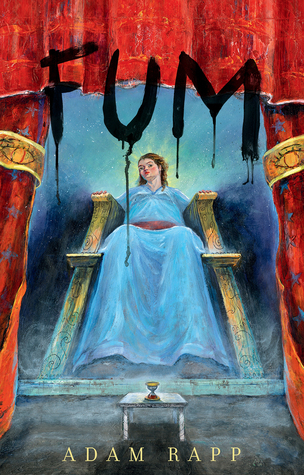
Turning Pages Reads: FUM, by ADAM RAPP

Welcome to another session of Turning Pages!

NB: This is not going to be the average review; I finished this novel despite my better judgment, hoping for some twist in the narrative that I wasn't expecting, to make it work. I picked it up this book because of the title... and the fact that on the cover is a female. In fairytales, all the giants are male, and we have very few newer characterizations of tall girls in young adult literature, though the too-tall girl at the school dance was an ongoing trope for a lot of the earlier years of young adult lit. As this book was listed under fantasy, I thought it would be more of a fairytale. Last warning: It's not.

Synopsis: After a pituitary tumor changes her body at age eleven, Corinthia Bledsoe emerges as 7'4" and 287 pounds. She uses a special desk, and a special toilet, because she's broken two. Her vision of a terrible triumvirate of tornadoes - and her subsequent loud, panicked warning of the entire school - is treated as some kind of violent dysfunction worthy of her being tackled by grown men, one of whom fantasizes as he does so about her bodily strength, and the kind of impact that she'd have on the gridiron. While Corinthia is already famous for her size and special-built desk, and for having a custom-built bathroom on campus, having broken two toilets since freshman year, she becomes terrifyingly infamous when the tornadoes come.

The story spins between Corintha's increasingly disturbing relationship to the school and community to the tale of Billy Ball, who, struggling with gastrointestinal problems and reeling from the death of his father, is enacting unexplained racist cliché "red face" rituals and obsessing on Native Americans. Not fitting in at the same school, he comes up with a list of students and faculty with whom his path has crossed, and seems to be preparing himself for violence. He seems vaguely aware of Corinthia, but they only meet once, and it doesn't propel the narrative in any direction. The third subplot returns to the Bledsoe household, and to a closer focus on Corintha's mother, who believes herself to be somehow tragically martyred for being Corintha's mother, and whose adult desires seem to be more important to her than her children's struggles.

Despite being a junior, Corinthia doesn't seem to have much of a view of the future, something which her ineffectual guidance counselor tries to elicit from her constantly, though her good-natured father seems prepared to accept whatever she'd like to do. Instead of a future, Corintha is mired in the present, as her brother disappears, and her mother goes into crisis. In possibly the oddest story thread in the entire book, Corinthia takes a road trip with one of the workmen fixing the school post-tornado, a man called Lavert. Corinthia's friendship with him, a grown man with a criminal past, and her understanding of his mortality is definitely unexpected, and strains the credulity of the reader past bearing.

Observations: Grotesquerie is a 20th century literary convention which, according to Wikipedia, can be linked with sci-fi and horror. For me, this novel falls squarely under grotesquerie, simply because Adam Rapp seems to be thoroughly disgusted with everyone in the entire book, and in his disgust, renders them... disgusting. From the names of the characters and their ill-fitting, cacophonous names to the description of Corinthia herself beginning from page one - "woodsplitter's hands," and the "great caves of her nostrils." Descriptions of her menstruation and nosebleeds, and comparisons between the two are a lovingly-depicted gross-fest.

The narrative never takes off, as it is heavily weighted with an abundance of cloying description, producing a plodding plot in a claustrophobic storyline which draws in the unsuspecting reader with the idea of a real giantess and instead confronts them with body dysphoria juxtaposed with an awkwardness masquerading as intimacy. No one seems to grow or change; the bizarre incidents simply crowd together, threaded with domino-sized teeth and Together, this creates one of the most unkind and body-averse narratives I've ever read, and an alleged YA book which focuses less on the young adult, her challenges and changes than on her body, and the bodies of everyone around her.

The body-consciousness remains central to the novel. At 287 pounds, Corinthia is said to be pretty, but every other word out of the narrative disregards that, and paints her as disgusting and vile. She's said to be third in her class - but every other description has her acting in bizarre and outlandish ways designed to repel the reader. Finally, Corinthia is alleged to have destroyed two toilets, once emerging covered in toilet water and swamping the girl's restroom...which is ...ludicrous, ignorant, and insulting.

FACT: People heavier than 287 use toilets on the daily. FACT: Nothing happens. Toilets - regular old public restroom toilets, and certainly the floor-mounted, vitreous china sort used in public schools - are rated to bear the weight of a THOUSAND vertical pounds, and yes, I am the big nerd who looked that up, but this jarring falsehood stands out. 287 pounds is just a number, and anyone who weighs that is just - still - a person. These scenes felt like a badly set-up, dehumanizing fat joke rather than a story detail filling in the blanks about who Corinthia is and what she's about. Kids in high school are this weight on a regular basis, and stand to be hurt and insulted by this abhorrent characterization. Reader beware.

Corinthia - her family - her school - basically her entire corner of the State seems very white... yet the teens in the story are obsessed with people of color, to very significant degrees. Billy puts arrows in his hair and paints some racist cliche of warrior marks on his face. As her family dissolves, Corinthia begins to pal around with a grown man who is also a face-tatted, do-rag wearing cliché of a prison-release workman who, early in their relationship, refers to himself as "nigga"... For a novel which, up to that point, had displayed a casual lack of empathy for any of its characters, this white-guy-included racism wasn't entirely surprising, but still reveals very poor taste.

Conclusion: I normally consider it a waste of time to review a novel which I vehemently dislike, but I made an exception for this because I walked into it unaware of its topic, or of any reputation with regard to its author. I won't make the same mistake again. While some will assign this novel as an example of satire, or may find within it deep literary meaning, or even feel that it is merely misplaced in terms of audience, and would crossover well with adults, for me, there is too much left unexplained, and what may have been a brilliant venture does not pan out in its execution. My main thought is that it is disturbing, written with a specific distaste and aversion for the body, doesn't have a discernible story arc, and is not especially respectful of the challenges and changes of adolescents, especially female adolescents. With its comparisons to people as animals and its basic disrespect for the teen body or mind, this novel seems to be an experiment with a broad scope which failed.


I received my copy of this book courtesy of the publisher. After March 20, you can find FUM by Adam Rapp at an online e-tailer, or at a real life, independent bookstore near you!

February 27, 2018

Turning Pages Reads: THE RADICAL ELEMENT, edited by JESSICA SPOTSWOOD

Welcome to another session of Turning Pages!

Synopsis: Women who persist aren't a recent innovation. A history of intolerance, which led to insistent female resistance is not an uniquely American story, but one which nonetheless has heralded seismic shifts within our national history. After the success of A TYRANNY OF PETTICOATS, editor Jessica Spotswood brings together twelve new tales of women who were upstarts and outsiders. From the 1830's through the 1980's, these stories, some based on actual events, others fictionalized accounts of historical periods, regale readers with young women who stood up and out as radically different, and in doing so, changed the way the world related to them. Contributors to this collection include young adult authors Jessica Spotswood, who also edited; Dahlia Adler, Mackenzi Lee, Erin Bowman, Megan Shepherd, Anne-Marie McLemore, Marieke Nijkamp, Dhonielle Clayton, Sarvenaz Tash, Stacey Lee, Meg Medina, and Sara Farizan.

Observations: Claiming an identity -- stepping outside of the role and voice assigned -- can be uncomfortable and awkward, intimidating, to downright dangerous and life-threatening. Without a clear idea of how things will end, each of the young women depicted in these stories sets out on a personal journey -- whether its to use her brown hands in the service of her country, when only paler hands are sought, or to make her escape from abuse, or to take her chances in a traditionally masculine world, playing a man's role. Readers will pause thoughtfully to discover these nuanced angles of history -- taking readers out of the realm of mere nostalgia into the realities of the difficulties and challenges of history through the voices of the traditionally excluded and silenced.

The women's outsider status is significant, as most of these voices are from women in the margins, due to issues of race, religion, sexuality, disability, gender, or professional desire. I appreciated the voices from early in our national history into more recent times. Some of my favorites were the story of the young Jewess, longs to study the Torah, and the Mormon girl who tries to find ties between her new country, and her faith. A Latina drains herself of pigment with the family's magic to bleach herself into the faded shades acceptable for silent films, while brilliant and neurodivergent young woman keenly watches court proceedings to determine the reproductive rights of the mentally unfit. Elsewhere, a half-Japanese girl braves 1950's xenophobia to compete to be the next Miss Sugar, while a young Cuban dons her first pair of go-go boots. The perspectives are fresh, the stories are original, and the anthology is a joy to read.

Conclusion: If you're not a short story aficionado, I think there's still plenty in this novel which will appeal. There's room to read and hop around, and then return to longer stories from time periods which you may not believe will hold your interest. You will be surprised!

In the editor's note, Spotswood outlines the purpose of this collection, and her wish that readers will be able to find themselves within these pages. Even as not a particularly radical individual, I found myself in the bravery and dauntlessness of these heroines, and I believe this book will work well for older middle graders, young adults, and adult readers.


I received my copy of this book courtesy of NetGalley. After March 13, 2018, you'll find THE RADICAL ELEMENT edited by Jessica Spotswood at an online e-tailer, or at a real life, independent bookstore near you!

February 23, 2018

Turning Pages Reads: THE RULES AND REGULATIONS FOR MEDIATING MYTHS AND MAGIC by F.T. LUKENS

Welcome to another session of Turning Pages!

Synopsis: Hungry to inhabit his true self, Bridger Whitt will do anything to find a job to help him finance attending college out of state. He’s desperate enough to take a Craigslist interview with a weird entrance exam... no, a seriously weird entrance exam, as in, "Will you enter the office via the window?" He's determined enough to ignore any… little oddities about his magically-everywhere boss (exactly what was Pavel doing out at Lake Michigan when Bridger was there and just happened to be being drowned... by... Things with sharp teeth and cheerfully malicious expressions?!), and has almost entirely tuned out the disembodied voices he sometimes hears around the office. Despite discovering his boss’s true identity, regardless of learning that his crush, Leo, may actually crush on him right back, despite all signs lining up for a HEA, Bridger still can’t find a reason to stay home. After all, there’s nothing to do, and nowhere to grow in the provincial, conservative small town of Midden, Michigan. You can only discover what's real, if you go away and pursue it. Real life can only be magical elsewhere… right?

Observations: Truly, there's no place like home - and this novel brings that theme fresh life, by examining the presupposition that a.) our high school and college years are The Best Years of Our Lives (TM), and b.) that those Best Years can only happen well away from the familiar, known, and loved. This book talks about coming out and Becoming in a way which allows it to be a process that happens internally, and externally, with constant course corrections and revelations along the way. The romance, while not central to the plot, is just squeezable.

However swoon-worthy the romance is, however, what I most appreciate is how much this is a family story. In the best and most inclusive, expansive of ways, F.T. Lukens reminds us that family CAN mean a long-suffering mother who works her butt off for you, and is hopeful she's making up for you not having a Dad, but also it can additionally mean a tough-as-nails Harriet-the-Spy type who loves you, spies on you, then kicks your butt for keeping secrets - like the sister you never knew you needed, a boss and a mentor who both challenges you to rise up, but holds you as you fall apart, and pixies who cheer for you in tiny, tinny, high-pitched, annoying voices, but come on, at least they're not laughing while unicorns try to kill you this week. Or, whatever.

With endless dry humor and plenty of quirky charm, this book never tries too hard, or goes for the easy laugh. It removes itself from some of the stereotype of YA lit with a tight, loving relationship between teen and parent, and allows older people and younger people the respectful, reliant relationships they sometimes have in real life. And the humor just gives the difficulties and subtleties Bridger has while navigating the real world even more life. There's magic. There's mythos. There's a really cranky Sasquatch. While the novel is YA in spirit, it also crosses over for to be enjoyable for other ages, and could be appropriate for adults through older middle grade. While Bridger is definitely moving along toward adulthood - but this doesn't mean he's making all adult decisions - definitely not in the thriving metropolis that is... Midden(and I can't even tell you how much I love that name).

Conclusion:F.T. Lukens brings a joyfully charming innocence into this endearing adventure of a snarky, fearful boy who thinks he is fleeing toward the big, real world — when THE RULES AND REGULATIONS FOR MEDIATING MYTHS & MAGIC reveal that there is more wonder, magic, love, — and terrifying unicorns — in the known world he knows than he could have ever imagined. While I try to review without bias, this was one of my all-time FAVORITE Cybils books of 2018, I have zero chill discussing it, and I want you to read it, too.


I received my copy of this book courtesy of Duet Books, for the Cybils Awards, for which this book was a finalist. You can find THE RULES AND REGULATIONS FOR MEDIATING MYTHS AND MAGIC by F.T. Lukens at an online e-tailer, or at a real life, independent bookstore near you!

December 19, 2017

Cybils SpecFic Bookmark: IN 27 DAYS by ALLISON GERVAIS

The Cybils Countdown Continues!

The Cybils SpecFic Bookmark: As a panelist for Cybils YA Speculative Fiction, Round 1, I'm going to be briefly writing up some of the hundreds of book I read as part of the award. As panelist conclusions are not for public consumption, the purpose of these write-ups is to keep track of what I'm reading, and will mostly touch on plot synopsis, with minimal comments on thematic tropes.


Synopsis: One melancholy feeling day, Hadley Jamison arrives at school to hear that a boy she'd been in Freshman English with has committed suicide. The feeling of melancholy she feels quickly swells to true grief. She hadn't spoken with Asher Morales in years. Really, she only stared at him in Freshman English and blushed a lot... but it seems wrong that he's dead, wrong that someone who had such obvious depths - even if he never spoke to her to share them with her - could have thought his life wasn't worth living. Seeking closure, Hadley lurks at the back of the church where his funeral service is being held. She lingers at his casket, wondering what she could have said to change things. She meets his family, and, on the way home, is accosted by the most terrifying man she's ever seen. Parchment white skin, knife-edged cheekbones, and the most insinuating smile. He takes her to coffee, and she's powerless to escape him. He has a proposition for her - a little job he'd like her to do. If she'll just sign a contract to help out, he'll drop her back twenty-seven days in time. She'll have a chance to save Archer, and right a little wrong in the Universe.

The guy says some vague things about danger and trouble, but Hadley's only hearing that there's a chance to bring Asher back to his family. Her parents are on yet another business trip, and the last person she talks to every night is the doorman. What else does she have to do with the next month, anyway?

But Asher is not easy. He's rude. He's abrupt. He's closed off and cold. Hadley's doing everything she can to get close to him, but if someone doesn't want you as a friend, you won't be friends. Is it worth it to keep trying? Is it worth caring for someone who doesn't care for you, especially if it looks like it might cost you your life?

Semi-Spoiler-y Observations: Originally published on WattPad, this is a fast-paced, emotionally engaging adventure which leaves the reader little time to do anything but hang onto their hat and be dragged into the narrative. A dominant culture girl with a cast of mostly white friends (Asher is Italian) Hadley is a very regular, ordinary girl who is suddenly thrust into a cosmic tug of war essentially between death and chaos. While she is chosen to take a stand against chaos, I found myself with a tiny question of "Why?" I kind of wished for a little bit of ...mystery or backstory to give her character some depth. Her parents are workaholics with money and impeccable tastes, but how did the Universe know that Hadley was worthy of taking on this huge task? Does this second chance business happen for anyone else?

Most people won't worry with nagging questions like this one, however, and will race into the story. As an adventure, giving a human being the power to fight on the side of life, it is compulsively readable.

Conclusion: For anyone who has wished that they could have a second chance to make things right, this story will be the best of wish-fulfillment catnip. A slow burn romance, a boisterous Italian family, and a chance to tally one up for the side of good vs. evil makes this a light, fun, vacation read.


I received my copy of this book courtesy of the publisher. You can find IN 27 DAYS by Allison Gervais at an online e-tailer, or at a real life, independent bookstore near you!

December 15, 2017

Cybils SpecFic Bookmark: SHE MYSELF AND I by EMMA YOUNG

The Cybils Countdown Continues!

The Cybils SpecFic Bookmark: As a panelist for Cybils YA Speculative Fiction, Round 1, I'm going to be briefly writing up some of the hundreds of book I read as part of the award. As panelist conclusions are not for public consumption, the purpose of these write-ups is to keep track of what I'm reading, and will mostly touch on plot synopsis, with minimal spoiler-y comments and thematic tropes.


Synopsis: Rosa is young, British, and has had a debilitating nerve disease which has taken her freedom. Quadriplegic and feeling like a burden on her family, she is eager and excited when a controversial "cure" emerges - the chance to swap her brain into the whole and healthy body of a comatose American girl named Sylvia who was also white and young. The family flies to America, and the surgery is done... but Rosa's doubts begin. Is she still... herself? Is she now someone else, too? Is she also carrying Sylvia's soul? Is it fair to go on if Sylvia - whom Rosa is now convinced is a resident somehow in her body - is unhappy? An unhealthy obsession with Sylvia begins, as Rosa researches her, stalks her family, and eventually attempts to insert herself into the life of the girl who is gone. With the help of a journalist with whom she becomes entangled, Rosa escapes from the medical facility where she's meant to be healing, and walks away from her own life to immerse herself in Sylvia's - hurting her own family, and ultimately herself. As she struggles to come to grips with who she is now, and who she's supposed to be, now that she's inhabiting Sylvia's body, Rosa falls in love and finds that the questions she had matter less than living her very best life, and being happy.

Observations: Speculative fiction has been debating the merits and demerits of brain swaps since the first very amusing black and white science fiction films. It's one of the last Big Questions about consciousness and the soul and the "you-ness" of a person. Rosa feels a lot of guilt after the surgery - guilty for being excited that she's attractive, guilty that she is attractive to others, guilty that she is just who she is, and not someone better or more deserving. She is conflicted and spends a lot of time in her head, coming to various conclusions about whether or not Sylvia is a reluctant rider in their shared body, or if Sylvia should take over and Rose should step back. She had a lot of questions, and I was dissatisfied with the conclusions Rosa came to, because she was derailed by her romance. Rosa watches a movie with a friend about a man who chooses to die rather than live with a disability... and especially since Rosa has lived with a disability, one that had really hit her from the ages of ten to eighteen, that seemed an odd choice, and I expected her to react differently to the film.

The author doesn't give us much information about Rosa's disease or the nature of its progression, or enough backstory to help us understand what what her life was really like, before having her brain swapped. Rosa's disability is framed against her parent's anxieties and her concern with not being a burden to them, but that tells us nothing about how she lived and what she did - which argues that the life of a quadriplegic person is of so little interest that the reader wouldn't have wanted to know anything about it. Which isn't true. This was one of the biggest quibbles I had with the novel.

Conclusion: An interesting and time-honored concept in speculative fiction, the brain swap remains one of the last bits of "undiscovered country" in our physiology. Rosa deals with questions and worries to that many a teen will relate. The idea of turning into a whole new person with a whole new brain, and finding a whole new attractiveness and a lightning fast romance will also resonate with many in an entertaining way - but readers seeking something with a deeper and more realistic look at disability might look to Sharon Draper's OUT OF MY MIND or Chelsie Hill's PUSH GIRL for more.


I received my copy of this book courtesy of the publisher. You can find SHE MYSELF AND I by Emma Young at an online e-tailer, or at a real life, independent bookstore near you!

December 12, 2017

Cybils SpecFic Bookmark: BROKEN CIRCLE by J.L. POWERS & M.A. POWERS

Happy December! The Cybils Countdown Continues!

The Cybils SpecFic Bookmark: As a panelist for Cybils YA Speculative Fiction, Round 1, I'm going to be briefly writing up some of the hundreds of book I read as part of the award. As panelist conclusions are not for public consumption, the purpose of these write-ups is to keep track of what I'm reading, and will mostly touch on plot synopsis, with minimal comments on thematic tropes.


Synopsis: Adam just wishes he could sleep. That's what normal people do: see their fathers. Sleep. Go to school. Talk to people they might kind of crush on. Normal would be great, but it's just not in the cards. First, Adam's mother vanished when he was four, and his dad is always gone, and never around when he needs him... except Adam sometimes sees him in his dreams. Adam instead lives with his cranky, paranoid grandfather, who believes everyone is out to get him. Adam's next challenge is that he can see... shadows on people. He knows when they're going to die, and no matter what he does to try and tell them... they die anyway, even if he's changed their path. Finally, speaking of dreams, there's this kind of... monster who basically hugs him to death when he dreams, and then he wakes when his dream-Dad saves him. Lacking sleep and overdosed on coffee, Adam fights monsters in a waking dream at school one day. Unfortunately, he wakes up with everyone believing he's had a nasty psychotic break. In the name of getting him "help," his father enrolls him in a residential school... which isn't for kids with psychiatric problems at all. It's for kids with the power to be soul guides. Adam finds opening to him a world he could never have imagined in his deepest, scariest dreams. He finds a place to belong, which surprises him, and feeds his soul. He also finds out about his mother - who disappeared in mysterious circumstances - and the whys and wherefores of his parents' relationship. He also finds himself going up against a shadowy organization which is bent on destroying him, and maybe his school, too. Adam's going to need to accept a few key things before he can move his story further - and unravel the unknowns between him and his goal of being normal... well, as normal as a guy who can drop into Limbo can be.

Observations: In many ways this story is familiar - there have been myriad other Secret Identity novels in which the Lost Prince or Boy Who Lived is unaware of a birthright world just on the other side of a bland retaining wall. He twists in the wind in a world where he doesn't belong until, voila, the hidden door opens, the wall vanishes, and the world, with its thousand shades of gray, opens. Nothing is pure good or pure bad anymore, the character stumbles and drifts until he meets a band of plucky outliers, and together they navigate this new plane. There are PLENTY of Potter elements in this book, but it is not about the new-things-per-page lovely whimsy which drive the earliest Potter novels. This book is dark and grim and Adam's existence is both snarkily amusing and realistically painful. While there have been other YA novels riffing on the idea of the Grim Reaper, and while the cover with the elegant scythe on it is a dead giveaway of some of the narrative elements, there is a lot of difference here to be discovered. Readers will rejoice in the brother-and-sister team's worldbuilding, which is rich and detailed, and while the twists in this book are mostly known before the character knows them, the characterization and remix of mythology will keep readers reading. Adam's self-effacing, sarcastic voice will work well for many readers.

Conclusion: Come for the sarcasm and the familiarity, stay for the unknown and the yet undiscovered! While this book wrapped up nicely in an "episode" fashion, there are some unanswered questions which leave room for a sequel - stay tuned.

"The Powerses' worldbuilding and writing will keep [readers] hooked. They will find themselves questioning what is fact and what is fiction and cheering Adam on as he journeys in this new, strange world. A gripping, philosophical paranormal thriller." --Kirkus Reviews


I received my copy of this book courtesy of the publisher. You can find BROKEN CIRCLE by J.L & M.A. POWERS at an online e-tailer, or at a real life, independent bookstore near you!

December 05, 2017

Cybils SpecFic Bookmark: THE MARROW THIEVES by CHERIE DIMALINE

Happy December! The Cybils Countdown Continues!

The Cybils SpecFic Bookmark: As a panelist for Cybils YA Speculative Fiction, Round 1, I'm going to be briefly writing up some of the hundreds of book I read as part of the award. As panelist conclusions are not for public consumption, the purpose of these write-ups is to keep track of what I'm reading, and will mostly touch on plot synopsis, with minimal comments on thematic tropes.


Synopsis: After the Melt, nothing is the same as it was, though Frenchie has heard stories. Epidemic disease, flooding, earthquakes and other disasters rage and the natural world is wildly out of balance. And then, the madness takes hold, as people lose the capacity to dream. In tribal communities, whispers of "Recruiters" surface. It seems that, together with the Church, the world has discovered a cure for the hopelessness and madness, and a way to save themselves. As always, this salvation comes through the blood of sacrifice - but only the sacrifice of some. The indigenous people in North America have not been touched by the chaos in the larger world. Their communities remain ...sane, and in the marrow of the indigenous peoples has been discovered to be a cure. "Recruited" into "helping" to save the world, indigenous people are being forced into residential housing and robbed of their bone marrow. It saves those unable to dream - and decimates the tribal populations.

With his father gone, his mother abandoning him and his brother lost to him, Frenchie at sixteen is shattered, heartsick, desperate and ill. Feverish and self-destructing, he stumbles on two other Elders and a passel of little kids also seeking their loved ones and trying to make some sort of a family and a home on the run. Wary and hopeful, he falls in with their pack, and begins to lose his heart to this band of survivors - and to make room in his heart for real love. Survival, however, can wear a person to the bone, and then disaster, which is always so close, strikes. In their quest to regain what they've lost, Frenchie and his team find what they weren't expecting -- in loss, promise, in conviction, re-connection. Through disaster and rebuilding, they learn that the things we love we truly never let go.

Observations: Every time I hear people telling me that post-apocalyptic fiction or dystopia is dead, I find a book in which there is a new and clever way of fleshing out what could be a stale and weary literary device. The author doesn't just plug North American indigenous tribes into a trite formula, however, but deeply weaves truth and metaphor into a conflicting and revealing story.

That the world ends badly and everything goes to hell is, of course, the basis of a post-apocalyptic novel, but too often speculative fiction then retreats into a story of mostly white females escaping from zombies or something. I especially appreciated this book because a.) there is a family here, with the sacred love between siblings that allows them to sacrifice for each other, b.) the story has nonwhite allies who have put their sweat and blood into saving people, and thus does not further the white savior narrative, c.) there is love of all kinds, and in fact that love story rises above the darkness and desperation of familiar losses and desperation. The disaster-and-survival aspect of the post-apocalyptic narrative is another place where the book is different... despite the impacts of global warming, earthquakes, and floods, the survivors don't seem unable to face the task. Not that living rough as an 'Apocalyptic Boy Scout' is anything but wearying and at times, dangerous; not that people don't sometimes greet a bed in an abandoned hotel with the greatest of joy. It's that these characters have their Elders and stories of the past on which to draw courage and techniques to survive. They each take up their burden - with only minimal outbursts of the unfairness of it all - and they get on with their true task, which is to rescue their lost ones, and recover their families again.

Bone marrow is the spongy tissue inside our bones, which, in newborn babies, produces new marrow cells, or stem cells. By young adulthood, the marrow inside the bones of the hands, feet, arms, and legs stop producing new marrow cells, and active marrow remains only in the spine, hip and shoulder bones, ribs, breastbone, and skull. All bone marrow produces blood cells, called red blood cells, platelets, and white blood cells - the things which are key to life, growth, and our survival, by which we fight off disease. When the "Recruiters" come to steal the marrow from the indigenous people in the book, this echoes the metaphor of what was done in American and Canadian history to indigenous children in the Westernizing residential schools. In taking their freedom and their language, their cultural health was being stolen in return for emptiness and death.

Conclusion: There is an exquisitely painful irony in the idea that marrow is what cures society of its inability to dream, and that they are taking the marrow from the indigenous peoples in the story. Despite the metaphor and shifting layers of depth and meaning, this is still an active story with a heart - at turns grim and painful, brutal and inevitable, and in other moments, tender and careful, hopeful and beautiful. It is not a fast-paced adventure, and this is not a book you will be able to skim through and put away. It draws readers in and they may find they care deeply about the wisdom and sacrifice of Minerva; about Miig and the memories he holds around his neck, a pouch full of glass shards and lost hope; about Rose and her round cheeks and flinty will; about Frenchie, and his longing for something - safety, maybe, freedom, and hope. This book will likely resonate with readers who enjoyed Walter Dean Myers' post-apocalyptic novel ON A CLEAR DAY, Patrick Ness' THE KNIFE OF NEVER LETTING GO, Moira Young's BLOOD RED ROAD, or Ann Aguire's ENCLAVE series.


I received my copy of this book courtesy of the publisher. You can find THE MARROW THIEVES by Cherie Dimaline at an online e-tailer, or at a real life, independent bookstore near you!

December 01, 2017

Cybils SpecFic Bookmark: SONG OF THE CURRENT by SARAH TOLSCER

Happy December! The Cybils Countdown Continues!

The Cybils SpecFic Bookmark: As a panelist for Cybils YA Speculative Fiction, Round 1, I'm going to be briefly writing up some of the hundreds of book I read as part of the award. As panelist conclusions are not for public consumption, the purpose of these write-ups is to keep track of what I'm reading, and will mostly touch on plot synopsis, with minimal comments on thematic tropes.


Synopsis: The Oresteia are the river - they've never been anything or done anything but skim up and back, hauling and freight throughout Riverlands as is their fate, through the auspices of their god. A fair bit of smuggling happens up and down the river, too, but the god stays mum, the wherries are sturdy, and there's always extra space for whatever, right? It's a free and easy life, freight-hauling, smuggling, and knowing the other wherrying families moving through the waterways. Caro was sure this was her fate, too, but the god never speaks to her - she's of age and past it, but even though she trolls her fingers into the water and listens hard, she never...quite...hears. It is the private heartbreak of her life, to be calling and calling, and never answered. And then, on a day when too many other of the wherry families have lost their barges due to a terrifying act of piracy, Caro's father is arrested. Smuggling's the charge, but it's mainly for refusing to ferry goods for soldiers. What's IN that ridiculous crate, anyway? To spare his life and commute his sentence, Caro agrees to carry the box without her Da -- only to realize she's being pursued, first by a mysterious fast cutter, and then, by every two-bit pirate and murderous dog in Riverlands. The smooth-talking courier who claims to know everything is obviously not telling her the truth. If only Caro knew which way she was supposed to go!

Politics, treachery, and lies are also in the churning waves - as well as gods and monsters. As Caro immerses herself in the current, a steadying hand on the tiller, she has to navigate these waters safely, or more than just her life and her father's life will come to an end.

Observations: Readers who enjoy fast-paced adventures with a whiff of politics will like this one. There's no overwhelming feeling of danger, as the plot twists aren't hidden, but easily discerned. This reads more as a safe adventure, in which the reader can be carried along without anxiety, knowing that, even though there are a few unexpected splashes along the way, the river runs true.

The idea of gods and them speaking is not often encountered YA lit, and this book contains an interesting exploration of this. Many readers will find the idea of life-guaidance via water entity an intriguing one. Readers who enjoy books which tell a simple story, and reveal a simple truth may find themselves drawn to the characters in this novel. Mistaken - or hidden - identity is often a fun trope, and though the way in which it is used in this novel is as familiar as a song, and readers will likely see it coming, it is nonetheless still fun. Who we are, and where we belong is something which can be determined ONLY BY US, and many teen novels, with their emphasis on the herd's decisions or parental input, can miss this. As teens, we spend a lot of time hoping this is true, and not sure we believe it, but this novel verifies: there is a place for us, and only we can find it, defying what our mothers are, or what our fathers say, there is a way forward for just US... if we have the courage to take the wheel and sail that cutter into the sunset.

Conclusion:Readers who enjoyed girls-on-the-sea books like HEIDI HEILIG's THE GIRL FROM EVERYWHERE duology, or Emily Skrutske's ABYSS duo will enjoy this story of a lively sailor girl who wants to be the terror of the high seas... eventually. Once she figures out to whom she belongs, and where. There's a bit of sailing jargon, which might produce a learning curve, and there's tons of travel, but the book is supplied with a map, so the intrepid reader shouldn't lose their way.


I received my copy of this book courtesy of the public library. You can find SONG OF THE CURRENT by Sarah Tolscer at an online e-tailer, or at a real life, independent bookstore near you!

November 28, 2017

Cybils SpecFic Bookmark: JANE, UNLIMITED by Kristin Cashore

The Cybils Speculative Fiction Bookmark:

As a panelist for Cybils YA Speculative Fiction, Round 1, I'm going to be briefly writing up some of the hundreds of books I read as part of the award. As panelist conclusions are not for public consumption, the purpose of these write-ups is primarily to keep track of what I'm reading, and will mostly touch on plot synopsis, with minimal comments on thematic tropes.


Synopsis: Jane is unmoored within her own life. College doesn't suit, living with three grad students and working at a coffee shop is hideous. The world is unfair and awful, but it's what Jane has, after the death of her Aunt Magnolia. She longs for something nameless - and it walks into the coffee shop. Her old tutor, Kiran Thrash is rich, disaffected, and deeply unhappy. She doesn't understand Jane's staying in her world, going in circles, when she could come home to the Thrash family mansion to be unhappy with an old friend. So Jane packs up her possession, including her trunks of umbrellas, which she makes as ongoing art projects, and goes away with Kiran, to Tu Reviens, the island mansion her aunt told her to visit if she ever got an invitation. After months of directionless wandering, at least Jane has this.

Or, so she thinks. There's something SUPER weird going on at Kiran's. First, Kiran's stepmother has just vanished - entirely. No one knows where she's gone. Second, while there's a gala happening in a few days, and there are tons of people there, there is more than just party-prep going on as rafts of people wander in and out. Some of them seem to disappear in hallways or in the library, others of them seem to have found a secret door - and was that a man with a gun!? The house either has a haunting spirit, or a baby somewhere, from the wailing in the walls. And there was this one little girl she saw, digging holes in the lawn. There's a rambunctious dog, a couple of wealthy ladies, and whole raft of bewildering servants - some of whom act a whole lot more like they own the house than that they work there - Kiran's boyfriend, and Kiran's very handsome brother, Ravi, who adores the priceless - odd, and sometimes tacky - art located throughout the mansion, and has just had his prized Vermeer stolen.

Jane should really just hang out with her lathe and saw and finish working on her precious projects. No artist in the world has it as good as she does, with the ability to just potter along and make art in this gorgeous, gorgeous place, surrounded by the sea, with amazing food to eat whenever she wants it, and a beautiful suite of rooms -- but Jane can't help her curiosity and her desire -- her need -- to figure out what's going on at Tu Reviens. As it turns out, the servants knew her aunt! Surely there's something of her left behind - more than just her photographs. Surely, someone can tell her something about the woman she adored, but discovers that she didn't fully understand. But, every bit of knowledge changes Jane - and every choice comes with a price. Leaping down the rabbit hole after any number of clues she doesn't understand could change Jane's story forever.

Observations: NB Readers who come to this book looking for a GRACELING or BITTERBLUE readalike will be disappointed, as it is not medieval-era fantasy, nor are there swords or kingdoms.

After the death of her parents, the discovery that college wasn't really a good fit, and then the death of her Aunt Magnolia, who has for so long been her touchstone, Jane doesn't have much control over the elements of her life. Going to Tu Reviens, to fulfill a quirky request from her aunt seems like a single direction that makes sense. At the house, there are either/or feelings too - Ivy or Ravi, upstairs or down, answering which call from whom first - all of these options are before her. The idea of divergent roads, multiple universes, retries and do-overs would seem, to her, deliciously compelling. Teen readers, too, who fear regret and making "wrong" choices will find these ideas appealing. What choice Jane ultimately makes - and where the book actually ends, is anyone's guess... and the reader's choice.

Conclusion: The charm of the mid-80's Choose Your Own Adventure craze was the power over a story, in which readers could, through a combination of skill, luck, intuition, or sheer randomness, power themselves through the life of the book, avoiding ignominious conclusions to emerge triumphant in a glittering heroic ending. Since real life doesn't work like that, the appeal of the books is easy to see. Cashore capitalizes on the idea of second chances and do-overs to make five weirdly compelling - and compellingly weird - branches from the spokes of her metaphorical literary umbrella. An intriguing puzzle box of a book, readers will come away thoughtful - and will likely read it again, to see what they missed.


I received my copy of this book courtesy of the public library. You can find JANE, UNLIMITED by Kristin Cashore at an online e-tailer, or at a real life, independent bookstore near you!

November 14, 2017

Cybils SpecFic Bookmark: THE EPIC CRUSH OF GENIE LO, by F.C. YEE

The Cybils Speculative Fiction Bookmark:

As a panelist for Cybils YA Speculative Fiction, Round 1, I'm going to be briefly writing up some of the hundreds of book I read as part of the award. As panelist conclusions are not for public consumption, the purpose of these write-ups is to keep track of what I'm reading, and will mostly touch on plot synopsis, with minimal comments on thematic tropes.


Synopsis: Eugenia "Genie" Lo - one of way too many Eugenias of her generation - has always been a bit of a firebrand. Unlike her fashionable friend Yunie - another Chinese Eugenia - Genie finds her center in her homework - which she does routinely, expertly and superbly - and in ignoring her mother's ranting, which she also does like a boss, because her mother is always screaming about something. A Bay Area kid living in the SiliValley, she also bitterly acknowledges that she's just like most of the hordes of teens living in the land asphalt, parking lots, bubble tea shops and strip mall nail salons: she's an education junkie. She's high-achieving. She's Asian. She's desperate to get out of the reach of her mother's voice, and into A Good School. Princeton, for preference, or even Harvard. So, when this weird new guy at school scopes her out and says, "You belong to me...?" Oh, nu-uh. Nope. Not in this lifetime. Genie Lo has way too many other plans - mainly to work on not being just like her father and to get the heck out of dodge.

But Quentin Sun - new guy - is not prepared to leave Genie alone, and soon, Genie realizes she needs him - and not just because he's ridiculously good looking. Quentin is all Genie has to teach her what she needs to know to save the world... and soon it's time to school herself on perfecting a whole new set of skills -- those of demon fighting. Genie's pretty sure she can't do it, but Quentin Sun is only an international transfer student in Earth's realm... in the Heavenly Realm of the Jade Emperor, he's the Monkey King, down to the love of peaches and the fuzzy tail. ...And Genie? Well, she's a reincarnated sidekick of his. Quentin's convinced that he and Genie's shared power will be enough to answer the rash of demon incursions on Earth - and into the Bay Area. They're terrifyingly strong and flesh-eating, and it's crucial Genie gets on board with the plan before more people - human people on the earth plane - are brutally murdered and eaten. But, what about being on track for an Ivy League? What about all of her plans? Right now, Genie's got a lot of studying to do - about everything, including the world as she once believed it to be - and there's not enough time...

Observations: Many YA readers were first introduced to this oldest and greatest of Chinese fables, the story of the Monkey King, in Gene Luen Yang's AMERICAN BORN CHINESE. The adventures of the Monkey King in that book are myriad and surreal. Author F.C. Yee renders these same surreal battles between "the good guys" and the demons through the eyes of one of the newest good guys - a sarcastic, short-tempered California teen who just wants to get on with things so she can polish up her college entry essays and go back to crushing her opponents on the volleyball court.

Readers seeking the trope of the "strong female character" will find a lot more than they bargained for here. Genie is strong both physically and mentally, and by meeting these characters from Chinese myth, she is learning to be strong spiritually. There is a lot of humor and snark which will appeal to many teens, and a lot of exploration of the various roles of Bodhisattva, gods, and monsters in the Buddhist pantheon, which also makes this an unique foray into the mythological and folktale history of Chinese literature.

Conclusion: This novel is written cinematically, in that readers may be able to envision each chapter as a television episode along the lines of THE MIDDLEMAN or a comic book. The colorful descriptions and sharp-edged snark combined with completely surreal demons and monsters make this a fast-paced, quick read which engages the attention and doesn't let it go.


I received my copy of this book courtesy of the public library. You can find THE EPIC CRUSH OF GENIE LO by F.C. Yee at an online e-tailer, or at a real life, independent bookstore near you!