July 15, 2016

Turning Pages Reads: IN THE FORESTS OF THE NIGHT, by Kersten Hamilton

Welcome to another session of Turning Pages!

Aquafortis got me thinking about comfort reads a few weeks ago. While I really started reading fiction mostly late in high school, I have some read-again books which resonate with me mostly because of their relative proximity to Narnia. One author with a key to the wardrobe is Kersten Hamilton, who was interviewed in 2008 at Cynsations, and whose book, TYGER, TYGER was a 2011 Cybils contender. A warmly written book about Teagan Wylltson, whose children's book illustrator mother and librarian father teach her to practice her Irish Catholic faith and care for those who need it - be they pets or people. The book goes unexpectedly sideways into the paranormal when a long lost "cousin" stays with the family, and Teagan finds out that the harrowing goblins from her mother's illustrations are... real. When myths are real and goblin nightmares come to life, only deep friendships, deep faith and strong hearts will get you through. Rereading TYGER, TYGER this week turned out to be exactly what I needed, and though I cried all the way through it - mostly at the poignant reminders of what stout-hearts do in times of trouble - I launched directly into the sequel. This might be a weird book to you for "comfort" but I grieve better with my boots on and a sword in hand, I think. And, so does Teagan.

Synopsis: Though she survived discovering how she and hers fit into the land of Mag Mell, that once mythical place of both the Green Man and the Dark Man, Teagan is far from resigned. She's had dreams and goals all of her life - she is going to Cornell. She is going to study animals. And no Dark Man nor his shadows, no Maggot Cats, no sluaghs and no gorgeous, heart-stealing saints are going to stand between this girl and her goals. But, it's not as easy to make the kinds of choices which keep Teagan on her path. She was born to be a Stormrider, born to shape the world to her liking, to bend to her will those inferior to her smarts. To stay on the path of rightness is a lot harder than she thought it would be -- and when things keep happening to her family and loved ones, it's almost impossible not to retaliate. Those who live by the sword die by the sword, and though Teagan is a Stormrider, she knows there's more to life than to just mindlessly ride the storm. If there's a way to heal Mag Mell, and to stop the rule of the Dark Man and to bring back peace and goodness, it needs to begin with her.

Observations: This isn't a good stand-alone novel, though there's a bit of backstory woven in to catch up those who haven't read the first book. But, oh, please do. It's all so much better then.

As always, I love the uses of literature in this book - having a librarian father means there's a lot of poetry read aloud and a lot of mythology and history; it's a treat. The prayers and the Irish blessings are also gorgeous and heartening. The writing is clear and the action is intense.

I suggested you read the first book, right? It's like reading The Lord of the Rings for the first time, mixed with Charles de Lint and set in a modern setting. I can't say enough good things. It's not a simple story, readers will have to read closely but this will do well with those accustomed to the ins and outs of old fairytales and Irish mythology, and those who like poetry -- and who have read Tolkien, of course. READ TOLKIEN, I said, not watched that trifling film.

Conclusion: While not as heart-stopping as the first in the series, this necessary second novel isn't just to impart information, but furthers Teagan's relationships and gives the side of Light a working team. The third book of the Goblin Wars was published in 2013 which means that yes, I am really late to the party on this, but I always prefer to read a series when it's finished - so I'm off...!


I received my copy of this book courtesy of my public library, on Overdrive. You can find IN THE FORESTS OF THE NIGHT by Kersten Hamilton at an online e-tailer, or at a real life, independent bookstore near you!

July 14, 2016

Thursday Review: SPARKERS by Eleanor Glewwe

Synopsis: With cover blurbs from the likes of Rachel Hartman, Margaret Peterson Haddix, Anne Ursu, and Ingrid Law, the MG fantasy Sparkers by Eleanor Glewwe should have caught my eye earlier. I met Eleanor at a conference this summer and I'm a little embarrassed to admit that it was the first time her book landed on my radar—in part because she lives in my home state but also because this book came out in 2014 and somehow didn't register. Better late than never! Not only do I get to plug a fellow diverse author, but I also get to spread the word about a promising, intriguing new fantasy series that will appeal to fans of books like The Magic Thief by Sarah Prineas and—yep, I'll say it—fans of Harry Potter.

Unlike in the Harry Potter world, though, in this one, it's the magicians who are in charge. Of EVERYONE. Sparkers—the colloquial term for halani, or people without magic—are the oppressed lower class in the city-state of Ashara. Kasiri—those with magic—run the government, have the best jobs, go to the best schools, and have all the advantages. That is, until a mysterious disease called the dark eyes begins striking halani and kasiri alike.

Marah, the narrator, is a bright student, a talented musician, a budding linguist…and a halani, in a society that's been structured to keep her in her place. Then, a random encounter with a little kasiri girl in the marketplace leads to a new friendship with the girl's older brother, Azariah, who is Marah's age—fourteen. He, too, is interested in books and languages, even long-dead ones, and he has more books than Marah could ever imagine having. One evening, poring over one of those books, they find something amazing: something that might help them figure out how to combat the dark eyes. As the people they love begin to fall ill and die—including Marah's deaf brother Caleb and Azariah's little sister—Marah and Azariah pursue their secret cure and end up discovering shocking secrets about their magical society…

Observations: This book has such an intriguing setting. Even if I hadn't known from the jacket bio that the author herself is a linguistics student, I might have guessed from the loving attention given to the language and culture aspects of world building. Linguists and those familiar with the cultures of the Middle East will recognize Hebrew and Arabic names, and sense the echoes of the uneasy coexistence of Arabs and Jews in places like Jerusalem. There are also echoes of the long history of religious texts and music and rituals and mysticism that seem to imbue the spiritual life of the Old World.

At the same time, it didn't seem that the kasiri and halani were meant to represent specific ethnic or religious groups, which to me was a positive. The dynamics in the book didn't, in other words, seem like stand-ins for real-life sectarian conflicts. For me, rather, this type of recognition subconsciously informed my mental image of the setting and characters. And it also helped create a very rich and well-developed world with a clear identity and history.

The intellectual bent of the characters was very appealing here, too—music and language are an important part of character as well as plot in this book. This makes it doubly interesting that Marah's younger brother Caleb is deaf. Music is such a huge part of Marah's life, and so is language, but his deafness is not an impediment to her sharing those things with him. They communicate through signs, and together with their mother, they are a close and loving family.

Conclusion: This was a unique story set in a complex and vivid world, with intriguing magic and recognizable, thought-provoking themes of class conflict and social change. Glewwe's next book, Wildings, comes out in November and I will definitely be looking for it.


I purchased my copy of this book at the Mixed Remixed Fest. You can find SPARKERS by Eleanor Glewwe at an online e-tailer, or at a real life, independent bookstore near you!

July 12, 2016

WRITER'S RITES: Creatives in a Vicious World

Did you catch this year's Newbery winner on NPR the other day? Kwame Alexander was reflecting on the recent police violence in the U.S., and what that meant for him as a writer for children.

"...Does it mean I'm oblivious to what's going on in the world? No. I choose to write for children. I like to make this remark, the snide remark that I've given up on the adults. And it's a half-truth. But the real truth is I really want to focus on the children. I believe strongly that the mind of an adult begins in the imagination of a child."


I suspect various news organizations, etc., are seeking comment from writers of color, and I'm glad Kwame Alexander is a writer with words of intelligence ... because Lord knows, nobody should be asking me. I have totally given up on adults, a long time ago. I've been grateful to be taking a breather (the second or third one this year) from social media, because I feel like all my words have been used up and the prospect of shrieking until I collapse in hoarse sobs is very, very real. I've even been calling in... absent-and-pretty-sick-of-my-life on my novel, because in many ways, writing feels deeply trivial. Fictional little stories, deeply unimportant. Anything I have to say, utterly frivolous. And yet. There is Pokemon. There is the inner life of pets. The sun rises, and tweens and kids keep being kids and tweens, even when the world is crumbling, and they need appropriate behavior modeled. People still need lunch and shoes tied and to have clean laundry. People have to keep going - it's just a thing we do.

We talk a lot about the subject of self-care when national disasters come. Writers - who are at times introverted, sensitive and emotionally reliant on words-on-paper to express themselves - writers especially need to take a break, to move away from media and social media, to have those all-important offline, IRL conversations which do not come with autoplay video of atrocities. Please remember to do things like take a walk and drink water and eat something other than what you can eat with one hand while you're glued to the news -- possibly eat something raw or fresh, which has a sharp and brilliant flavor which reminds you that it is summer, a time you once dreamed of and longed for during all the months of school. Remembering who you were before this past month - that's important.

So, too, are the other things that support mental health -- things like candlelight, porch lights, and most of all, stories. What are the stories that you tell yourself to get through a difficult time? What are the flashlights you use to keep a light on the dark and scary business going on under the bed?

I've read more blog posts about baking and cooking these past couple of weeks - and it reminded me of how much Food Network I watched in September, 2001. People are sharing about favorite podcasts. Sarah blogged the other week about comfort reading - reading those old books that you utterly adored like LM Montgomery's The Blue Castle or Robin McKinley's Sunshine or Shadows or, if you need to know how to be armed to fight the goblins which have suddenly appeared Tyger, Tyger by Kerstan Hamilton, or all my Tiffany Aching books by Terry Pratchett. Additionally, there's romance - stories with a guaranteed Happily Ever After can be comforting, if they let you into another world. I've been reading a lot of pointlessly amusing stories about weredragons. While I hate in-person shopping and want to kill it with fire, I'll go online and put a lot of shoes into a cart that I won't buy. It's oddly soothing, not spending money. Whatever you're doing, may it give you a font of ideas, and hope with wings.


WHEN

When the world is not so beautiful
the flowers waste water

the women can no longer find their song,
the children refuse to play

there are no men to teach to love
the ground inside collapses

the coldest winter screams
the summer burns red
the sea is full of blues
and the sky opens up,

at least I'll have poetry
- a gathering of words,
a get-together of emotions,
a font of ideas,
hope with wings.

- Kwame Alexander

Central California Driving 13

Taken with the phone in the car through a bug-smeared window, but ...a reminder: the sky is bigger than we are; the world is bigger than this moment.
Peace and good word-counts to you.

x-posted, in some vague fashion, at fiction, instead of lies

July 11, 2016

Monday Review: NEVER MISSING NEVER FOUND by Amanda Panitch

Synopsis: Suspense stories that deal with kidnapping and imprisonment (consider that your trigger warning) don't always put an equally weighty focus on the aftermath of the trauma. This particular thriller suspensefully covers both the dramatic events and what comes after in alternating parallel storylines. And, of course, "what comes after" includes even more suspense and drama.

In Never Missing Never Found, we are introduced to narrator Scarlett, who was kidnapped and spent four years imprisoned in a basement with another girl before she was found wandering the side of the road. Her family moved to another city, far away, and tried to recover. Now a teenager, she is working at a local amusement park and finally feeling like her life is more or less on track. All except for her younger sister Melody, who just never managed to warm up to Scarlett after her return.

And then…a co-worker from the amusement park goes missing, a girl named Monica. Another co-worker seems to know too much about Scarlett, things she's never told anyone here. The alternating past and present viewpoints add tension to an already gripping story without giving away too much at once, and the reader can only watch as Scarlett's past, inevitably, catches up with her.

Observations: The author uses an interesting structural device to reinforce one of the story's major themes: that we are the sum of the choices we make in life, that the results of those choices end up defining us in some fundamental way. Scarlett relates her story in terms of five critical choices she made along the way, from the day she was taken, on forward to the story being told in the "present." It's a device that could seem artificial, possibly, but it isn't overused here. Instead, these carefully chosen critical moments are fleshed out and developed so that we understand the narrator more and more along the way. Ultimately it all seems to unfold mostly organically. I did have a couple of moments where I was surprised by Scarlett's actions, and became skeptical, but all was explained in a rather nifty twist at the end.

Also, kudos to the author for having Latina main characters but having it not be a "thing." It's a part of their identity, but the story isn't about that. 

Conclusion: This is a good fast page turner for fans of suspense. I'll admit I wasn't sure about the plausibility aspects of some parts of the story, but I was able to suspend my disbelief and just enjoy the action and the psychological twists. It reminded me of the Joan Lowery Nixon/Lois Duncan brand of thriller—which I devoured as a teen. I'm sure I would have enjoyed this one as a young adult reader.


I received my copy of this book courtesy of my library's ebook collection. You can find NEVER MISSING NEVER FOUND by Amanda Panitch at an online e-tailer, or at a real life, independent bookstore near you!

July 07, 2016

A. Fortis and TS Davis in Revisionland

To be honest, one or both of us is always ALWAYS in Revisionland in some form or another. And when we're lost in Revisionland I tend to go back and re-run old installments of Toon Thursday to cheer myself up. So, I have one of those for you, but lo and behold, as I scoured our archives I also found some useful advice which I posted and should probably follow.

I also need to give myself a little encouragement to keep going and keep the energy flowing. Anyone out there have useful tips for when you know you need to tackle the rewrite but your own mean brain is trying to sabotage you? Writers, what are some of the ways you're nice to yourself when the job gets frustrating? What are some of the carrots you turn to when the stick's not working? Food bribery? Affirmations? Distractions?

Chime in in the comments below, and please to enjoy this oldie but goodie pie chart.


July 06, 2016

Turning Pages Reads: TELL THE WIND AND FIRE by SARAH REES BRENNAN

Welcome to another session of Turning Pages!

I tried very, very hard in high school English to read Dickens. I hated Dora. I loathed David. I wanted to smack Uriah Heep (but then, didn't everyone). I hated Our Mutual Friend. I had no luck with finding anything compatible in the voice, in the characterizations, nothing. And then I read A Tale of Two Cities.

It remains my favorite Dickens novel of all time; I was hooked, the moment I read those beautiful, lyrical words, was the best of times, it was the worst of times, it was the age of wisdom, it was the age of foolishness, it was the epoch of belief, it was the epoch of incredulity, it was the season of Light, it was the season of Darkness, it was the spring of hope, it was the winter of despair, we had everything before us, we had nothing before us, we were all going direct to Heaven, we were all going direct the other way – in short, the period was so far like the present period, that some of its noisiest authorities insisted on its being received, for good or for evil, in the superlative degree of comparison only.

I probably had to read that six times to get it. But then, I did. And I was in.

Suffice it to say, I was a little wary when I read that Sarah Rees Brennan did a modern version of my favorite Dickens novel... very wary indeed.

Synopsis: The Light part of the City is where the ones who practice Light magic live - it comes from the natural world. The Dark part of the City is walled - to keep the Dark magicians close, but not too close. The Light needs the Dark to survive - to drain the sediment of the Light from their blood, lest they die. But how disgusting, to take blood for a living, to drink it? There are too many of them, and their half of the city is squalid -- buried, is what they call living there. There's never enough food, and there is violence. But, they're a necessary evil, even the doppelgangers; the result of a Light spell to save the life of a Light magician. That illegal spell actually creates a Dark magician - one who wears the Light magician's face. They're hooded, collared, hidden. Another necessary evil -- hated, but needed.

Lucie Manette knows better than to say how she truly feels about the state of things in her world. She lives in the Light now, she's a Light magician, but she was born buried -- born in the Dark. Once, to save the life of one she loved, she made a spectacle of herself, a spectacle the Light was unable to ignore, and one that no one has ever forgotten. Lucie's a celebrity now, has a doting boyfriend of the ruling family, and knows that only her silent, smiling compliance saved her father's life, and keeps him - and the life she now lives - safe. Everything is in balance now; she can almost relax and believe in the loveliness that Ethan has brought to her world ... but one slip, one mistake, one wrong move, and suddenly, it's all up in smoke. Ethan has secrets, too -- secrets Lucie would never, ever have guessed. Heartbroken and in a rage, she sets before him the impossible task of making everything right again. But, nobody can. It seems that nothing can stop the revolution -- but Lucie has to stay one step ahead of the mob if she is to once again save her heart.

Observations: This was a hugely risky novel, but I feel like Sarah Rees Brennan was one of the few writers who could have pulled it off. As she says in her author's note, "Fantasy is a tool for talking about the real world," and this novel does indeed hold our gaze to a messed up, tragic world that is created and maintained by both hope and fear -- and cause us to ponder a better system that could make something of it.

A magical dystopia was the perfect setting for a novel the reader could view a little more dispassionately than something set in the now. And a dispassionate view is necessary, when reading both the Dickens and this modern retelling of A Tale of Two Cities. Knowing the history of the French Revolution you know -- spoiler alert - that blood will run in the streets. Some of the characters in the beginning of the novel will necessarily not be there by the end. Who, though? How can Lucie save anyone?

In the violent, angry, dark and breathtakingly cruel society which has spilled to both sides of this Dark/Light divided New York, what is WORTH saving? Like Dickens' classic, this book allows the reader to lose oneself in the story... and also in some pretty deep thinking.

Conclusion: A novel that has a lot in common with the Dickens it gives a hat tip to -- but will probably be a lot easier to read than the original novel for many teens. Difficult, complex and troubling, this is a story of lies and sacrifice, and when it's time to start lying about them.


I received my copy of this book courtesy of my public library. You can find TELL THE WIND AND FIRE by Sarah Rees Brennan at an online e-tailer, or at a real life, independent bookstore near you!

July 04, 2016

Reading In Tandem: THIS IS THE STORY OF YOU, by BETH KEPHART

It's July 4th! Maybe by now you're tired of sunshine, patriotic colors, smoke from the bbq or your neighbors, relatives, and friends, and would prefer to get back to your usual semi-monastic existence of reading and not speaking to people. At Wonderland, we are HERE for you.

Welcome to another edition of In Tandem, the read-and-review blog series where both A.F. and I give on-the-spot commentary as we read and blog a book together. (Feel free to guess which of us is the yellow owl and which of us is purple ...we're not telling!)

The School Library Journal says Beth Kephart's latest novel is a "beautifully written book [which] works on many levels and is rich in its characterization, emotion, language, and hint of mystery." Kirkus muses that it is "A masterful exploration of nature’s power to shake human foundations, literal and figurative." With plenty of stars and lots of kudos, Beth Kephart's books are well received by the literary community. However, as Tanita had never before read a Kephart novel (her primary preference for YA speculative fiction with ethnic/culturally diverse characters has caused her to miss Kephart's YA), it seemed a prime opportunity for an introduction. We read this book together, because too often blogging critique miss nuance and depth that we could gain from each other when discussing literature. As we explore Kephart's famously lyrical style, you're welcome to join our discussion. We are...

Two writers,
     & Two readers,
            Exploring one book...

In Tandem.

On Haven, a six-mile long, half-mile-wide stretch of barrier island, Mira Banul and her Year-Rounder friends have proudly risen to every challenge. But when a superstorm defies all predictions and devastates the island, when it strands Mira’s mother and brother on the mainland and upends all logic, nothing will ever be as it was. A stranger appears in the wreck of Mira’s home. A friend obsessed with vanishing is gone. As the mysteries deepen, Mira must find the strength to carry on—to somehow hold her memories in place while learning to trust a radically reinvented future.

Gripping and poetic, This Is the Story of You is about the beauty of nature and the power of family, about finding hope in the wake of tragedy and recovery in the face of overwhelming loss.


We found copies of this book courtesy of the public library, and our personal bought-it-myself libraries. You can find THIS IS THE STORY OF YOU by Beth Kephart at an online e-tailer, or at a real life, independent bookstore near you!

AF: Like our own Sara (Author Sara Lewis Holmes, peerless poet and member of our writing group), Beth Kephart has a wonderful, lyrical way with words that transforms even the most everyday of situations into something mystical--even a sleepy island beach town in the off-season is a place of tiny magics. Friend magic, family magic, and a life that is somehow everything a person needs, even with its downsides: absent fathers, a brother with an incurable genetic disorder, a high school class that consists of the same 14 people you've known forever.

tanita: Having gone to a very small school for ten years with the same people, all that time, I could imagine this little town of Haven... and Kephart does make it sound nice. Safe. Familiar. Unchanging, unchallenging. Like, a good place to... start a heroine's journey. You know when we talked about the "I Wish" song which shows up in so many Disney films, where is really the moment wherein you find what the character wants most? It's a little weird that... we kind of hit the beginning of the book, and I don't know what this character wants.

AF: Something interesting that struck me when reading the beginning of this story: we don't find out our narrator Mira's name until a few chapters in. It gives the reader an impression of "WE-ness" if that makes sense, emphasizing the importance of the community identity, the year-round islanders who are bound together by that identity. It makes the surprise of a brand-new person even more startling: the boy Shift, who shows up in Mira's class one day and captures the heart of her friend Eva.

tanita: Yeah, it's all totally "eddieandbill" and " bettyandisbel" before then, just a recitation of the known, and then suddenly... Shift. Last name? First name? Kingdom? Phylum? What? Maybe that's why Mira is so hard to figure; she's an "us," a "we," and not a "me." But then, suddenly... a name. Shift. And, boom, just like that: the careful lines of the set scene are messed up, the gun is lifted, and it'll go off any second.

It interested me that this novel is described as a mystery. I guess a disaster story is kind of a mystery, because the first thing people ask is, "What happened!?" But, it seemed more obvious here, first -- we know. There's foreshadowing, the whole story through: the teachers who give their students these open-ended assignments called "flows." The science course that's all about conservation, and what is leaving, what is already lost and gone. The jars and jars of ...sand, an element which metaphorically is always slipping away through hourglasses. Oh, and don't forget the cryptic utterances by wise old Shift, mysteriously dark-complected with light hair, in the way that so many mysterious peoples have (he could have had eerily light eyes, that would also have fit the mold). In many ways, this novel seemed more like... a play we already know. A series of scenes acted out with not-quite-real characters, standing in for metaphors.

AF: Yes. This story almost had the feel of magical realism, even though there wasn't anything specifically magical about it--it was more in the way the narrator looks at her life and the way she describes it. Like you said, the not-quite-real characters--they feel like archetypes, almost. Old Carmen, Deni, Eva. Their classmates, who are kind of a collective entity even with their small distinguishing features. The people who make Mira who she is as an individual, who lend her specificity--her mother Mickey, her brother Jasper Lee--are out of the picture for most of the story, though not out of her thoughts.

tanita: Archetypes, stock characters, and a lot of reverie... all of this truly gives the book an almost "Our Town" kind of feel... we're all standing next to the Stage Hand and Mira, watching the story play out, somewhat distantly. I'm intrigued by this. I find that I need to read a few more Kepharts and see if this is a common device of hers, or if she writes fiction which is more immediately accessible. Not that this is inaccessible but that distance... it puts quite a spin on the whole novel, and in a way, its mysterious, enigmatic tone could be a little limiting to some readers... Limiting, and yet, I'm not sure we should be looking for the "perfect" book anyway. Sometimes, you read the story and it percolates further in your brain because something about it leaves you... unfinished. Not as close as you wanted. Maybe this makes it "Literature."

AF: Hm. In the end I was left with so many questions, even though the final reveal dealt with a lot of the small mysteries that were raised throughout the story. I wanted more: and yet, real life doesn't always solve our mysteries for us, either. Things are left unknown, never-to-be-known, all the time. Life can be profoundly unsatisfactory in that way. We might find out the who, as in this story, but the how and the why are still up in the air. The puzzle might never be entirely put together; you might always be missing that one piece of the sky.

tanita: And on that deeply unsettling note, we conclude today's In Tandem. This was a really beautiful book, based loosely on the aftermath of Hurricane Sandy, a deeply unsettling event which irrevocably changed the coastlines and the lives of many on the Atlantic side of the country in 2012. With a certain stillness and fine nuance in the narrative, this book will best be appreciated by readers of poetry and plays, or those who have experienced something so big - like a natural disaster - that it's hard to articulate it.

Stay tuned for our next encounter with literature. Until then, have a splendid day doing exactly what makes you feel safest and happiest.


According to Wikipedia, Beth Kephart is an American author of non-fiction, poetry and young adult fiction for adults and teens. Kephart has written and published over ten books and has received several grants and awards for her writing. She is primarily known in adult fiction as a memoirist, and teaches workshops and classes for other adults - and teens - to learn to write non-fiction creatively. Kephart has created a detailed teacher's guide to go along with this book.

July 01, 2016

Turning Pages Reads: TWISTED by Hannah Jayne

Welcome to another session of Turning Pages!

Every adult summer of my life, I look back with disgust on the summers I squandered, wishing school would start again. Adult Me wishes I had endless days off to read basically non-improving books. We call them "beach reads" because they're quick and light, but that doesn't mean they have to be dumb - they're just an afternoon's entertainment. While normally you might not go seeking a book about, say, the child of a serial killer, that might be the type of book that distracts you in an airport, doctor's office, or keeps you awake on a lazy afternoon outdoors. Without giving away any spoilers, this novel has misdirection, emotional confusion and multiple good guys to confuse its mystery narrative.

It starts with a girl who's keeping secrets.

Synopsis: She's starting over. Pixie cutting and lightening her long brown hair. Ditching her old wardrobe for Basic Teen, Generic. Changing her name. Abandoned daughter of an alleged murderer Beth Anne Reimer is now Bex Andrews, in a new city, with new foster parents and a whole new outlook on life. No longer tainted by history in the city of Raleigh, four hours away in the quirkily named Kill Devil Hills, there is nothing dark, nothing bad, and nothing tragic haunting her. If Bex could just sort of ...tune in, and make sure her new foster parents like her, make certain that she plays her part, she'll begin to believe that everything might be really all right now.

And, contrary to Bex's expectations, everything's... fine. She makes friends, immediately - with cheerleaders, no less. A boy claims her from the herd, paying her special attention she's never received before. This is what everyone wants, right? Bex is now living the American Teen, Generic dream. But, it still doesn't feel right. Every shadow makes her jump, every unexpected touch launches her out of her seat. And then, a friend she's just barely made is murdered --

-- and everything dark and bad and haunting and tragic that Bex fears is back in her face, larger than life.

All she wants - desperately - is for the past to stay gone. But, if she's not exactly clear about the truth of the past, maybe she owes it to herself to find out what really happened back then, for real. Maybe then, she can lay her ghosts to rest, once and for all.

Observations: I picked this book up because too often in YA lit, adults are used as set pieces to be moved around the stage at the convenience of the main character. My parents, bless them, were NEVER convenient, and I wanted to read a book which depicted realistic adults. While this book makes an attempt to do that, showing the painful and often confusing journey Bex takes in dealing with her past, the novel relies heavily on no one ever talking to an adult like they're a real person to make the plot work, which didn't work for me.

Several spooky things happen - a back porch gift, which turns out to be tainted, a postcard, and a few other exchanges - and there's no follow up. No one talks to a policeman, a teacher, a school counselor, or each other, ever again about the cumulative body of evidence that SOMETHING is wrong. I recognize that these books are meant to be depicting teens, but as I often grouse, young doesn't mean stupid. Bex isn't swanning around, trying to play Nancy Drew, and while eventually she doesn't know whom she can trust, her friends at least should have had some questions about what they discovered -- questions which they should have asked insistently, until they got answers.

Conclusion: For the most part, entertaining with a bit of a thrill, this twisty mystery isn't a Whodunnit so much as a Who Do I Trust, which is more nerve wracking, in many ways. The ending is a bit rushed, but those seeking a soupcon of danger with a reassuring Happily Ever After will find that here.


I received my copy of this book courtesy of the publisher. And, after July 5, you can find TWISTED by Hannah Jayne at an online e-tailer, or at a real life, independent bookstore near you!

June 28, 2016

Guest Post: Elizabeth May On Writing Faeries and Creating Monsters


Today we are excited to host a guest post by the author of The Falconer Trilogy, Elizabeth May. We're concluding an action-packed blog tour schedule that includes the following:

Tuesday, 6/21/2016: The Reader's Antidote
Wednesday, 6/22/2016: Tales of the Ravenous Reader
Thursday, 6/23/2016: Once Upon a Twilight
Friday, 6/24/2016: Mundie Moms
Saturday, 6/25/2016: Fiction Fare
Sunday, 6/26/2016: Cracking the Cover
Monday, 6/27/2016: Stuck in YA Books

Without any further ado, here is Elizabeth's guest post shedding insight onto her inspiration and writing process when it comes to writing faeries and monsters...


All images are provided courtesy of
the publisher and author.
The fae are an incredible example of how beauty does not necessarily mean goodness. They’re romanticized due to their otherworldly good looks, and their sexual allure is, literally, written into their legends. But more than that, faeries are interesting to write about because their moral ambiguity is a feature of their mythology. They are quick to offend, and very, very quick to resort to punishment and murder.

In Katharine Briggs’s book The Vanishing People: Fairy Lore and Legends, which I used a great deal for researching my series, The Falconer Trilogy, she has an entire chapter devoted to the morality of fae. She concludes her analyses with a statement I kept turning over in my head as I wrote my books: “We are dealing with a pendulous people . . . whose mirth is often hollow and whose beauty is precarious and glamorous. From such no great compassion can be expected” (p. 161).

Briggs draws a comparison between faeries and humans being equally morally ambiguous, and this is an idea I kept coming back to: what would a human be like if they never aged, couldn’t die, and watched as other creatures lived and died and lived and died through the centuries? What kind of monster would that create?

A big part of The Falconer Trilogy is an exploration of what creates the conditions for monstrosity, and in what conditions they’re reversible. In The Falconer, Aileana slaughters faeries because she feels justified at first (one killed her mother; they also murder people), but realizes that in doing so, she’s become something of a monster herself. Her love interest, Kiaran, is a faery with a very awful past (revealed in The Vanishing Throne), who finds himself becoming more like a human as he begins to feel for her.

My trilogy is, at its heart, like any fairy story: monsters are neither inherently good nor bad; they’re created by circumstance.

The excerpt I’ve included here is from The Vanishing Throne, and it touches a bit on this. I hope you enjoy, and thank you for reading!

Xx Elizabeth May


Huge thanks to the author and her publisher, Chronicle Books, for putting together this blog tour! It was a privilege to catch a glimpse into another writer's process, and of course it's always fun to promote an enjoyable YA fantasy adventure series featuring a strong heroine.

Click on the respective links to read longer Scribd excerpts of The Falconer and The Vanishing Throne. 

Visit Elizabeth May online on Twitter, Instagram, Tumblr, and Facebook.

June 27, 2016

Monday Review: THE VANISHING THRONE by Elizabeth May


Synopsis: The first book in this trilogy, The Falconer (reviewed here), was one of those surprise reads for me—as a combination of historical fantasy, faeries, and a dash of steampunk and romance, I wasn't sure I would like it. I've read a lot of urban fantasy books over the years about faeries and I reached a saturation point a while back. But the unexpected setting of Victorian Scotland, surprising characters, and a healthy dose of action meant I enjoyed it much more than I expected to.

The Vanishing Throne is the sequel and Book 2 of the trilogy, and it continues where the first book left off. The malevolent fae named Lonnrach has narrator Aileana in his clutches, her Falconer fae-hunting powers neutralized and her body and soul under his control in the faerie realm. Rescued from this dark, harrowing, and gruesome torture, Aileana returns to her home of Edinburgh only to find that a horrible future has come to pass and everything she knows and remembers has been destroyed. She must ultimately team up with the few remaining humans and her fey allies in order to prevent Lonnrach from acquiring even more power and destroying what remains of her world.

Observations: As in Book 1, Aileana is an engaging, relatable, and empowering character. She makes a great heroine: she can wield a sword like a master, she creates nifty mechanical inventions, and, of course, she has a Dark Side. This is a very classically structured tale in that way. Aileana also comes with intriguing sidekicks: her training master Kiaran, a faery himself, with a vendetta against his own kind (and we find out exactly why in this book). And, of course, the pixie Derrick, who somehow manages to be both the angel and the devil on her shoulder at the same time, and wields a mean sewing needle. Derrick's wisecracks provide moments of levity in a story that is otherwise quite dark, and will probably appeal to fans of Melissa Marr and those who like tales of dark faerie doings.

However, where some books about malevolent faeries focus on the mental and psychological horror, this trilogy so far is more about action and adventure, and I've enjoyed that. Aileana is daring and swashbuckling, and the action in this book is pretty much nonstop, from her escape from the faery realm to cheating death to defending the human outpost. And don't forget the romance—through it all, Aileana's feelings about Kiaran inevitably continue to grow. The more they grow, and the more she learns about his dark past, the more complicated things get…

The only minor quibble I had with this book was the language. Admittedly I don't think this is something readers will take issue with or even think about, because contemporary-ish language in historical fantasy is something you see all over the place. Derrick's wisecracking sounds undeniably modern to my ears, and I found myself wanting a little more here and there to make the characters sound…more Scottish, I guess. More Victorian. But it wasn't anything that brought me out of the story for more than a moment here or there.

Conclusion: This reminds me of other urban fantasy reads where the faery realm is subject to its own political machinations and is using humans as its pawns, like Infinity Concerto by Greg Bear, or the many wonderful books by Charles de Lint. Fans of Victorian-era historical fantasy with a steampunk twist, like the Stoker and Holmes books, might also enjoy this one.


I received my copy of this book courtesy of the publisher, Chronicle Books. You can find THE VANISHING THRONE by Elizabeth May at an online e-tailer, or at a real life, independent bookstore near you!

If you enjoyed this review, stay tuned for an upcoming guest post by the author!! Yay! 

June 20, 2016

TBR Monday! More Books On My List


Greetings, Book People of Earth! I kind of enjoyed doing that previous post on my TBR pile, so here's another one with a few more recent acquisitions. Comments, opinions, and ancillary recommendations are welcome!

Clockwise from Upper Left: Out on the Wire is a graphic novel recommended by friend, fellow author, and writing group colleague Sara Lewis Holmes. She mentioned it during our writing group meeting and it sounds right up my alley, since it's about various awesome public radio personalities AND it's a GN by an artist I really like.

The Vanishing Throne is the sequel to The Falconer, a faerie/steampunk/action fantasy which I reviewed here and which ended up being quite enjoyable. Stay tuned for an upcoming review soonish, and a guest post from author Elizabeth May on Tuesday next, thanks to Chronicle Books! I'm hoping she'll talk a bit about world-building, a topic that is much on my mind currently...

My mom lent me the first two books in a series called The Neapolitan Novels by Italian author Elena Ferrante, the first being My Brilliant Friend. Evidently it starts with the character's childhood and follows her as she grows up, which is always an interesting strategy. I liked it in the Anne of Green Gables books, the Little House books, and the Betsy-Tacy books, so I am certainly intrigued. Evidently these books are quite popular in Europe but not so well known here.

I got a copy of Once Was a Time for review some time ago and it languished on the pile, even though I very much like the sound of it. It's a middle grade read set in wartime 1940s England, so that is an immediate draw for me. Also, it involves time travel and a main character named Charlotte--possibly a nod to the cult classic Charlotte Sometimes? Anyway, I look forward to it.

Happy Reading!

June 14, 2016

Turning Pages Reads: GIRL IN THE SHADOWS, by GWENDA BOND

Welcome to another session of Turning Pages!

Full disclosure: Gwenda is a blog buddy, and she and AF share the same agent, so this is more of a "hey another Bond book!" advertisement than a terribly critical booktalk. AF reviewed the first book in this series, GIRL ON A WIRE.

Synopsis: Moira Mitchell is eighteen and dying to step into the spotlight of her famous father, The Mysterious Mitchell, Master Magician. Moira needs him to see that she's ready for an act of her own. After all, she's lived at the Casino with him since she was a little kid, and she knows the Vegas Strip, she knows the lights, and she's got the patter down. She's been performing on the street -- by herself -- for a little while now, doing card tricks and even escaping from a straitjacket. But, now she's ready for a stage and an assistant -- is that too much to ask? But apparently it is -- her Dad has always stood between her and her dreams, and even blows her off in front of Raleigh, his assistant. The discovery of a flashy Florida circus auditioning for their summer Midway show - an invitation that rightly belongs to Raleigh - gives Moira the impetus she's long sought. Inventing a summer program in upstate New York, she loads up her props and sets off across the country.

The minute Moira - newly named Moira Miracle - lands in Sarasota, she meets a gorgeous boy, totally blows her audition -- and worse, the person to whom the invitation she's stolen belongs - Raleigh - has arrived, and he got there before her! There's only one reason the panel of judges is giving her a chance -- and it's not because of her bad card tricks. Something strange is going on at the Cirque American, and it's not just the intensity of the feelings Moira has developed for the handsome Dez, contrary to her own Vegas-sharp brain telling her it knows a con when it sees one, or the strangely tidy break-ins and gossipy whispers about an old coin that has everyone talking. Moira's sleight-of-hand doesn't seem so slight anymore -- and she'll take all kinds of chances to get to the bottom of what is, and is not real.

Observations: I'd forgotten that I'd read the first book in this circus series, so had a good laugh when I found myself surprised at recognizing names. I looked back at my reading log, and said, "Ohhh! Duh." Though AF wrote the actual review, I knew these people, this place, and this circus already very well. This is not a true sequel, but a companion novel to Jules' story of finding the truth about her family's bitter rivalry, and a companion to Bond's little love letter to real-life 20's wirewalker Bird Millman.

Unlike Jules, Moira - privileged and fairly blind to it, living on the penthouse level of the Menagerie Hotel and Casino - hasn't got angry Flying Garcias to get past -- just one very professional, very wealthy father. Running away is easy, but getting her act to come out right is hard -- a couple of times, nearly fatally so. There is a wonderful dialogue, a more-than-passing summer romance - long lost discoveries, lies, betrayal - and a lot of spotlights, bows, and very narrow escapes. The author mirrors the homage paid to historical female circus performers in the first book by adding Moira's desire to perfect the trick of another real life performer, Adelaide Herrmann.

Conclusion: Moira is a risk-taker, and makes decisions fully deaf ear to the pleas of others to not do something, be careful or at times, to use plain common sense. At eighteen, Moira is an adult, however, and as her decisions lurch from bad to worse before they get better, readers will come to sense her strong desire for independence and saving herself. Moira learns, as everyone has to, from getting it wrong before getting it right.

Though I'm not at all a circus fan, and things like wire-walkers, clowns, and contortionists make me break out in hives, I find myself impressed every time I read a book in this series at how the author immerses me into the world. The smell of greasepaint, cotton candy, and dusty canvas is practically palpable. A much stubborner, riskier girl with even more to lose than Jules, Moira will be a good beach companion this summer.


I received my copy of this book courtesy of the publishing company. After July 5,you can find GIRL IN THE SHADOWS by the inimitable Gwenda Bond at an online e-tailer, or at a real life, independent bookstore near you!

June 13, 2016

New Books Haul

I was good. You'd be proud of me. I limited my book buying spree to merely THREE.

This was at the Mixed Remixed Festival, which took place over this past Friday and Saturday at the Japanese American National Museum in downtown L.A. (Read a great recap here.) I was a volunteer on Saturday, mostly working at the registration table, but I also got a chance to chat with folks and attend a fantastic reading by featured writers F. Douglas Brown (a poet), Willy Wilkinson (Lambda Award winner), Natashia Deon (who KILLED it with her reading from just-released Grace), Jamie Ford, and Sunil Yapa. It was a great opportunity to buy one of Jamie Ford's books, which I've been meaning to read for a while, and I was really blown away by all five speakers. I feel privileged to have gotten to chat with and/or congratulate all of them afterward. Lovely people one and all. And of course the wonderful Heidi Durrow, author of The Girl Who Fell from the Sky and director of the festival. We had some great phone chats over the past few months as I worked on laying out the program.

I had some kidlit-specific encounters, too! I got to say hi again to Katrina Goldsaito, author of the upcoming kids' book The Sound of Silence and fellow client at Andrea Brown. (I also had a great chat with her agent Jamie Weiss Chilton! All those Andrea Brown peeps are fantastic.) And I met Eleanor Glewwe, author of DIVERSE FANTASY MG title Sparkers, which I'm looking forward to reading. Last but not least, it was nice to talk again to Jamie Moore of Mixed Reader, who was the one who initially invited me to read at Mixed Remixed a few years back--she's a fellow Central Valley resident, so we resolved to try to meet up at some point.

There is something unique and magical about meeting other writers in a context that is not just related to one's writing, in an environment that is all about acceptance and celebration of all our mixed and mixed-up stories. In that context you know you have something immediately in common, that you have experiences in common and those experiences have inextricably informed your writing and formed you as a person.

It's always hard to put those things into words, though, and do it justice. If you want to know more, check out the Twitter hashtag!

June 09, 2016

Self-Belief, Grit, and Writing

In a recent article in The Atlantic entitled "Is Grit Overrated?", Jerry Useem examines recent research by University of Pennsylvania psychology professor Angela Duckworth on the topic of GRIT: a sort of hard-to-define special something that is one of the secret ingredients in the sauce of success and a rather persistent ingrained belief--one that can be somewhat damaging, as it turns out, when it comes to us writers. It wasn't a specific thrust of the article but what I found the most interesting was Useem's extrapolation of the problems with grit to some of the recognizable day-to-day tribulations of the writing life.

Duckworth "argues that grit—perseverance plus the exclusive pursuit of a single passion—is a severely underrated component of career success, and that grown-ups, too, need a better understanding of the nature and prevalence of setbacks." And yet there's this: "Ask Americans which they think is more important to success, effort or talent, and they pick effort two to one. Ask them which quality they’d desire most in a new employee, and they pick industriousness over intelligence five to one. But deep down, they hold the opposite view." In other words, we have this deeply ingrained idea that true genius is somehow inherent, inborn, and glamorous, rather than a product of many hours of hard work to overcome obstacles.

Here's the part of the article I found the most interesting, though:

Whatever its origins, the bias has practical implications. Certainly, it suggests that my deep terror of letting anyone see my half-written article drafts is not irrational but adaptive. It perpetuates a myth that I’m a natural—the words just flow out, folks, as fast as I can type!—and hides the far more mundane truth: that the words come out fitfully and woodenly, gradually succumbing to a state of readability only after many seemingly fruitless sessions. “If people knew how hard I had to work to gain my mastery, it would not seem so wonderful at all,” Michelangelo observed. Nietzsche concurred: “Wherever one can see the act of becoming one grows somewhat cool.”
Which suggests that Duckworth’s basic admonition, “Embrace challenge,” needs a qualifier: Do it in private. Grit may be essential. But it is not attractive.
It may not be attractive, but I'll tell you one thing: it's reassuring to those of us normal folks whose words do not flow out with constant ease and immediate perfection. And it's hopeful: it implies that, given enough work and time and effort, we, too, can improve and achieve a higher level of creative production.

What thinkest thou about GRIT? Chime in in the comments.

June 07, 2016

Turning Pages Reads: DARA PALMER'S MAJOR DRAMA by EMMA SHEVAH

Welcome to another session of Turning Pages!

Here's one of the infrequent middle grade novels we review here on this site; I chose it because the main character is a.) adopted and b.) Cambodian - just like my sister. She would have laughed a lot over this ten years ago.

Synopsis: Eleven year-old drama-queen Dara Palmer is convinced that Miss Snarling (actually, Snelling, but close enough) hates her, for serious. She never chooses Dara for any of the school play leads, and this time, when they're doing The Sound of Music - a weird old play based on a movie nobody's even heard of - Dara doesn't get a part at all. She has a sneaking suspicion it's because she's Cambodian - and clearly, Maria in the movie was Austrian. Except, there are kids of all shades in the play this year - all shades, from deep brown to lighter colors - so maybe it's just that Miss Snarling just... really ... hates Dara?

It certainly CANNOT be because Dara can't act.

Dara PRACTICES pulling faces in the mirror, just so she'll always have the right "Surprised!" "Grieved." "Horrified!" expressions. She's imaginative -- to the point of constantly daydreaming about her convertible, her Oscar, and her famously rich lifestyle in someday California. She's obsessive about her TV - yanking the remote away from her little sister and imitating voices and inflections, so hers will be just right. From the tops of her dark-haired head, to the spangles on her tutu, Dara is sure she'll be a star. She's just got to figure out a way to a.) grow up, b.) make it through school without dying, and c.) make it through home without killing her little sister, Georgia.

Dara's self-absorbed certainty of her own amazingness takes a hit in this brightly doodled, creative novel, which should appeal to the bouncier young readers of your acquaintance. In addition to all of the drama surrounding the school play, a friend and fellow Cambodian adoptee, Vanessa, decides to take the long trip back to Cambodia, to reconnect with where she's from. Dara is shaken by this -- isn't it enough for Vanessa to be English? Should they even be talking about their country? What if it upsets their English Moms? But Vanessa insists on exploring those deep-down-don't-talk-about-it feelings she feels -- which makes Dara realize that she not only has those feelings herself, but that those feelings are real, important, and won't go away. Dara realizes that, despite all of her trying and trying to BE an actress, be a star -- and be English, she is what she is - brown, Cambodian, and only a Palmer-by-adoption who maybe can't act. What she has to discover is if that's good enough... and if not, what she can do about it.

Observations: Dara is one of the frothier main characters I've read in awhile; totally in her own head and very happy not to actually interact with The Rest of the World. She learns and changes and grows, of course, but the beginning of the novel may be challenging for some readers who find "silly" unsympathetic. I found Dara's growth to be unexpectedly poignant, as she tries to understand why her sister Georgia is so unlikeable, by trying to put herself into Georgia's shoes and understand her. She fails - because her own shoes are so much cooler - but the real moment of growth is realizing that Georgia is inoffensive, and that Dara's her sister's worst problem.

There's a timely portion of the novel which will spark off some good conversations with readers. Dara is star-struck and dying to act. There's a great deal of talk in the media just now about the paucity of roles for Asian American actors, and when Dara suspects that it's her Cambodian-ness which stands in her way, she goes looking for representations of Asian actresses and actors to hang on her wall. She finds very few are in films she's ever seen, and the search is harder than it should be. What she chooses to do about this is typically Dara - but a great example of the need to be the change we seek.

Conclusion: Filled with onomatopoeic representations of the dramatic feelings any young actor feels, as well as squiggly doodles and interesting typography, the irrepressibly dramatic Dara will connect readers to her dramatic, empathetic, and thoughtful little world.

The author reads from her book - hilariously.


I received my copy of this book courtesy of the publisher. After July 5, you can find DARA PALMER'S MAJOR DRAMA by Emma Shevah at an online e-tailer, or at a real life, independent bookstore near you!

June 02, 2016

Toon Thursday: The Return of Psychobabble for Writers

That's right--last time's rerun was just a teaser for the real thing: a lovely new cartoon featuring everyone's favorite bummer topic, DYSTOPIAS. More precisely, the shiny happy people who write them. Any resemblance to existing writers, living or dead, is purely coincidental. No angry notes this time, thanks.


June 01, 2016

Turning Pages Reads: AND I DARKEN, by KIERSTEN WHITE

Welcome to another session of Turning Pages!

Readers who enjoy a sprawling fantasy epic will be glad to see another female-centric contender on the horizon. Though The Conqueror's Saga is a series, its first book stands alone with a finished arc including beginning, middle, and end, leaving the reader the choice to continue or consider the epic over and done. Like most political-kingdom-conquest fantasy books, there is the violence of war and personal violence, though violence against women is minimal.

Synopsis: Ladislav Dragwlya's name is even the feminized version of her father Vlad's, and Dragwlya means "daughter of the dragon." Everything about her is in his imprint, in his name, and he is the sun in her universe -- not because she has warm and loving feelings toward him, but because she has already learned what it is to be nothing, and only in his eyes, in the brief benediction of his smile, does she feel she has any worth.

It's clear what Vlad values - power - his own. Weakness and softness are reserved for things like women, who are worthless. Lada - who refuses to answer to any name but that - despises these things too, from babyhood, even though this means she despises her younger brother, who is beautiful, with big, round, innocent eyes, and no capacity of viciousness or suffering. Radu is a pawn, as surely as Lada is, in their father's kingdom, but he looks like it - and is bullied, tormented, and beaten because of it. Wallachia is for the strong, Lada gathers from this. No one expects a vicious backhand or a knife in the dark from a princess. Which suits our antihero Lada to the ground, because she is all those things: the knife in the dark, the headbutt that breaks the nose, the spit in the eye, the graceless, masculine princess. She is determined to be Someone, not a girl. Not useless. Not soft. Not used to solidify another's power. She endeavors to express this to Radu - bloodying him in her attempts - but he simply cannot learn to toughen up. At a loss, she reluctantly decides to protect him. After all, he is hers - and what she has, she keeps.

"If anyone is going to kill you, it will be me. Understand?"
Her brother nodded, snuggling into her shoulder. "Will you protect me?"
"Until the day I kill you."

Clearly, they have the dynamics of sibling relationships worked out.

While beautiful - and useless and terrified - Radu exudes privilege just by existing, Lada is all frustrated ambition, since being used is all that's left to the daughter of a price of Wallachia. Lada and Radu are traded to the Ottoman Empire to secure Wallachia's good behavior. The sultan and his advisors torment them, until the Sultan's son Mehmed, for whom the Sultan cares nothing in particular, takes them away to his home. Mehmed, like them, is just a tween -- weak - the son of a low-level concubine - but he is kept in comfort above anything Lada and Radu have ever experienced. He saved them, and Radu adores him unreservedly, longing with his whole heart for a real friend, someone who isn't prickly and apt to leave him bruised like his sister. Even Lada almost likes him, although she doesn't trust this soft spot where they have landed. She trains hard with the Janissaries serving Mehmed and tries to keep from realizing that she is hurtling toward womanhood at horrifying speed. There is nothing for girls in this world but to be married off as pawns -- and so Lada has determined to never marry, become a soldier, and return to her lands - somehow. Some way. Radu, meanwhile, has found solace in faith in the Ottoman Empire, and while his sister longs for the freedom of Wallachia, Radu believes that he is home.

Abruptly, the idyll ends and Mehmed is called into office. His other brothers and their heirs have mysteriously died. His father is retiring his sultanship, and Mehmed is suddenly in line to getting everything he's ever wanted... but he's still only twelve. Lada believes that if he simply acts, he can manipulate his father into coming back. Mehmed's mother believes she can manipulate events herself. Radu simply wants to love, and be loved, but political ambition -- his sister's burning quest to have some use other than being ornamental, and Mehmed's confused desire for both power and approval -- simply roll in and drown him in the tide. Before any final choices can be made, the Empire is out of their control, and the three must entrust their lives to each other. Betrayal, jealousy, lies, and mistakes stand between Lada and her dream of returning home, between Radu and his desire for love, and between Mehmed and his throne. In the end, only one of them truly receives what they've needed, and none of them quite get what they want -- but all of them are players on the board of empires.

Observations: The first half of this book I enjoyed more than the last, as Lada acted as a true antihero. She was hateful, vicious, angry, and completely unconflicted with it. Conflict came in the form of emotional attachment, and a very painfully messy love triangle. I'm always astounded when novels depict non-traditional girls as being tomboys so obviously not knowing anything about their own emotional state, feelings and desires. I was disappointed that the conflict was so cheap - this brilliant triumvirate fell apart over lust for a character whose characterization and motivations weren't strong enough for me to feel that the affection was organic. Despite the varying messages about a woman's power throughout the novel, it is only when Lada began to lie to herself that I despaired for the plot. However, things right themselves after not too many false starts. The twanging narrative tension will be someone's catnip, though not entirely to my taste.

This novel is violent, rife with soldiers, assassins and the like, and while the author is careful to keep the inherent violence of a militia against unescorted women to a minimum, there is some - be aware of this. The marketing compares this novel to the George R.R. Martin Game of Thrones series; I have neither read nor viewed that unfinished mass of epic-ness, so couldn't say, but I do know that there the level of political machinations are about on par with other novels about empire, so there's that.

Conclusion: At 498 pages, this is a thick, weekend doorstop of a novel to enjoy tucked up in bed. AND I DARKEN will suit readers in search of a "strong female character" down to the ground, and may perhaps change how we think of strength, and what we imagine we know of sacrifice.


I received my copy of this book courtesy of the publisher and am quoting from an advanced reader copy. After July 7, or June 28 in the UK, you can find AND I DARKEN by Kiersten White at an online e-tailer, or at a real life, independent bookstore near you!

May 30, 2016

Happy Memorial Day and Heat-Soaked Mondaze

I have nothing noteworthy for you today: not a thing. For one thing, it's a holiday. Gimme a break. Also, it is really HOT. Thirdly, I'm trapped in the mental quagmire that is novel revision, and it is a doozy. But I did want to pop my head up and say HEY! I'm here! Hope your day looks something like this:


May 28, 2016

WRITER'S RITES: Nobody's got time for that

I tweeted this the other day, but the drawback of Twitter, of course, is chopping things up into tiny bits. This quote needs to be seen and savored in its entirety. It's from the legendary dance diva, Martha Graham in a 1973 interview. She was interviewed countless times throughout a long and brilliant career, of course, but one of the biggest things she's ever said that stuck with me was about struggling as an artist. She told the Christian Science Monitor, `You are unique and so am I. If you do not fulfill that uniqueness, it is lost to the world. No matter how uncomfortable it may be, you must pay your debts to the life that has been permitted you. And to do it with as much courage as possible.'

It's the COURAGE that stood out to me.

It's odd how some people seem to equate being a writer with suffering in some vague, indefinable way, as if the suffering itself, the self-deprecation and the, "Oh, I make no money with it," is part of the gig. That really has nothing to do with the writing, the desire to write, or why we do so. I distrust a writer who gets too involved with The Struggle (TM), this idea that The Arts and The Life are some sort of all-caps calling to which they're supposed to sacrifice everything. Part of me constantly chafes at myself for indecision and nonsense, while the other asks, "Did you choose this life, or not?"

"There is no place for arrogance in the arts, but neither is there room for doubt or a perpetual need for affirmation. If you come to me with doubts about a particular move in a piece, or if you come to me and ask if what you've written has truth and power in it, these are doubts I can handle and respect. But if you come to me and moan about whether or not you really have a place in the dance or the theatre or in film, I'll be the first person to pack your bags and walk you to the door. You are either admitting that you lack the talent and the will, or you are just looking for some easy attention. I don't have time for that. The world doesn't have time for that. Believe in your worth and work with a will so that others will see it. That's how it is done; that's how it was always done."

x-posted @ Fiction, Instead of Lies

May 27, 2016

Proof that We Actually Exist

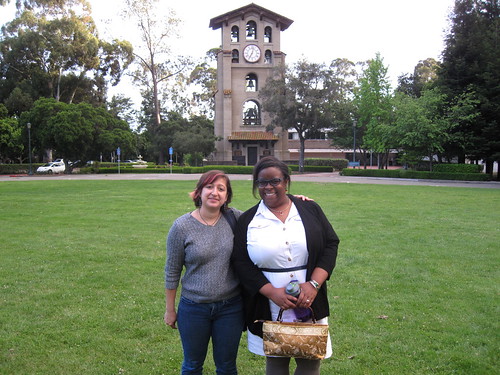
2016 Mills College 08

AF and I met up the other day at our grad school alma mater, Mills College, to speak to the graduate and undergraduate writers in Kathryn Reiss's YA writing course. It was a lot of fun, but it was an afternoon class, and it was a fairly warm afternoon. We were FAR more lively/hopped up on caffeine than the students, and I think we might have scared them the tiniest little bit. Ah, well.

There's nothing like doing a classroom visit with someone else! Our ideas sparked off of each other, and I think we were pretty much quadruple the entertainment for the money. Photographers came by, too, which ... is also kind of funny; we're apparently going to be part of the school's PR for "Authors Occasionally Come And Visit! Try Our School!" It's all good, though; we're happy to help, and hope others are encouraged to get their MFA or at least take a few writing classes.

Stay tuned for more random reviews, bits and pieces of this and that, and eventually another tandem review. When we can settle on a book...