April 12, 2016

Reading In Tandem: A.S. King's I CRAWL THROUGH IT


Welcome to another edition of In Tandem, the read-and-review blog series where both A.F. and I give on-the-spot commentary as we read and blog a book together. (You can feel free to guess which of us is the yellow owl and which of us is purple ...we're not telling!)

We were excited when our blog buddy, Melissa @The Book Nut, volunteered to head up the team to organize the Kansas City KidlitCon for this autumn. She's interested in local authors, and capably got on the ball to secure A.S. King as one of our keynote speakers as soon as possible. Since through the years we've been working our way through various A.S. King books, including THE DUST OF 100 DOGS, PLEASE IGNORE VERA DIETZ, and most recently, GLORY O'BRIEN'S HISTORY OF THE FUTURE, we thought we'd grab a new one, in celebration of A.S. King being our keynote. We'd heard a lot about this book. I CRAWL THROUGH IT has been described as one of the author's more "surrealistic" landscapes.


Two writers,
& Two readers,
With one book.

In Tandem.

Four talented teenagers are traumatized-coping with grief, surviving trauma, facing the anxiety of standardized tests and the neglect of self-absorbed adults—and they'll do anything to escape the pressure. They'll even build an invisible helicopter, to fly far away to a place where everyone will understand them... until they learn the only way to escape reality is to fly right into it.
We read library copies of this book in the treehouse. You can find I CRAWL THROUGH IT by A.S. King at an online e-tailer, or at a real life, independent bookstore near you.


tanita: Welcome to another edition of Tandem Reads! Our last Tandem was, uh...June of last year, where we reviewed a Stephanie Kuehn scary book. Our irregular little series is a lot of fun for us, despite the fact that we don't seem to do it too often. Today, spoilers kind of abound -- in an oblique way - for this book, so be forewarned: it was just hard to discuss without getting a bit specific, but we hope it's not too much. You'll certainly still need to read the book. Well, okay then! Let's just jump in - a very offbeat novel with a beginning that required ... a little concentration to figure out what was going on.

Aquafortis: This book actually took me a long time to get into--I'd say about a quarter of the way into the book before I really felt connected to the characters and what was happening...or not happening. I think the trouble for me was that there was not as much in the way of action in the first part, and more character development. And because the characters were so enigmatic and their world so strange, I was never entirely sure WHAT was happening. I have had trouble in the past connecting to magical realism, so it could well just be me...maybe that's part of it.

tanita: ... you are not alone. I feel you on the novel's beginning. I kept thinking, Okay, the helicopter: is this an existent thing, or a non-existent thing?? Only on Tuesdays? WHAT!?
I expected to flail in this novel - and possibly fail and drown - but because of more recent of King's works, I didn't expect it to go too badly. I mean, I struggle with magical realism, period. I remember reading The Dust of 100 Dogs, my first of A.S. King's novel for YA, and not knowing if I'd properly followed the narrative. I jumped in and was like, "Wait, Pirates??? Wha??? DOGS!?" It was... kind of a shock! And yet: there's an entertainment factor in just letting go and letting her tell the story. Kind of like letting a child sweep you into their narrative where there are some inconsistencies, but it's not your job to point them out or to define reality for that kid. (NOT that I think A.S. King writes at all childishly. Just a par example.)

Aquafortis: Yes, the helicopter was a snag for me. I kept going back and forth, thinking, it is REAL--no, wait--it's not real--it's invisible--no it isn't... I might just be one of those people who isn't comfortable with not knowing. (And you might already know this about me...) I still don't know what the heck the Place of Arrivals was, though. I guess my problem there is literalness, and the desire to try to interpret things in light of the real world. It's hard for me to take this kind of thing at face value, because my tendency is to analyze and assign meaning...

I did notice something interesting, which is that the parts of the book that seemed...REAL...were heightened for me. The closer we get to the end, the more of these flashes of reality there were, and so I connected with the story more as it progressed. I started to feel for the characters more when they seemed to be doing real things in the real world, after spending so long in a place of randomness and imagination, a place of questionable believability.

tanita: I believe that maybe The Place of Arrivals... doesn't matter. I mean, it's not a place you have to go by helicopter, but it's more the place where the characters, uh, arrived? It was Away. They wanted to go Away, and they did. And, as often happens when you go Away and don't have a serious plan about it -- but you carry some stuff on you, and you're vulnerable and a teen, someone can take your crap. You have to hide it. You have to pretend. And, maybe they met some artists. Maybe those artists were... not as cool a commune/collective place as they had once been, and it had become scary. Maybe a real adult woman - fearing for their safety - thought, "to heck with this, they need to go home and I'm taking them." Or, maybe the adults were incidental and imaginary. SO hard to tell. And, at the end of the day, it's not the adults' story, really.

Aquafortis: It reminds me of the "other minds" problem--how do we ever truly know ANYONE is really there or if they're figments of our imagination? And on some level, everything IS filtered through our own minds, and so the story at hand at any given moment IS what is real for the person telling it.

tanita: That sounds both wonderful... and terrible. Kind of life life...

Aquafortis: In the end, bizarrely enough, the character who seemed to exist most in the real world for me was China's dominatrix mother--also the news reporters, who seem to kind of come from some "outside world" and serve to remind us of what appears to be people's interior, imaginative lives spilling out all over the place.

tanita: The character with whom I connected all along was China Knowles. Poetry... it's supposed to be ineffable anyway, so the sort of cryptic, disconnected characterization from the others allowed me to sort of snag onto her earlier. I also felt like the Unspeakable Thing made her cryptic nature make sense: SOMETHING happened with Irenic (& wth kind of name is that, anyway? she should have mocked him in her mind for it) Brown, and it was A Thing that could not be spoken of: again, making China's obliqueness easier to take. (and I agree about her mother -- the swirling sense of shame in China that her mother and father have alternative lifestyles coupled with their horror to find out that ... they thought they were doing Parenting okay, and that pain and shame had snuck in on their watch.)

Aquafortis: I liked her too. Not only because China is the writer, the observer, but her way of dealing with her past traumas felt more familiar, I suppose. Not in a literal sense, but swallowing one's self in order to not-think about certain things, in order to keep the world at bay--I think most of us know how that feels. And so China, and the things that happened to her, felt more real to me.

tanita: The one I couldn't deal with was Lying Lansdale. I just... argh. Her character by turns scared and worried me. The Man Behind the Bush - forces her to take a kiss and a letter. What was that!? I was ...upset. The question seems to swirl around - including with China - is she trampy, or is she in trouble? Hard to tell. (Also, the letters...? I want to assign meaning to those, but...)

Aquafortis: I know!! Lansdale. She was the character I understood the least, felt most distant from--maybe she was less developed as a character, or maybe I simply wasn't clear on what was driving her. I just kind of wanted...more...something. I wanted to know her more, but she seemed like, at most, a side player in the lives of Stanzi and China. And yet she's also the one who connects most directly with the "outside world" in a way, with the news man. I'm not sure what it all means.

And yes, the letters! I kept wondering, if I go back through the book and write down all the letters that the Bush Man gave them, would it spell out a secret message? But I was too lazy.

tanita: HAHAHA! Talk about assigning meaning. I think it would spell the same gibberish Stanzi wrote on her test papers...

I want to talk about the student test thing. ALL OF THIS is supposed to have taken place because of test stress. I just didn't relate to that. I went to a ridiculously laid back little school - which was private, yes, but which never put undue stress on those tests because, well, we weren't expected to go to any college but a private Christian liberal arts college or somewhere else private and small, and most of those are ... easier to get into, if you cough out a wad of change. So, I didn't get test pressure in the same way that kids who are a.) super smart like you or b.) who went to big state schools like you did/do. So, tell me how realistic the school pressure thing felt to you?

Author photo courtesy of the author's website.
Aquafortis: can't help but say obviously there IS something to the idea of test stress. And it's something you and I did not have to deal with because we did not go to school in the No Child Left Behind days. So I'm hesitant to look to my own personal experiences for insight--also because I was one of the weirdos who kind of liked taking tests because I was generally good at it.

In thinking about this, though, I remembered that my AP/IB Biology teacher my senior year showed us a video about Harvard Med School and how kids were constantly under pressure and committing suicide from stress and so forth. And, in looking back, I feel like I had a lot of teachers like Mr. Carroll who really cared about their students and about the learning experience.

...but this is all simply to say that my experience may not shed much light on the pressure felt by the kids in the book. I actually wanted that aspect of the story to be explored more--I wanted to SEE why it was a thing, who was exerting the pressure and why exactly, because it can be something that is extremely politicized...and yet it is not universal to feel this sort of pressure--I would venture to say that's true even now with tests taking a much larger role.

tanita: Okay. So, in the end, I CRAWL THROUGH IT was weirdly enjoyable, but my enjoyment isn't the question, really: I wondered how and if Actual Teens (TM) would relate. Teen Me... aka "Me From the Past" would have been confused by this, but would probably have stuck with it because a.) A.S. King a "cool kids" author, b.) I personally enjoyed reading things no one else had read, in hopes it was obscure enough to make ME cool.

Aquafortis: I'm honestly not sure what Teen Me would have done with this one. I was decidedly less interested in literary fiction, but...maybe, depending on who handed it to me, or if I'd already read/enjoyed her other work. I CAN think of teens who would, though, connect with it. And maybe there is something generational, something having to do with living in a world of school shootings and test pressure that makes the old fears, like an eccentric naked man behind a bush, seem familiar and old hat and even comforting in a way. Maybe when the world seems to make less and less sense, a story in which reality is amorphous is just...the way things are.

Conclusion: A challenging, plot, a surrealist narrative, filled with relatable yet deeply quirky people whose choices - or lack of them - will leave you thoughtful or provoked. Disturbing, enigmatic, ambiguous - this has all the earmarks of a good Tandem Read. Thanks for joining us as we reviewed this notable and memorable book from A.S. King.

April 07, 2016

Toon Thursday: Return of the Inner Critic

I suggest clicking to embiggen this one, since I had to reduce the size to fit the width of our center column. 


April 04, 2016

Happy National Poetry Month 2016!

Hey, everyone, it's...
You can grab that logo there, and find tons of cool ideas for celebrating poetry, on the Academy of American Poets website. Memorize a poem! Create your own anthology on Poets.org! Watch a poetry movie! Most of all (sez me), get involved in local poetry events in your community. I've been a member of our local, relatively new Modesto-Stanislaus Poetry Center and we are holding our third annual benefit gala this month on the 17th, along with our usual monthly poetry reading/open mic on the second Tuesday.

In honor of National Poetry Month, one of my favorite poems:

The Second Coming
by William Butler Yeats

Turning and turning in the widening gyre
The falcon cannot hear the falconer;
Things fall apart; the centre cannot hold;
Mere anarchy is loosed upon the world,
The blood-dimmed tide is loosed, and everywhere
The ceremony of innocence is drowned;
The best lack all conviction, while the worst
Are full of passionate intensity.

Surely some revelation is at hand;
Surely the Second Coming is at hand.
The Second Coming! Hardly are those words out
When a vast image out of Spiritus Mundi
Troubles my sight: somewhere in sands of the desert
A shape with lion body and the head of a man,
A gaze blank and pitiless as the sun,
Is moving its slow thighs, while all about it
Reel shadows of the indignant desert birds.
The darkness drops again; but now I know
That twenty centuries of stony sleep
Were vexed to nightmare by a rocking cradle,
And what rough beast, its hour come round at last,
Slouches towards Bethlehem to be born?

April 01, 2016

Turning Pages Reads: UPDRAFT by FRAN WILDE

Welcome to another session of Turning Pages!

Synopsis: Kirit Densira lives with her Trader mother in the Towers - skyscrapers made of live, organic bone, which pulse and grow. The City is alive, and the Traders are some of the most powerful and free of its denizens, below only the Singers, whose word is final, and whose wings, songs, and glass knives keep the City safe from the invisible sky-monsters which hunt its citizens. Densira Tower, once thought unlucky, has grown two tiers higher since Kirit's mother, Ezarit, has brought it prosperity through her daring flights and trades between other towers. There is safety in height - and in keeping to one's own Tower. Ezarit is well spoken of, for trading necessary medicines between the Towers and changing the way things are done, and Kirit longs to be just like her.

Kirit wants nothing more than this - just to walk her mother's path as a flyer and a trader. Once she passes her wing-test, she, too, will contribute to the luck and prosperity of their tower. But, days before her wingtest, her mother leaves on an urgent mission, and Kirit, loathe to see her go, bends the Tower Law and stays to watch her go. In a moment of inattention, everything changes -- one of the monsters the Towers all fear attacks. Kirit's screams of terror change everything. Suddenly her life is no longer the straight line planned, from wing-tested apprentice to Trader, partner at her mother's side. Suddenly, she's pulled between the tower and the Spire; between the bright world of sky and air, and the closed-in world, gray world of the Singers. Losing everything, Kirit decides to save herself -- and finds truths about her family, the City's past, and the secretive and terrifying Singers that change the way she sees everything. But those truths aren't hers to tell - and those secrets may destroy everything.

Observations: This is, in basic, surface ways, a huge adventure story of a Chosen One who finds out Big Secrets and with the help of the underdogs and the overlooked, saves her city and those she loves. It's a familiar story, easy to lose oneself in and stay happy. It's also a deep and complex story of power brokering, trades and betrayal - a story about secrets, and the lengths to which we sometimes go to keep them, about power and absolute power. It's also a story about loving one's family, in spite of everything, and that's a story we know very well. So, on the surface, despite its being a new story entirely, UPDRAFT has plenty that will feel familiar to the reader.

The worldbuilding in this story is superbly detailed and thought out, which makes sense, since more than one book will hang on this framework. Though the novel spent a lot of time setting this world in place, I found myself with more questions than the book answered: what were the bones made of? Why were people going blind from the sun, or having breathing problems - what is inimical in the atmosphere that affects humans so? Are the people in the City entirely human? The protagonist is, from the cornrowed hair she sports on both covers, a person of color, but there's not detail about this in the book, at all. Where did her people come from? How did they get into the bones? And, the bones of ...what? If the bones are organic and still growing... where's the rest of the body? What is it, down below on the planet surface (Earth? Or what planet is it?) that's worse than what's above the people, the invisible monsters? I found myself with more prosaic questions, too - the people ate mostly birds and what they could grow from small gardens - but I wondered where they got their water, and how. Details like this (mainly because I've been playing a simulation video game called Cities: Skylines and have started to dream about water pipes and adequate power plants) tend to distract me a little - but not too much.

Conclusion: UPDRAFT is Fran Wilde's first whole novel, after plenty of short story writing in the speculative fiction universe. Her characters are unique and apparently diverse; her writing chops are strong. The characterization in the novel has an air of familiarity to it which provides an absorbing and comfortable narrative, - as comforting as most Heroine's Journey books tend to be. It is adventurous and exciting, and there were so many more details I wished to have! I hope to find more answers in the sequel (CLOUDBOUND, 9/2016) to come. As it stands, UPDRAFT had a sufficiently satisfying beginning, middle, and end, and despite the sequel, reads well as a standalone. Still - the good news is, there's more to anticipate.


I received my copy of this book courtesy of the library! You can find UPDRAFT by FRAN WILDE at an online e-tailer, or at a real life, independent bookstore near you!

March 31, 2016

Thursday Review: THE NAMELESS CITY by Faith Erin Hicks

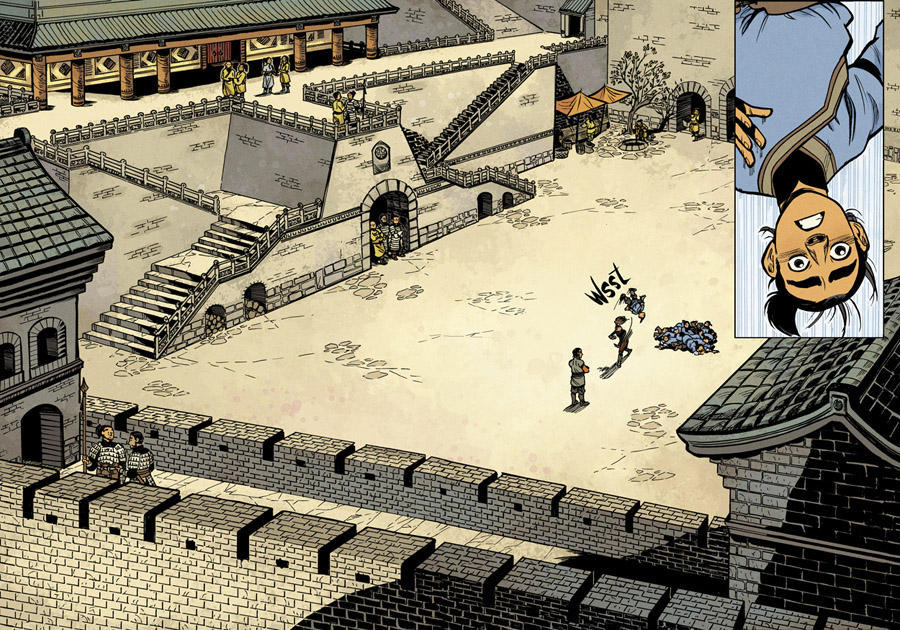
Synopsis: If you keep up with Finding Wonderland, you'll know I already have plenty of awe and amazement for graphic novelist Faith Erin Hicks. (See reviews here, here, and here, and interview here.) Her latest contribution—officially to be released on Tuesday—is The Nameless City, and reading it left me with even more admiration for her artistic and storytelling skills.

The setting is the City. To us readers, it looks a lot like someplace in China's early history: from the architecture to the armor, clothing, and hairstyles. The City has had many different names over the centuries, depending on which group of invaders has conquered it, for it controls a strategic pass through the mountains to the ocean. Through every wave of invasion, the City's native residents bow their heads, bend their backs, and forge on as best they can.

Click to embiggen. Images courtesy of
First Second/Macmillan.
Currently, the City is controlled by a people known as the Dao, a people of great military prowess. Kaidu is the son of General Andren, and when we meet him at the beginning of the story, it's his first day at the palace, his first day of training to fight with the other Dao boys. He's come from living with his mother in the homelands and is plunged into the sights, sounds and smells of the City. While out and about, he meets a City native, an urchin named Rat. At first she resents him simply for being Dao. But Kaidu has grown up far from the City and its tension between residents and invaders, and he resists being pigeonholed. He's lonely, and he wants a friend.

Gradually they do become friends, and Kaidu begins to know the city as Rat knows it, running along the rooftops and scrounging for meals. It matters not at all to him that they are from two different worlds. Worry not, though—this isn't a depressing, Fox-and-the-Hound scenario. When the two of them find out about a plot that could put the palace and the City's rulers in danger, their loyalties are tested, their abilities are stretched to their limits, and their friendship is at the heart of it all.

Observations: The visuals here, with astounding color by Jordie Bellaire, are lush and immersive. For me, everything about the graphic storytelling was awesome, from the characters (individual and expressive) to the amazingly detailed setting, to the artistic choices of the author in rendering scenes into series of panels. The quiet scenes were beautiful, and there were full-page panels I could have just gotten lost in, but there was plenty of action as well. Never, though, did I feel lost about what was going on in the story itself.

The way the author makes the City itself a palpable presence in the story—the City and its people, the Named—is an important and effective unifying theme. It also is a tidy way of emphasizing other elements that further deepen the story: sociopolitical themes like self-rule vs. outside conquest, as well as interpersonal themes like who is inside and who is the outsider, and what it means to be friends across a social divide, and what to do when you have competing loyalties: family, friends, nation. It is the kind of book that rewards thinking about it and re-reading it, because it is deceptively simple and yet multilayered. The characters become a central focus around which these larger themes revolve and are brought to vivid life.

Conclusion: I'm going to be shoving this forcibly into the hands of all of my comic-loving friends, because this one has a universal sort of appeal with its sense of action and adventure and humor. I'm also pleased to see it's only the first book, with more to come.


I received my copy of this book courtesy of the publisher, First Second. You can find THE NAMELESS CITY by Faith Erin Hicks at an online e-tailer, or at a real life, independent bookstore near you, starting on Tuesday, April 5th!

March 29, 2016

Turning Pages Reads: SOUNDLESS by Richelle Mead

Welcome to another session of Turning Pages!

Synopsis:

Long ago, Fei's community of hearing impaired people was cut off from others by a huge rockslide. Their mining community continued to mine, and to send down their wealth of metals via zipline to the village below. People never used the zipline, because it was deemed that people were too heavy, but materials could go down, and food for the village could come up. Intermittently. The villagers up the mountain are in dire straits, but their straitened circumstances are underscored by their Elders' insistence that some of the community paint a record of their lives. These artists receive high status, more food, and better clothing. The miners are given much less food, but must do manual labor... The miners are kept on the edge of starvation, and as the generations pass, these hearty mountain people begin to develop the symptoms of blindness. Fei and her sister are born deaf, as are most of their generation, and only the very oldest and frailest remember sound. However, the alarming trend towards losing sight is treated with panic and shamed silence. Those visually impaired and hearing impaired now live as beggars on the fringes of society, a society already too impoverished to adequately feed itself, and utterly dependent on those down in the valley. The rocky mountain outcropping where they live has little or no game, and poor soil for farming. Everything depends on the miners, their metals being sent down the mountain, and the village's rigid adherence to the way things are.

Fei, a favorite of the Elders, does as she is told; respecting the betrothal the Elders have arranged for her, and only admiring Wei, a sturdy miner boy who is outspoken and decisive, in secret. Her life changes when one night something awakens her -- a sound, in a world where there had been none. Holding her mysterious cure close to herself, Fei is stunned by the awakening of new senses -- and horrified as her sister's hold on vision begins to slip away. When Fei learns of Wei's plan to climb down the dangerous rockslide to the valley below to get help for their village. she is eager to help - it's the only way to save her sister. Wei and Fei slip away from their village in secret, but it turns out that the truth they find down the mountain is the biggest - and most destructive - secret of all.

Observations: I was intrigued that this book was about a village of people with full hearing loss. The challenges and solutions in that community alone would have been worth exploring. I was initially disappointed that Fei's hearing loss magically vanishes less than a third of the way into the book... and I guess that this magical intervention felt necessary to the author, but I didn't find that there was much the character could do with her hearing that she couldn't do otherwise, except be the hero of the day and "prove" the existence of the paranormal. I wish the author had made a different choice that didn't disrespect the abilities and cunning prowess of a person with hearing impairment. She could still have saved the day without hearing anything.

I also found it difficult to suspend my disbelief that no one built a larger zipline down to the valley, in all the years that the village had abruptly gone deaf. Surely it's ridiculous that no one had taken it upon themselves to, little by little, year by year, clear away the rockslide which had cut off the village. It would be one thing if they had all they needed up top, but being dependent on foodstuff and etc., from a mysterious kingdom and people who felt they had the right to punish them by adjusting their food deliveries -- I cannot imagine an entire village of passive people with only Wei somehow active and filled with righteous indignation. ...Really? How? Why? So many questions.

I came to this book with few preconceptions. It was a random library pick-up and I read no reviews or buzz beforehand. However, knowing that Richelle Mead isn't Chinese, I was prepared to be both more interrogative and less ...expectant of the narrative in terms of how the protagonist's ethnic heritage was handled. I'm inclined to say that while the novel wasn't saturated with Chinese culture in extensive world-building, language usage and cultural behaviors, neither did it overshoot the mark, as so many authors do when writing about a culture not their own, and indulge in fetishism. On the other hand, I asked myself, "What did it add, that this novel was set in China?" A specific type of paranormal entity, and... not a lot else. When asking the question, does this interpretation of Chinese culture harm or benefit both Chinese and non-Chinese readers? the answer kind of weighs on the side of negative, for me. Simple omissions, from character names to the cover model to an apparently shallow understanding, by the characters themselves, of pixiu, all these things and more seemed to point to cursory research and not taking positive advantage of the full and rich smorgasbord of diversity for which the setting allowed. This was unfortunate.

Conclusion: Fans of Richelle Mead may enjoy this lightweight, fast-paced standalone full of the usual adventure tropes, including a monsters, daring escapes from harrowing danger, and decisions based on true love alone. Add a sprinkle of imaginary ancient China and stir: instant beach read. Readers may be better served by enjoying Cindy Pon's Kingdom of Xia series, which is a story full of Chinese folklore that includes more narrative ambiguity and richer details of culture and language.


I received my copy of this book courtesy of the public library. You can find SOUNDLESS by Richelle Mead at an online e-tailer, or at a real life, independent bookstore near you!

March 28, 2016

Monday Review: NEED by Joelle Charbonneau

I think this is a pretty effective cover.
Synopsis: Need, which I randomly picked up as part of a recent library haul, is a suspenseful thriller with a topical premise—the insidious power of social media and the questionable ease of online interactions—but it also asks timeless questions about ethics, peer pressure, what we want vs. what we truly need, and how far individuals will go to get what they want.

When sixteen-year-old Kaylee finds out about Need, the new social media site for students of Nottawa High School, she is initially skeptical, and understandably so. Sure, it sounds too good to be true that all you'd have to do is invite a few friends or complete a simple task, and then you'd get to make a request. But then people start getting things like new phones, new computers…and Kaylee decides to take a chance and ask for what she really DOES need: a new kidney for her younger brother DJ, from a donor who is a good match.

Then things start to get sinister. People start to get hurt. The tasks assigned by Need aren't so harmless anymore. Pretty soon someone winds up dead. Kaylee starts questioning who's behind it all—and suddenly it's a race against time as people are picked off, one by one.

Observations: One of the strengths of this book is the level of suspense created as the reader watches helplessly while everyone descends into a sort of Lord-of-the-Flies, everyone-out-for-herself game of survival, wondering who is pulling the strings. It's definitely a page turner, as the viewpoint shifts between several characters, each of whom has their own needs and wants—and some of whom will go to any extreme to get it. What do we choose when faced with temptation, with a devil's bargain? Which of the seemingly normal people around us might be a hidden sociopath? What happens when we allow ourselves to be manipulated? These are all fascinating questions explored by this story.

I did have a few minor issues, though. As for who is pulling the strings, I unfortunately guessed pretty early on because, realistically, the options for whodunit were limited. I also found the whydunit problematic—the villain struck me as a bit over-the-top, a bit of the typical madman sort with no conscience and abundant megalomania. Lastly, I did find myself questioning the believability of the overall premise: how realistic is it to think that a harmful and manipulative social network would escape the notice of adults or the outside world for long enough to cause this level of havoc? BUT—I don't think these are questions that are going to bother most readers, and they don't keep the book from being an engaging, interesting, and fast-paced story.

Conclusion: Fans of contemporary thrillers will want to check this one out—it tackles topically relevant issues in a very compulsively readable way, and definitely hits frighteningly close to home in our internet- and social-media-saturated society. It might also prove thought-provoking for readers growing up in a world where social media has always been a fact of life—and get them to ask the right kinds of questions when the next new thing comes along.


I received my copy of this book courtesy of my library. You can find NEED by Joelle Charbonneau at an online e-tailer, or at a real life, independent bookstore near you!

March 25, 2016

Turning Pages Reads: FUTURE SHOCK by Elizabeth Briggs

Welcome to another session of Turning Pages!

Synopsis: Elena Martinez is a foster child who is aging out of the system in just a few months. She's seen what happens to kids in her situation, without direction, support, or funds, they end up on the street, perpetuating the cycle of bad decisions and parent-less kids. Determined that her life is going to go a different direction, beginning with college, Elena's job hunting like mad. To her advantage: her eidetic memory, excellent grades, and ability to focus and work hard. Against her, her sleeve of tattoos and her Latina-ness, in the face of largely white and apparently prejudiced potential bosses. Interview after interview, and so far, Elena's out of luck. She can't afford to be out of luck, so when a stranger comes to her foster home from the Aether Corporation, a high-profile tech firm in the city, and offers her the chance to make a ridiculous amount of money just to "participate in a short research project," she knows it's too good to be true - but she signs on anyway. The money will pay for college - she's got to take a chance.

The research project turns out to be a chance to travel to the future for twenty-four hours - and simply to pick up information. Easy enough, except that Elena's not the only one chosen, and some of the rest of the team are real pieces of work -- a couple of aggressive, hardcore punks like she's run a group homes before, a quiet, punky girl who looks like she might be afraid of her own shadow, and a kid who looks like he got lost on the way to a GQ shoot. What's weird is that every single kid but one on the team, except for Mr. GQ is... a foster kid. Is that because they're expendable? And, why are there only kids, anyway? What happens if something goes really wrong in the future? How are they supposed to cope? And, why does Aether Corporation make such a big point of reminding them not to check out their own futures? Could it really give them some kind of a stroke?

With twenty-four hours on the clock and a strong desire to secure her future - and get back to her past in one piece - Elena is watching everything, and everyone. And, when the inevitable happens, all she can do is throw herself behind the belief that the present is still waiting to happen -- and gamble everything that somehow they can change the future.

Observations: This novel is grippy! Though some readers may find the pacing uneven, the gradual - and despairing - beginning of the novel and then the faster, creepier quicker pacing works for me. The characterization is quick and dirty at first, then deepens, and the reader gets a chance to know the protagonist a little, and she held my attention to a surprising degree. I really like that Elena Martinez is a GATE kid - and she's Latina. Her home situation is bad, she has tattoos and a violent history, but hey: she's in the gifted program at school and can make the grades. (Some of the other members are the team skewed, for me, a little closer to type than character - The Thug, the follower, the hipster - but the characterization does deepen somewhat.) The author pegs the ragged edges of the main character immediately. You see that Elena gets her back up easily, but you also see that she has a big, soft heart beneath all of the fronting. Readers will empathize with her tenuous situation - knowing that once she's eighteen, she's out the door of her overcrowded foster home is a very real, relatable fear, and author does her justice here.

The mystery aspect of the novel, as Elena tries to unravel a pretty basic "Whodunnit" is surprisingly frustrating - but not in a negative way, but in a way that is essentially realistic. Elena runs out of clues, out of neat tricks, and literally out of time, which means that the team has to cobble together a kind of "um, maybe this'll work" scenario, then pop back into their timestream. I was really surprised by that - the frayed, no-consensus, disorganized retreat is really atypical to a mystery narrative. And yet, it was very realistic that Elena had to just... live her life, to find out what really happened. That she wasn't able to control everything was also terribly realistic.

Conclusion: An intriguing beginning for apparently a series, this mostly quick-paced mystery novel has a touch of romance, some genially mad scientists, those driverless cars we're just now seeing (no flying ones, however) and a lot of promise that the future is much, much more disturbing and cooler than we may have previously imagined.


I received my copy of this book courtesy of the publisher. And, after April 1, you can find FUTURE SHOCK by Elizabeth Briggs at an online e-tailer, or at a real life, independent bookstore near you!

March 24, 2016

Toon Thursday: The Writing Guru Returns!


I am seriously chuffed that I have managed two new cartoons in the past month. I hope this marks the beginning of a new Toon Thursday resurgence, and a bit of momentum to get my cartoon Tumblr going. This one's pretty silly. Here you go.


March 22, 2016

Turning Pages Reads: DIG TOO DEEP by Amy Allgeyer

Welcome to another session of Turning Pages!

Synopsis: Liberty's junior year just cracked wide open and catapulted her out on the ground. Her mother - a placard-carrying, species-saving, liberal-agenda-advancing, chronic protestor - is currently under guard at the Pender Women's Correction's Institute. A car bomb, which injured five people, went off at her last demonstration, and while Liberty's mother swears she's innocent of involvement, the judge isn't letting her go without a little more proof than just her word. Bad enough that Liberty's spent days, sometimes weeks not even seeing her mother, making her own meals and paying the utilities bills at the apartment because her mother is too involved with her causes to remember, but now she's discovered that her mother has spent the college money her grandparents had saved up for her on yet another one of her causes, and Liberty is BEYOND finished with her. Calling her "my former mother," and moving on with her life to save her sanity seems the best option. Packed off from their DC apartment and her private school, which offers Comparative Religions, Anthropology and German III, to her Granny Briscoe's farm and the local high school in rural Plurd County, Appalachia, where "coal mining keeps the lights on," Liberty's life and dream of early admission to Georgetown are faded, distant memories.

Things in Ebbottsville are a lot different than Liberty remembers - for one thing, the tap water's bright orange. Though the neighbor boy she ran around with when they were small turned out to be simply gorgeous, there's not a lot else to recommend the place. The underfunded high school, staring townspeople, rusted junker cars, and endless underage partying going on in the back hollers are just background noise to the stark reality of food stamps, buying bottled water, and too few resources on the Briscoe farm. Liberty's reality now includes a grandmother who is thin, stooped, and coughing up blood, half a mountain visible from her grandparent's property, the top removed to mine the mountain for coal, and the effects of the mining a poison blighting the creek, the hills, and the ground. Mining is killing Ebbotsville, Kentucky and the Briscoe Farm -- and it turns out that mining -- may be responsible for killing Liberty's Granny, too. Is there really anything one poor person can do to stop a rich person bent on making more profit from his crooked business practices? Liberty aims to find out. Suddenly being a placard-carrying, species-saving, liberal-agenda-advancing protestor doesn't sound half bad. But, is there a point at which a person should stop tilting at windmills? When are the costs of fighting the good fight too high? And, what happens to a community if whistleblowers dig too deeply for the truth?

Observations: The minute I read about water coming out orange from the tap, and the number of sick and out-of-work people in town, I knew this was a story that was "ripped from the headlines" as it were. My thoughts immediately went to other whistleblowers in history, and the situation in Flint, Michigan.

Teen whistleblowers aren't entirely an unknown in YA lit, but reading about teens facing economic hardship and food insecurity are exceedingly rare. Liberty is actually hungry in the novel; fast food - cheap and plentiful for most - is even out of reach, and she and her granny live on things like ramen and tomato soup and rice. Liberty has to put fresh fruit and vegetables back on the shelves, in order to afford bottled water. These are the choices, and this is the real deal facing hundreds of thousands of people. A painful reality of poverty in a small community is that there is often no place to get resources to do any better. In the novel, Liberty manages to score free lunches at school; weekends, however, are very hard as they are for many students.

Liberty is a realistic character in other ways - she's immature enough to get involved with the first boy who looks at her nicely, even though there's no real reason for them to hook up except that she wants to ignore what's going on in her life. She's smart enough to use the internet and dig to find information and solutions to the community's problems. However, I felt that the potential personal danger for her within that community was underplayed; historically people really dislike a disruption of the status quo and especially business owners of corporations which are making a quick buck while destroying the environment. The jacket copy makes it sound as if Liberty struggles with the idea of turning to violence, but the narrative has her strongly not in favor from the first, and terrified of those whose belief is that is the only choice. I wish the novel had spent some time exploring that. Is violence ever a good idea when protesting against the status quo and insisting on change in a community?.

I found that the novel's conclusion bothered me a little. The solution the novel offered didn't fix anything. Oversimplifying is a pitfall in a YA novel dealing with a situation of this complexity. While teens are often too accustomed to seeing issues laid out in black-or-white shades, this issue was too deep for the band-aid that a teen and her friends could offer. Liberty isn't exactly painted as the savior of the entire town, but the conclusion of the novel still ends up tidier than it has a right to be. Without including spoilers, I wished that the novel would have explored the option of continuing the fight, and taking the reports and information Liberty and friend had gathered to the highest level.

Conclusion: An important, suspenseful novel with easy to relate to characters, this will begin conversations about ethics and options, as well as when to stand up and protest, and when to stay silent. This novel also asks some interesting questions not just about mining and its environmental impact, but about dissent and protest and its efficacy.


I received my copy of this book courtesy of the publisher. After April 1, you can find DIG TOO DEEP by Amy Allgeyer at an online e-tailer, or at a real life, independent bookstore near you!

March 21, 2016

Monday Review: SCIENCE COMICS: CORAL REEFS by Maris Wicks

Synopsis: First Second Books' new series Science Comics is no doubt something that I would have loved as a kid. There wasn't nearly the selection of graphic novels or educational comics in the 1980s, though. I had a pretty good collection of Charlie Brown's Super Book of Questions and Answers and a cartoon-illustrated book about science that I got at the Exploratorium, but that was about it for my collection of science comics. (At least, until I was a bit older and discovered Larry Gonick.) If I'd had Coral Reefs: Cities of the Ocean I would have been thrilled. It's part of a new-ish series of Science Comics on a range of topics by different comics artists.

Maris Wicks, who created the graphic novel Primates (reviewed here) for older audiences, is the artist and author of Coral Reefs, and her depiction of the fantastic forms of life under the sea and in coral beds is inviting, charming, colorful, and funny. And, of course, educational. The book is divided into chapters that cover everything from how coral reefs are formed, to which animals live there, to how coral reefs and oceans are an integral part of the planet.

Observations: I was impressed by the science part of the book. It's substantial—it doesn't talk down to kids or avoid presenting new vocabulary—and makes excellent use of illustrations and diagrams to keep it from ever feeling too heavy or dense (although very young readers might have to skim over the science-speak). Everything from water molecules to phytoplankton to fish is depicted with personality, telling its own story while also making the point that our planet is alive, filled with living things in a vast network that includes us.

Click to embiggen. Image courtesy of Macmillan.
The narrator of the story is a little yellow prawn-goby, a tiny fish that lives in coral reefs. Unlike with Nemo, there's no need to resort to a family tragedy in order to feel sympathetic to this little guy. Our goby friend is ready with a smiling face and intellectual hipster glasses, well suited to the task of zipping here and there in the reef and doing the heavy lifting of breaking down the chemistry, biology, and ecology of ocean life. The artwork is simple when it needs to be, and more complex and scientifically accurate when called for, without losing a consistent colorful charm throughout.

The book also contains some supplemental educational material, giving it additional heft for classroom use: a glossary, of course; a bibliography and list of resources; and an in-depth diagram of a coral polyp.

Conclusion: Coral reefs and sea creatures are just plain cool. I personally learned a lot, was reminded of knowledge I hadn't thought about in a while, and enjoyed myself in the process. The smiles on the characters' cute little faces made me smile, too—I imagine it was very fun to draw all the different types of animals and organisms. Though written for kids and tweens, this would be an enjoyable read for anyone of any age who wants an introduction to the topic with both breadth and depth. BONUS: Tune in later this year for an interview with Maris Wicks—I can't wait to ask her more about Mr. Goby.


I received my copy of this book courtesy of the publisher, First Second/Macmillan. You can find CORAL REEFS: CITIES OF THE OCEAN by Maris Wicks at an online e-tailer, or at a real life, independent bookstore near you!

March 18, 2016

Turning Pages Reads: PURPLE HIBISCUS by Chimamanda Ngozi Adichie

Welcome to another session of Turning Pages!

Synopsis: Privileged and perfect is how life could be described for fifteen-year-old Kambili and her brother, Jaja. In Nigeria, where so many deal with fuel shortages, power outages, strikes at hospitals and universities and scarce, or uninspiringly plain foods, Kambili has nice clothes, meat almost every day, her own room with a nice bed, and the stern and despotic will of her Father dominating her every breath. Infected with a self-hatred which enacts itself in extreme religiosity in respect to the Catholicism that he's embraced, Kambili's father demands impossible obedience to a law of rigid social and religious perfection which leaves the family emotionally, psychically -- and very often physically -- scarred. Their prayers at meals are twenty-minute long exercises in piety, church is never missed, including the visit to the priest after; confession is constant, and their father even parcels out the time they're allowed to visit his father, Papa-Nnukwu, whom he tells his children is a hell-bound pagan (though his sister simply explains the man's adherence to his own faith as being a traditionalist). To settle the concerns of the village fathers, the children get fifteen minutes in their grandfather's presence and are urged to eat or drink nothing, though the man clearly is nearing the end of his life, lives in deep poverty, and longs to know his grandchildren and share time and stories and meals with them.

It is only through their aunt's guile that the children are taken from their home to visit their father's sister. Their father allows his sister, Auntie Ifeoma to take his children to spend a few days in her home in Nsukka. Promised a pilgrimage to a place where the Virgin Mother has appeared, the children are instead gifted with a time of relaxation - books and television, no threats, no shouting, no not measuring up to an impossible ruler. They hear music from the heart, singing at prayers, laughter, jokes, free discussion, and games. And Kambili - numb and awkward at first - observes dully her brother Jaja turning like a sunflower to the warmth of this free home, and turning into someone she doesn't know. Cautious and wary, Kambili's every thought remains of her father, obsessed with keeping his rules, even when out from under his eye, but she watches as her brother simply decides... "no. No more." Fearfully, Kambili waits for the world to end. It doesn't -- and then she meets Father Amadi, a young and attractive chaplain of the University of Nsukka where Auntie Ifeoma works. Casually dressed, playing soccer, with a kind word for everyone, he's one of the only Igbo priests Kambili has ever met - and even his voice obsesses her. Filled with hints of a whole new world, that of affection and infatuation, Kambili, finally, begins to imagine a world away from what she's always known. But, every vacation ends, and for every little sin, there is to be a painful and terrifying reckoning. Their father remains ominously in the background, even as the hideous stress of running a free press begins to have its fatal effects during the despotic Nigerian political regime. Her family cannot remain as it is -- not when Jaja is getting older every day, and pushing back against their father. But, is courage in this circumstance, what is endurance? Is it standing in the face of oppression, as their father does against the political forces in their nation? Or is it, as Auntie Ifeoma is doing, preparing to emigrate to America, walking away?

Observations: This book, first published in 2003, has been reprinted multiple times, and was nominated for many awards. Obviously tightly written and concisely plotted, Adichie's characterization is clear and true, contrasting individual triumphs and failures against the backdrop of Nigeria's failures and eventual turn toward change. Despite its having a fifteen-year-old narrator, many teens read this novel as part of World Literature, not as ordinary genre fiction. What separates the two is mostly topical, but also a lyricism of writing that isn't often as apparent in other fiction forms. (This is not to say that it's nonexistent; it's just that this book has history and politics entangled with the narrative, which changes it and its concerns.)

Oppression is thematic in this novel. Myriad things loom over the family within the first third of the book. The heat is looms oppressively. The political climate holds the threat of oppression. The religion is certainly all-pervasive and oppressive, and then there's the father's chronic disappointment looming, and always ready to break over their defenseless heads. Though Kambili describes things with a small-voiced detachment - small voices, because she has never had speaking-up behavior modeled at home; small-voiced, because she believes in her father's view of her, that she is sinful, stained, and spoiled -- one nevertheless gets the sense of the absolute numb horror taking place around them. As Kambili and her brother scrub their mother's blood from the floor, after one of their father's "corrections" of the nearly silent woman's sinful behavior, the reader gets the sense of being seen in a funhouse mirror; much smaller than previously believed... see-through, perhaps... and helpless. But, no one - not the country, or the climate, nor the family - is beyond help and change in this novel. Adichie pulls the narrative inexorably and smoothly toward the small explosions which culminate in the release - and then the aftershock - of the inevitable tragedy.

Conclusion: Though in some ways grimly tragic, this is also a beautifully written novel which introduces readers unfamiliar with Nigeria to a small part of it -- without that being the point of the novel. As a matter of fact, with no glossary or "notes" on how to make sense of the culture, except through savoring the narrator's words, it's not about the culture at all, except through its people -- and the characterizations are worth their weight in gold. No one is single-dimensional, every quick conclusion the reader makes they have to take out again and scrutinize as they peer at the pieces of what makes a person who they are, and how they become. Even the monstrous father isn't a monster so much as someone whose self-worth is so afflicted by not being Western and white that he's absorbed the cruelty of the West's disdain for he and his people, and taken their cruel white Catholic god to heart. What else can he do, but try and erase Nigeria's stain from his own family? And yet, he obviously loves his people and supports so, so many of them - which is one of the reasons Kambili is so proud of him, even as he batters away all that she could love about him... a complex and multilayered book, even in its painful tragedy, it leaves the reader with a hair-thin sprout of hopefulness.


I received my copy of this book courtesy of the library. You can find PURPLE HIBISCUS by Chimamanda Adichie at an online e-tailer, or at a real life, independent bookstore near you!

March 17, 2016

Thursday Review: THE FOG DIVER by Joel Ross

Check it out--no whitewashing here!
Synopsis: The Fog Diver was this year's Cybils Award winner for Elementary and Middle-Grade Speculative Fiction, and I've been intending to read it for several months now—so when it won the Cybils I made a particular point of getting to it. And I am so glad I did, because this one was yet another MG spec fic that I want to hug (like last year's finalist title The Greenglass House, which I also loved). Joel Ross's post-post-apocalyptic world, with humans relegated to living on mountaintops and hot-air-balloon platforms in order to stay off the earth's tainted surface, is vivid, creative, and really intriguing, but it's the characters—who can resist a plucky cast of young misfits?—that make this one sing.

Chess, the narrator, is a thirteen-year-old fog diver, and he's the best there is. Expert at descending via tether into the treacherous nanite Fog, he scavenges useful items from the time before the human-created microscopic nanobots went rogue all over the planet's surface. Successful scavenging means survival for Chess and his fellow balloon crew members Swedish, Bea, and Hazel, who live in the floating slums outside the mountaintop city of Rooftop. But now their search for loots is even more desperate: their caretaker, Mrs. E, has finally succumbed to fogsickness. Their only hope is to salvage something valuable enough that they can buy passage to the rebel city of Port Oro, hostile to the Rooftop's ruler Lord Kodoc but rumored to have a cure for the fogsick.

Observations: This was an exciting adventure that not only had excellent, creative world-building (super intriguing for me, because I’m also writing a post-post-apocalyptic story right now) but also characters I really cared about and wanted to see prevail. This is another story about the family you choose, or that chooses you: Mrs. E rescued all four of the crew as children and has been raising them and caring for them, and they have the love and loyalty of a family. Each one has his or her own special talent, bringing something unique to the group and making the whole greater than the sum of its parts. Hazel is a natural leader; Chess is their talented fog diver, the nanites trapped in his eye giving him special skills; Bea is a genius gearhead, keeping their balloon ship running through thick and thin; and Swedish is a crack pilot.

And of course they will all have to use their unique skills to their utmost in order to succeed in their quest to help their foster mother without even worse disasters befalling them: Lord Kodoc's evil eye has landed on them—specifically, on Chess—giving their mission an even more desperate edge as they battle mutineer pirates (airship pirates!!), relentless Rooftop guards, and Lord Kodoc himself.

Conclusion: This book was packed with fun details rendering our own world in slightly skewed fashion and reminding the reader that this world was once the one we live in: for instance, the ancient story of Skywalker Trek, a battle between the Klingons and the Jedi. And, of course, the sometimes-inexplicable items Chess finds during his forays down to the surface. Those are the kinds of details I love, and will surely appeal to fans of Philip Reeve's Mortal Engines (reviewed here) and other post-apocalyptic sci-fi that has a strong thread of the fantastical. I also couldn't help thinking it would make a GREAT Miyazaki movie (along the lines of Nausicaa of the Valley of the Wind)—hint hint! I look forward to the next book. Another not-so-subtle hint.


I received my copy of this book courtesy of my library's ebook collection. You can find THE FOG DIVER by Joel Ross at an online e-tailer, or at a real life, independent bookstore near you!

March 15, 2016

Turning Pages Reads: RED INK by Julie Mayhew

Welcome to another session of Turning Pages!

Synopsis: Snarky, brittle, awkward, British-Greek teen Melon Fouraki is fifteen and unmoored after her mother is hit by a bus. Despite them going away to Crete every summer, somehow Melon never was introduced to any of the grandparents, aunts or uncles who passed in a blur before she was dragged off to yet another beachfront hostel. East Finchley, Melon's blue-collar neighborhood in London, has virtually no connections left for her except for her mum's social worker mates -- and her mother's "partner" who is awfully broken up about everything, and apparently has a picture of her mother wearing a diamond ring...? Melon is a bit bitter that she hadn't... noticed the ring. What? Her mother was engaged????

There's a great deal that Melon hasn't noticed -- that her "best" friend, Chick, is quite self-centered and unkind, that Chick's parents can't stand Melon and are in horrors of being left with her after her mother's death, and that her mother has created a narrative for their lives in London that's long on lyricism, but not exactly detailed, and explains exactly nothing about why there are few, if any, pictures of Melon's babyhood, no pictures of her father, and little communication with the Fouraki family... but it's the story that Melon knows the best. The Story. The tale of her mother's childhood, of the reason she's named "Melon." The story of her missing father, the Fouraki feud with his family, and the reason for the distance from the family back in Crete. The Story is Melon's origin story, the story of how she, and her mother, Maria, came to live in East Finchley. With the holes left in Melon from grief -- and rage, because her mother was offbeat and hard to predict, and their relationship suffered from Maria and Melon's self-absorption -- The Story is all Melon has left that tells her who she is, and who she has the capacity to be. But is The Story everything Melon's mother could have told her? And, can a grief-stricken, resentful, dead-ended Melon pull herself together to write herself a new chapter, so that she can go on without Maria?

Observations: The characterization of a British teen reads as spot on for me. Melon's shock-oriented "I'll say anything" attitude, occasional potty mouth, and bitterly blasé attitude toward school, adulthood, and authority is familiar to those who enjoy contemporary English or Commonwealth YA authors. One doesn't often read novels about people who've landed in care due to the death of a parent, and the sort of bewildering trail of social workers and bereavement counselors - and Melon's indifferent reaction to them all - would be in some sense atypical for an American teen, as there is much more... institutionalized anxiety, as it were, about kids in the foster system due to a lack of family. Melon's time with the bereavement counselor is especially amusing, as she repeatedly articulates her confusion that everyone is so broken up about her mother's death, and resents feeling an expectation to weep and be upset when she feels not much of anything except resentment at the inconvenience, and that no one knows what to do with her. Melon just wants to hold out until she's sixteen and can leave school. Unfortunately, she has several months to go, and is stuck with her mother's partner, Paul, until then, as he's the only one who wants to deal with her, and frankly, Melon's not sure about that.

Women are very important to this narrative, and the strong women who are Maria's friends have Melon's respect, after her mother's death. The men in the novel - Melon's grandfather, uncle, and father - are largely immaterial; Melon finally noticed her mother's coworker, Paul "around," and the niggling issues she (and her Greek relatives) has with him are borderline racist, but mainly unexplored, as if the tensions don't exist. Though he's been "around" for more than a year, and though Maria has stipulated in her will that Paul will care for Melon if something happens to her... Melon is caught off-guard by his grief, and his presence. This willful ignorance is something which both Maria and Melon share; Maria ignores that people laugh at Melon's name and that her daughter is struggling at school with being bullied by boys mocking her shapely body, and Melon ignores... pretty much everything about her mother. They live in a state of armed siege, and then the siege is broken unexpectedly - and unfairly, to Melon's point of view.

A lot of this novel is about identity and omissions - life, and its lies. Near the end of the novel, Melon, after finding out news that simply guts her, has an encounter with a boy which is essentially non-consensual. As many do during an assault, she lies to herself as it happens - continuing the storytelling-as-coping-mechanism her mother was so good at -- re positioning the narrative to reflect what she chooses to see. Interestingly, Paul corrects this tendency toward denial and asks Melon straight out for the factual version of events (leaving the reader wondering if he managed Maria in the same way). Through her own bitter experiences with truth, Melon begins to value that a story is not, at times, entirely factual. At the end of the novel, she realizes the uses of a permeable truth and begins the work of forgiving Maria, most tellingly by seeking that kind of truth about her mother's life, as seen through the lens of her other Greek relatives. The big picture takeaway of the novel is that truth sometimes matters less than perspective, especially when dealing with family history. Everyone has their own Story, and Melon begins to come out of her extreme self-absorption and notice this simple fact.

Conclusion: Written in flashbacks, the non-linear style of the novel reflects the circuitous versions of The Story which keep Melon's understanding of her identity encapsulated. Melon's Story flows from the author's pen with a lyrical style, a beautiful tale to reassure a child. But a pretty story isn't what most of us need to live and grow, and Melon's ragged brashness the bright light of perspective on truth, lies, and the need to create a self without our parent's storyline.


This book was first published in the UK in 2013. I received my copy of this book courtesy of Candlewick Press, and now you can find RED INK by Julie Mayhew at an online e-tailer, or at a real life, independent bookstore near you!

March 11, 2016

Turning Pages Reads: TRUTHWITCH by Susan Dennard

Welcome to another session of Turning Pages!

Synopsis: Safiya fon Hasstrel is a Truthwitch, who can discern the truth in all situations, and of the upper class. Though she usually doesn't look or act like it, as her uncle has drank away much of the family wealth in Venaza City, Safi was raised to move in the highest echelons as a Domna of Cartorra, one of the nations of the Witchlands... Safi shrugs this off; as the last of the Truthwitches, she knows herself in truth to be a political pawn in the wrong hands. For that reason, her uncle has taught her to protect herself, and to test every situation. Wariness and weaponry doesn't play as well in the glittering court, so Safi feels she only fits in with her friend Iseult det Midenzi, a Threadwitch who can see the ties between people, and where their hearts are inclined. Iseult's magic is tribal Nomatsi, and certain religious factions throughout the Witchlands believe such native hedgewitchery should be stamped out, and only the legitimate witcheries should be left. Others believe that Threadwitches are useful enough to be sold to the highest bidder... However, Iseult is safe, as long as she keeps her high contrast pale skin and dark hair covered, and stay under the radar. Of course, with a Threadsister like Safi, that's basically impossible.

Privileged, impetuous, and overfond of her snark and her sword, Safi is always dragging Iseult into one mess after another, but this one -- a revenge-heist against a Guildmaster gone terribly wrong -- boils over into true danger. A monk of the Carawen, a Bloodwitch, whose rare, rare talent was meant to be used in the service of the now vanished Cahr Awen, now works as a mercenary for the Guildmaster. He sees only two witches he can sell to the highest bidder. The chase is on -- and then turns personal. It seems like this monk is trying to kill them. The only thing left to do is run.

Observations: It's rare that I review very popular and saturate-the-market hyped novels, and I'm not sure why this one crossed my path except that I read the first chapter months before it was out, and I was stuck wanting to know "Did they get away?" so well played, market-saturaters. Of course, had I know how often the pair would be chased, I probably wouldn't have picked up the book -- being chased is a lot of the novel. A LOT. If you like adventures which don't go quite as deep into the feels, because the action is nonstop, this one's for you.

My biggest criticism of this fast-paced novel is the girls' friendship, which is meant to be the pivot on which the book rests. I wanted to like Safi and Iseult's adventures more, in a buddy-movie type of way, in which the deep friendship was epic and the main point of the novel was staying together because of that deep friendship... but I just couldn't. Because while we're coaxed to believe in the Threadsister/Truthwitch bond here, real friends don't make repeated impetuous and stupid decisions that endanger their sisters. They just don't. Ninety percent of the trouble that Safi and Iseult get into is because Safi just can't not do something dumb. Cheat at cards? Threaten someone? Steal something? Boast and call attention to herself? Every. Time. And, while the pair have the good fortune to usually be bailed out of their troubles, Safi seems genuinely unable to do anything but further endanger the people attempting to help her by insisting - fighting tooth, nail, blood, and bone - she not to be separated for five minutes from Iseult. It's as if there's some medial reason - like they share an organ - that they can't be across the room. Snarkiness aside, I guess I didn't buy the depths of the friendship; we're told of this great affection more than shown. The requirements of mutual respect, trustworthiness and empathy aren't met by an obsessive need to be next to one another. Though Safi finally begins to get this through her head toward the end of the novel, it was too late for me to thaw any toward her.

This is the first book in a series, so I am less vocal about my issues with worldbuilding -- there are a lot of political issues, minor characters who pop up for less than the length of a chapters, and a few strings which are twined together that just get laid down which I KNOW will be picked up in subsequent volumes -- but I found some of the "whys and hows" a bit muddy, and honestly, not knowing may cause some readers to put the book down or find the beginning to be a bit slow and befuddling.

Conclusion: Though less characterization in favor of more action isn't my cup of tea, this will be catnip for someone just coming off of an emotionally involved novel. Characters all seem multidimensional, and it's apparent that there's more than meets the eye to many of them, especially Safi's uncle, Merik's aunt, and the Bloodwitch. Safi is prickly, snarky, and fast with a sword - and Iseult is always trying to stay calm, calm her down, and control the situation, just like your best friend is usually trying to keep you out of a fight. There's a lot of action packed into this novel, but if you're willing to hang in there through slightly uneven pacing and some not-fully-explained political structuring, you'll find yourself starting off on a tremendous adventure to ...somewhere.


I received my copy of this book courtesy of the public library. You can find TRUTHWITCH by Susan Dennard at an online e-tailer, or at a real life, independent bookstore near you!

March 10, 2016

Toon Thursday: LOOK IT'S A NEW CARTOON!

Hey kids! Are you writing a mystery or thriller but just can't seem to decide WHO, in fact, DUN IT? Well, fret no more, because Toon Thursday has a brand-new addition to the Writer's Toolkit JUST FOR YOU. Just spin the wheel, and you can blame it all on that seemingly harmless elderly citizen. Here you go. Thank me later.

March 08, 2016

Turning Pages Reads: FINDING HOPE by Colleen Nelson

Welcome to another session of Turning Pages!

Trapped.
Every fingernail scrapes
On shut doors,
Ripping off.
At least the blood
can escape.

- from the ARC

Synopsis: Fifteen-year-old Hope is her mother's last chance for vicariously getting out of the go-nowhere, nothing town of Lumsville. Hope's mom should have left after graduation, but she'd already met her first husband. The next thing she knew, she was five years out of high school, the widowed mother of a three-year-old, and stuck fast in a town of meth and hopelessness, going nowhere. Hope knows her mother's dream is for Hope to get out, and for Hope to have the opportunities she didn't, so Hope is going to Ravenhurst, a girl's boarding school, in hopes of interrupting the cycle of hopelessness that's already taken root within them.

Hope isn't sure what she hopes for, really. A place to belong, where she isn't in the shadows of her older brother, isn't the awkward one who doesn't party, doesn't drink, doesn't smoke, and doesn't want any part of that. Eric was the hockey-star, their mother's first dream for someone getting out of Lumsville, but something derailed him, and first pot, then meth pulled him down into a deep, dark, bottomless pit. Hope takes care of him as best she can, giving him most of her babysitting money, leaving food, warm clothes, pictures in the stump where they used to build forts. She writes poems expressing the rage and sorrow and the silences that have fallen in her family, at the inexplicable loss of the brother who was once a rising star. Hope's finding her feet at Ravenhurst, has found a few edgy, popular girls to hang with, and, with her new boyfriend, Devon, from the neighboring school making things fun, she feels she's finally given herself a new start where things can be good. But, the truth is that wherever you go, there you are, and Hope soon finds herself in a bigger mess than before. Hope's mother can take Hope out of Lumsville, but is it possible to take Lumsville out of Hope?

Observations: This book was painful to read, in myriad ways. The short chapters, told in alternating voices, the tersely minimalist blank verse of Hope's poetry, and the bleakness of the situation create a sort of alternate universe of silence and white spaces -- this is a novel of what isn't said. Eric's painful self-recrimination is a slow horror in swinging imbalance with his manic sketchiness. The reader's horrifying sense of revelation tears away at them as they are handed sharp shards of truth, a sliver at a time, truths which lodge in the heart and make it bleed. At first I resented hearing Eric's voice in the novel, I'll admit. He constantly railed against the people who wouldn't give him the means to destroy himself, and it was apparent that he was wearing his sister out. And then I wanted him to stop railing against himself and make better choices - I wanted to shake him. I appreciate that the narrative doesn't supply the Eric character with an easy fix, because while he was destroyed by someone else, the hole he dug when he hit rock bottom was of his own making. The author doesn't make a big "just say no" statement, which is helpful and realistic, but neither does she let him off the hook.

Hope's struggles and mistakes are immersive and deeply painful as well. A lonely girl, she seems almost too young to leave home, isolated in Lumsville and trusting too easily in her new school, and too soon. She enables others in their behavior, and though she knows so much about these issues, in some ways, she willfully blinds herself. Some readers may find her naïveté frustrating, but this is less an issue of Hope's characterization and more how well known the "Innocents vs. Mean Girls" trope has come to be. Additionally, I had deeper questions about Hope I wanted answers to, such as how she felt about being the holder of her mother's vicarious hopes? Did she feel she had worth to anyone as just... Hope: not her mother's vicarious sojourner, not her brother's next hit, but just Hope? I wished that there had been one scene where she spoke one-on-one with her father, as well, as he was largely invisible except as characterized by his refusal to further enable Eric.

We all saw Hope's downfall from a mile away, as the obvious pitfall was hard to miss. The novel's antagonist is over the top, and the "whys" of this are never answered. Her removal solves one of Hope's immediate issues, but the others -- the total lack of friends, the loneliness -- should still have existed at Ravenhurst; the solution there, and with Eric as well, felt facile. The choppy, sketchy style of the book leaves us somewhat only with what we can see, so going deeper with the characters wasn't as easy. We are left to imagine a great deal, and this is what is useful; readers will ask themselves these types of questions, and perhaps come away with some deeper understanding of how they would handle this.

Conclusion: Drugs, alcohol, and sex: they're all in this novel, realistically and darkly portrayed, and there are a lot of f-bombs dropped, so I'd suggest this book for readers who haven't been sheltered, and aren't easily shocked. With somewhat of a rushed last chapter, which provides resolution without easy answers, this is very good book showing the difficulties and struggles of a family trying to survive a meth-addicted member. This novel will resonate in reader's minds and be a good jumping off point for discussions.


I received my copy of this book courtesy of Dundurn Publishing. After April 12th, you can find FINDING HOPE by Colleen Nelson at an online e-tailer, or at a real life, independent bookstore near you!

March 07, 2016

Monday Inspiration: The Wise Natalie Goldberg


Photo taken by me, this past fall, at West Head, Ku-ring-gai Chase National Park, near Sydney, Australia. Quotation is from the always inspirational book Writing Down the Bones by Natalie Goldberg, a must-have for your bookshelf of writing inspiration. When you are feeling like what you have to say isn't important--remember that it is all our moments, all our details, all our selves that are, collectively, of critical importance. It's like one of those heinously complicated, thousand-piece jigsaw puzzles: even if it's just one single teeny piece of the sky missing, the whole scene will feel incomplete.

You are that piece. Go fill in the space with words!

March 03, 2016

Thursday Review: MARTians by Blythe Woolston

It's hard to see, but that's a pattern of
little shopping carts in the background...
Synopsis: So far, everything I've read by Blythe Woolston—that being The Freak Observer (reviewed here) and Catch and Release (reviewed here)—has been a tiny nugget of intensity like a knot in the gut. That's also how I would describe her latest book MARTians, which, though it's more dystopian than the other two, still packs that same emotional wallop. Oddly enough, though, it's the lack of emotion in this story that catches and holds you—because it is all too familiar and believable.

The world of the narrator, Zoe, is very much like ours, only everything has been consumerized. Big-box stores are everywhere, and they are everyTHING. Everything you could ever need or want or even think to want. And now, the last of the public schools have been privatized by the government, so Zoe's been graduated early and shuffled right on into the workforce. Unfortunately, her mom chooses this as the time she must leave the newly-minted adult Zoe and go look for work elsewhere.

Zoe may be home alone, but at AllMart, she's set on a path to productive citizenship. The problem is, this isn't how she wanted her life to be. The other problem is, she isn't even sure what she SHOULD want: Her AnnaMom? The perks that come with being a model worker? Then, when fellow employee Timmer comes into her life, his unexpected care and friendship throw her for a loop, and make her realize that maybe, just maybe, AllMart can't actually offer her absolutely everything

Observations: This story is unique and quirky and yet terrifyingly recognizable in many ways—the details made me want to laugh and cry, sometimes at the same time. There are these fun/scary little asides, like news reports that provide a backdrop of current events (such as the turning of Zoe's old high school into a production facility for Bats of Happiness Guano Fertilizer), and the "Better Know a Product" feature (giving you all you need to know about said Bats of Happiness). These interrupted asides influence the feel, the structure of the story, with the interesting effect of immersing us even more in Zoe's world, punctuated by television bulletins and in-store announcements and advertising on her phone.

In a world where consumer culture is telling everyone what to think, how to feel, and what to buy to make that happen, Zoe is this little but shining bright light, a candle flame to be carefully nurtured. Her small individual journey is in fact incredibly important—in a way, it's a struggle for her soul, her very self.

Though I had a few questions—things I didn't quite understand about the way the society worked or why AnnaMom left—they ultimately didn't stand in the way of the book's effectiveness. It feels allegorical, this story, in a way similar to stories like Feed by MT Anderson, the Uglies series by Scott Westerfeld, or, especially, Margaret Atwood's Oryx and Crake and the rest of the MaddAddam trilogy.

Conclusion: This is the type of dystopia where it isn't so much the trappings of our civilization that are disintegrating but our own morals. In a way that is much scarier, because it's far easier to believe—but we can hope that stories like these can keep us thinking and feeling and being human. For more from Blythe Woolston, you can visit her blog.


I received my copy of this book courtesy of the Stanislaus County Library. You can find MARTians by Blythe Woolston at an online e-tailer, or at a real life, independent bookstore near you!

March 01, 2016

Turning Pages Reads: THE RAVEN AND THE REINDEER by T. Kingfisher

Welcome to another session of Turning Pages!

Synopsis: This book was my Valentine's gift to myself.

Once upon a time in Hans Christian Andersonland, an evil troll creates a mirror which reflects things as they are not. Facing beauty, it regardless shows ugliness. On a lark, taking the mirror up to heaven to make fools of the angels (!) the mirror somehow falls to the earth and breaks. Mirror shards get into people's hearts, and freezes their affections. Then they can no longer see beauty, good, or happiness in anything. One summer a boy becomes cold and mean and horrible to his dearest friend, and only finds beauty in the perfection of snowflakes. Instead of backhanding him as he so richly deserves, she rightly fears that he has got a mirror-shard in his heart and, pitying him, determines that she should somehow do something to help him.

As winter draws on, the boy meets a woman in a fur coat in the market, and she takes him away, finding him cold enough for her wintry tastes. His friend, desperately loyal, goes after him into the deep North of winter, because she is wise and good and true. She is delayed and diverted by the whipping winds of Winter, but has help from the people of the North, including a robber girl, a great black crow, and a reindeer. The girl saves her friend from the Queen of the Snow with prayers and miracles, and a little help from her friends, and all's well that ends well; it's summertime again. The End.

Anderson wrote "The Snow Queen" in 1844, and this somewhat convoluted and bizarre original story has spawned myriad rewrites and imitators from CS Lewis' White Witch in The Chronicles of Narnia to the more recent "Frozen" and "The Huntsman" films. I kinda hate the mythos; winter can be trying enough without imagining it being the fault of an evil troll or an woman of great beauty who heartlessly freezes humans, but having someone to actively hate also sometimes helps.

Observations: T. Kingfisher's version of this story is wonderful, for myriad reasons. Gerda is clearly good and honest and true, but she's also kind of ridiculous, as she is filled with determination and nothing more. The narrative lets you know up front that sometimes that's the worst thing a girl can be, because life takes advantage of people who believe that determination is all that they need, and not, like, actual skill or preparation or OTHER PEOPLE'S HELP - life will eat you in one gulp, if you're that silly. And, Gerda gets eaten for awhile, and it's not all terrible or evil, what happens, -- it's worse, it's well-meaning which is very bad indeed. Which just goes to show you: sometimes the very worst thing is not at all what you feared.

Kai, the Kidnapped, meanwhile... well, Kai is... you just want to slap his little perfect blonde head 'til he rolls down a hill. He's sappy and dreadful. Hans Christian Anderson made him out to be eminently desirable and save-able, the scope and reason for Gerda even being in the story is to Save Kai. He is not, however, very worth saving; he is a mean little ice-eyed weasel, with apologies to weasels. Gerta loves him, so you make allowances... however, the droll narrative voice gives the reader the information that Mr. Anderson didn't bother with -- that sometimes loving someone not worth your effort is a joyless drudge, and very, very hard. This takes the story from the realm of fable or fairytale, right out into the real.

In another realistic twist, Gerda and Kai don't suit. At all. I mean, that's obvious to you and me right out the gate, but Mr. Anderson would have twisted the story around so somehow self-sacrificing Gerda would somehow deserve Kai, for all her sins. Kingfisher obviously thinks she's suffered enough. Gerda is meant for someone else entirely, and it's a bit of a surprise at first - for her too - but then it seems to make sense. The reindeer is selfless -- but selflessness usually means sacrifice, and most times, sacrifice is not pretty. The crow is... well, a crow. It wants eyeballs, really. And to give out sassy backtalk and bad advice. And, it's responsible for Gerda getting in more trouble - and getting more help - than she expects, and it's a much more fun character here than in the original.

Conclusion:T. Kingfisher, in the person of Ursula Vernon writing for adults, has so far only published her fairytales as ebooks, but at least one has been picked up by publishers to appear in print, so if you're a paper-book person, don't lose hope - this one will likely also make the cut because it's original and funny. Meanwhile, this is another winner of a story, has positive LGBTQ content, realistic information about the indigenous peoples of Scandinavia, and reprises the valuable - and not-often-expressed theme that some boys are not worth spending one's time and life running after. I really like how many Kingfisher fairytales underscore this truth in droll and amusing ways. The author continues to depict the world as it is, rather than as some lovely and well-meaning but otherwise completely bizarre Swedish story states that it should be.


I purchased my copy of this book because Kingfisher Fairytales are for me an auto-buy. You can find THE RAVEN AND THE REINDEER by T.Kingfisher at an online e-tailer near you!