April 01, 2013

Monday Review: UNDER THE NEVER SKY and THROUGH THE EVER NIGHT by Veronica Rossi

Reader Gut Reaction: The first book in this trilogy, Under the Never Sky, was on my radar since it launched, but I hadn't gotten around to reading it until my library recently dangled a free e-book version of it and its sequel in front of me. Being a dystopia fan, I was intrigued, but to be honest, the jacket copy hadn't really pulled me in before. Fortunately—as all of us writers should know by now—the jacket copy only ever gives you a quick glimpse of a book's true contents, and that was true in this case.

Told in alternating points of view, these two books follow the intertwined stories of Aria and Perry. You could call Aria an uptown girl—she lives in the enclosed dome city of Reverie, safe from the harsh outside and its unpredictable storms of energy called Aether. Like the other inside Dwellers, she spends most of her time interacting with her friends inside the virtual Realms, which can send you to any environment imaginable through a piece of biotechnology called a Smarteye. And frankly, the domed cities are big and all, but they're finite, so it's no big surprise people spend most of their time in the Realms. Until Aria is held responsible for a dangerous accident…and then she's booted out, sent into the Outside to fend for herself. I had a few questions about that part of the premise—but I suppose they're questions we're meant to ask, such as: What kind of world would exile a teenager into a hostile, ravaged environment? And if they can do such a thing so readily, is the world inside truly safe?

Concerning Character: While we see Aria on a realistic journey from helplessness to self-reliance—making plenty of mistakes along the way, and learning to tap into her still-present human core of curiosity and survival instinct—Perry, aka Peregrine, is the downtown boy to her uptown girl. The humans who have learned to survive and even thrive outside of the domes are, rather literally, a different breed. In fact, some of them have developed heightened senses of sight, hearing, or smell, and Perry's one of those.

His special status makes him a valued member of his tribe, the Tides, but he's also in the precarious position of being the younger brother of the tribe's leader, Vale, and he doesn't always see eye to eye with his bro. And when Perry runs into Aria trying to survive in the middle of a wild Aether storm, he knows it's only going to make it harder for him to fit into his own world. Both characters are sympathetic, intriguing, and clearly from different worlds, yet they complement each other; their attraction to one another seems natural, even as their developing friendship goes through rocky patches. And, of course, they're the only ones who can help one another…but can they get past their differences enough to save themselves, let alone the rest of their (respective) people?

Recommended for Fans Of...: Dystopian and/or sci-fi series in which environmental and climate change has irrevocably altered the world…fans of the Across the Universe books or Glow by Amy Kathleen Ryan would probably like this one, as would fans of the Carbon Diaries, Matched, Blood Red Road, and the like.

Themes & Things: What will happen to us when (note I said WHEN, not if) we start spending more time in virtual reality than in REAL reality? How will it change our humanity, our biology? Conversely, what will happen to those without any contact with technology? These are just a few of the questions posed by the premise of this book. It was the scientific what-ifs that really ended up drawing me in—they're an inextricable part of the story, but they're present without being heavy-handed or overly science-y. Instead, the author successfully shows us what might happen if the worlds of technology and nature were to completely diverge, then collide again, and how we as humans might change in the process. Besides the technological/dystopian angle, though, this book also showcases the resilience and flexibility of the individual. We are left with hopeful faith in the possibility that just a few determined people can change and grow in a way that benefits not only themselves, but might possibly even change the world for the better.

Cover Chatter: I like all the weird tangles and energy-storm background swirls, but I don't know who either of those fancy-pants people are. Aria, maybe, I could see, on the cover of the first book, but if that's supposed to be Perry—um, no. The description in the book created a mental image of long blond dreadlocks, tattoos, and some scary armaments like knives and arrows. I don't see any of those. Still, the covers are eye-catching.

Review Copy Source: Library (E-book from 3M Cloud Library)


You can find Under the Never Sky and Through the Ever Night by Veronica Rossi online, or at an independent bookstore near you!

March 28, 2013

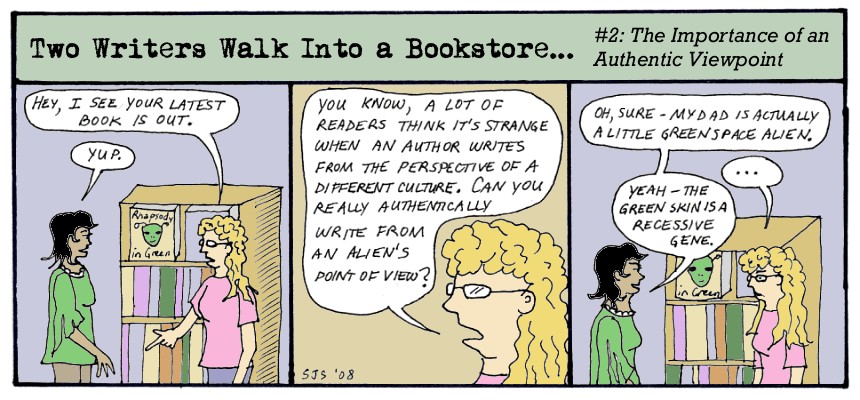
Toon Thursday: On Authenticity


Click to view larger. Sorry today's is a rerun. I had an idea all ready to go, but TIME, people, time is not on my side right now. Perhaps I should've taken a 2-week break from blogging, but I was afraid to stretch it out too long lest I fill that time with other stuff more or less permanently, which is the opposite of what I want to do.

Anyway, Happy Spring, Happy Easter, and Happy Writing!

March 27, 2013

Turning Pages: The Night Swimmers, by Betsy Byars

Everyone from Forbes Magazine to individual authors are selling the "thar's gold in them there backlists!" schtick. But, is there really? Are book which were first published in the seventies or eighties best kept there? A book which goes out of print goes out for a reason, does it not?

Yes. And, then again, no.

With the advent of online bookstores, finding a book which you'd loved as a kid is easier than ever. Making a backlist available in this way is a great idea. It might have the unfortunate side effect, however, of making us wonder about the popularity effect of a book - would a book you loved as a kid stand up to today's readers? Do the award winners of yesteryear automatically become today's crowd-pleasers? Maybe not. For example...

Reader Gut Reaction:

THE NIGHT SWIMMERS is a Boston Globe-Horn Book Honor Book, a 1981 American Book Award winner, a Parents' Choice Award, a Child Study Children's Book Committee: Children's Book of the Year award winner, an IRA-CBC Children's Choice, and a School Library Journal Best Book of the Year. (NOT a National Book Award winner; the ABA is a whole 'nother award.) So, on one hand, that's a lot of acclaim. Clearly, there's something enduring here... but I am of the opinion that the "something enduring" is not necessarily for kids, not with this book. Please be clear: this is a good book! The writing is clear, the plotting is true, the inner mind is precise. However, THE NIGHT SWIMMERS is also a candidate for a crossover book - I suspect it ought to be read by undergraduate social work majors rather than middle graders.

The author has a very keen and perceptive eye toward motivations and reasons, the way primary school kids think, and exposes the vulnerabilities of these children in a single parent family in a way that is both heartbreaking and eerily bloodless. There's a sense of "it is what it is," a weary resignation, and a great deal of super-mature reasoning on the part of the main character. The bird's eye yet distant point of view endows the piece with such an isolated feeling that this is not an early reader or MG novel most kids would enjoy, and yet... it's a clear snapshot of the late seventies-early eighties with no nostalgia, and I think the plot could well be played out in countless homes, in various ways, today.

Concerning Character: Retta is thrust into sibling leadership at the death of her mother. When their father moves them to a new town to revitalize his flagging country music career, Retta's concerned for her siblings' reputation in their new town. She wants to give them so much - new experiences, the right clothes, the right knowledge - so she marches them out, in the middle of the night, to a neighbor's pool, for swimming excursions. In her mind, she's being a good mother by giving them these experiences.

Retta's siblings by turns resent and adore her, but when this story begins, their mother has been dead for two years, and resentment is rapidly taking over adoration. Their father, a honky-tonk lounge singer who works nights, is a self-absorbed peacock of a man with few redeeming characteristics. He remains unavailable in hopes that problems will solve themselves. He honestly does not SEE his children - at all. He sees himself. His loss. His life. His dreams. Three children - no mother - and though he loves them, in apparently the deepest way his very crowded and shallow heart can muster, they have no real father, either. A sister who thinks she's responsible for her little Clearly, these guys are in trouble.

Retta is bossy - and quite an officious little bustling busybody. She is, as a sibling, both perfectly caricatured, and perfectly unlikable. Yet, most of the story is told through her desperate eyes. She sees the world through the lens of her television, and often acts in ways in which TV mothers act - because she has no other role model. This loss is neither particularly saddening nor sharp, but is deeply pervasive within the plot. Retta does what she does and acts as she acts because this is how TV mothers act, and God knows, she and her siblings need a mother - any kind of mother. She clings grimly and pathetically to the role, giving them peanut butter sandwiches, pinches, shakes, and scolds... and she's doing the best that she can. When the elder of her two younger brothers finds a new friend to hang out with, and invites their youngest brother along, she feels her tiny empire crumbling - and her family further falling apart. Desperate to keep "parental" failure at bay, one night she follows her brother to meet his new friend - leaving their dreamy youngest brother unsupervised. It quickly becomes apparent that Retta is not a mother - and that someone must shoulder that responsibility for her family, before it's too late.

Recommended for Fans Of...: Kid/teen survival novels with siblings, like Adele Griffin's RAINY SEASON, Heather Quarles' A DOOR NEAR HERE, and the first three books of the Dicey Tillerman cycle - HOMECOMING; DICEY'S SONG; A SOLITARY BLUE by Cynthia Voight

Cover Chatter: This was a critically acclaimed book, and so there are many 80's covers to love.

The first cover was done in the style we can only call Early Depression. I mean, seriously? I know 1983 was a rough year - Regan was president, after all - but I think the children needlessly suffered the brunt of that adult malaise. Sheesh, book designers. Just... sheesh.

Early Depression gave way to Paperback Depression; the first Dell paperback at least gives us a better depiction of children, with an accurate portrayal of Ray cuddling Retta, and Johnny off to the side. 12-year-old Retta looks far older than she should, but we can blame that on the muted colors.

The cover most familiar to the rest of us will of course have been put out by Scholastic. The red edging and accurate artistic rendering makes me want to get out a magnifying glass and look for the tiny, tiny book symbol... that it looks like the children are swimming in broad daylight is an unfortunate side-effect of their enthused - and wonderful - use of color.

Probably the best depiction is this later - early 90's? - cover which focuses more on the boys than on Retta - which is interesting. Though the story's point of view briefly visits each child, Johnny is the least talkative, and rarely commands the narrative. Retta as both sitting stiffly upright, in the "in charge" position and far from the fun speaks to her real position in the family.

The final cover is the ebook version, which is the most stylish from a graphic design perspective, but also somewhat confusing, as it has a very adult air about it. A reader not familiar with the author might see three bathing suits and expect something entirely different.

Authorial Asides: The title was what drew me to this novel, and it also was what came first to the author, who came up with the idea from a friend's concern that the nights they weren't home, that neighbor children were coming over and swimming. While her friend no doubt continued worrying about drowning and liability insurance, Betsy Byars likely tuned her out, mentally caressing her precious title, and wondering how to plot the four thousand sentences needed to create her book...


FTC: This novel was courtesy of the author and Open Road Media. You can find tons of Byars backlisted titles now in ebook form, and you can buy THE NIGHT SWIMMERS at any library, online, or at an independent bookstore near you!

March 26, 2013

Turning Pages: Saving The Planet & Stuff, by Gail Gauthier

It was amusingly ridiculous, the trouble it took to get a copy of this book. First, I thought I'd already reviewed it, years ago. Turns out I'd reviewed another of the author's novels (and hadn't even labeled that one properly, so almost didn't find it). Next, I forgot all that I'd learned during the Cybils about ebooks and Mobi and Epub and took forever to get it uploaded - my fault entirely. When that FINALLY came together, I started reading, and within the first three pages laughed. Oh, yeah. I HAD read this book before. And it was just as snarky-funny as it was the first time.

Reader Gut Reaction: SAVING THE PLANET & STUFF is an old-school crossover. The main character is confused, but intelligent, the subject matter interesting to a wide audience, and the gentle - but accurate - digs at counterculture, ecoculture, aging adults, alarming teen girls, vegans, and others are peppered throughout, keeping the chuckles coming. Though the main character is supposed to be sixteen, I could see enjoying this both as a sardonic and smart upper middle schooler, and as an adult.

As I'd read before with A Year With Gus & Spike or Happy Kid, the author is good at creating realistic boy characters who are clueless yet intelligent, observant, and blurt out some home truths that adults at times do not want to hear. Hypocrisy is really hard to support with these goofy-but-wise guys hanging around.

Concerning Character: Michael Racine III comes from a family of ordinariness that is mind-numbingly, eye-glazingly borrrrring. He's pretty sure he's good at nothing, too - and in tiny ways, it's beginning to gall him. He had a job, but it... well, ended, which means he's sure wandering off to Vermont with his grandparents' aging hippie friends, Nora and Walt will provide fodder for a much more fascinating summer - more along the lines of the adventure of being in Spain or working at a summer camp or as an assistant on an archaeology dig, which is what all his friends are doing. Going to be a "gofer" at The Earth's Wife, an ultraconservative, old-school environmental magazine he's only heard of disparagingly from his grandfather is kind of a lame gig, but a lame gig is better than nothing, right? Right?

Actually, as it turns out, "nothing" might have been more relaxing. For starters, Nora and Walt are nuts. Nora may - or may not - even wear a bra. Walt is big, touchy, and yells a lot - which Nora says only means he's passionate, not angry, but Michael can't really see the difference. And then there's the magazine itself - hopelessly uninteresting - and their house! Hip-high weeds - because mowing is against nature - no AC, because, those fluorocarbons poison the planet, tofu dogs instead of meat, and the oldest computer known to mankind. Somebody is ALWAYS ragging on him about turning off the lights. Summer at Nora and Walt's is never going to be the hipster, cool type of adventure Michael wishes it could be. However, he is where he is for a reason, because something is in the air... and it's not just narrow-mindedness, more-eco-than-thou attitudes and hypocrisy...

Recommended for Fans Of...: While I cannot ever say I've read something in the genre of "eco-comedy," this one is for fans of Saci Lloyd's books, including THE CARBON DIARIES, Carl Hiaason's HOOT, FLUSH, SCATand CHOMP; and other books with a focus on environmental impact.

Authorial Asides: This ebook is another example of authors publishing their backlists through digital media. The author did some re-editing tweaks, figured out how to get her content into a downloadable form, designed the cover, and produced the book. I have a lot of questions about the whys and the process, and look forward to hosting the author's answers on this blog as to what platform she used, how she contracted an

Cover Chatter: I like both covers of these books - the original novel form, and the ebook form, because the planet is centrally featured. The original has some good natural features - the little recycling symbol is the symbol of Nora's conviction that everything can be reused, including everything currently being stuffed into the the spare rooms of the house; I am only said that there's no picture of a composting toilet. The ebook cover depicts Michael bent under the weight of the planet while just trying to send email. Both covers fit so well with the story. Especially knowing that the ebook was self-pubbed, I'm curious as to how the newest design was completed - and what all goes into these types of decisions.


FTC: Wonderland received a copy of this novel courtesy of the author. You can find your copy of SAVING THE PLANET & STUFF by Gail Gauthier online, or at an independent bookstore near you!

March 25, 2013

Monday Review: PAPER VALENTINE by Brenna Yovanoff

Reader Gut Reaction: This is the first Brenna Yovanoff book I've read. I meant to read The Replacement, but hadn't yet. And then this one caught my eye on the library shelves: a murder mystery, an unexpected love story…and a ghost or three. I've been gravitating toward books with ghosts and supernatural powers because of my own projects (and my curiosity about how other authors write such things), but throw in that suspense element and I'm hooked.

This book definitely did hook me, from start to finish. In the first chapter, we learn that there's been an unsolved murder of a teen girl, and we learn that Hannah, the narrator, is being haunted by the ghost of her best friend. And of course you'd expect a ghost to be somewhat morbid, but Lillian seems inordinately interested in the mysterious death. Not because her own death was a mystery; she died of anorexia. But perhaps it's that she's scared for Hannah and her younger sister Ariel, and clinging to life so she can make something right.

Concerning Character: The narrator, Hannah, is almost never without the ghost of Lillian, even though she admits she's not the kind of person who gets haunted by anything. But Lillian seems caught, unable to leave, and Hannah has to deal with it. She's a capable and strong protagonist, and I like that a lot; she's got a lot of responsibilities, but she has the personality to shoulder them—watching out for her sister, helping her cousin Kelly at her photography shop over the summer. It's just that when it comes to taking care of herself that she's a little less careful.

For better or for worse, though, she has Lillian's ghost, who is a wonderful combination of creepy and sympathetic, and she has a good family with a great stepdad, and she has Finny Boone, a delinquent with a heart of gold who ends up surprising her with his capacity for kindness and friendship. But she also has this murder mystery that seems to be drawing her in whether she likes it or not, and that keeps the reader on edge wondering whether someone in her life would have the capacity to kill. The author does a good job of keeping us on our toes, never quite being able to trust anyone…

Recommended for Fans Of...: Anya's Ghost (reviewed here) or Friends With Boys (reviewed here)--both stories about figuring out how to fit in, especially when you've got a ghost bugging you. Even more strongly recommended for fans of suspenseful murder mysteries with just a touch of the supernatural, like Lois Duncan's books.

Themes & Things: Though Lillian died from anorexia, this is far from being a problem novel—rather, it's much more about grief and about secrets, about learning who you are and who others are despite the fact that we all keep our secret hearts hidden to some extent. It's also about the strong bonds of love and family and friendship, and the terrible things that can happen when you don't have those bonds to save you, to hold close to your heart.

Cover Chatter: The paper-cutout girl and heart is just really, really cool—fitting for the plot of the story, but also unusual and eye-catchingly creepy with its stark red and black silhouette.

Review Copy Source: Library.


You can find Paper Valentine by Brenna Yovanoff online, or at an independent bookstore near you!

March 22, 2013

Iowa, Rhode Island, and Parts East: I feel you


Via Indexed, by Jessica Hagy.
Feel better this frigid day by participating in the March Madness Poetry at Ed DeCaria's THINK KID, THINK. It's Third Round and time for the elite eight to come forth for the finals. Join the fun!

March 21, 2013

Maybe this is only news to me, but...

Okay, so I know the rest of you who are avidly following Hank Green's (well, it's not only his, but) webseries, THE LIZZIE BENNETT DIARIES are seeing that shiny hundredth episode drawing nigh, and doing a lot of sighing. But, what else are the Bros Verde doing these days? Dispensing knowledge. More knowledge. To Knowledge junkies. Together with my fave magazine mental_floss, John Green is talking smarts. This week Mr. Rogers, who is always a happy topic, and who would have been eighty five this month.

Tor.com's morning links included this most awesome piece of 19th century sci-fi ...embroidery. Yes, while other girls were cross-stitching horrible maxims about staying barefoot and pregnant (okay, no, not really), the luckier ones were embroidering models of the solar system. Hurray for girls doing science!

And, speaking of girls doing science, AARRRRGGGGGGHHHH to the whole Jane Goodall plagiarism thing. As a respected scientist, this is WHOA OH NOES territory, as a woman in a male-dominated field, bad, bad news, and as a writer... realizing that she has a ghost writer?? Oh, dear. Oh, dear. Really -- I'm watching this whole thing with crazy intensity, seeing how it's going to turn out.

It's La fiera del libro per ragazzi once again! Or, if you non parlano Italiano, that's the Children's Book Fair, held yearly in Bologna, Italy. Last year, Jules went, I think the year before that, Betsy Bird went and both had a fine, fine time. My agent goes every year, and I... pout. Someday, someday!

The fab thing about the fair, other than the fact that it's where many American publishers gather to sell international rights to their author's works, is that this year Bologna is celebrating fifty years. We tend to be a little provincial, as Americans, and forget that our own children's literature history barely getting started, compared with the many countries in which our own tales find their roots abroad. Here's to international stories, international traditions, and seeing more of the world in American books for children. I hope my SAM has a lovely time, and even if he doesn't bring me a cool bookmark this time, I won't begrudge him too much.

Happy Thursday. AF will be back in a week or so. ☺

March 20, 2013

Turning Pages: Awakenings, by Karen Sandler

Wow - March has almost slipped away! This book is out in April, so I thought I needed to get a move on in reviewing it. This is kind of your "waiting on Wednesday" wait no more review - I know a lot of people are anxious for this one to come out. I feel privileged to have been offered it from Tu Books. Thanks, Tu!


Last time I encountered a Karen Sandler book, I came away with these questions: What is it that makes us human? What happens when we apply the one-drop rule to genetic modification? Does someone with a pacemaker still count as fully human, or partially automaton? How many ways will the upper classes use to justify creating a servant class? And is it already happening? And now, reading the sequel to the fabulous TANKBORN, I... can't say I have any answers. Yet.

Reader Gut Reaction: The second book in a trilogy is never, ever easy, and this one has those growing pains showing up immediately. For readers who have read the first book, the second begins slowly, with Kayla and Devak apart, and both of them working separately for the greater good of their newly formed society. There is almost what I would call misdirection in the first section of the book. We have a lot of time with Kayla and experience her inner mind, which is a mess. She's pining over Devak, only to discover he's not that into her. She's chafing at having to appear subservient to Risa, her lowborn Kinship partner, and she's worried to death at violent attacks against the GEN, there have been explosions, and the Brigade is getting all riled up. Changes are happening - changes Kinship isn't starting. Then, a GEN boy named Abran is hurt in an explosion. Risa and Kayla pick him up - but he might not be exactly who he seems. He might actually be the one who set off the bomb. Things are beginning to feel out of control...

Misdirection only works insofar as it gets the reader to look the other direction. Eventually, all of the pebbles of plot roll together in an avalanche, and the reader finds themselves looking - intently. The last half of the book, things start to click. The beginning being slow matters not at all - and I actually found myself going back, making sure I hadn't missed anything when I hadn't been as engaged. We're left not sure how things will end, and with a very clear understanding - there's a new game in town, and it's not about friendship or opening up new avenues of trust between Lowborn and GEN and Trueborn. It's not about Kinship, and who we thought was in charge isn't in charge any longer.

There are deaths, which are upsetting - and in some cases, downright gross, but remember, this book has, as its main character, a GEN, a genetically modified human being who was, once upon a time, someone else, until she was changed. That comes up again, and is actually more important than we first realize.

Concerning Character: While there are new characters introduced, there are few who readers need to remember. Minor characters who we'll probably see again will be reintroduced in the next book; the minor characters from Tankborn who reappear in this book are fully fleshed out, and adequately memorable. The more important characters, aside from Kayla and her friends, are mostly not human.

Setting remains almost a character - the varying landscape of the planet of Loka, its various religious groups, the castes and sects of allabains, who gather themselves to live a certain way, the tricky compromises of the Trueborns who have lost status, and live in sectors which are peopled with both lowborns and demi-status Trueborns, the enforcers, the Brigade, the ginormous, man-eating bhimkay spiders, the six-legged desert cats, the holographic house decorations. The worldbuilding in the Tankborn series remains one of my favorite things about it - imaginative and complete, though the names of things and people will be a little confusing to those just getting into it with this book, because with the GEN there are so many characters, but still, it's all solidly explained.

Scratch - a disease - is also a character in this book, in a manner of speaking. It has some overlap with smallpox, another disease which swept through populations of people who were unwanted.

The final new "character" in this novel is graffiti. The letters FHE stand for Freedom, Humanity, and Equality. Oddly enough, none of those three words are really present in this book... but the letters show up repeatedly. Those words, of course, bring to mind the slogan of the French revolution - "Liberté, Egalité, Fraternité ou la mort" - and many will agree that none of those things showed up in the French revolution for a long, long time, either. Is it any wonder that the third book in the trilogy, slated to be published Spring 2014, is titled REVOLUTION? And that it appears that this brave new world has possibly already lost its way? Can't wait to read this saga's conclusion.

Recommended for Fans Of...: Ender's Game, Orson Scott Card. Dawn, Octavia Butler. The Powers That Be, Anne McCaffrey. Beggars and Choosers; Beggar's Ride, by Nancy Kress. The Sky Inside, Clare B. Dunkle. Birthmarked and its sequels, by Caragh M. O'Brien. And tons more YA novels on genetic engineering, but none quite like this one, which also brings thoughts on class, caste, and color.

Cover Chatter: At first, I was just mesmerized by the face on the cover - kind of a floating head thing going on. And then, I wondered why the head was floating above the floor of a room? And THEN, I finally saw the graffiti. It took me a minute - I admit that I was distracted by a pair of eyes, and a GEN mark. As ever, I am not a fan of face covers, but I like this one. With the multitudes of GEN characters in the novel, it's probably better to stick with a single image on the front - but, if choosing between the graffitied wall and no face, or having a brown face on the cover? I like the addition of the face.

Authorial Asides: Did you know Karen Sandler has math and physics degrees, wrote romances for Kensington/Harlequin, and she's also writing a mystery, due out in 2013? A cross-genre writer after my own heart!


After April 1, you can find AWAKENING, Tankborn #2 by Karen Sandler at online, or independent brick-and-mortar bookstores near you!

March 18, 2013

A Brief Hiatus

Which parts are burnt out? Answer: All of them!
For the health of my poor brain and all of the many things I've been forcing it to do over the past couple of weeks, I'm taking a brief blogging hiatus until next week. With the last of my book edits due on Friday, several other deadlines looming, and a parental visit beginning on Thursday, I suspect this short break is a very good plan. Brain burnout has been feeling dangerously imminent.

I shall see you all in a week--one year older (yep, the ol' birthday is coming up this weekend) and, one hopes, a bit better rested.

March 14, 2013

Thursday PREview: GADGET GIRL by Suzanne Kamata

Reader Gut Reaction: Gadget Girl: The Art of Being Invisible, by Suzanne Kamata, comes out in May, but I've been cleared by the author to get some buzz going—and I'm thrilled to be able to do so with a book that deftly handles many facets of the mixed-race/bicultural experience. In fact, I was impressed by how many "issues" (for lack of a better word) the author was able to include without seeming like they were gratuitously crammed in—rather, narrator Aiko's life is a realistic mess of desires, fears, embarrassments, love and hope.

Concerning Character: Aiko Cassidy is half Japanese, but she's never known her father, who is an indigo farmer in Japan. But she wants to meet him someday, and so she eagerly consumes every bit of Japanese culture that she can, especially if it's got to do with manga. Having inherited quite a bit of talent from her artist mother, Aiko draws her own semi-autobiographical manga called Gadget Girl. But when her mother announces their summer vacation, Aiko is devastated: they're not going to Japan after all. They're going to…Paris?

Yep. Her mother's won a prestigious art award and that's where they're going. This brings a whole lot of family issues to the fore, because her mother's main sculpture subject is Aiko herself. And Aiko? Well, she has a curled left arm and a limp from cerebral palsy. At heart, this story is in many ways a study of Aiko's changing relationship with her mother, as she learns to accept others and, in doing so, learns to accept herself. However, we also see her gain more confidence and courage, and learn to be who she is when her mother isn't around, when she doesn't have an immediate support system, and that's truly gratifying.

Recommended for Fans Of...: Stories about coming of age and finding yourself when you're traveling, like Thirteen Little Blue Envelopes by Maureen Johnson or the Traveling Pants books; stories about the mixed-race experience and growing up sort of between cultures. I think this one is particularly suited to MG and younger YA readers.

Themes & Things: What doesn't this story cover? In some ways I found myself wishing it was longer, because then it would be possible to delve even more deeply into some of the themes. I was impressed with how the author handles the bicultural aspects of the story, bringing in issues that a lot of mixed-ethnicity readers will find familiar: the fact that there are many cases in which the marriage doesn't work and the kid(s) get brought up in one or the other culture exclusively; the fact that there might be a new family with new half-siblings; the fact that extended families in traditional cultures have different ideas when it comes to half-breed kids. These are important, and I know there will be plenty of readers for whom this will resonate and who will feel less alone because of it.

The other theme I thought the author explored particularly well was that of acceptance, particularly self-acceptance. Disability or not, self-acceptance is not an easy task, and Aiko has plenty of reasons why she feels like she's invisible; but Aiko has a strong support system, and she's able to take major steps in the journey toward realizing she has the right to the same desires and dreams as anyone. I particularly loved her stepfather Raoul (yay for awesome step-parents!). Despite a few moments that made me teary, it's ultimately a hopeful story, and I'm glad to see another addition to the mixed-race YA fiction oeuvre.

Cover Chatter: I absolutely LOVE that cover. It's fun and colorful and appropriately manga-esque—but it's got that touch of humor in the eggbeater and other gadgets, too. And the eye is definitely eye-catching. Total win.

Review Copy Source: Author/publisher.


You can find Gadget Girl by Suzanne Kamata online, or at an independent bookstore near you!

March 11, 2013

Monday Review: BAD GIRLS by Jane Yolen and Heidi E.Y. Stemple

Reader Gut Reaction: Imagine my excitement when I heard that Our Jane was back, and tackling history for young readers in an illustrated/graphic novel-type format. Tanita and I practically grew up on Jane Yolen, and we admire her so much, in part because it seems as if there's nothing she can't do when it comes to writing for young readers.

In Bad Girls: Sirens, Jezebels, Murderesses, Thieves & Other Female Villains, Yolen collaborates with her daughter Heidi and illustrator Rebecca Guay in chronicling the stories of 26 notorious women in history and legend, from the famous—like Cleopatra, Anne Boleyn, and the actual Biblical Jezebel—to the less well known, like the fascinating female pirates Anne Bonney and Mary Read (whose tales no doubt inspired those Bloody Jack books I can't get enough of).

The book's format alternates between brief prose write-ups of each infamous lady—accompanied with an imaginative full-color, full-page illustration of each—and a page or two of comic panels with a sort of linking meta-narrative of Jane and Heidi discussing and debating each woman's guilt or innocence, each one's potential mitigating circumstances in the eyes of history. It's an interesting structural choice, one which I believe is designed to try to pull in readers of a variety of ages. The font size for the prose sections is rather large and the writing style clear and unadorned—these segments seem like they're meant to appeal to younger readers who might be reading the book with parents, while the comic panels bring in a more mature viewpoint that I see as more middle-grade or older.

Concerning Character & Theme: While I have mixed feelings about the format of the book and its intended audience, I was riveted by the stories of each of the women, and this seems like a great jumping-off point for discussion and further research into their histories. Indeed, there are ample resources listed at the end of the book for those who like bibliographies (*ahem* me…), and I really enjoyed reading about the ones I either hadn't heard of or didn't know much about.

Each figure is presented in a way that shows there is more than one side to every story, even when it's history, and it gets the reader thinking that it just might be possible some were victims of circumstance. Other women, meanwhile, might have been making the best of a bad situation, or might have suffered a bad rap for seizing control of their own lives during historical periods that didn't look kindly on women doing such things. Others, of course, might have been just plain bad. In that respect, the book gets you thinking about what it really means to be a "bad girl." It's an entertaining introduction to women's voices in history, as well as a fun way of exploring our cultural fascination with outlaws and hoydens.

Recommended for Fans Of...: Richly visual interpretations of history, myth, and legend, like the various Olympian graphic novels by George O'Connor (Zeus reviewed here), or Outlaw: The Legend of Robin Hood (reviewed here).

Review Copy Source: Publicist (Raab Associates).


You can find Bad Girls by Jane Yolen and Heidi E.Y. Stemple online, or at an independent bookstore near you!

March 08, 2013

TURNING PAGES/WCOB: The Changeling, by Zilpha Keatley Snyder

- Know all the Questions, but not the Answers -
Look for the Different instead of the Same -
Never Walk when there's room for Running -
- Don't do anything that can't be a Game."


The Never Grown-Up Spell, from The Changeling

I have a lot of respect for Open Road Media. Once upon a time, one of its co-founders was the CEO of HarperCollins, so it's not as if the company is unfamiliar with "traditional" publishing. But, they understand that part of the road in ahead in publishing will be through the medium of digital media. And, it is through Open Road that many authors are getting in the gate, taking a chance on first publications, or publishing their backlists and getting them back into the hands of new readers. Zilpha Keatley Snyder is responsible for THE HEADLESS CUPID, THE VELVET ROOM, and THE EGYPT GAME and hordes of other interesting and unique series, and I'm excited to review her book, which was first published in 1970.

It's often a strange experience to read YA lit written before I was born. I compare characters, plotline, and story arcs. I realize that a lot of what was published back then would be difficult to get published for the first time now. I'm not sure how I feel about that... or what it says about the childhood reading choices of kids who are kids now, and not in the eighties and nineties when I was much younger.

I have a feeling there's entirely too much to say on that topic! However - I simply will celebrate the eclectic, varied, and unusual stories I grew up with, be glad that LIBRARIES are at the forefront of holding on to author backlists, and that this digital age is digging up some gems to put into the hands of a new generation and a new style of readership. Here's to ferreting out a few more awesome overlooked books to share.

Reader Gut Reaction: I had two gut reactions, one, this book is told almost entirely in flashback. Nowadays? There's no way that an editor would be happy about three quarters of a YA book being told in flashback. Two, this book would be perfectly appropriate for young middle grade readers. Despite the fact that the beginning of the novel is when one of the main characters is a high school sophomore, the amount of time the flashback spends in grade school means that a lot would resonate.

Concerning Character: Martha is shy, plump, and babyish. She is the well loved and completely misunderstood youngest child of the well-meaning Abbott family. Not a take-charge extrovert like the rest, bookish Martha lacks confidence in herself, and spends much of life in floods of tears.

Ivy is underfed, large-eyed, and raggedly clothed; one of those piss-poor Carson kids, whose low class family usually has one or another members in Juvie or in jail. How she and Ivy become friends is through the magic of elementary school - and a shared love of their imaginary friends. How they remain friends through years of time, very different families, and a frowning community is something of a miracle.

Together, the two make an unbeatable team. They find magic in their make-believe, and that magic fuels their world.

But, sometimes, the worlds of our imagination bump up against The Real World, with painful results.

Is it survivable? Yes. But, is it easy? Never.

Recommended for Fans Of...: S.E. Hinton's THE OUTSIDERS, in its commentary on the individual and society, THE UNSEEN, by Zilpah Keatley Snyder, for its out-of-place-in-my-family main character, Jerry Spinelli's STARGIRL, for the quirky and unusual Ivy, THE HIGHER POWER OF LUCKY, by Susan Patron, and just about anything by Madeleine L'Engle, Cynthia Voight's early books, and Judy Blume's middle grade gems.

Themes & Things: Many of ZK Snyder's books are about families - ordinary folk who have jobs, who endure school, and who navigate the usual bits of growing up through sports, games, and the long unfettered days of summer. Snyder focuses on the sometimes quirky individuals who make up those groups. Characters are either not in step with their communities, as in Martha and Ivy's case, or apt to engage in hugely imaginative games which others might not get into, like in THE EGYPT GAME, or THE WITCHES OF WORM. The novels usually also feature characters on the cusp of adulthood, and feeling the usual twinges and pains of growing - twinges which sometimes cause them to do things which are questionable or cruel - witness both witness minor character Kelly's angry obsession with Ivy, or Jessica in THE WITCHES OF WORM blaming her unkind behavior on her cat. Snyders books seem to feature a lot of inner mind and times when the character holes up and tries to figure out the world - which is how a lot of my adolescence was spent, anyway. Despite the fact that this book is pretty dated in years, the timestamp of the seventies is trimmed neatly from the text. I still think it skews younger than YA, just based on the sort of flashbacks from ages 7 - 16, it's a book that would work well as a read-aloud for younger middle graders, and a "on my own" type of read for older middle graders, and more sensitive YA readers.

Cover Chatter: Well, this was barely the seventies. You know there will be COVERS...

First, I have to say it: the watercolored cover was probably a mistake. The style seems meant to be amateurish, and while it does hark back to the book, where the girls were one day painted by a woman whose name was Mrs. Smith, it is neither exactly the painting that Mrs. Smith did, nor an accurate representation of the girls - something I'm a stickler for. It was a lovely image that probably... shouldn't have been attempted.

The more generic aquamarine cover is nice enough, and once you discern the face in the leaves, it makes more sense that it is a depiction of Ivy. The color says 1980's pretty loudly. ☺

The dark cover with the title in blue, and Ivy dancing before the tree in her yellow dress once ties back to the story, but sometimes the depiction of someone who is supposed to be different or look counterculture can be too specific, and feed the imagination where it would better be to allow a picture to develop all its own. Ivy never looked nutty with her dancing to my mind - just free. Here, she looks like she's been caught up in a tornado that might leave her in Oz.

I love the Dell cover. Just. Love. It. It's solely for the purposes of familiarity, but these were the covers of my childhood, with those photo-realistic drawings that always went along with some happening in the book. I also really like the most modern cover, which is the first one depicted. The girls in the woods - themselves in silhouette, but their clasped hands, telling the story of a friendship that through distance and misunderstandings, survived.


You can find THE CHANGELING by Zilpha Keatley Snyder at your local library, or at an independent e-retailer, and possibly even in some pretty special brick-and-mortar indie bookstores near you!

March 07, 2013

Toon Thursday: It's YOUR Turn, Nonfiction...

...Feel the mordant wit of my mighty pen. MWAHAHAHA!

...Yeah, I can't really do a good evil voice. Anyway, here's your toon:


I would be remiss if I didn't mention that I looked up a load of cool frog facts in researching this cartoon.

March 05, 2013

TURNING PAGES: THE RUNAWAY KING, by Jennifer A. Nielsen

Well, you know what they say about middle books.

No? You don't? Well, "they" usually say that in any trilogy, the middle book is awful - that it doesn't give you any new information, and that it doesn't do anything but take up space. Sometimes this ubiquitous "they" are correct - that the middle book is the one in the trilogy where Nothing Happens. However! This time? In this second book of The Ascendance Trilogy? They're wrong...

It's hard to talk about the middle book in a trilogy without some SPOILERY*SPOILERS, but I will do my level best.

Reader Gut Reaction: Well, you know I had some major love for the first novel in this series. Though others talked about seeing the twist in the plot coming early, I had only the lamest suspicion until All Was Revealed. So, I was caught off-guard; the writing in the first novel took me in and held me under until the book was finished in a single gulp. It wasn't like that with this one.

I have a problem sometimes when I begin to care about a character. I cannot - cannot! - bear to let anything happen to them. Dumb, I know, but keep in mind I was the wee girl praying for Batman every week, okay? I just wanted him to be okay. Readers always want that, but it makes for very boring fiction. So, Things Must Happen. Painfully.

Concerning Character:So... Sage. Yeah. Last we met him, he was a scrappy, foul-mouthed, hard-headed, stubborn thief. As it turns out, he's a HARD-HEADED, NUMB-SKULLED, STUBBORN SON OF A ...queen, and he's made it home in one piece, mostly. But, he's barely there before it turns out that his country doesn't really love him, and doesn't even want him. And he's hurt. So very, very hurt. And when he's sent away to be kept safe, after an assassination attempt that comes far too close, he realizes that the threat to his country begins and ends ...with him. And thus, once again Sage comes up with the OH, MY GOSH WORST IDEA, EVER, in the world.

And then I had to put the book down...

...because I knew he was going to leap onto this bad idea with both feet. And the stakes in the plot were thus being raised to a dizzying height, in some kind of game of life/death that just COULD NOT end well. Readers began to care early on about this very scrappy character in the last book - and his arrogance (READ: fear) and stupidity (READ: fear) often cause him to cut off his nose to spite his face. And then to see the potential for it happening -- again. Only, this time, that he might end up cutting off his whole head to spite... something?? It gave me scairdy-cat vibes, and I had to pull back.

All of the doubts Sage had in the first book weren't revealed to the reader - we saw him primarily from the outside, for the most part, being a sap-skull and getting beaten for his pains. This time, though, we know every doubt, ever fear, and feel every risk twice as much. It's excruciating. It's...painful. It's going to make the third book something we all are just a little ANTSY for, by the time it's released.

What? Oh, you thought I hadn't finished it? Oh, ye of little faith.

Recommended for Fans Of...: The Attolia books, by Megan Whalen Turner, THE WHIPPING BOY, by Sid Fleischman, THE LUMATERE CHRONICLES, by Melina Marchetta, THE PRINCE AND THE PAUPER, by Mark Twain.

Cover Chatter: The deceptively simple cover is back, this time with a broken sword instead of a broken crown. In the book, there's a wooden sword that breaks inconveniently - which brings this to mind. Just like eventually there was more than one cover there's more than one cover for THE FALSE PRINCE, there's also the UK cover for THE RUNAWAY KING. And yet, I think I still like the American one better. No face - no body - just the symbols of a ruler - shattered. It makes a statement.


FTC: ARC by NetGalley and Scholastic; this was an unsolicited review.

After March 1, find THE RUNAWAY KING, The Ascendant Trilogy, Book 2 by Jennifer A. Nielsen online, or at an independent bookstore near you!

March 04, 2013

Monday Review: GEEKS, GIRLS AND SECRET IDENTITIES by Mike Jung

Reader Gut Reaction: I've been meaning to read Geeks, Girls and Secret Identities for quite a while, because the author, Mike Jung, is an online buddy and avid blogger, and he's also local to the Northern California area and this is his debut. After going to his, er, stupendous book launch and buying a copy, I had it sitting in my TBR pile, but then I had to put it off just a bit longer because Cybils time was looming, and Mike's book was on the finalist list for MG sci-fi and fantasy (yay!).

Anyway, this book is definitely deserving of its spot on that finalist list. It's got a blend of humor, silliness, geeky fun, and action that will appeal to middle grade boys for sure, and girls, too. Anyone familiar with the superhero genre will enjoy the humorous take on classic tropes. Also, it was a lot of fun to see Mike's very characteristic writing/blogging style translated into a book for young readers. If you've seen his blog (specifically, his blog URL), then you won't be surprised that the hero of this book is Captain Stupendous. Well, he's the SUPERhero of the book. The actual heroes are Vincent Wu and his friends, who have to save Copperplate City when something goes a little awry with their patron-in-spandex.

Concerning Character: Vincent Wu not exactly a popular kid. In fact, he's kind of little and nerdy. (And he's biracial—another yay!) But he's got his two friends George and Max, and together, they comprise the Unofficial Captain Stupendous Fan Club—not to be confused with the OFFICIAL Captain Stupendous Fan Club, who are a bunch of jerks, or the Stupendites, who are a bunch of girls. Vincent and his friends are the most devoted of the fans, though, and they know every last detail about their idol and protector. It seems like the only person at their school who doesn't really care about the whole superhero thing is the girl Vincent has a crush on, Polly.

The characters are all funny, appealing, and wisecracking but also realistically goofy and weird and awkward—recognizable and believable kids, even in a somewhat fantastical setting where there are superheroes (and, of course, supervillains). Vincent is an engaging protagonist who helps demonstrate that being a hero isn't just about brawn—brains are pretty important, too, not to mention loyalty and bravery. Mike Maihack's lively illustrated renditions of the characters bring them to life in a bold black-and-white style.

Recommended for Fans Of...: Sci-fi or fantasy humor, and books that have a somewhat tongue-in-cheek approach to the genre, like Jasper Fforde's The Last Dragonslayer (reviewed here), Redshirts by John Scalzi (reviewed here), or even City of Spies by Susan Kim (reviewed here), which isn't exactly in the same vein but has a superhero theme.

Themes & Things: As I touched on above, there's a lot in this book about what it really means to be a hero, and the author explores this idea from a number of angles. I don't want to give away any spoilers, because there are some really fun twists and turns, but generally speaking, this story shows that there are a lot of different ways to be a hero and a worthy human being. It's not all about having magical super-moves or being big and brawny. And you certainly don't have to have any of those things to be a winner and a hero in your own life, to the people who really matter.

Review Copy Source: Purchased my own copy.


You can find Geeks, Girls and Secret Identities by Mike Jung online, or at an independent bookstore near you!

February 28, 2013

What's In My TBR Pile?

Since I didn't yet manage to finish the book I wanted to review today, I've instead decided to devote this space to a booklist, since I don't do very many of those. And today's booklist theme is What's in Sarah's TBR Pile Right Now? Call it a random sampling of stuff I want to read in the coming months/year. Not counted in the list: stuff I'm in the middle of reading. And yes, some of you will no doubt see books you've sent and/or lent and think, Jeez, you haven't read it yet?? The answer is clearly no...
  • Seraphina by Rachel Hartman (Cybils SFF Teen winner; found at library) 
  • Paper Valentines by Brenna Yovanoff (a random fantasy find from the library) 
  • Gadget Girl by Suzanne Kamata (multicultural YA w/biracial protag) 
  • Bad Girls by Jane Yolen et al. (nonfiction graphic novel profiling infamous ladies of history) 
  • Under Shifting Glass by Nicky Singer (YA randomly sent to me by Chronicle) 
  • The Golden Shore by David Helvarg (history of California's coastline lent to me by Colleen) 
  • You Are Free by Danzy Senna (literary short stories by biracial author) 
  • The Unnaturalists by Tiffany Trent (has a super awesome steampunk cover) 
  • Just My Type: A Book About Fonts by Simon Garfield (Xmas present from Mom) 
  • Red Handed: The Fine Art of Strange Crimes by Matt Kindt (graphic novel I forgot I requested from First Second and which showed up in the mail to my delight) 
  • Pirate Cinema by Cory Doctorow (ebook I got as part of Humble Bundle) 
  • Magic for Beginners by Kelly Link (ditto) 
There are also a handful more books that I'm embarrassed to admit I haven't read yet, books which have been sitting in my office for ages. And then I anticipate a few more showing up because I just today heard our county library has started doing e-book lending. Squee!

What's on YOUR TBR  pile?

February 27, 2013

Turning Pages: The Summer Prince, by Alaya Dawn Johnson

Oh, my gosh, this was a hard book to review. Maybe because I kept kind of having to shudder, because I knew what was going to happen - what had to happen. I mean, hello, title. It's clearly there. The. Summer. Prince. People who read enough mythology - both Greek and English - and soak it up through international fairy tales know the score - the minute you put a season to some royal son's name, you've doomed him to die as a sacrifice at harvest time.

What made this a good book to review? The language - the nuanced sentence structure, the realization that, though this novel is directed to the YA market, that it will cross to the new adult and adult markets with relative ease. The author doesn't water anything down - not vocabulary, not theme, not the complicated cat's cradle of desire and reaction - it's all there, real life, in all its permutations. There are no easy explanations - no definitions, no hand-holding. Further, the book defies easy categorization - it's neither dystopian nor utopian, it's just... kind of post-apocalyptic cultural continuation. It's a hopeful, disturbing, haunting, book about the things we take as survival, and what changes them - and us.

And, it's about love - power - sacrifice, and endings. It kept me up late, and gave me weird dreams, because, in the end, it's kind of a book about everything.

Reader Gut Reaction: As I said, the idea of a summer prince wasn't a happy one - that's typically an Arthurian sort of fey and faeries thing, and after Holly Black and Melissa Marr, I'm pretty happy to leave that urban fey thing along. But! I took a chance that this was by an author whose work I respect, and boy howdy am I glad. And may I just say again that I so appreciate SFF authors of color writing for younger readers? I am truly excited.

This novel also touches some on the future of sexuality - with ideas of family and gender painted on a changing canvas. The author knocks cockeyed some perceptions, and will hopefully leave readers not only longing for new dialogue on that topic in the future, but seeking ways to make it happen now.

Concerning Character: June is quicksilver. For all that she's named after a fairly benign, sweet month of sunshine and loving promises, she's a heady, impetuous fireball - chomping at the bit to live life, dance hard, play hard, and defy her mothers at every turn. Her live-wire personality is in part because of the culture in which she lives - the pyramid of Palmares Tres, build with Japanese technology after nuclear winter rendered much of the land water-covered, inhospitable, or radioactive desert. Four hundred years into this new future of what was Brazil, the country is run by red-turbaned Aunties - because was it not man's foolishness that plunged the world into war? - and as a sacrifice to the land, and to the traditions, and to the gods, perhaps, every five years a young summer king is crowned. He is chosen in the spring, despite the summery name, and it is this king who dances the season away - a god of virility, sexuality, and charisma. It is he who chooses the next queen to reign. Though he has to die, the summer king's power is the embodiment of the hope of the wakas or young people of Palmares; he embodies the strength of its grandes, too, like tenacious tropical vines, clinging to life, and rising up again, even after nearly being wiped from the face of the earth.

Youth is important in Palmares - but not in the way you might think. Their ties with the Tokyo pyramids have benefited the Palmares folk greatly - they now have tech and body mods which allow them to live for up to three hundred years. This causes a lot of shudders in the waka - who in their right mind wants to live that long? Their lengthened childhood and adolescence causes them to chafe at the restrictions the Auntie place - restrictions on technology, social and societal restrictions on what behaviors a young person can do - there aren't many ways in which to distinguish oneself in such a society. There's nothing to strive for, when some of the Aunties have been in power for fifty years or more. Every other goal is so far from their grasp... and so young men dream of being summer kings, and young girls dream of being their consorts.

It's not much, but sometimes, a little can be everything.

Palmares is a sophisticated city, in its way - the city has AI which moves elevators up and down the pyramid levels - the top is where the Aunties live, including "the Auntie of Aunties," the Queen. The bottom is where the poor workers live - people with no connections, whose tech is spotty, and who take care of the algae pits which give oxygen to the massive living structure which supports life in this place. Social strata follows the levels of the pyramid - the Aunties don't like to think about the ones who live below, who are dark - so dark-skinned, who are poor, and dress in the clothes that remind them that once in their historical past, the people of Palmares were slaves. Unbelievably, there's a summer prince from the bottom tier of Palmares Tres society in the running this year for king - a gorgeous dark boy named Enki. June, together with her very best friend, Gil, is going to help Enki win.

And Enki... well, Enki is going to change everything.

Recommended for Fans Of...: Melissa Marr's Wicked Lovely, Julie Kagawa, The Iron King, and Karen Healey's really disturbing The Shattering. We gotcher summer kings right here, yo.

Themes & Things: Oh, the themes, we have them. Parental love, when your mother might live forever, might also mean that you can still fight with her about things that happened years ago, like they happened yesterday. How does one go about remembering? Forgetting? There's an exploration of death and grieving in a society pressing for ever greater longevity - which feeds into the themes of the importance of the dreams of our youth, and what makes our growing-up years vital.

June is an artist. She expresses her art in her body - from her hair to the bodymod lights embedded in her skin. She draws, she paints, but mostly, June wants to live as art... but is addiction to the spectacle actually art? What is art in a culture trying to forget the past, and clinging to the present so hard that it almost denies its children a future...? There is a journey to our art - a process - and it is deeply personal, and sometimes torturous, as we see in June's case.

The theme of revolution - of who has the power to change things, and of what gives us the knowledge to needs change, and the courage to take the first steps -- there are so many amazing thematic kick-off points for conversation right here. This is a multi-layered novel that offers so much to the reader - readers who can truly engage are going to find a lot here.

NPR has a bit from the first chapter of this book, and don't miss the Q&A with the author.

Cover Chatter: When a character in a novel has such a hugely DEFINING thing like a tattoo - or, heck, even hair color, a specific weight or height or birthmark - you kind of expect to see it on the cover. That doesn't always happen. FORTUNATELY, this novel had a great book designer. You get a sense of tech - movement - dance, even, in the dark background, which gives movement and color to the lights creeping across June's skin - especially visible when the lights go out in Palmares Tres. No face, but a suggestion of crinkled hair and brown skin - lots to like, here. I wonder if there will be a different cover for the paperback - eventually she got pretty daring with those lights...

Authorial Asides: This is Alaya Dawn Johnson's first book for young adults - but not by any means her first book. She was featured in the YA anthology, Zombies vs. Unicorns, and also has published short stories just about everywhere. Total bibliography list here.


FTC: This is an unsolicited review, ARC courtesy of NetGalley.

After March 1st, you can find THE SUMMER PRINCE by Alaya Dawn Johnson online, or at an independent bookstore near you!

February 26, 2013

Wicked Cool/Turning Pages: Dragon Time & Other Stories, by Ruth Nestvold

Technically? This is a WCOB - one of those wicked cool, overlooked books. The technicality surfaces when you realize this anthology is made up of previously-published pieces by author Ruth Nestvold. Asimov’s Science Fiction mag, Realms of Fantasy, Sci Fiction, Strange Horizons -- the list goes on. She's kind of everywhere, and is a two-time contributor to the Year's Best Science Fiction collections. And writing isn't even her day job.

I just happened upon her book of shorts because it was a one-day Amazon special. I was gobamacked when I zipped through the stories and found one which included the famous Aphra Behn. Being a Mills-girl studying the English Restoration in grad school and being a reader on some restoration thesis projects, I got to learn all about this fascinating woman - the first professional female writer in the English language - and it was fun to see someone else celebrating Behn's awesome creativity with a bit of her own.

Each story bears a little bit of history - fictionalized, of course - but these little nibbles of fact and realism create lovely settings for the cast of unique, complex characters. Nestvold has a deft hand with even such limited word counts - I would love to see some longer pieces by this author (ooh - a short Google, and I found some). While this book isn't marketed specifically to young adults, any SFF loving teen will appreciate them. I'd love to see what she'd write specifically for YA; there's shades of Tamora Pierce here, people.

But - I digress. On with the stories!

Reader Gut Reaction: If you were asking basic questions, I guess you could say that Dragon Time and Other Stories is a 30,000 word short fiction collection, made up of four quirky, creative stories that are intentionally side-stepping tradition. They're supposed to be, kinda-sorta a touch on the romantic side. They're all about strong female characters, and ...they're about staying strong. Sometimes that means hanging onto who they are with all they've got. Other times it can mean holding their horses -- no, all of them. And everyone else's...

Concerning Character: Katja, grand-daughter of the finest clockmaker in Unterdrachenberg, would love to practice that craft. She knows that she knows how - her grandfather has let her have a little set of tools, and a workroom all her own, even if he won't let her actually do anything to fix time - not for real. But, then, her opportunity comes - the dragons, who gave Unterdrachenberg its time, have suddenly taken it back. Does life stop, if time stops? And, is it worth putting aside your fears to make sure that nothing ever stays the same?

Ai Kyarem is bold as brass - all tough sinew and tanned strength and a long horsetail braid. The Great Mare is her goddess, and she bows to no man. However, her days of freedom might soon be over... This story reminded me of the steppes of Russia, and the Cossacks. Great fun.

Brilliana sets the stage on fire - and has the eye of Bonnie Prince Charlie. She has everything to lose if she admits that she's a witch, but someone is plotting to kill The Age of Magic.

Priscilla is perfectly able to run the kingdom by herself - God knows she's been doing that just fine for most of her life, since her father, the King, is a well-meaning but perfect dolt. However, fairy godmothers are around to make sure that princesses marry - even when they don't want to. Epic battle of wills, film at eleven.

Sound intriguing, don't they?

Recommended for Fans Of...: Tamora Pierce, Robin McKinley, Shannon Hale, and Kristin Cashore.

Cover Chatter: Covers for self-pubbed books can go a variety of different ways. Heck, any covers can be a train wreck, thanks to the overuse of Photoshop, but there are times when self-published writers really do themselves no favors, and I wish they'd had some better advice. This cover I like, because it shows an appropriately immense and terrifying dragon, contrasted with the teeeeensy tiny silhouette of a person in a doorway far, far away. It makes one feel reasonably frightened for poor Katja. ☺

Authorial Asides: From her website: Her novella “Looking Through Lace” made the short list for the Tiptree award and was nominated for the Sturgeon award. In 2007, the Italian translation won the “Premio Italia” for best international SF novel. Her “Big Fat Arthurian Fantasy” Flamme und Harfe (“Flame and Harp”) appeared with Random House Germany in 2009, and has since been translated into Dutch and Italian as well. Ruth Nestvold, international woman of mystery... or something like that. I'm happy to find a new author short fiction appeals to me, and I think Tech Boy will like them, too.


FTC: This is an unsolicited review; all opinions are my own.

You can find DRAGON TIME AND OTHER STORIES by Ruth Nestvold @ online retailers. Look for her other works here, at Gardner Dozois’s Year’s Best Science Fiction, and in several other anthologies.

February 25, 2013

Monday Linky Goodies, including Medieval Humor

Since I just got this rather large packet of printed proofs from my publisher on Saturday, ready for my proofreading perusal, this week has suddenly become rather busy. Therefore, today I've just got a round-up of interesting links that have come my way recently.
  • Giving back: Via the Goodreads newsletter (BTW do NOT be checking my Goodreads updates right now because I am sooooo behind) comes another wonderful-sounding book charity called Raising a Reader, which helps out by training parents to help kids be readers and by giving kids bags of books. I just loved the photo on the Goodreads blog with those cute kids holding their book bags, faces full of glee.
  • Marketing Multicultural Books is going to be the next topic on the CBC Diversity blog's It's Complicated series. Local Oakland librarian Nina Lindsay will be one of the contributors, and it promises to be another exciting conversation. (One in which Tanita and I, of course, have a vested interest.)
  • Do You Remember Bridget Zinn? She was a kidlit blogger and writer, and she died tragically early of colon cancer, and she was a truly lovely sweet person whom I had the pleasure of meeting at Kidlitcon in Portland some years ago. Her husband, Barrett, and her many blogging friends are trying to get some buzz going for the posthumous release of her fantasy novel Poison, which comes out in March. If you're interested in helping, as an author, blogger, reader, tweeter, parent, or whatever, check out more information here.
  • Graphic Novel Goodies! I owe my ability to stay abreast of this topic to GraphicNovelReporter's wonderful newsletter. In their last edition, there were a couple of  items I got excited about, including a monograph of Daniel Clowes' (author of Ghost World) art, and an interview with Lucy Knisley, who just wrote a food-related memoir-ish graphic novel called Relish: My Life in the Kitchen.
  • Hey, Teachers: Have you seen Edutopia? It just looks like a super cool site and they very  nicely have a rotating feature on bloggers who join their community.
  • In LGBT News, my blogging friend Lee Wind alerted me via his newsletter to the good, as well as the bad and somewhat ugly. And then, if you want cheering up after reading that last item, just read any of Lee's book reviews or his recap of his many wonderful and inspiring school visits.
  • More Cheer: Minh Le of Bottom Shelf Books never fails to crack me up, from medieval-inspired library admonishments to snarky book cover comparisons to Willems Shakespeare presents: Hamlet (starring the Pigeon).

February 24, 2013

2005-2013... and onward.

Still amusing ourselves after all this time...