December 07, 2006

A Predictable Betrayal

This book is a 2006 Cybil Award Nominee for YA Fiction.

Alex Fitzgerald is Barbara Belanger's shield; without him, she remembers that she's overweight and unpopular, that she has a port-colored birthmark covering the side of her face. Her mother abandoned her and her classmates have never been kind, but Alex rode into her life like a white knight one day on the playground, and everything has been better ever sense.

BJ wants to be a film director, and Alex longs to be a musician. BJ buys him his first guitar, and Alex and BJ's dad pool their funds to buy her a video camera. Alex's dream for music begins to come true, but the first cracks in his surface occur In the Garage, the day an admittedly gay boy auditions to be the band's lead singer. Abruptly, it tears the band apart.

What BJ doesn't sense about her best friend, Alex, their classmates pick up on easily. BJ's desperation to have female friends leads to her implausibly trusting Victoria and Rachel, two super-gorgeous creatures who convince her that maybe Alex isn't her friend, and that she should take his journal and read it and see just what he says about her. They're nosing for clues about him, and BJ is too self absorbed and miserable to realize this until it's too late. The predictable melodrama is kept to a minimum by the tersely written vignettes, but the conclusion of the novel is muddied and tragic and expected. The reader is left with BJ's questions and regrets, and not a little bewilderment as to where the adults were, and if in fact a murder has occurred in Alex's garage.

A painful and sobering story of betrayal, and another frustrating story in which a kid who is different pays with his life.

A Regular Family, Falling Apart

This book is a 2006 Cybil Award Nominee for YA Fiction.

Psychologists talk about the deep relationship that sons have with their mothers, how it is a hard bond of love that is unlike even the bond sons have with their fathers. It is a special kind of love, and Nicholas Nathaniel Thomas Tyler -- a kid with four names and two Moms -- is lucky to have it -- as lucky as any kid. But what happens when you're only legally connected to one Mom -- and then your Moms split up?

Basically, what happens is what happens to every other kid whose parents divorce. Nicky bleeds. He goes, in his eyes, from having had everything to having nothing, and no one to whom he can turn. Impetuous, playful, crazy Jo has been his mainstay, his idol, his whole life. His biological mother - careful, prudent, thoughtful - is also loved, but she isn't who Nick wants to be like. Who's going to smack him upside the head when he cusses? Who's going to have lightning flash in her eyes and stride out to fight for him when things go wrong and he gets teased -- or pushed aside -- at school? Who's going to tell him everything about everything, and always tell him the truth, even as she deals with her own dragons? Once Jo is gone, it seems like there's nobody left for Nick. What's worse is that Nick's birth mother, Erin, absolutely refuses to let him see his other mother, and her new girlfriend has moved in -- the one who's allergic to animals. Stuck Between Mom and Jo, Nicky's feeling like he has to choose. He can't. He falls into a debilitating depression, losing everything but the ability to yearn for who he has lost. When his beloved fish can't even interest him, his mothers finally intervene -- almost too late -- and choose for him.

Wrenching and honest, this could be a story about any family -- and what happens when families falls apart. An excellent depiction of some of the similarities and challenges of same-sex families, this is a true 'family' story, no matter what kind of parents one has.

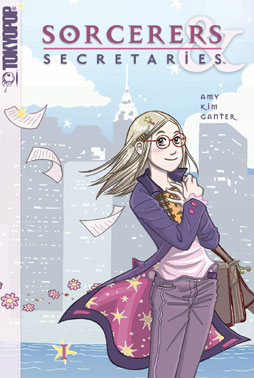
A Star-Crossed Secretary


This book is a nomination for the graphic novels category of the 2006 Cybil Awards.

Nicole Hayes is a young college student who works evenings as a beleaguered receptionist for a design firm. But she also has a secret life—in the pages of her notebook, where she writes and draws the story of a lonely sorcerer, betrayed by his only friend, a familiar who was a vengeful demon in disguise.

Nicole's rich fantasy life helps alleviate the boredom of her day-to-day existence, but underneath it all she's still lonely. It's difficult to let anyone in, though, when she's afraid to reveal her fantasy creations, her true self. Her friend Susan, who also works at the design firm, thinks fairy tales are for children. If that's how people think of fantasy, how can Nicole ever find someone who takes her seriously?

She might not have far to look—her former neighbor Josh Kim, who works in a local bookstore, is smitten with her. She's the only girl who's ever presented a challenge to him. Every other girl who crosses his path practically throws herself at him, while Nicole…is mysterious. Even when they were neighbors, she'd been difficult to get to know. If only she'd give him a chance, if only she knew what a secret romantic he was…

This is the first book in a cute, funny, manga-style two-volume set--Sorcerers and Secretaries by Amy Kim Ganter. The characters are sweet and the parallel story of Nicole's fantasy world is a nice counterpoint to the real-life action. Some of the stylistic conventions might be perplexing to those less familiar with manga, such as the use of chibis, or simplified, childlike versions of a character that are used for humorous or expressive purposes. The artwork is endearing and expressive, though a bit "cartoony" as opposed to realistic. It's an entertaining and quick read to add to the growing collection of graphic work that appeals to female readers.

The Happy Season of EidChrisSolKwanZukkah Continues

Now that my abortive entry into National Novel Writing Month is over, I feel like some of the pressure is off for my life to begin again. (Cheers to A.Fortis for finishing, however!) Only, there's not so much beginning going on with the blog. I comfort myself that there's not much going on in the publishing/YA literature world at this time of year anyway... Short of the blanchingly bad sex awards (not necessarily an award you want listed on your book jacket, eh?), the sad litany of deaths of authors, and an amusing piece on the sadism of Peter Rabbit in the Guardian, everything else in publishing news now is "Best of" lists or worse, gift guides, and I'm plugging my ears singing "La, la, laaaa!" because I simply cannot think of gifts or shopping yet for anybody while my big pile of Cybil reading is yet to be done (I have twenty more books to read out of the original eighty, so I am feeling quite pleased with myself!). However, I expect most of my fellow bloggers are all frantically shopping and singing and lighting candles, dressing up, attending prayers, burning incense, eating well, and decking the halls anyway, so before you have time to miss me, I'll be back. In the meantime, thought I'd take a break from reading and reviewing to wish you all the type of holiday you enjoy -- whether it be full of people and events or completely silent and cozy. I am already enjoying the best of taking time off to relax, thanks to my reading. After all these great books, I shall be ever so spoiled -- the perfect attitude with which to begin a new year.

Skateboarding Is Not A Crime... Mostly...

This book is a 2006 Cybil Award Nominee for YA Fiction.

Paranoid Park has a rep for being one of the toughest hangouts for skaters around -- it's even tougher than Suicide Stairwell, where Jared Fitch used to hang. Paranoid -- which non-skaters call "the unauthorized skate park beneath Eastside Bridge" -- is under a cement overpass, and it's where Streeters hang out. Streeters can hack the hard runs and the big drops at Paranoid, 'cause they are tough -- they're the reason for Paranoid's rep, after all. It's one thing for Preppies to hang out there in herds -- they're safer that way, and really, in their clean clothes riding their pricey boards, people can tell they're not Streeters. The Streeters might give them some lip, but they pretty much avoid each other -- Preps watch the Streeters, Streeters watch the Preps, and everybody pretty much stays on their own side.

Just, don't go there alone, okay? Stuff... happens out at Paranoid.

An accident leaves a dead body and no witnesses, and one terrified and unnamed Prep, whose visceral reaction to the horrifying, which includes weeping, sweating, and running scared -- is very, very real. Someone has died, someone with a family, maybe, an adult, and that is some serious stuff. He's sorry -- really sorry. It was an accident, but he's going to call someone. He's going to talk to his Dad. He's going to make some kind of decision -- soon. Only, his parents are getting a divorce and his Mom spends all her time crying, while his Dad is -- camping? And his kind-of-girlfriend cheerleader Jennifer is aggravatingly pressuring him to sleep with her (All of her other friends have "done it;" wouldn't want her to be the only virgin and out of the loop), school is like a noose tightening around his neck, and now the police are rounding up the Prep skaters, saying they just want to "talk." There are justifications in the silence, and in the silence, there is nothing but the memory playing over and over and over again.

What would you do?

A taut thriller that explores the power of secrets, the moral responsibility of the truth, and the power of using words to keep us sane, Blake Nelson has crafted a finely balanced semi-epistolary novel (that will soon be a movie!) with a surprising conclusion.

Haunting New York

This book is a 2006 Cybil Award Nominee for YA Fiction.

One bright morning in 1904, fifteen-year-old Mallory boards the General Slocum, a steamship on the East River of New York. The ship routinely puffs serenely between lower Manhattan and Long Island, New York, and all aboard are full of the excitement of their day. Mallory and her family are off to a picnic on Long Island with the rest of the members of St. Mark's Lutheran church. They are mainly German, and where they live in lower Manhattan is then called Little Germany.

Mallory is full of thoughts of her beau, Dustin, and their first kiss, which they will soon share. When the steamship catches fire and goes down, Mallory, now dead, can still only grieve for the beautiful, perfect boy she lost, and for the rest of her family who is left behind.

More than a thousand people died that summer day in New York in 1904. This is an unique telling of another American tragedy that depicts a turn-of-the-century America filled with racial intolerance, harsh working conditions, love and death, corruption and life. Fans of ghosts being haunted by lost loves and The Unresolved historical mysteries will appreciate this one.

Lorenzo Rides Again

This book is a 2006 Cybil Award Nominee for YA Fiction.

Eighteen-year-old Lorenzo Bannister is a doctor working in New Orleans with happiness just within reach. Secure in his friendship with Spanish Colonel De Gálvez, and with his wedding just days away, Lorenzo has resigned his commission from the Continental Army, and hopes to live in peace as a civilian. However, war is still on the horizon, and once again fate intervenes to squelch his happiness. His bride-to-be, Eugenie , vanishes, and a hurricane wreaks destruction on the great city of New Orleans. As the waters recede, Lorenzo finds that not only is his home destroyed, but Eugenie has been seen in the company of a British man in Baton Rouge. Could she be a turncoat, a spy for the British cause? Lorenzo has to find out. Reluctantly, he joins the Army... just in time for them to attack the British all over again.

A chance to discover the Latin American flavor of American History, Lila and Rick Guzmán's Lorenzo Bannister series is an engaging narrative aimed at depicting the cultural diversity of America, from its roots up. Instead of feeling like a social studies book, Lorenzo and the Turncoat reads like an adventure with myriad characters and descriptions of locations that spring to life. This series would be a great companion to any classroom study of the Revolutionary War and its causes.

Geek For Hire: Does Roofing Too

This book is a 2006 Cybil Award Nominee for YA Fiction.

16-year-old Fisher Brown has the answers to everything. Well, mostly because they're pasted up around his room by his well-meaning guidance-counselor father. But the problem with answers is that they come neatly tied with questions -- and Fisher's got questions that he doesn't dare ask. It's a matter of disturbing the universe... it's dangerous to do that. Better to stick to the way things are: him and his dad, making it through every day, doing what has to be done, which, for Fisher is going to school, going to SAT study after school, tutoring (and drooling over) the hot-but-clueless Annie Cagneys of the world, and studying, studying, studying, studying.

Fisher is a straight-A student, and he and all of his friends are "going places," someday -- all except for his best friend, Desireé, who thinks she has to stick around and go to a junior college to take care of her wild sister. Unfortunately, Fisher doesn't have time to listen to Dez and her fears and needs -- he needs to go someplace now -- quick, before his brain finishes melting and pours out of his ears. He's blowing everything, he knows it. He just can't concentrate anymore. He's going to totally wipe out on the SAT's, he knows it. And then what will his Dad do?

A chance for a getaway comes when his Dad's out of town. The neighbor's weird, wild little brother Lonny has a weekend roofing job to do, and he could use a hand. Sure, Fisher's supposed to be studying, but what's a little break?

Hundreds of miles and days later, Fisher's flat broke and sleeping under a bridge, dealing with questions and stresses he's never come across while studying quadratic equations. There's a whole ton of stuff going on in the outside world that he can't make heads or tails of, and all he wants to do is get away, and get back home. The Real Question is how he'll get there -- and whether Fisher has finally learned who and what is important, and where to go from there.

A surprisingly astute book by Adrian Fogelin, this novel is fast-paced and nightmarish, with a satisfying ending. Highly recommended.

December 06, 2006

Revisitations: They're Not All Bad


This book is a nomination for the graphic novels category of the 2006 Cybil Awards.

I have to admit—when I first heard that I would be reading a continuation of the story that was started in the 1986 movie Labyrinth, my reaction was something like Oh, God, no. You see, I loved the movie Labyrinth. It brought to stunning life the visual creations of Jim Henson and Brian Froud, as well as feeding my unhealthy May-December crush on David Bowie.

When an already-existing fantasy world is revisited years (decades, now) later, with one of the major creators long-dead, it understandably causes some trepidation in the heart of the adoring fan. Sorry if it sounds a little harsh, but the movie was one of those cherished pre-teen experiences that I didn't want marred by some inferior fan-fic crapfest. At best, I felt it would be like the recently publicized new Rockymovie—a tale that had its day in the sun but was attempting a return to fame with elderly characters and a tired storyline. VERY fortunately, I was wrong about Jim Henson's Return to Labyrinth.

Although nothing can quite match the original creations and artwork of Henson and Froud, writer Jake Forbes and artist Chris Lie do a pretty fair job of bringing this fantastical tale back to life. It's much more lovingly crafted than I expected, both textually and visually, and the characters more appealing. The story picks up several years after the last one left off (and if you haven't seen the movie, minor spoiler alert). Toby, who was just the hapless baby brother in the movie, is now a teenager...perfectly normal, except for a bizarre and unwanted tendency for his wishes to come true. For he's being watched over by the Goblin King, Jareth, and now he's been lured into the Goblin realm by an anonymous impish thief who has stolen his homework (okay, so that part's pretty goofy).

Toby decides to find the Goblin King's castle to confront Jareth about the way he's been interfering in Toby's life. On his way through the treacherous realm, he's joined by a little goblin named Skub, a disgruntled faerie, and her hairy beast of a mount. In the meantime, there's a parallel story going on, whose significance has yet to be revealed in some future volume of the series (for yes, this is a series). A human girl named Moppet is mysteriously in the employ of the mayor of a Goblin city. Each day she disguises herself, and hopes to win the attentions of a handsome goblin knight. Why? We don't know. But when all are invited to a ball at the Goblin King's castle, things really start to get heated and the intrigue begins—for not everyone in the realm supports Jareth. The volume ends, of course, with a major cliffhanger.

For a revisited fantasy series, this was not bad. I generally don't approve of this sort of thing, but Return to Labyrinth comes off as a tribute and not a travesty. It wasn't perfect—specifically, I think the artwork could have been better, and could have relied less on Ben-Day dots or Zip-a-Tone or whatever it was for shading. But overall, it was an enjoyable trip back into an imaginative fantasy world.

Difficult; Necessary


This book is a nomination for the graphic novels category of the 2006 Cybil Awards.

Until I read Art Spiegelman's classic graphic novel Maus, I had no idea of the scope or potential of the comic medium for telling stories of great import, of great pain, of great historical significance. When I did, I realized that graphic novels have a unique capacity to unflinchingly convey difficult realities while somehow also making them both more beautiful and less painful; more cathartic and less harsh. Of course, this is one of the functions of art.

Like Maus, J.P. Stassen's Deogratias: A Tale of Rwanda tells the story of one individual against a violent backdrop of the horrors humankind inflicts on itself—in this case, the aftermath of the Rwandan genocide of the mid-1990s. This is definitely not one for younger YAs or middle-grade readers, but older YA and adult readers will find this an eye-opening, tragic look at how the effects of civil war and constant violence can turn an ordinary teenager into a half-mad half-wild creature whose sense of reality slowly slips further away.

It was a little difficult to follow the timeline of the novel—it slipped between past and present, between the time before Deogratias' life was changed by the genocide and the time after horrific events caused him to turn to drink, to turn inward. The cue given was Deogratias' general state of deshabille, but at times I had had trouble figuring out when something was happening. However, this was my only complaint about a work that should probably be required reading.

For those of us who remember the time of the Rwandan genocide, many of us probably experienced it as a faraway, theoretical occurrence, happening to someone else, somewhere far removed from our own lives. Deogratias brings it to life, gives it a name and a face (in fact, several names and faces). The dark, vivid colors of the expressive artwork appropriately echo the darkness and chaos of this haunting story. A must-read, this will make you wonder what the world was thinking that we allowed this to happen.

Not-So-Juvenile, Definitely Delinquent

I have accumulated SO many links over the past few weeks that it's unreal. But trust me, I feel such a sense of accomplishment at having finished NaNoWriMo and having made significant progress into a new YA novel that it's worth the amount of time I need to play catch-up. Especially since I was sure I wasn't going to finish my 50,000 words. It's amazing what one can do with proper motivation (and the lucky happenstance of being able to write for six straight hours).

Anyway. I've been meaning to address the whole idea of graphic novels vs. comic books since TadMack brought it up a few posts ago and "ahemmed" me into explaining the difference. Bearing in mind that I am far from being an expert on the industry (so please, no flames from fan-folk--if you feel the need to correct or enlighten me, please do so in a tactful manner, remembering that I'm trying to do good here, not spread misinformation), I'll do my best to elucidate.

A comic book is that flimsy-paper, weekly or monthly booklet that you see laid out on shelves in your local comic store, or stored lovingly in plastic packets by comic collectors, or sitting in a revolving tree in the drugstore (which is where I bought all my Archie comics when I was about ten). They may be more or less flimsy, they may use a larger or smaller page size, but it's your basic serial-story-by-installment. A graphic novel is a book-length work of sequential art. It may be a stand-alone work; it may be part of a series. It may even be a compilation of several comic books that form a complete storyline. And manga, or Japanese comics...I'll let Wikipedia explain that.

So, I hope that helps somewhat. As part of the Cybils Graphic Novels nominating committee, I've been thinking a lot about what makes a good graphic novel, and what criteria ought to be used in judging such a work. In addition, there is the issue of what makes a work appropriate for a YA audience to the extent that it should be considered for a YA award. One of the graphic novels I read for the committee is a real standout, and could be enjoyed by an older (16+) YA audience, but I just don't think it's YA, and I don't think it was intended to be so either. I think the author's intentions factor in here. Also complicating matters is the fact that this book is a memoir--it covers many of the author's teen years, but as I learned in grad school, a book with YA characters doesn't mean it's a YA book. Adult books popular with a YA audience are often referred to as "crossover" titles, and I think that when YA awards are usually judged or booklists compiled, the committees consider books that are specifically written for a young adult audience.

Having said that, graphic novels don't necessarily fit neatly into an age category, as the blog Read Roger nicely discusses. It's fairly apparent when they are written specifically for younger children. But there are so many "all-ages" graphic novels--for instance, when I was a kid I had a graphic-novel version of Macbeth. That could potentially appeal to anyone of any age. Same with a number of the graphic novels I'm reading for the committee--and many of these are not specifically labeled with an age range. One exception is the manga titles, most of which have an age label of some sort. And then I think about comics that I read as a teen, comics like The Sandman or Hellblazer that were fairly mature in content, and I wonder if it would be wrong to exclude titles that aren't specifically teen-oriented, or seem too edgy or sexual or collegiate (i.e., you need a college education to understand it). And I think about all the adult books--mainly fantasy and sci-fi--that I read from about age eleven on up, and the fact that many of them had what could be considered mature content.

So basically, the upshot is that I'm not sure what to do about the books on the nominations list that strike me as being not fundamentally YA. Especially since the two I'm thinking of are particularly good. I think I also worry that graphic novel titles are being nominated here because of a sort of underlying prejudice in our society that comics--along with animation and graphic novels--are not for adults (ironic, eh, considering how these media got started?). Using that logic, any graphic novel regardless of content would have to be YA or younger; and so in order to be considered for any award at all, the graphic novel titles which are more adult would still be considered in this context. However, because there are awards like the Eisner Award, among others, it is clearly not the case that comics for adults are not recognized. There are just not very many literary comic awards, to my knowledge.

Well, my ranting has not enabled me to come to any sort of conclusion about this, so I'll stop now. But rest assured I have so much more to blog about. I've been saving up. Really.

Sister & SideKick

This book is a 2006 Cybil Award Nominee for YA Fiction.

Jessica just wants life to be somewhat... normal. But normal's just not in the cards. Her Dad's hiding in the garage, her Mom's getting tension lines on her face from being polite when she'd rather scream, and her sister, Eva, has just turned a walk-on role in a sitcom into a full-time job, and the whole family has moved -- from Anaheim to ritzy Beverly Hills.

Eva is driven and determined to get what she wants -- but nobody's really sure what that is anymore, least of all Jess. Eva's always "on," turning heads and flashing great smiles -- and trying to wind Mom around her little finger. All Eva wants right now is the chance to audition for a fabulous movie that's a bit more grown-up than the sitcoms she's been doing. All Jess wants is for her best friend, Leo to at least email her, for her family to go back to normal, and for her sister to be happy.

Happy's just not in the cards, either, though. Someone is totally promoting the most wicked smear campaign against Eva. There are awful stories circulating about her in the gossip columns, and they get worse every week. Jessica is desperate to know who is doing it, and why. She turns super-sleuth to try to help her sister -- but her clumsiness gets in the way. Jess is determined to help her sister fend off her co-stars, and maybe find her place in the new Hollywood circle -- somehow.

A lightweight, quick-paced read that leaves a few edges dangling to help launch it into its sequel, The Hollywood Sisters: Backstage Pass is just the first in a series which has a lot of room to grow.

Night in the City

This book is a 2006 Cybil Award Nominee for YA Fiction.

Holly's teacher, Mrs. Leone, give her a blank journal and asks her to write, to help her through a "bad time." Holly is disbelieving and sarcastic. What does Mrs. Leone know about a bad time, or about ANYTHING!? Holly's life is a living hell -- the foster family she lives with is awful. The first one had a husband who touched her all the time, and when she complained, SHE got moved. The next one is even worse. They treat her like the dog and lock her in the laundry room. She doesn't get to sleep in the nice room they show the social worker. What's weird is that NOBODY sleeps in there -- so why can't Holly? 'Cause she's not GOOD enough, her foster parents tell her.

The day she gets her head flushed down the toilet by her foster father is the day Holly decides she's outta there.

This isn't the first time she's been a Runaway, but this IS the time that Holly doesn't plan to get caught. See, she's had it with the foster care system -- she knows what it's about. She's decided to be a gypsy -- like her Mom was. Maybe she'll even head for California.

But Holly doesn't know that being homeless is a living hell of its own kind. Stowing away in the cargo hold of a bus -- which is driving through a desert -- sleeping in homeless shelters, hanging around libraries and scrounging food out of the trash is no joke. It's cold at night, and people are crazy dangerous -- even more dangerous than the book implies.

L.A. is no City of Angels, that's for darn sure. All Holly wants to do is go home.

If only she had one.

Fans of the Sammy Keyes series by Wendelin Van Draanen will catch a glimpse of Sammy in this story, and maybe recognize Holly, too.

The Tragic End of War

This book is a 2006 Cybil Award Nominee for YA Fiction.

Anna is different, like her father was. She doesn't think with the herd, but has her own thoughts, hopes, and dreams. This is why she reacts as she does, when she finds the lone man in the snow, in the village where she lives, which edges the border between Germany and Czechslovakia. He's fevered and obviously afraid. Instead of turning him in to be shot, like her Hitler's Youth brother, Felix, or twisting her hands and worrying like her mother and grandmother might have, she does her best to care for him, taking him to an abandoned bunker and feeding and caring for him.

This could cost Anna her life, she knows, and find her branded as a Traitor and killed, but why should people like Felix be right? Why should anyone be treated as less than human, hunted, and killed? Just because they are different, like her father was? No matter what so many other Germans think, Anna believes that what her country is doing is wrong. Her brother Felix has so taken in what he has learned at Hitler's Youth that when it is apparent that Germany has lost, he is lost, too, and feels he must keep on fighting. It is his inability to let go and move on which results in the horribly tragic conclusion of this novel.

An important historical novel translated from the German which reminds us that not everyone in Germany thought with one mind, even during history's most terrible times, and that even now, there is danger but honor in thinking for oneself.

Breaking All the Rules - to Find New Ones

This book is a 2006 Cybil Award Nominee for YA Fiction.

There are rules in life, Grace knows, but honestly, she can't see the point of most of them. Especially because they're the rules of her father, a class-A hypocrite disguised as a devout Christian. Graces is tired of the flow of "thou shalt nots" that have been pouring over her head since she was small. She's eighteen now. Surely there's more to life than turning out like her Mom -- a drab little sparrow whom Grace adores, but who seems to have forgotten how to smile -- and how to stand up to Dad.

Gorgeous Michael is from a different world, and knows poetry and wines. He doesn't have to ponder things like right and wrong so deeply like Grace does -- he just does things, and lives. The simplicity of that lack of theology -- not to mention the seductiveness of Michael's handsome-older-professor vibe seems like the brass ring Grace has been waiting to grab. She gets involved with Michael, and at first it seems like he's the answer to everything. And then, when Grace is able to see a little further, she realizes she may have some of the answers to her own life, herself.

There is no guidebook to the perfect life. Nobody wakes you up the morning of your 18th birthday and whispers instructions in your ear. Grace finds the people who guide her through the making of a good life to be unexpected and startling, but in the end, her true friends have what it takes to show her How It's Done.

December 05, 2006

Death in Africa

This book is a 2006 Cybil Award Nominee for YA Fiction.

Framed against the ordinary daily memories of a young girl growing up in Rwanda is the story of a horrible year, 1994, when Jeanne d'Arc Umubyeyi lost everything she had. Though only eight years old, Jeanne is the only one of her family to survive the Rwandan genocide, a countrywide murderous scheme by Hutu mobs run amok with no real reason behind it, and no real after effects. Her family and others of the Tutsi tribe are gunned down, battered with machetes and clubs and no one seems to notice or care. The morning after her family is destroyed and her home lost, people are out preparing banana beer and hanging out clothes as if the night before their neighbors had not been bludgeoned to death in their side yards.

A testament to the power of humanity, readers know from the fragmented snapshots of before and after that Jeanne learns to smile again after losing her entire family. But how does a country or a person recover from such things? And why do they happen? What was the purpose of the genocide? Why did it happen? German author Hanna Jansen, Jeanne's foster mother, writes this account in order to help Jeanne pull together some of the disparate strands of memory into a coherent whole, but she does not have those answers. No one who's life who has been touched by war seems to have answers of any kind.

A book of great but terrible importance, Over A Thousand Hills I Walk With You tells the story of a journey that is still taking place -- the journey toward peace and hope and healing.

Besoburo - International Pasttime

This book is a 2006 Cybil Award Nominee for YA Fiction.

1890 is a time of transition in the nation of Japan. 16-year-old Toyo Shimada prepares to begin the year at First Higher School of Tokyo while around him is a world that still echoes with the last of the Shoguns. Modern life is catching up to a society that was feudal for centuries. Japan is rapidly increasing its pace as it catches up with the Western world. Bustling trains, pitch roofed houses, black business suits and umbrellas replace a slower pace, horses, kimonos, tatami mats and samurai.
The new Japan is not a world that is always in agreement with itself. Despairing that there is no place for the samurai any longer, Toyo's favorite uncle Koji commits suicide in a beautifully stylized seppuku ritual that nonetheless is brutal, frightening and painful for a young boy to see. Toyo is torn between the old world of privilege and social stratification and the new; his love for the new gaijin (American) game of besuboro (baseball); his desire to be on the Ichiko team; and the knowledge that his intelligent journalist father, who believes strongly in the old ways, is preparing to leave him the way his uncle did.

School doesn't make matters any easier. Toyo is trying to make a place for himself but it's an all-boys school, and the instructors and his fellow students are tough. The students are under self-rule, that is, the Seniors are in charge, and from them come brutal midnight beatings and hazings and terror as the younger boys try to be worthy of the Ichiko name while remaining unbruised. There is harshness and little room for humor or mistakes in school, and it seems there's a lot of growing up to do in a short time. Toyo realizes as his father comes to school to teach him the bushido, the way of the warrior in preparation for him to learn to be a samurai, that he is running out of time. He has to prove to his father that there is a place for the greatness of spirit that the bushido teaches, and the honorable ways of the samurai in this new Japan, or else he will have to take his turn at finishing his father's seppuku ritual. Can Toyo's father ever understand the balance that can be found in baseball?

A gorgeously stark novel that finds its own pace, Samurai Shortstop is an enjoyable novel that captures the small beauties and touches of humor in a harsh and disciplined world, and depicts the poignancy of losses and change in a new world. Detailed and deeply researched, this historical fiction underscores the place that baseball has held for years in Japan's national consciousness.

No Cats or Katies, Just Katherines, Please

This book is a 2006 Cybil Award Nominee for YA Fiction.

It's not every day that you run into a couple of characters like Colin and Hassan. They're a buddy movie waiting to happen. Hassan is a Lebanese American Sunni Muslim -- and not a terrorist, thank-you. He was homeschooled for most of his life, and he's a genius on the sly, having figured out that it doesn't always pay to advertise how smart you are. He's acidically sarcastic, hilarious, doesn't take himself or anything -- including his man-boobs, his intellect or his education -- seriously.

On the other hand, Colin is a guy who could read at the age of two, and went on from there like a shooting star, memorizing arcane facts (such as where one gets an eyelash is best described as one's pupillary sphincter), compulsively making up anagrams, and winning money on game shows from his sharp intellect. He is sometimes horribly humorless, and is basically a high strung, perfectionistic, nerdy, brainac, so desperate to hang on to anything good in his life that he's already looking ahead to how he will lose it all. Intellectually Colin is the blazing genius of the pair, but he considers himself as an academic has-been. He hates being called a prodigy.

Mostly, Colin has issues because he's a Dumpee. See, he's been dumped. Repeatedly. But nineteen girls named... Katherine. What are the chances of nineteen Dumpers named Katherine-with-a-K, you ask yourself? It's the type of question Colin would LOVE to answer. And he tries to -- with formulae.

Yep, this guy is a genius, hardcore. Except at little things like life... and people... and love.

When the last of the Katherines dumps Colin on the last day of high school, he is so shattered that he thinks he cannot recover. His overprotective parents agree to allow him to go on a road trip with his best -- and in their opinion more normal -- friend, Hassan, who has put off attending college for a year and is just bumming around, cracking jokes. Colin wants more than anything in the world to matter, while Hassan just tells him he wants to be famous. Running under the radar works best for Hassan, but Colin's too scared to do that. He wants to make sure that people see him, and know he's there. Otherwise, he's afraid he'll just be left behind.

On a quest to find the grave of Archduke Franz Ferdinand, the boys meet up with Lindsey Lee, her mother Hollis, and her unique group of friends with tight pants and chewing tobacco in the deep back country town of Gutshot, Tennessee. And in taking down oral histories, going on a hog hunt, and finding where there are hidden tampon strings, Hassan and Colin discover some deep things about themselves, and about life.

No, really.

A strange journey that includes sardonic and snort-aloud funny banter between Hassan and Colin, neat - but weird - historical facts, word puzzles, complex mathematical asides (which, the footnotes tell you, are entirely optional, but quite cool), and some realities about dating, An Abundance of Katherines is an indescribable book that I think I need to read again and again to totally appreciate its scope. Highly recommended.

December 04, 2006

Action, Adventure…and Snappy Comebacks

Runaways Vol. 5 is a nominee for the 2006 Cybil Awards for Graphic Novels.

I never did read a huge amount of superhero comics when I was younger. Oh, there was the very occasional issue of Teenage Mutant Ninja Turtles or X-Men, but essentially I went straight from Disney and Archie to Sandman, skipping several years in between. My education on the hierarchy of superheroes and mutants was mostly secondhand, via TV, movies, and geeky friends.

If I'd had something like Runaways to read, I'd probably have read more superhero comics. Similar to Marvel 1602, this Marvel series provides a new take on the same old superheroes, and brings in a few new ones to boot. It's got all the action, baddie-fighting, and superpowers you expect from the genre, along with pretty sharp dialogue that seems to laugh at its own cheesiness.

The Runaways are the children of a group of evil super-baddies called The Pride. The Pride are now gone, and their teenage children have vowed to never trust any other super-folks and fend for themselves fighting evil in Los Angeles. Along with the Pride's children, the group has accumulated a few new friends with various powers, including Karolina Dean, whose parents were evil aliens form a distant world.

Unfortunately, as we find out at the beginning of Volume 5: Escape to New York, Karolina's evil parents arranged her marriage to an alien called a Skrull as part of a nefarious plot to start a war between their two worlds. Now their planets have been engaged in a years-long battle. When the Skrull, named Xavin, shows up to claim his bride, she realizes that part of her resolution to fight evil means she needs to go back with him so they can try to undo the damage their parents did.

Meanwhile, there's hoodoo going on in old New York. Lady Dagger, half of the superhero team Cloak and Dagger, has been hospitalized after a beating—for which her partner Cloak was framed. The Avengers, including the familiar Captain America, Wolverine, and Spider-Girl—thinking Cloak was the culprit—are on the warpath. Cloak turns to the Runaways for help. They take an unexpected side trip to New York, where they help Cloak uncover the baddies who set him up.

This is a fast-paced, good-vs.-evil adventure, but it also deals with themes of friendship, family, loyalty, and responsibility. The characters are distinct and intriguing. And it's just plain rollicking good fun. The verdict: More than just your average superhero comic. If you're a newer convert to the genre, the writing, the comedy, and the adventure will keep you going; but fans of the old classics might also enjoy this new visit to the Marvel universe.

Black Lipstick & Comic Books

This book is a 2006 Cybil Award Nominee for YA Fiction.

It's not that Don doesn't realize that life is worse than usual this year -- he does. He's so bored in classes he's just doing the routine in his sleep. Freshman year, he convinced an entire history section that there were turtles involved in the Great Depression. Seriously.
It sucks to be smarter than your history teacher.

At home, Don just slinks down to his basement room to stay the heck out of the way. See, his mom and the stepfacist have managed to -- horrors -- breed, and there's a Half Alien on the way. His Mom's always trying to get him to touch her belly or "discuss" how life is going to be once the half-thing arrives. Ugh. Don knows he's kind of seen as a geek by his stepfacist, who probably didn't even finish high school, and by the abundance of jockheads at school; he's basically invisible to his dad, whom he only sees in the summertime, but that's okay -- Don's content to fly beneath the radar, because he's got bigger things cooking. See, there's a comic book convention coming, and he's going to show his new graphic novel off to his favorite comic author Brian Michael Bendis -- soon. The graphic novel is his whole life, and he's been working on it -- hard. He knows something life-changing will come of it --

If he can make it that far. School sucks, in the meantime. Donnie's best friend -- his only friend -- is Cal, a jock who's on lacrosse and on the wrestling team. He loves comic books and graphic novels, too, and though they share much, Don doesn't really believe that they're true friends -- not the lasting type. Being a popular jock is going to come first someday, Don knows it will, so he prepares himself by building walls. Don carries insurance in his pocket -- he knows if it all goes wrong, he's got an out. Besides, it's no big deal that he blows off Cal's lacrosse games. If he can convince himself that Cal's going to blow it someday, maybe it won't be so hard when he does.

But while Don's getting beaten up during PE and trying to find the silver lining in pining his hopes on his graphic novel, he realizes somebody is watching -- somebody notices. It's this Goth girl named Kyra. She intrigues him. She contacts him. And suddenly, the isolation that Don's been living in doesn't seem to make as much sense. Kyra -- or Goth Girl, as he thinks of her, reminds him that other people love comics and cynicism. There is a world beyond high school that allows for dreams to be attained, people to become attached to, and life to be lived. Fanboy, as Kyra calls him, realizes that if he gives the world just half a chance, good things can happen. He can roll off in a semi-happy ending, of sorts, just like the people in his graphic novel. Sort of. Maybe.

But he's still just a fifteen year old comic book geek. How can he help Kyra understand all this?

A painfully funny, true-voiced novel for those of us geeky geniuses in high school who don't fit the mainstream mold, The Astonishing Adventures of Fanboy and Goth Girl comes highly recommended. Also this novel comes with a fresh new angle on YA lit -- a vidlit video -- which dramatizes some of the greatness of the novel -- but only SOME of it. Sure, watch the vid, but you'll want to read the novel for yourself.