February 18, 2016
Randomly, on a Thursday, She Caught Up. Sort of.
Find out whether Dess and Hope can learn to cross socioeconomic, racial, and plain old personality divides to become friends as well as foster sisters--You can buy Tanita's latest novel PEAS AND CARROTS at an online e-tailer, or at a real life, independent bookstore near you!
Go check out this wonderful post by Sharon Levin entitled Children's Books Make Me Smarter. I kind of thought I might be the only one who feels this way, but I'm glad I'm not! I am ALWAYS (and PROUDLY) learning from what I read, fiction and nonfiction alike; written for children, teens, or adults. This is yet another reason why we need lots and lots of stories, why diversity in children's literature is so incredibly important. As a child I learned about animals and people, about illness (You Can't Catch Diabetes from a Friend) and about Waltzing Matilda. As an adult I am still learning: pox parties, the Women's Army Corps, female aviators, neuromorphic circuitry, what it's like to live life as someone with a very different background. Let's not stop reading; let's not stop getting smarter.
Next Wednesday, February 24th, is World Read Aloud Day! Thanks to author and agent-sister Kate Messner, I was able to sign up to participate in Skype classroom visits in honor of World Read Aloud Day, and now I'm booked for four virtual middle school visits, two on Wednesday and two on Thursday. I am very excited and a bit daunted, but I think this is a wonderful opportunity to talk to students about writing and read a little of my work. Plus I get to talk to kids in Minnesota, Florida, and Maryland without leaving my office....now I just have to clean my desk so it doesn't look like I am a total slob....
February 16, 2016
Turning Pages Reads: HOLDING COURT by K.C. Held

Welcome to another session of Turning Pages!
Synopsis: Sixteen-year-old Jules Verity - whose last name does indeed mean "truth" - can't stop herself from blurting the truth. All of it. All the time. The weird thing is, though, that she can't exactly recognize it as truth. She normally can't recognize the sentences and phrases she blurts out as... anything. Her best friend, Cami, calls it "Psychic Tourette's Syndrome, which is also inaccurate, but whatever it is, it's caused Jules to be fired from every single job she's ever had and to be regarded as somewhat of a freak in the quirky small town of Lunevale. If she'd stop fighting it, her Gran assures her, her gift would sort itself out. All of the Verity women have some sort of gift; Gran helps people find their true love, while Jules' mother can tell the provenance of anything, making her a very useful sort of antique dealer. Jules can't figure out what her gift is good for, and only wishes to get rid of it, buy a car, and drive out of town, in that order. Oh, and if she could somehow separate Grayson Chandler, the boy she's been crushing on since the sixth grade, from his perfect girlfriend, Bree, her life would also be improved. Unfortunately, the thing with Grayson is not going to happen - Bree is way too sweet, and Jules is not like that, anyway -- and Jules' dream of buying a car (and avoiding her Gran's hot pink electric golf cart) are derailed when her mother announces she's traveling to Europe on a buying trip - and plans on the antique store for the summer. Without her usual summer gig, Jules is at a loose end until she meets Henry VIII at the antique shop - Hank Bacon in costume. She blurts out something odd to him, but only later she finds out it means that Tudor Times, Hank's mansion-turned-dinner-theater which once belonged to the Lunes who founded the town, will have an opening. Jules rapidly finds herself employed - but not some gorgeous Tudor princess, but as a mad nun who spouts prophesy. Regardless of the fact that this is one job she can't possibly get fired from, things get dicey the first day -- Jules, trying to hide her black-swathed nun's outfit from Grayson's eyes, trips a switch, finds a secret room and - falls over a dead body. Which, when she screams and finds her way OUT of the secret room, disappears.
It is seriously shaping up to be a LONG, weird summer.

Observations: This book is a ROMP. I love the whole RenFaire vibe, costuming, dinner theater, and all of that - it is a rich, rich setting. Add in Jules' particular "gifts" and the whole thing is just over-the-top awesome. The novel is the kind of deliciously delirious, frothy fun that I love to read in cozy mysteries. It is JUST. TOO. SHORT. I wanted more, more, more - reader greed will bite you badly with this novel.
My cry of "more" can be said of a lot of things: the characters, the town (LUNEVALE. I mean, come ON, it's like Nightvale only...weirder? Is that possible?) the length, yes, but also the emotional detail. We know that Jules is twisted in the clutches of a crush, but we don't really know... why. The way we like people in the sixth grade has to change if we still are crushing that hard sophomore year. What is it about Grayson - other than his resemblance to Prince Wesley and his stunning abs - that make him swoonworthy? I wanted Jules to dig deeper into her own emotions - I know that in many ways, the novel was action focused - that made it really, really fun - but I would have loved to slow down and really feel Jules' emotions of sheer terror, anger, and disgust. She's sometimes just a bit unflappable. Except about Grayson, which, okay, got it: she's crushing.
There is diversity in this novel, but I wanted more of that too - essentially, a deeper exploration of the choices and the emotions behind the discovery. I'll leave it there to avoid spoilers, but if there's anything I'm mildly critical of in the novel, it's that both the emotion and the resolution were just handed to us as faits accompli, which robbed the narrative of a texture and depth it could have really developed. I wanted a little backstory, a little...depth to the Verity family magic as well. If I couldn't have it in this book, I'll accept a sequel. Just putting that out there, Entangled Teen, and Ms. Held. Just putting that out there...
Conclusion: The Verity's are hilarious; Jules is amazing, and this absolutely fantastic debut novel feels like a gift you give to yourself. A quick, light, funny read, the book will leave readers happily clamoring for more.
I received my copy of this book courtesy of the publisher. After March 1, you can find HOLDING COURT by K.C. Held at an online e-tailer, or at a real life, independent bookstore near you!
February 13, 2016
Us and Books: We Ship It...A CYBILS WINNER UPDATE!
MG Speculative Fiction
Young Adult Fiction
Every Last Word stands out because of its honest, moving portrayal of mental illness. But it also stands out because of Sam’s hard-earned character growth. After being a bully just to fit in with her toxic friends, becoming a member of Poet’s Corner allows her to right some past wrongs and learn that finding your unique voice is more important than blending in with your friends. Along the way, we experience the highs and lows of high school cliques, show how there are always ways to redeem yourself even if they aren’t easy, and feel the emotions of all involved from every angle. The poetry included helps break the ice on what can be a difficult topic, making it more accessible, while the “feels” you succumb to will make and break your heart. It’s not always pretty, but it’s real and fair, making it a story that Young Adult readers can connect with on many levels.
Graphic Novels
Non-Fiction
by Steve Sheinkin
Roaring Brook Press
Nominated by: Benji Martin
Speculative Fiction
The concept of good came up frequently among the judges in the Cybils Speculative Fiction list, as the Round One crew offered up seven novels which were very good indeed, and left to the Finalist judges the struggle to elevate one above the shining host. Intriguingly, the concept of “good” and “good enough,” repeated within the narratives as well. Whether any of the protagonists in SLASHER GIRLS & MONSTER BOYS, edited by April Genevieve Tucholke, can be considered “good” is debatable unless you’re a fan of horror, as many of our judges are. Ultimate good is at issue in THE SIX by Mark Alpert, as characters sacrificed their bodies to become mechanized weapons.
And then, there was “good enough;” Hallie struggled to be good enough to be loved by her sister in AN INHERITANCE OF ASHES by Leah Bobet; In MORTAL HEART by Robin LaFevers, Annith longed to be good enough to leave the convent of St. Mortain to do real work. Sierra Santiago must fight monsters AND patriarchy to prove she’s good enough to own her own magical heritage in SHADOWSHAPER, by Daniel José Older. In the novel by Laura Ruby, Finn O’Sullivan has to fight the belief of the town of BONE GAP that he and his brother aren’t good enough for the people they love not to just leave. There were a lot of “good” reasons to choose any one of these books, because they all have skillful writing and teen appeal. But, eventually, we realized that few books could be more appealing than what some of us referred to as “the killer ballerina book.”
Ballerinas, normally the artistic apex of beauty and grace, were shown as something violent and unfamiliar, underscoring themes of innocence and its loss. Nova Ren Suma’s THE WALLS AROUND US provides an unhinged look into the competitive, obsessive world through the eyes of Amber and Violet, two girls with vastly different futures: one in a Juvenile Detention Center; the other on her way to a promising career at Julliard. A challenging narrative with definite speculative, creepy supernatural elements, the novel’s shadowy, edgy setting with its distinctive voices, together with the atmospheric beauty of the writing convinced even the dubious to embrace this psychological thriller. We cordially invite you to weigh the good in these selected books, and do the same.
February 12, 2016
Turning Pages Reads: PULL by Anne Riley

Welcome to another session of Turning Pages!
Synopsis: It was pretty well going to be the most depressing visit to Blackheath 17-year-old Rosie Clayton had ever taken. Though she visited her grandparents in the London neighborhood from Nashville eight weeks every single summer, this year her beloved Papa has been given just three weeks to live, and Nana is devastated. Complicating family matter further, her brother, Paul, has turned into a hostile, drunken stranger in the wake of his best friend's accident. Paul, only fifteen, is drinking himself blind while Rosie's frantic parents send him to therapists and counseling that isn't working. Nobody is telling him, "No," not her mother, who bites her lip and endures, nor her father, who never deals well with anything, and spends most days in a wordless, sleepless rage, breaking dishes. As her grandfather's life abruptly ends, Rosie can feel her family - her life - imploding, and tragedy dragging them all in the undertow.
And then she watches a girl get brutally attacked. Screaming, she watches as the girl fights to get away, as her attackers drag her inexorably toward a parked van. Helpless, Rosie runs after them, knowing that now she, too, is in danger...then, while a bright light flashes, and her stomach seems to turn her world inside out, Rosie... sees the attack... not happen.
What Rosie sees and then doesn't see changes the whole tenor of her summer. Everything that has happened since they arrived in London - really, the last six months - have been mired in pain and tragedy. But, if tragedy happens and can... unhappen, she's got to know more about how. The boy who suddenly appeared and saved the day, Albert, he knows too many things he won't tell her. Who is he, who are the people he hangs around with, saving others? And why is Blackheath, just a safe, slow, corner of London on the heath - why is it so dangerous suddenly, so full of terrifying strangers who seem to be attacking Albert's crew? And why does it seem that they might be... after Rosie, too?
As Rosie struggles to make sense of things, Paul continues to drift, fading inexorably from the brother she knew and loved to a cold, desperate stranger. He hangs out with violent thugs Rosie knows are trouble - and yet -- he's grieving, just like she is, just like their parents are. When his life is on the line, if she can't save him, nothing she's finding out about her grandfather's past, and about herself -- nothing she now knows -- is worth anything.

Observations: There is a LOT going on in this book - the pacing is fast, the details are crammed in there chock-full. This book is going to be a favorite of people who love time travel novels like Myra McEntire's HOURGLASS and INFINITYGLASS books - however, it has the breakneck danger-danger-danger feel of an episode of Dr. Who or at least the MORTAL INSTRUMENTS series, and it's definitely more fantasy/speculative fiction because despite the technology usage, NOTHING here is based in science; this is pure magic. PULL isn't quite about traveling back in time... at least not more than a half hour. It's time jumping, - time fiddling - which seems more useful. I don't need to go back and see history in person, but if I could take back a stupid conversation or the moment before I landed on my tailbone on a sidewalk curb, that would be downright helpful.
Rosie is not entirely credulous, so it takes a while for her to believe what she's experiencing, and then it takes even longer for those involved to tell her - which seems a bit unfair, and enrages her, and rightly so. I like that Rosie is independent, and even though there's a love interest, she's a woman of her own mind, very much so. One does wonder where she gets this from, as her mother's example in the book is definitely of a woman who bites her lip, bites her tongue, and doesn't speak -- even when she should. Even her grandmother simply waited for her husband to come home, accepting her role and not seeming to seek adventure outside their door, so when her husband died, she was utterly gutted - and left with no clue to who he really was. That seemed unfair. The frayed familial emotional knots and ties don't ever untie - Rosie's father is a rageaholic control freak when the book begins, and is still when the book concludes, but he's defanged, because... Rosie went out and did what must be done, not waiting to ask anyone and he's had to accept that, as every bully whose victims move out of their power must. Rosie's mother and grandmother are just... quiet, and accepting; their detail of their character sketches becomes more chalk than charcoal as the novel moves forward, and Rosie takes center stage. In the end, her parents seem awfully accepting of an awful lot, but other readers may be able to suspend disbelief on that detail.
The conclusion of the adventure is, at first, a tiny bit of Deux Ex Machina, with an eleventh hour save - but reversals happen on a dime in this novel, and achieving a happy ending is sometimes less a matter of luck then of sheer determination. I was a bit disappointed that money can simply make all problems go away, but more important was the idea of choices - some of them you may not be positive are the best ones you could have made, but accepting what you've chosen is something no one can avoid - or reverse.
Conclusion: With its striking orange and blue cover overlaying a watch face atop Tower Bridge, this book has both a very commercially successful look and a fast-paced, sticky hook to bring readers in. The quick pace, sense of danger, and details will keep them interested and wistful for more.
I received my copy of this book courtesy of the publisher. You can find PULL by Anne Riley at an online e-tailer, or, as of 2/16/16 in paperback at a real life, independent bookstore near you!
February 08, 2016
Happy Blogiversary Indeed!
Three years in, I posted a cartoon of THE TWO OF US in our imaginary writing spaces--Tanita was still in Scotland, as evidenced by the sheep and castle, and I apparently lived within sight of the Golden Gate Bridge (which is a wee 90-mile exaggeration):
And, exactly 10 years ago yesterday, we put up our 101st post! Tanita posted a quote from the wonderful Sid Fleischman, and it's the perfect inspiration for another blogging and writing year:
Now that Finding Wonderland is 11 years old and counting (puberty must be coming--uh oh), let's hope that any reliving of our awkward adolescence is limited to the books we read and write!
February 05, 2016
Aquafortis, Oh, My Word, It's Our Blogversary.
(AF, If we were married, we would totally FAIL this anniversary thing. How did we miss 10 years last year????
Well, if you're having fun, you must not notice where the time goes. Or something like that. Happy Blogversary.)
Turning Pages Reads: THESE VICIOUS MASKS, by Tarun Shanker, Kelly Zekas

Welcome to another session of Turning Pages!
Synopsis: Jaded, bored, and sarcastic, Evelyn Wyndham, at an eminently marriageable age, is deeply disinterested, and thought to be the tiniest bit odd both by her parents, and by well-bred Bramhurst society at large. She's indifferent to their opinion, however, because she's mostly indifferent to everything that isn't her envious and wistful attention to her friend Catherine's travels on the Continent - oh, if she could only GO! - her younger sister, Rose, and Rose's prospects of being a doctor someday. The Wyndham girls have become well-known throughout their community for seeing associates through the frightening fevers and terrible consumptions which plague England and sending them on their way to health, and now at Sir Winston's ball, given in honor of his nephew Sebastian Braddock, even before the dancing even begins, Rose is being stared at and whispered about, although Mr. Braddock is the worst, the way he stares like a loon, makes mention of her miracles ... then basically runs away.
The ball is as tiresome as Evelyn suspected it would be, but for Mr. Kent, an old friend who always provides her entertainment. Seeing a large stranger peering into the drawing room from outside worries Evelyn tremendously. When Evelyn finds Mr. Braddock furiously ordering the large man away from Rose, her curiosity edges into dismay ...! Who is he, and what does he want? Rose assures Evelyn that the man has an ill sister, but Evelyn is more worried by the way Mr. Braddock snarls at the man, acting as if Rose is his possession to which the stranger has no right. When he mentions her "powers," in such an odd way, Evelyn is on edge. Certainly, Rose is beautiful and good, and of course, as she's now marriageable age, the gentlemen will be interested, but all Rose needs is to start collecting attention from odd men. Gathering her oblivious sister, Evelyn insists that the family cut their time at the ball short.

The morning after the ball, Rose is gone, her room shows signs of a disordered exit, and a scribbled note saying all the wrong things is all that's left. Now Evelyn is convinced it's not Rose's medical skills that were in demand -- it was Rose herself, and that she's been kidnapped to London. Evelyn, against her parent's expressed wishes, heads for London -- on foot, until Mr. Kent happens upon her -- to the rescue. Her first clue along the road to finding Rose? Mr. Braddock, who seemed to have known the giant who asked her to see to his sister. Surely, that enigmatic and odd man must know something. But there are secrets, evasions, and mistakes ahead - and there's too much at stake for anyone to lose focus, or fall in love.
The novel concludes the sometimes worrying, sometimes frustrating search with a rather abrupt ending which leaves a clear gateway to the next novel.
Observations: This was a novel which for me was, by turns, entertaining and frustrating. Evelyn is hilariously deadpan, but her snarkiness is of a decidedly modern bent; it's hard to imagine a well-bred and high class Victorian girl as defiant and mouthy as she. There are bits and pieces of the novel which are picked up - and then discarded. The first is Evelyn's best friend Catherine, who is on the Continent -- her trip is everything Evelyn wants, at first, and then... she's not mentioned again, nor do the girls write, when letter writing and household arts seem to have made up most of how a young Victorian woman spent her time. Evelyn's parents are at first deeply concerned for their progeny's launch into society, and then when Rose disappears, they seem to vanish -- while it's believable that they would want to protect their family name, not even mounting a search for a disappeared younger daughter who is only seventeen seems a trifle beyond belief. To avoid spoilers, I'll only say that the conclusion is a gut punch that leaves a great deal to be desired and will frustrate some.
Some readers seeking to see themselves within the novel and within the fun setting of Victorian London may be disappointed; the authors leave no space for diversity, which, as there were Victorians of many ethnicities, is both inaccurate and unnecessarly, since this recreated Victorian London already has people with unheard of fantasy powers - apparently diversity is too far a stretch?
Tarun Shanker and Kelly Zekas met in a writing class, and began writing this book a few years later. Tarun is one of the few guys writing YA speculative fiction romance; I can't tell which is his perspective vs. his co-author's, but it's nice to welcome another guy into the field, and we can only wish him good things and hope to hear more from them both.
Conclusion: Some have called this book "X-Men meets Jane Austen;" to me it more resembles that frothy confection of a film The League of Extraordinary Gentlemen, a beautiful movie with enormously enthralling effects, breathtaking cinematography, and an incomplete plot coupled with flawed and problematic storytelling. For those fans of snark and sisterhood, there's a great deal of potential to this debut book, and the series looks to have enormous teen appeal and will most likely be swallowed whole by some, but there are a few details yet to be worked out for those with a little more discriminating palette.
I received my copy of this book courtesy of Swoon. After February 9th, you can find THESE VICIOUS MASKS by Tarun Shanker and Kelly Zekas at an online e-tailer, or at a real life, independent bookstore near you!
February 04, 2016
Thursday Review: SECRET CODERS by Gene Luen Yang and Mike Holmes
Anyway, The Secret Coders--the first book in a new series that promises lots of fun and adventure (and CODE)—did not disappoint. And, especially as it comes during a time when a lot of effort is being put into STEM education for girls, and there are groups out there like Girls Who Code and so forth, it made me very happy to see this adventure into the world of programming being led by a (mixed race!) girl, Hopper.
It's not just about coding, though. This book is about the perennially relatable theme of being the new kid in school—and it just happens to be a school where something SUPER CREEPY is going on. Why is the shed door padlocked? Why is the janitor so crabby about them going near it? (MUST be something interesting in there.) Why do all the birds have FOUR EYES? Hopper is confronted with all of these questions at the same time that she's trying to make new friends at her new school, where nobody seems to be amused by her cool robot voice. Luckily, she does manage to find a friendly face, and her new friend Eni even helps her decode the secret of the four-eyed birds. But when the two of them find out what's in the locked garden shed, all craziness breaks loose…very, very slowly…
![]() |
| Click to embiggen |
Much as I thought at the time that this was a terribly inefficient way to draw pictures, it was one of the earliest opportunities for kids in school to start learning very simple programming. I'm sure it set the right tone for me, many years later, to be unafraid to try tackling HTML and CSS. And this graphic novel brings back those memories and provides some actual coding—and decoding—fun for a new generation of readers, with try-it-yourself coding problems that you can solve right along with the characters.
Of course, this book isn't all about learning how to translate numbers in binary and learning how to command a so-called turtle (imagine the disappointment! the "turtle" was a mere triangle!) to draw geometric shapes. Hopper is an appealing and funny main character, and one of the hilarious parts of the story is watching her make friends with Eni, who then teaches her the secrets of binary and logo. Appropriately (since many a 1980s computer had those green-on-black screens), the book is printed in green and black, but don't let the simplicity of the color choices fool you: there's plenty of fun stuff going on here, and just as the story brings us to an exciting peak with robots and angry janitors and the ultimate test of the kids' coding skills (and yours, if you choose to follow along)—you're left with a cliffhanger. Until next time, kids.
![]() |
| So easy, a monkey could do it! |
Conclusion: This will surely appeal to fans of other graphic novel series where kids solve the mystery of a creepy school—e.g. Gunnerkrigg Court—as well as existing fans of Gene Yang's work.
I received my copy of this book courtesy of First Second Books. You can find SECRET CODERS by Gene Luen Yang and Mike Holmes at an online e-tailer, or at a real life, independent bookstore near you!
February 02, 2016
Turning Pages Reads: OF BETTER BLOOD by Susan Moger

Welcome to another session of Turning Pages!
Synopsis: One day she's leaping in the waves near the family's Paradise-by-the-Sea beach home, the fittest of the fit, dreaming of finishing Little Women and having a new best friend; the next moment her lower body is numb and unresponsive and she's so terrified that she can barely breathe, and cannot speak... polio in the 1920's stole many children's lives and liveliness just that quickly - but it stole didn't just steal Rowan Collier's legs, it stole her family - because the Colliers are charter members of the Betterment Council, an organization which encourage people to come in and fill out information about their family histories, their family trees, and see if they're "fit" to breed. Rowans father and sister have made their mark on society, writing eugenics articles and doing research regarding the burden of the feeble-minded and the unfit on American society. As Colliers are nothing but fit, Rowan now simply cannot be one. The disease steals her name, as her father abandons her to be taken into a hospital for orphaned children for care.
No name, no home, no hope -- Rowan withdraws into a silent bubble of shame and pain in the hospital until a caring physician comes along, who revives her spirit, and reminds her to take care of herself. She flourishes under his care, but her older sister, Julia takes even that away from her, in the name of sending her to a Betterment Society doctor... who pressures Rowan to be sterilized. Now, at sixteen, Rowan's not heard a word from her father in five, long lonely years. Her "livelihood" - a cot in a tent and at least two meals a day - is earned through work as an actress in a play. She lives the role of Ruthie the unfit cripple who drops the baby. At night, she is imprisoned with the group of the "unfit," locked away as a sideshow freak for the Betterment Council's traveling show. Dorchy, an orphan carney girl who is employed by the leaders of the freak show, thinks "fit to breed" is a crock. She's determined to use her con-woman skills to find her uncle, and restart her life on the Midway. With nowhere to go, and without the protection of her father's name, Rowan must escape from an uncomfortable situation with the show which rapidly becomes dreadful. When Rowan and Dorchy go on the lam, Dorchy revives her con-artist carney ways to get them money and leverage, but Rowan fears that the two girls are too different to go the same direction. They make a plan, a pact, each giving the other courage as needed. The two of them find themselves working as staff at an island summer camp in Maine. Camp Loup is a Betterment Society camp for orphaned unfit children -- but though the Betterment Council representative makes many promises, it quickly becomes apparent that this situation is worse than their last. An influenza has swept through, and many of the campers have died -- and still more are dying, of the 'flu, or of the cold-eyed doctor's so-called cure? Rowan and Dorchy must survive the camp's directors, the island, a storm long enough to escape, and let the world know the truth about what's going on at Camp Loup. At the last Rowan must stand - on her own two, polio-weakened two legs - against how she was raised, and decide how she wants to use what she knows to make a difference.
Observations: The information in this novel about eugenics, "fitness" and "betterment" movements throughout the United States through the 1920's-30's is a little explored region of pseudoscience, and it's usually only dug into in YA lit in reference to how it was practiced in Germany during the Jewish genocide. However, it's an American science, and it's something which informs the historical treatment of the poor and those with mental health issues in this country, and should shape how we respect those populations today. There are myriad German doctors who make appearances in the novel, but the author is unstinting in her revelations and lets no one off the hook - everyone who was of a privileged or upwardly mobile class was interested in eugenics, and everyone - even Civil Rights activist and N.A.A.C.P. founder W.E.B. DuBois - believed that Americans should be somehow better. DuBois wrote eloquently about "uplifting" the race, chiding African Americans to be aware of and rejecting of the unfit within their own race. Eugenics wasn't a German mistake, it wasn't merely the furtive study of some mad scientists in a Frankensteinian laboratory somewhere: this was mainstream supremacist ideology supported by thinkers such as Thomas Edison, Winston Churchill, Margaret Sanger, Linus Pauling, Marie Stopes, Robert Heinlein, HG Wells, Theodore Roosevelt, Nikola Tesla, Alexander Graham Bell, Woodrow Wilson, and George Bernard Shaw. It was virally infectious in a country which feared contagion from the lower classes, from other nations and the pollution of their ideas as well. There's plenty of history here to sink one's teeth into in this work of historical fiction, and readers may come away wanting to find out more.
With that in mind, the narrative aspect of this novel - of Rowan and Dorchy - is less arresting, as the girls' emotional resonance doesn't have as much time to develop. Still, Rowan's many falls and her dependence on her crutches, her weariness with her disabilities and her occasional despair rings all too true. Readers may find it unbelievable that there was no one to whom she could go for help. Still, Dorchy's strong friendship, and the risks and terrors of the girls' escape catches the heart, and will help readers identify more personally with the history and information that they read.
An author's note at the end of the novel emphasizes a strong takeaway message about ignorance and the abuse of power masquerading as "thought" and theory, "I wrote Of Better Blood to emphasize the danger of policies in which people are categorized, isolated, and eliminated for political ends," the author writes. This is a timely reminder in an election year, for sure.
Conclusion: A horror story told in matter-of-fact prose, the story of eugenics, "fitter families," and "better baby" contests is a history that led American medical health facilities to atrocities like the Tuskegee Experiment, forcibly sterilizing women in mental institutions and a wave of negative attitude and abuse against poor families with many children. It is the shame of medical history that we at times abused the poor and weak and those who needed help and support the most. This novel clearly shows what evil happens when good people do nothing, and will give a horrified shudder to a science-minded reader, and be a good jumping off place for a lot of discussion.
I received my copy of this book courtesy of Albert Whitman Teen. After February 1st, you can find OF BETTER BLOOD by Susan Moger at an online e-tailer, or at a real life, independent bookstore near you!
February 01, 2016
Monday Review: A MAD, WICKED FOLLY by Sharon Biggs Waller
![]() |
| The cover even LOOKS like a Libba Bray book... |
Against this backdrop of extremely rapid change, our narrator Victoria Darling embodies some of these radical departures from the norm. As the story begins, we see her in her art atelier, which she attends when she isn't going to finishing school in France. That day's session, alas, is without a figure model…and, after some trepidation, Victoria decides to take her turn. The young men in the class have had to do it from time to time, after all, so why not her?
Why not indeed. Part of the reason there are so few female Impressionist painters who have made the history books is that they were usually prevented from drawing from the live model—and yet drawing from the live nude was a necessary prerequisite to being a serious artist. Painting still-lifes and domestic scenes was a mere hobby for young ladies. Women had to resort to dressing as men and sneaking into art classes, or they had to have the support of a husband or father to gain art training, and even then, it was not a "suitable" pursuit for a young lady, but rather a mad, wicked folly.
Plus, you couldn't go about on your own or consort with people of the lower classes if you were someone like Victoria. But she's determined to be a serious artist. Even when her father finds out about her scandalous disrobing and brings her home to London to be married off, Victoria plans to try to gain admission to the Royal College of Art. While implementing her plans, she meets suffragettes campaigning for the vote (getting her in further trouble), a handsome young constable (SO off limits), and continues to be dogged by scandal—and of course, at a certain point she ends up having difficult choices to make, between her family and her social position and her own goals and what she thinks is right.
Peaks: This is a great period piece for showing the incredible social and technological change that was taking place at the time, but it's also a story of a character whose moxie and determination will appeal to contemporary readers. There are multiple love interests, there's Victoria's fascination as she discovers what life might be like if women had more power, and there are very real repercussions to her actions, ranging from family disappointment to a frightening night in jail. The characters are varied and well drawn, and the contrast is made stark and clear between the older generation represented by Victoria's staid parents and the changes taking place before their very eyes. The fact of her mother's frustrated artistic inclinations makes this particularly poignant.
Valleys: Victoria does have a tendency to rush headlong into things without thinking about what might happen, and that was a bit frustrating as well as discomfiting, especially when she lands in trouble through very little fault of her own, simply being in the wrong place at the wrong time. And yet, for all the times she lands in trouble, the results were hardly ever grievous. I found myself the most excited when her explorations finally result in her having to make a major change in her life (I won't give away spoilers) but this part of the story wasn't developed quite as much as the earlier portions.
Conclusion: Besides the minor pacing issues, I really enjoyed (for obvious personal reasons) this story of a young woman determined to be an artist in a world that is dead set against her…but which is in the process of changing. The fact of it being a time period of upheaval and change keeps Victoria's character from feeling anachronistic, and she meets plenty of like-minded sympathizers in her journey. Readers who enjoy stories set in the Victorian era or the early 20th century (e.g. fans of Libba Bray) will want to check this one out.
I received my copy of this book courtesy of my library's ebook collection. You can find A MAD, WICKED FOLLY by Sharon Biggs Waller at an online e-tailer, or at a real life, independent bookstore near you!
January 29, 2016
Turning Pages Reads: THE ABYSS SURROUNDS US, by Emily Skrutskie

Welcome to another session of Turning Pages!
Synopsis: Cassandra Leung is a Reckoner trainer-in-training, which means she knows her place -- as far less important than the giant beasts she trains, and apt to get benched in disgrace if she screws things up. She's been given her first job -- taking Durga, the genetically engineered five-ton behemoth - part sea turtle, part iguana, all dangerous - into the NeoPacific to the cruise ship on which Durga has imprinted, to oversee the animal as it guards against pirates. Durga is a killer, and Cas has worked hard to handle her. All is well, until Durga becomes ill with nothing she's ever seen before. Calling home would be only helpful if her mother in the lab had answers - she doesn't. Cas is on her own, and has known this from the moment her father handed her the EpiTas pill tucked into the collar of her uniform. EpiTas is half of the Spartan phrase E tan e epi tas - "with your shield, or on it." When the pirates strike, instead of being gunned down with the rest of the crew trying frantically to protect the passengers on the boat, Cas is taken hostage and her suicide pill slapped from her hand. Her job? To train a tiny new replacement for Durga, who died so horribly - and to give the pirates of Santa Elena's ship a fighting chance to claw their sovereignty from the major corporations who now own the waves and the sea. Despite herself, Cas falls in love with the murderous Reckoner despite herself - and finds the camaraderie of the ship a world away from the lonely world she inhabited. A prisoner held captive has only one duty - but can Cas do her duty? And what exactly, in this case, is it?
Observation: Cas views herself as unimportant - to her family, and to the industry which supplies their livelihood. It's a little ironic that with all of her resentment she never seems to twig to the fact that she was hand-picked for her abduction, which meant that someone saw her value, even if for the wrong reasons. Readers accustomed to being able to easily determine for whom to root in a narrative will struggle to find their feet in this novel in a good way. Cas is eager and nervous at the novel's beginning, then morphs into a girl furious, resentful, and -- reasonably cowed by the swaggeringly tough Santa Elena and her hand-picked crew. There is literally nothing she can do to save her help herself, and small rebellions are punished with incredible prejudice aboard the Minnow. The captain is slightly deranged and cruel, and Cas herself is no fighter, not really. And yet -- somehow she begins to like the crew.
The novel spends little time on the genetic engineering as a science which creates the behemoths with with Cas works, which is unfortunate, as it's easy to see that her family is fairly well-off for a post-apocalyptic civilization. The story hints at social injustice and political maneuvering which has left populations both vastly rich and vastly poor. There is brief mention that after the waters rose and the country boundary lines changed, some flotsam of former nations were left with no recourse but to come together in gigantic flotilla villages and turn to piracy and salvage in order to survive. Teen readers accustomed to reading critically about social inequality and financial injustice will pick this up. Unfortunately, there's not much more than a hint and readers may feel a need to fill out the details and help it to make sense. Much is implied and obscured, less is explained, which nevertheless won't prevent readers from being riveted by the action and tension.
There is a romance -- and while no one jumps into lust, which is a nice change from insta-love -- it troubles me, as romances rooted in inequality always do. For a change, all parties acknowledge that there can be no relationship when both parties are not on equal footing, however, in the usual blissfully dumb romantic way, choices and sacrifices are still made favoring a relationship. It's not quite clear to me why, and I guess that's because for all that I'm intrigued I'm never quite sold on the romance, or on a non-pirate falling in with the cutthroat ways of pirates aboard ship. If the novel had spent more time "before" with Cas in her natural environment, it would have been easier to see what type of person she was, to observe her place in the world, and make sense of why she and piracy would be a good fit, but we have to trust the author for a great deal, which, since the narrative is at times light on detail, is sometimes hard to do. Readers are left wondering at the novel's conclusion whether Cas has won or not -- a clever hook left by the author to reel readers back for the doubtless action-filled sequel.
Conclusion: The first in a planned - and apparently already penned - duology, THE ABYSS SURROUNDS US is a slightly uneven, unsettling, and unexpected book featuring hard-as-titanium lady pirates, a romance which doesn't quite get off the ground as far as it could, a hardcore series of deep loves and deep betrayals, and a twist at the end. Readers looking for queer fiction with a believable love story will be all in favor; readers in favor of tough girls who draw blood and take no prisoners (except one) will take savage joy in this as well. I'll be interested to see how the whole thing ends, and what the larger issues of right/wrong turn out to be.
I received my copy of this book courtesy of Flux. After February 8th, you can find THE ABYSS SURROUNDS US by Emily Skrutskie at an online e-tailer, or at a real life, independent bookstore near you!
January 27, 2016
#ReadYourWorld and Celebrate MULTICULTURAL CHILDREN'S BOOK DAY!
Summary: Cross-cultural and transracial adoption is a great topic for a children's book, and families who have chosen to be open about adoption from the very beginning will be pleased to see an addition to the small but growing shelf of books for young children that address this topic. It's something that we as a society are increasingly aware of—and yet there is shockingly little statistical information available. According to ChildWelfare.gov, a program of the U.S. Department of Health & Human Services:
"There are no national statistics on the number of children who are living in transracial adoptions; that is, children who are living in an adoptive family in which they differ from at least one of their adoptive parents in terms of racial/ethnic characteristics. In statistics drawn from FY 2000–2004, about 28 percent of the children placed with public agency involvement were placed transracially, as defined above. Many intercountry adoptions are also transracial adoptions."
I was floored to read this, considering how many people I have known throughout my life from families with transracial or transnational adoptees. As we know, though, kids need books in which they can see their own situation reflected. ABC, Adoption & Me provides families with very young children that mirror in which they can see their own family as part of the varied spectrum of happy, loving families.
Peaks: The cute, happy cartoon illustrations by Paul Griffin put a smile on my face. There is a wonderful variety of families and children depicted in this book, in various permutations of race and ethnicity. At the same time that it shows adoptive families as normal, happy families, though, the great thing about this title is that it also gives kids and parents the opportunity to talk about adoption and encourages kids to ask questions and feel whatever it is they feel, positive or negative. For instance: "Q is for questions. It's OK to have questions about what being adopted means." Some pages have simple and clearly worded facts about adoption and adoption-related terminology (e.g., birth parents, open adoptions) while others provide affirmations that it's OK to miss your birth parents or wonder about who you will look like when you grow up.
Valleys: I had a few quibbles with the design/layout of some of the pages, but the fact is, the strength of this book lies in the chance it provides families to talk and laugh together, and address a topic that can be very difficult to bring up. Adoption in general can be an uncomfortable discussion for families, let alone the specific questions that come up in regard to transracial or cross-cultural adoption. This book addresses many of these questions, and provides helpful strategies for parents who are wondering how they might use the book as a discussion tool and a way to bring their family together.
Conclusion: It's no surprise this book has won various awards and accolades (see the author's website here). You can find it on Amazon, where it has earned an impressive 5 stars, and you can view the rest of the wonderful MCCBD blog reviews over at the #ReadYourWorld linky.
January 26, 2016
What I'm Doing Besides Reading for Cybils, Catching Up on Reviewing and Stuff...
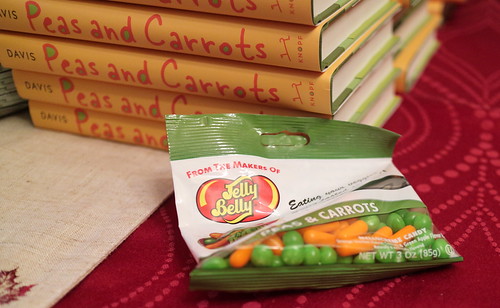
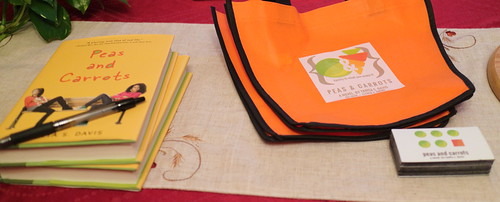
People expecting copies of PEAS AND CARROTS, those are going out this week. People who want a chance to win a copy, along with a lunch bag and a little magnet -- please stay tuned to the February 9 release date --
February is not just when the groundhog emerges (albeit with a LOT of help from people pulling it) from its hole to find its shadow - it's apparently the month when introverts Make An Effort (also with a LOT of help from people... pulling). I'll be booktalking, and being visible this February here and there - first, I'm presenting a webinar February 2nd for The National WWII Museum on Mare's War as part of their WWII emphasis this year. Teachers and families who do homeschooling, you'll want to jump on this! The week following, I'll be on the blog STACKED and then the tumblr Size Acceptance in YA; at BN Teen Blog's Open Mic project sometime next month, and on John Scalzi's WHATEVER blog's Big Idea project on February 9th, which is the same day that PEAS AND CARROTS has its book birthday.
I'm grateful to everyone who asked me to show up and hang out next month, and given me the opportunity to talk about what I do and how I do it.
X-posted from {fiction, instead of lies}
January 21, 2016
Toon Thursday Redux: Writerly Daydreams
One of my many writing-related goals this year is to whip up a few more brand-new Toon Thursday cartoons here and there--we'll see how I manage. And I'll have some new book reviews commencing next week, and picking up again after this year's Cybils Round 2 is done. In the meantime, enjoy Tanita's reviews and have a creativity-filled weekend, replete with writing, daydreaming, and possibly donuts. (Or pie. Pie's good, too...)
January 19, 2016
Turning Pages Reads: SERPENTINE (Kingdom of Xia: Second Series #1), by Cindy Pon

Welcome to another session of Turning Pages!
Synopsis: SERPENTINE begins with a familiar feel -- a mistress and a handmaiden, brought up as close friends, often playing games and once spying on the monastery - and a cute monk - which was utterly forbidden. Skybright would do anything for Zhen Ni, but spoiled Zhen Ni often makes thoughtless comments, as if there's no real difference between the two. Skybright, however, can never forget the gulf that lies between them. At least Skybright can dream about the handsome monk she met in the woods, Kai Sen, even though nothing will ever come of that relationship. When Zhen Ni finds love and Skybright's place within her household seems threatened. In time, a secret is revealed: it turns out that all along motherless Skybright was the daughter of someone very important -- except her legacy is not in the human world, but of the mythical Underworld. Now that Skybright knows she's a daughter of the Underworld -- and that her mother was a queen of temptresses - she's not sure who she's supposed to be, and Zhen Ni is discovered to have secrets of her own. As demons and discovery threaten everything Skybright knows, she's backed into a corner of evasions, half-truths, and outright lies, trying to protect herself, and her mistress. Are there any right choices left?

Observations: Readers who enjoy retellings and new spins on mythological tales from other cultures will enjoy this novel. The setting is rich in detail and meaty with diversity. Like many fairytales, there is, from both Skybright and her mistress, a deep longing for something, but instead of that longing being to find a handsome prince or whatnot, their desire is for nothing to change -- to go on as they are, as close as they are. Of course, this doesn't happen - and as a metaphor for growing up, what happens to Skybright seems both monstrous and terrifying but also exciting and freeing - she seems at her most alive and engaged in the novel when she is in the forest, less passive and accepting, and more master of her own fate, which is something which will resonate with American readers. The sensuous language describing Skybright moving through the forest at night also spoke of the potential pleasures to be had when one accepts change and stops fearing it as The End of All Things, which is a great little secondary meaning whether the author intended this to show up in the narrative or not.
I was glad to see that this novel is the first in this series, because there were a lot of unanswered questions for me. SERPENTINE felt short - almost a blur of detail, worldbuilding, set-up and setting with a few teasers waved in front of the reader about the contents of the next book. Readers will easily root for Skybright, worry for Zhen Ni, and wonder what their future holds. Skybright's romantic choices felt a little hurried to me, and readers may not understand her choices. Skybright's tremendous sacrifice at the novel's end, because the ending is a little abrupt, doesn't have quite the sense of momentousness it should have, and we don't get her feelings about her choice - but that just means that readers can't predict, even a little bit, what happens next. Thus we curiously await the sequel...
Conclusion: Though I wasn't as pulled in as I could have been by the passive main character or her romance, there is so much richness that I wanted more time to linger in the fantastic and mythical, mystical world. If you enjoy retellings featuring ancient mythology, gods and demons and want a fresh take on a fantasy tale, you may enjoy this first book in the Kingdom of Xia series.
I received my copy of this book courtesy of the public library. You can find SERPENTINE by Cindy Pon at an online e-tailer, or at a real life, independent bookstore near you!
January 16, 2016
Turning Pages Reads: UNDER THE DUSTY MOON, by Suzanne Sutherland

Welcome to another session of Turning Pages!
Synopsis: Sixteen-year-old Victoria Mahler is the reluctant daughter of a has-been star, one Micky Wayne, who once fronted the band rising indie rock band, Dusty Moon. That was a long time ago, now, as the band broke up shortly after Victoria was born. Micky now works at a bar and does gigs every once in awhile, but their lives are pretty much hand to mouth as Micky has recently moved them back to the big city as she waits for her next big break. Victoria's well aware that she was great, once - it's kind of inescapable since she still has fans who show her their Dusty Moon tattoos, talk to her in grocery store aisles about how that one song of hers gave their lives total meaning, and post rumors and gossip - even all these years later - of Dennis, the one who walked away from the band, the one who no one knows is dead or alive. The one who might -- maybe -- be Vic's father. At sixteen, though, Victoria's too tired of the hoopla to care much. She just wants a life where her mom is her mother, and not a star, where she has a boyfriend she's not terrified to talk to, where she has a friend who actually likes her - just a life that is...normal. Is that too much to ask?
Observations: The addition of diversity of all kinds might have added additional depth and interest to the novel, though I did note that Victoria's crush did not have a stereotypically muscular male body, being described as having a soft belly and a round, full face. Readers interested in being band groupies or what it might be like to be the kid of a rock star will find this book interesting if not entirely realistic. I was initially sympathetic to Victoria, who is frustrated with Micky to the point of hiding the truth even from herself, and lying about who she is to new friends.
However, Victoria is at times outright mean and whiny with her unhappiness - granted, as anyone would be, playing second fiddle to a Great Talent - but I felt unable to relate to her deliberate and disastrous choices. She continually ran down her mother for doing what she set out to do - moving them to a larger city, getting noticed, going on tour, and getting her musical career back on track. While Victoria may not have agreed to this plan, she was tacitly on-board until it started to happen.
Victoria's father - maybe - is brought out in the beginning of the novel as a possible mystery. I expected her to use the prodigious digital resources most teens can access to try and find him - if not at home, then at a public library, at least. Instead, she simply wonders if he's dead or alive, resents that he's not there and resists her mother taking up with another man. He never reappears in the narrative, unfortunately. Victoria doesn't seem to have a lot of reasons behind her behavior which makes her hard to understand. In the end, there isn't much change or growth in Victoria's life - but she's coping, and she and her mother are speaking again, which, after all the self-induced chaos, feels a little like a victory.
Conclusion: For readers deeply interested in celebrity novels, and behind-the-scenes tales of the real and fictitious in rock music, this novel may be a winner. There's a little bit in the novel about girls designing games, which is a bonus, it's got a nice cover, which is another bonus.
I received my copy of this book courtesy of the Publisher. After February 16th, can find UNDER THE DUSTY MOON by Suzanne Sutherland at an online e-tailer, or at a real life, independent bookstore near you!
January 14, 2016
January 27th is Multicultural Children's Book Day!
Bloggers can sign up to review a book, donated by publishers eager to support this effort--go read more about it here.
Authors, and other interested individuals, can donate to the cause via sponsorship and get a little love in return--here's that info.
Lastly, don't miss the TRULY MASSIVE amount of information and links to diversity book lists for kids and other resources.
And, of course, stay tuned for the upcoming celebration! In the meantime, did you know you can check out all of our multicultural and diverse book reviews in one place (well, two places)? Thanks to the magic of tagging, you can read all of our reviews tagged with Multicultural Fiction or with Diversity just by clicking those links right there.
January 05, 2016
TURNING PAGES: SORCERER TO THE CROWN by ZEN CHO

This is my favorite book so far this year. Seriously.
Though this novel isn't marketed to YA or as YA, this is a crossover I need you to read. If you like Regency novels, tales of the fey, Jane Austen, or 19th century anything, you want this. Buy it online, visit a bookstore, reserve it at your public library. Go on, I'll wait.
Now. Check out The Book Smugglers guest blog post with author Zen Cho wherein she talks about the influences that shaped this book. It is, and she is, sixty kinds of genius. I read this book slowly at first, trying so hard to roll the situations over my tongue and savor them... and then I looked up and I'd finished it already. Drat. I wanted to start over and read it again, but I equally wanted to thrust it into Tech Boy's hands and stand over him until he started it. Sadly, my selfishness ruled the day.
This is SUCH an excellent story. It's ostensibly about magic in England -- but a half step deeper into the narrative, it becomes about such very real things as microaggressions and this relentless, "hail fellow, well met" community racism that just dissolves the soul. At times I snickered aloud, other moments made me feel like I had to clutch my chest and recover from a punch to the solar plexus. The author shapes her characters with a charming affection and they charm the reader in return. This is a BUY series, which for me, eternal haunter of the library, woman of far too many books and far too many book boxes (and veteran of far too many moves), is rare and special. But, don't take my word for it...! Read it, read it, read it, read it.
This has been a public service announcement.
Summary: At eighteen, Prunella Gentleman has run out of classwork, the options of her class, and out of time. Her future as a mixed race Englishwoman of gentle breeding and no antecedents means staying at the boarding school for gentlewitches that she's been at since she was tiny and trying to find a way to fit... while being groomed for a life of staying in the background, hiding her magic, stopping the younger girls from dueling with theirs, miding her "betters" and doing all the work. It is a decidedly unpalatable future for someone so brilliant and sassy, and she's not having it. It's a rare stroke of luck that brings the Royal Sorcerer to her school. He's high up in government and must be quite well connected. If she can just get him to help her, she could escape the hand that Fate has dealt...
In a stroke of incredibly poor timing, Zacharias Wythe's mentor has died, leaving him in he unwanted post of Sorcerer Royale. To complicate things, Zacharias has been enjoined to do his bit for the English government in a matter touching on another country's political conundrum - just when it's being noised about that he killed his predecessor and adoptive father, Sir Stephen, in order to take the magical staff of The Royal Society of Unnatural Philosophers and succeed him in his position. It would be wonderful if Zacharias could do what the government is asking him to do - but it's against his conscience and his ethics, and also, it's potentially impossible. Then there's the matter of Sir Stephen's missing familiar -- and the fact that England seems to be leaking magic like a vast and shiny sieve. There are major problems afoot in the Unnatural Society, and the old guard is certain that it must be the fault of that upstart African who thought to set himself above the sorcerers of English blood that the country has come into so much difficulty, right? It is unjust - and cruel - to blame Zacharias for being elevated to a position he doesn't want, on the grave of someone with whom he had a complicated and obligatory relationship -- but silence and obligation are a part of Zacharias' life, and a part of the duty he's embraced for years. He suffers the outrageously cruel remarks people make in silence... because that's how it is, after all. One doesn't make a fuss, or at least, one doesn't directly confront one's accusers -- what accusers, after all, and of what could he be accused? His crime, such as it is, is obvious - once a slave, now a sorcerer, and the color of his skin has indicted him. Despite the tenuousness of his position as the King's magician, Zacharias is a brilliant sorcerer and a very stubborn and ethical -- and, deep down, very hurt, lonely, and angry -- man. And one headstrong young woman, a Fairyland full of stubborn fey, witches in revolt, and a bunch of racist English magicians can't stop him from doing right, and making things right, no matter the cost.
Peaks: Both characters are Other within their society; a gentlewoman with magic when women are not meant to show any vulgar knowledge of the aforementioned; slightly brown when the flower of English womanhood is milk white, a woman of no family when England rises and falls on family trees. Zacharias' troubles, as a former slave, are numerous, and the cruel kindness of being saved from that world - and thrust into another on which there is a brightly lit stage, expectations, and a magician's staff -- he, too, is Other and resented for it.
The political issues are squarely about the rights of women. I won't say anymore but -- go, women!

I mentioned Jane Austen -- Zen Cho is a Malaysian write and not an Englishwoman from the 18th and 19th century, but by golly if she hasn't reanimated an Austen hero. Zacharias Whyte is ... so ... constipated with duty and hemmed in with rules and chained to obligation. He's perfectly Darcy, only he's too realistic to have any overweening pride. Instead, he knows what he owe. And he owes, and he owes, and he owes, and he takes what he isn't owed right in the teeth and never loses his composure - just his sleep and his sense of peace. Zacharias holds up such a perfect mask of civility that when he's insulted to his face, people can't tell that the barbs hit, and that he bleeds. As a character, and an example to Prunella, he's larger than life.
Meanwhile, Prunella is zany and delightful - and privileged and completely blind to it, which may cause a few eye rolls in some readers at first. Watching her learn her own mind, as well as come into a better understanding of the world around her is a lot of fun, because as much as Zacharias accepts -- she does not. She asks questions, she makes observations, she throws herself wholeheartedly against the strictures the world puts up to bind her -- and does not mind a little disorder in the cause of freedom. She's a burden and a pest and a trouble to Zacharias from the moment they meet. What I enjoy is that in the end, Zacharias actually learns something from her, and empowers her to do more and be more.
Valleys: These are observations, not valleys: the action is sometimes a little quick, and readers may find themselves rereading to figure out what just happened. As mentioned, the language is Regency, so readers may need to read carefully until they catch the cadences. This is also the first in a trilogy, I believe - and we've no way of knowing how long until the second book emerges, though this one was published in September. However this is a fully told story - beginning, middle, end and no cliffhanger - so read away.
Conclusion: This is a brilliantly-written book featuring a half-Indian heroine, and African hero, and it is written by a Malay woman. Were you seeking in 2016 to up your diversity in reading, this might be one to pick up. If you're just looking for a brilliant story to lose yourself in with a pot of tea and a duvet, this is what you want, for sure. Happiest of reading New Year's.
I devoured my copy of this book courtesy of the public library. You can find SORCERER TO THE CROWN by Zen Cho at an online e-tailer, or at a real life, independent bookstore near you!
January 04, 2016
Congrats, Mr. Ambassador! Celebrating Gene Luen Yang
![]() |
| Photo courtesy of the author and First Second |
The Kidlitosphere's own Betsy Bird was part of the selection committee, and having met Gene on a few occasions, I know it couldn't have happened to a nicer guy. We're longtime fans, and we've featured his books here on Finding Wonderland several times (with a review of his latest, Secret Coders, still upcoming); we've hosted him for interviews, too. In honor of his appointment as the 5th Ambassador, here's a roundup of our posts featuring Gene and his books:
Interviews:
Kids Comics Q&A Blog Tour: Interview with Gene Luen Yang - 5/11/2015
Diversity in YA Kicks Off Tour at SFPL - 5/9/2011
Summer Blog Blast Tour Kick-Off: Gene Yang - 6/16/2007
Reviews and such:
Reviews in Tandem: THE SHADOW HERO by Gene Luen Yang and Sonny Liew - 6/30/2014
Waiting on Wednesday: Some GENE LUEN YANG Love - 2/13/2013
Thursday Review: LEVEL UP by Gene Luen Yang - 5/26/2011
May Graphic Novels Roundup, Part Two: Prime Baby, Mercury, and Stitches - 6/6/2010
Two from :01 (The Eternal Smile) - 6/26/2009
Learning Your ABCs (American Born Chinese) - 2/1/2007
CONGRATULATIONS, GENE!