September 17, 2008

Books Worth Knowing

A friendly note from a cool person at Flux let me know that A LA CARTE is being featured at the Illinois Library Association's Reading Conference. Along with my book are some other tomes of awesome, including Marla Frazee's well received A Couple of Boys Have the Best Week Ever (here's a Just One More Book podcast from last year), Neil Gaiman's The Graveyard Book, Rapunzel's Revenge, by Shannon Hale, and Siobahn Dowd's The London Eye Mystery, and Paula Yoo's Good Enough.

I'm in fantastically good company. Thanks Illinois librarians!

TBR3: A Tale of Two Cities: Selflessness & Survival

Are you reading?

Detailed, Aquafortis mentioned, and yes, Dickens is that. I note my chapter recaps getting longer and longer and LONGER, so I attempt herewith to reign them IN. To the text!

Book 2: The Golden Thread, Chapters 17-20


Ch. 17 ~ One Night

I think the word that best describes this chapter is selflessness. The 19th century penchant for sentiment-drenched moments of epiphanies between friends is here clearly seen, as Lucie and her father exchange remembrances the night before Lucie's wedding. Yes, it's slightly cloying, to my personal sense of familial affection, but it's also sweet. Lucie clearly doesn't want to abandon her father, and her father, the esteemed "Doctor of Beauvais" does not want her to waste her life nursing him. He actually talks about his past here, more than previously, which gives Lucie chills.
"My child, you did see him, and it is Charles. If it had not been Charles, it would have been another. Or, if it had been no other, I should have been the cause, and then the dark part of my life would have cast its shadow beyond myself, and would have fallen on you."

It was the first time, except at the trial, of her ever hearing him refer to the period of his suffering. It gave her a strange and new sensation while his words were in her ears; and she remembered it long afterwards.

The Doctor is well pleased that Lucie is to be married, and their household undergoes only the slightest change; Lucie will simply take the rooms above where her father lodges, so she will always be near him if he needs her, but has her own home as well. No word on where Miss Pross will stay.

So, this is the night before Lucie marries. I still recall that on the morning of the wedding, Charles will tell the doctor his real name. Despite all being restful and peaceful in the light of the full moon, I don't think that will go well.

Ch. 18 ~ Nine Days
"You were a bachelor in your cradle." Now, there's a line to which there's no easy comeback! Ah, my dear Miss Pross is back -- sniffling and slightly ferocious and completely necessary to render the wedding not completely bile-inducing. I love how she and Mr. Jarvis get along, and though she tells him he was cut out before birth to be a bachelor, I think she has a wee soft spot for him. After all, the woman loves hats -- can't dislike a man who likes his wigs...

As it turns out, Pross and her ferocity are hardly needed to keep the chapter from being a bilge-fest; Doctor Manette came out from talking to Charles looking quite pale and haunted, and the moment Lucie's carriage drove away, he fell into his old madness... for nine whole days.

And dear Mr. Lorry, for the first time in his life, took time off from Tellson's to watch him, in hopes that he'd come back to sanity.


Aaargh! WHY did Doctor Manette wait until the very last minute for Charles to tell him the truth? And WHY did he never tell Lucie? I remember in the last chapter, he talked a lot about having a son to revenge him, and a son to know his story... and a daughter to show him her house and children. Okay, so there's my answer. Lucie of the Agile Brow is obviously no bloody help. Hmph.

Ch. 19 ~ An Opinion
...and then, suddenly SNAP! And everything is back to normal. Sort of.

I grow to respect Mr. Lorry more and more, in these chapters. Before, I thought him a dry stick, a clueless old duffer, to press Miss Pross as to the reasons for Doctor Manette's never speaking of his mental illness. Now he shows himself to be the soul of tact and courage as he broaches the difficult subject, in the name of "a friend," and allows the poor Doctor Manette to know that he has, in fact, slipped his cogs and gone shoe-making mad once again.

"Now, did you ever see him," asked the Doctor, distinctly and collectedly, though in the same low voice, "engaged in that pursuit originally?"

"Once."

"And when the relapse fell on him, was he in most respects -or in all respects- as he was then?"

"I think in all respects."


19th century readers were familiar with Bedlam Hospital, and its horrors. Dickens must have been deliberately freaking out his readers - and trust me, even sans Bedlam, it's working. Poor Doctor Manette. And the worst things of all is that he doesn't remember what set him off... and Mr. Lorry has guessed very wrongly indeed what it was.

On the night of the day on which he left the house, Mr. Lorry went into his room with a chopper, saw, chisel, and hammer, attended by Miss Pross carrying a light. There, with closed doors, and in a mysterious and guilty manner, Mr. Lorry hacked the shoemaker's bench to pieces, while Miss Pross held the candle as if she were assisting at a murder for which, indeed, in her grimness, she was no unsuitable figure. The burning of the body (previously reduced to pieces convenient for the purpose) was commenced without delay in the kitchen fire; and the tools, shoes, and leather, were buried in the garden. So wicked do destruction and secrecy appear to honest minds, that Mr. Lorry and Miss Pross, while engaged in the commission of their deed and in the removal of its traces, almost felt, and almost looked, like accomplices in a horrible crime.


Ch. 20 ~ A Plea
Ah, the darling and dissolute Sydney returns! I adore Sydney. I can't help it. He's so honest. I aspire to Miss Pross' ferocity and Mr. Carton's honesty -- to go around and tell people, "No, you don't like me. And I don't like you. Let's get over ourselves!" is kind of refreshing, if a bit terrifying. And now he's extended his terrifying uncouth manners to chide Mr. Darnay about using figures of speech instead of saying what he really means.
"Ah!" said Carton, with a careless wave of his hand, as if he waved that away. "On the drunken occasion in question (one of a large number, as you know), I was insufferable about liking you, and not liking you. I wish you would forget it."

"I forgot it long ago."

"Fashion of speech again! But, Mr. Darnay, oblivion is not so easy to me, as you represent it to be to you. I have by no means forgotten it, and a light answer does not help me to forget it."

Charles: Sydney! Of course we're friends.
Sydney: No. We're not. But we should try now.
Love it. Although, it really brings the questions as to why Syd wants to be his friend... for Pure Lucie's sake? Lucie, of course, goes all Eyebrows and Concerned on her husband's behind when he says even the tiniest thing about Syd, and he has to kiss her dear, sweet widdle compassionate tears away. Gak. Lucie still wears me out, but at least she's safely married now, and maybe we can focus on something other than her forehead for a chapter or two...

Tune in next time to see if Doctor Manette rebuilds his cobbler's bench, if Miss Pross should take to more outrageous millinery choices, and if Mr. Lorry might declare himself to her once and for all...

September 16, 2008

Gearing Up for Fall

There are so many exciting kidlitosphere goings-on right now, I can hardly stand it. Besides TadMack and I gearing up for the WBBT in November, I'm also getting REALLY excited about the Portland Kidlit Conference in a couple of short weeks. I'll be doing my best to represent for FW and RR, and I'll also be helping Jen Robinson and Interactive Reader Jackie with a session all about the Cybils. If you're interested in the Cybils and planning to go to the Kidlit conference, stop by the session for an overview of the awards process and helpful hints for panelists and for people who just want to spread the word.


Another cool thing going on this fall is National Arts and Humanities Month, sponsored by Americans for the Arts. Granted, I know we all deserve more than a measly month, but I do like the idea of making arts and culture extra visible for a little while.


Now that I've finally finished reading Breaking Dawn, I felt like I could read the Smart B's post that TadMack linked to without fear of spoilers. Turns out there weren't really spoilers, but it was such a great post that I wanted to link to it again. Thanks to SB Sarah, I now have a new theory: the reason why Bella is so addicted to Edward is that he is, quite literally, MADE OF CRACK. It's what makes him so sparkly.


Since I'm done with vampires for the time being, I'm making an effort to get caught up with Miss and Doctor Manette, the aptly named Jerry Cruncher, Mr. Jarvis Lorry of the Ambiguous Motives, the chocolate-obsessed Monseigneur, the sneakily freedom-fighting Madame Defarge, and the rest of the Tale of Two Cities cast of characters. I'm finding myself a lot more taken with Dickens' sense of humor now, but similarly frustrated at the rather excruciatingly slow pace, though I can appreciate his eye for detail. Every single detail.

September 15, 2008

TBR3: A Tale of Two Cities - Sighing for Versailles

Are you reading?

It occurs to me that we now are thoroughly acquainted with the two cities of which this novel is a tale. Saint Antoine and Soho; Paris and London. In both cities there is graft, theft, degeneracy (which is a great 19th century word) and poverty. In both cities there are good people living above average lives, and average people living lives that could be considered thoroughly dicey. Perhaps Dickens' point is that this selfsame story could have taken place... in either location.

This brainwave came to me because the characters continue to amaze. At times I root for them, then, in the next page, I pretty thoroughly hate them. That's... like real human beings. They're complicated and really hard to pin down.

Dickens. A master novelist kind of guy.

Onward ~ to the text!
Book 2: The Golden Thread, Chapters 13-16

Ch. 13 ~ The Fellow of No Delicacy
*sigh*
Lucie Manette, three, Universe, zip.
It was inevitable that Sydney Carton, poor moody, melancholic Syd, would come admire Lucie's charms next. At least it wasn't with an eye towards securing said charms for his Eeyore-ing self. He once called her a golden-haired doll, and apparently he chooses to use her as small children use dolls -- to talk to, and to tell a secret. They have a thoroughly depressing conversation:

She was pale and trembling. He came to her relief with a fixed despair of himself which made the interview unlike any other that could have been holden.

"If it had been possible, Miss Manette, that you could have returned the love of the man you see before you- self-flung away, wasted, drunken, poor creature of misuse as you know him to be- he would have been conscious this day and hour, in spite of his happiness, that he would bring you to misery, bring you to sorrow and repentance, blight you, disgrace you, pull you down with him. I know very well that you can have no tenderness for me; I ask for none; I am even thankful that it cannot be."


Poor Lucie.
For the first time, I feel kind of sorry for her, and feel that mighty brow might actually be creased in genuine confusion. Imagine some guy coming by and saying, "Basically I'm wrecked over you, but I'm not good enough for you, I know you'll never like me, I'm glad you can't, but for a moment I considered trying hard enough to be better than awful for you, now let's never talk about this again."

Awkweird!!
At least Syd got it off of his chest.
(I guess.)

Ch. 14 ~ The Honest Tradesman
Ah, Dickens, Dickens. Such irony, using the word "honest."

Here we see Jeremiah Cruncher, heathen rustic (!), surveying the world from his stool in front of Tellson's, along with Jeremiah Junior, who sees a funeral procession coming, and ...cheers, the little ghoul. He gets a thick ear for his pains, but then his father goes off and joins the rowdies who kick out the mourner and take over the hearse of the alleged spy. With a bear processing along out front, they sing and cheer and dump the body at the morgue -- and then rush off to accuse other people of being spies, and kick the crap out of them.

Right.

Somehow it doesn't surprise me at all that this Cruncher guy is in the thick of the ignorant behavior of the mob. Not at all. His ignorance continues at home -- where he accuses his wife of praying for him again (showing himself to be a True Believer, only somehow of a backwards sort), not feeding up Jerry Junior and basically bullies and threatens everyone for an interminable length of time, until he orders them to bed.

Meanwhile, Jerry Jr. turns out to be a dab hand at the spying game. He's faked sleeping, knowing his Dad is going "fishing" that night. He follows him and sees him meet with another mysterious fisherman, and then they go to the graveyard...and fish out something horrible, to poor Jerry's eyes.

It hid in doorways too, rubbing its horrible shoulders against doors, and drawing them up to its ears, as if it were laughing. It got into shadows on the road, and lay cunningly on its back to trip him up. All this time it was incessantly hopping on behind and gaining on him, so that when the boy got to his own door he had reason for being half dead. And even then it would not leave him, but followed him upstairs with a bump on every stair, scrambled into bed with him, and bumped down, dead and heavy, on his breast when he fell asleep.


Jeremiah Cruncher returns home without whatever it is he was after while grave-robbing, and he's in a fit. He abuses his wife some more, and goes to bed, but is later cheered by the sly comments of Jerry Junior, who asks what a Resurrection Man might be, and comments that he wishes he might be one someday. His father tells him ponderously to mind that he "dewelop" his talents, and finds himself much soothed to think that his smart boy will make up for the boy's mother.

(At this time, I'd like to say that it is my sincerest hope that Mrs. C. does something really awful to that man.)

Ch. 15 ~ Knitting
Boy, the drinks flow early in Saint Antoine. Six a.m., and Mme. DeFarge is already up and knitting and passing out very bad wine, apparently a sort that makes people more ill-tempered than ever. Nobody seems to notice M. DeFarge's absence, and when he finally appears, there's a general stir of almost... happiness. He's brought a man with him called Jacque, who is a road mender, and young and poor. Jacques has a glass of wine, eats some black bread, and soon retires to an apartment M. DeFarge is happy to show him. Of course, it's the same apartment where Dr. Manette convalesced after his imprisonment.

Crazily enough, everyone in the apartment is named Jacques. I mean, okay: this is France. But the fact that they're numbered Jacques clues me in to the fact that they're code names. And then I remember: the name signed by the Marquis' executioner... was also Jacques.

Ooh.

This Road Mender Jacques tells Jacques 1-4 about the guy he saw on the bottom of the Marquis' coach that night. And then he tells about how the guy was arrested. Sadly, it was the father of the child who the Marquis' coach and horses killed, or so it's assumed by the authorities. Despite M. DeFarge's seeking a stay of execution from the King, explaining what had happened with his son -- for which he is beaten by the guardsmen and soldiers -- Gaspard is tormented, imprisoned, and hung -- above the fountain in the town, which poisons it for the whole village.

The Jacques dismiss Road Mender Jacque, and pass judgment. Doomed to destruction, they decide, and write it down.

And then, wisely, one of the Jacques wonders if they should be writing down anything. The wine shop owner calms them, and reminds them that the registrar is Mme. DeFarge, who knits the records in a pattern only she can read -- which explains her constant composed stitching.

The road mender is unnerved by her knitting, and shocked when she brings it in the carriage and into the public sphere on their trip to Versailles. Not surprisingly, after an explanation, the newest Jacques finds her work just that bit more terrifying:

"You work hard, madame," said a man near her.

"Yes," answered Madame Defarge; "I have a good deal to do."

"What do you make, madame?"

"Many things."

"For instance-"

"For instance," returned Madame Defarge, composedly, "shrouds."


Okay, yikes, lady.

And then, in one of the most succinct and condescending conversations ever, Mme. DeFarge cheerfully tells Road Mender Jacques that he's a royalty whore, that he'd cheer for anything with enough bright lights and color, and that if he could have the shiniest dolly or the brightest bird for himself, he'd pick the prettiest one.

"You have seen both dolls and birds to-day," said Madame Defarge, with a wave of her hand towards the place where they had last been apparent; "now, go home!"


Ch. 16 ~ Still Knitting
So, at last, the DeFarges go home, and Road Mender Jacques goes his way, to look at the chateau of the Marquis. The DeFarges are stopped at the police station; the policeman looks over their papers and exchanges a bit of information with M. DeFarge -- mainly that there's a new guy in town, and he's a spy. Mme. DeFarge asks for a description of him, and it's detailed -- she's quite pleased.

M. DeFarge takes the news with a bit of discouragement; his actions on behalf of Gaspard are probably the reason the spy is coming to town. Mme. DeFarge simply makes note of the man's name and appearance, and says he will have to be "registered."

I am reminded of Lord and Lady MacBeth in reading this chapter. The DeFarges -- though plotting -- are so loving to each other. M. DeFarge paces and watches his wife's pecuniary economy admiringly; Mme. DeFarge, in her brisk, acerbic way, watches him pace and yanks him out of his halfheartedness and encroaching depression.
"How long," demanded madame, composedly, "does it take to make and store the lightning? Tell me."

Defarge raised his head thoughtfully, as if there were something in that too.

"It does not take a long time," said madame, "for an earthquake to swallow a town. Eh well! Tell me how long it takes to prepare the earthquake?"

"A long time, I suppose," said Defarge.

"But when it is ready, it takes place, and grinds to pieces everything before it. In the meantime, it is always preparing, though it is not seen or heard. That is your consolation. Keep it."


At first, I thought that the rose that Mme. DeFarge had next to her the following day, in the fly-ridden wine shop, was from her husband, in thanks for her supportiveness. I had briefly forgotten with whom I was dealing! These are revolutionaries! A rosebud in a lapel or, in this case, in Mme. DeFarge's high hair, is a SIGN, and when Mme. DeFarge puts hers on, the wine shop empties... except for a newcomer.
"Good day, monsieur."

She said it aloud, but added to herself, as she resumed her knitting: "Hah! Good day, age about forty, height about five feet nine, black hair, generally rather handsome visage, complexion dark, eyes dark, thin, long and sallow face, aquiline nose but not straight, having a peculiar inclination towards the left cheek which imparts a sinister expression! Good day, one and all!"


The spy has been so well described that Mme. DeFarge is on to him in a second. (The second major clue is that he says the cognac's good -- and of course, it's not.) For awhile, Mme. DeFarge chats with him and admits nothing, and then M. DeFarge arrives -- and he's really not as good at the whole Spy v. Spy thing as his ruthless lady. He doesn't jump when the spy calls him Jacques -- which gave ME a turn -- he just tells him that's not his name. The spy persists, acting like he knows all manner of things, but no one bites.

They do a sort of James Bond sort of wrangling -- the spy trying to get them to admit things, the DeFarges turning bland ears to all of his comments -- until he strikes a nerve, and tells them that Mam'selle Manette is going to marry the nephew of the evil Marquis. Soon afterward, Spy Barsad leaves, and M. DeFarge expresses his disbelief that Charles Darnay -- D'Aulnais -- could possibly be marrying Manette's daughter, when Doctor Manette was so ill-treated by the government. M. DeFarge hopes for Lucie Manette's sake that Charles keeps the heck out of France.

Mme. DeFarge, meanwhile, just knits in Charles Darnay's name into her register!

Her husband smoked at his door, looking after her with admiration. "A great woman," said he, "a strong woman, a grand woman, a frightfully grand woman!"


Oh, dear. "Frightfully" is right.

September 14, 2008

Keeping the Love

Once again, the blogosphere has provided a sort of writer's echo chamber ~ a place to throw out ideas and have them reverberate back changed and clarified and strengthened.

Viewing the serious state of things in the world can often cause artists to question their purpose and their place in the state of things, and it seems that more than just a few of us are wondering how to keep going. Via Writing & Ruminating, a really excellent piece by Jennifer Lynn Barnes on how to recapture the joy of writing.

"Now, however, I've discovered many other terrifying possibilities that writers have to make their peace with, too. Like what if you write a book and you sell it and then the chain stores don't pick it up and readers can't find it and the sales are disappointing and every time you try to sell another book, editors pull up those numbers and it's a giant brand on your forehead, and you end up being worse-off than you would be if you'd never published a book at all? Or what if the book does really well, but all of the people who liked your previous books absolutely HATE this one and feel personally let down by you and it ruins your previous books for them because they just hate this one that much? What if (and this is, I swear, something every single published writer I know has thought at one point or another) the books you've done so far are just a fluke and you've been lulled into a false sense of security in thinking that maybe you don't suck, but you really do, and soon you will be revealed as an impostor, full of suckiness?


Jennifer Barnes follows these ponderings on suckiness with fourteen concrete ways to keep your head, and keep your love of writing alive. Though she writes from the point of view of someone who has achieved mucho success with Golden and her Squad novels (and you may want to haul off and belt her with a fish you think she's bemoaning her success -- she's not, so hold off on the piscatorial punishments), there's plenty here for the unpublished writer as well. More encouraging suggestions follow in the comments.

This is a fabulous piece to read and reread and then push off into a strong sprint into your writing week.

Cheers, and thanks, Kelly and Jennifer.

September 13, 2008

The Grey Areas of History


This review has also been cross-posted at Guys Lit Wire.

"Rebel or Redcoat, there were none who needed to use us sufficiently to save us."

In the Author's Note to M.T. Anderson's Astonishing Life of Octavian Nothing, Volume II: The Kingdom on the Waves, it states that "our Revolutionary forefathers espoused a vexed and even contradictory view of liberty." This second volume in the biography of Octavian--an imaginary character--takes place during a very real historical time period, one which the author has meticulously researched and depicted in all its contradictory glory...and ignominy.

Volume II brings to vivid life the idea that the patriots who fought against the British during the Revolutionary War were not necessarily the united front of politically idealistic, intelligent, salt-of-the-earth, clever, just, and resourceful Paul Revere clones that we tend to envision. In fact, the story of our country's early origins was—of course—complex and multifaceted, its residents a diverse but also strangely skewed cross-section of early settlers from across the Atlantic. And, of course, many of those residents did not consider "liberty" to include people of African descent; though they may have espoused liberty for all men, the definition of "men" might vary depending on whom you asked.

This volatile sociopolitical situation is, in many ways, embodied in the story of Octavian Gitney. At the beginning of this second volume, he is once again fleeing the College of Lucidity, this time carrying his former teacher—and current co-conspirator--Dr. Trefusis upon his shoulders. The two soon learn of a proclamation by Lord Dunmore offering freedom to any slaves who defected to join the British forces.

Octavian—certainly anything but a slave, in his own mind—decides to join the Royal Ethiopian Regiment, but in the strange times of the Revolution, nothing is quite as it seems, and war is not necessarily the righteous, clear-cut battle of oppressed against oppressor. For a young man coming of age, the imposing principles of slavery and racism, liberty and self-government, sometimes take a back seat to issues of friendship and trust, love and family and identity. For Octavian, the lofty and the worldly are all hopelessly intertwined.

Octavian Nothing: Volume II is an epic, provocative and eye-opening look at what history might have been like—indeed, probably was like—during the Revolution. As in Volume I: The Pox Party, Anderson's use of language is amazing, creating a character who is both incredibly intellectual but also an authentic product of his time. (And, if you're like me, and you shamelessly delight in appropriately used but seldom-seen vocabulary words, this is a smorgasbord of delectable morsels.) Fans of the first book won't be disappointed by this conclusion of Octavian's saga. Look for it in October 2008.

Quotes and comments herein are based on an uncorrected proof.

September 12, 2008

Poetry Friday: A Crooked Kind of Healing

" I can't tell you how many times my whole self has been saved by one moment of beauty. One string of words. One image. One thing created by another human being that says: you are not alone. I stand with you." - Sara Lewis Holmes


One of the better reasons for blogging is that sometimes you throw out your thoughts into an echoing universe, and behold -- somewhere there's a wall, and something comes back to you -- changed, smarter, and more coherent than anything you might have thought yourself.

This is what happened to me yesterday. I was reminded of something that I already knew, and now I'm holding on to a tiny thread of ...purpose.

When Yeats wrote this poem (which I discovered in a 1927 edition of The Oxford Book of English Verses, which was on the shelf at this lovely B&B where I am taking a mental health break), he wasn't exactly talking about art making the world heal, necessarily, but that's how I'm taking it. I have been reminded why I write, and that's good enough for me.

Where My Books Go, by William Butler Yeats

All the words that I utter,
     And all the words that I write,


Must spread out their wings untiring,
     And never rest in their flight,


Till they come where your sad, sad heart is,
     And sing to you in the night,


Beyond where the waters are moving,
     Storm-darken'd, or starry bright.


Mille graize, Sara.

Poetry Friday is hosted today at the Biblio File, who is reviewing Nikki Giovanni's hip hop poetry book.

TBR3: A Tale of Two Cities - So The Drama!

Once again, it's The Big Read! Are you reading?

O, Woe!

Well, it was bound to happen, wasn't it? One fabulously wimpy, gloriously golden-haired and agile of forehead girl -- one wild red woman -- and a bunch of men hanging around like cats around a cannery. It was bound to happen. But it's all so awkward. I feel so... cheap.

Or something.

Chapters 10-12 of Book Two: The Golden Thread.

Chapter 10 ~ Two Promises
...Mr. Darnay finally makes his move.
Okay. So, it's been a year. Mr. Darnay's been busy:
A certain portion of his time was passed at Cambridge, where he read with undergraduates as a sort of tolerated smuggler who drove a contraband trade in European languages, instead of conveying Greek and Latin through the Custom-house.
-- That's especially funny to me because the UK educational system? Is still largely ...um, traditional. I can see Mr. Darnay being sort of the back-door French tutor, while everyone else learns Latin like they're "supposed to." Anyway! Mr. Darnay's been working hard and looking elegant -- he's shown he's got a handle on the whole work-ethic thing. Well done, Mr. Darnay. He's been a good and patient man, and eaten all of his vegetables, and now he'd like to move on to dessert, please and thank-you, Doctor Manette. Of course, one does wonder -- what's Lucie think of the whole thing? Nothing, yet. As Dickens puts it:
"But, he had not yet spoken to her on the subject; the assassination at the deserted chateau far away beyond the heaving water and the long, long, dusty roads- the solid stone chateau which had itself become the mere mist of a dream- had been done a year, and he had never yet, by so much as a single spoken word, disclosed to her the state of his heart."
I've been known to read things into this book previously, but the word ASSASSINATION? Is not one that I would have used in my thoughts if it were my uncle. I would have thought murder. Assassinations are... political. Professional. Premeditated.

Oh, dear. Who did away with Mr. Darnay's uncle, the Marquis? Was it a family affair?

Meanwhile, Mr. Smooth makes his case with Doctor Manette, who, in fact, does not take it well. While Mr. Darnay assures him that he'd never take his daughter away from him -- and Doctor Manette insists that he knows of know bias or other suitor, and that he does indeed believe that Charles Manay loves his girl, he's a bit squeamish about hearing anything more from him. No, don't tell me your real name. No, don't let's talk about France. Really: just go, before Lucie comes home.

Then poor Doctor Manette decides to fiddle with some shoemaking... just to steady his nerves. It's been so long since he's gone there, that Lucie is really, really upset. Boy, would Lucie be unhappy to find who was making her father so unsettled.

Hm.

Meanwhile, back at the ranch...

Chapter 11: ~ A Companion Picture
We go from Mr. Smooth to Mr. Clueless, in this chapter. The King's barrister, Mr. Stryver, sets his cap and his rather pudgy, blowhard self to court Lucie. She is young. She is female. He is settled, successful, and most of all, himself. She cannot help but want to secure him and in doing so, her place in the world. He's of an age, after all, to want the comforts of home, who better than to provide for him but Lucie?

If I said "EH!?" quietly to myself in public, I hope I could be forgiven for it; this came directly out of left field.

Mr. Stryver is ...a moron. And a horrible friend. Sydney Carton is a man of great patience... or else a very amiable drunk who doesn't hear well. (Pssst! Syd! Take off the bloomin' TOWEL!!!) If a man whom I helped all the time to be successful in his job was so rude to me -- !

The prosperous patronage with which he said it, made him look
twice as big as he was, and four times as offensive.

"Now, let me recommend you," pursued Stryver, "to look it in the face. I have looked it in the face, in my different way; look it in the face, you, in your different way. Marry. Provide somebody to take care of you. Never mind your having no enjoyment of women's society, nor understanding of it, nor tact for it. Find out
somebody. Find out some respectable woman with a little property- somebody in the landlady way, or lodging-letting way- and marry her, against a rainy day. That's the kind of thing for you. Now think of it, Sydney."

"I'll think of it," said Sydney.


Gee, girls. Isn't Mr. Stryver romantical? Marry against a rainy day. Kind of like saving all of your quarters in case your washer breaks. Economy. That's really what it's all about, isn't it?

Chapter 12: ~ The Fellow of Delicacy
Stryver still thinks he's going to marry Lucie. Not win her. Not woo her, simply... present his glorious self to her applause and grateful tears.

Yeah, right.

I really wanted this man to down in flames. Unfortunately, Insufferable Stryver stops in to see Mr. Jarvis Lorry at Tellson's before he commits to his dubious course.

Tellson's is ...well, Tellson's. You'd think this fusty, dusty, old-school dim Establishment would slow anyone down, but no. Tellson's is where Stryver's money is, so the moldy old clerks have to see him courteously. He blows in and talks too loudly, stuns the geriatric clerks, and generally blows a tornado in his wake. He's inflated pride is highly offended by Mr. Lorry's idea that there's a problem in his reckoning about Lucie. It just amazes me that Mr. Lorry -- a dried twig of an old man who wears a dreadful win -- still has more of a clue about things than Mr. Stryver, who deals with people in all states of emotions every day. There's something wrong with the old boy that he doesn't get this simple thing:

"When I speak of success, I speak of success with the young lady; and when I speak of causes and reasons to make success probable, I speak of causes and reasons that will tell as such with the young lady. The young lady, my good sir," said Mr. Lorry, mildly tapping the Stryver arm, "the young lady. The young lady goes before all."


Poor self-centered Stryver. The young lady goes before all!? Oh, noes! He scuttles into retreat, in the wake of Mr. Lorry's stubborn insistence on checking with the family before Stryver proposes, so as to avoid embarrassment for everyone -- and when Mr. Lorry brings back the news of Lucie's indifference to him, pretends he had never even thought of marrying at all. Oh, yes, he is SO slick. Which is how clueless, self-centered people always think of themselves.

Tune in next week when we see if anyone else is going to try and marry Lucie, and then we'll figure out if Dickens has added her strictly for comic relief -- and what's going on with Doctor Manette, and if Mr. Darnay is really someone Lucie should even have around the house...

September 11, 2008

Toon Thursday: We Write to Entertain...

Or draw to entertain, as the case may be. This one's in honor of the discussion below, and the idea of us "making faces to entertain anonymous masses"... I recommend clicking this one to view it larger.


I am so unutterably behind right now. I should never again go out of town in the middle of the week. And I should never follow that up with getting sick. I have numerous links to blog but will have to do so at a later time...and some of them are good ones, too, so stop back by...

Rubber Bullets

"He is not, as children’s book writers are often supposed, an everyman’s grandpapa."

It's kind of a joke, the idea of suffering for one's art. We've gotten away from the starving artist in the garret, looking emaciated, and, for some reason, French, with beautifully miserable eyes, like those horrifying poodle portraits painted on velvet that your grandma used to have.


But... artists -- writers -- do suffer.
In the last three weeks, I've been doing a lot of queasy hanging over the virtual toilet of my mind, and retching. I've torn apart a hundred and sixty-one pages of a manuscript -- unfinished, mind you -- six times, and now I've rewritten forty pages of it to my satisfaction. (Not really. "Satisfaction" means I know I have to move forward at some point, so am sitting on my hands to leave that bit of it alone.) I've received a letter from a former student, asking me to mentor her, that is sitting unanswered in my inbox. I've realized I'm supposed to be a contributing member of the Poetry Princesses, and find it a stretch some weeks just to participate in Poetry Friday. My writing, at this point, sucks.

So, reading what Maurice Sendak said about his made me want to cry.

Never mind that Mr. Sendak’s originality and emotional honesty have changed the shape of children’s literature; that his work is featured in museums; that he has designed costumes and sets for operas, ballets and theater; that he has won a chest full of awards and prizes including a National Medal of the Arts. As the playwright Tony Kushner, one of his collaborators, said, “He’s one of the most important, if not the most important, writers and artists ever to work in children’s literature. In fact, he’s a significant writer and artist in literature. Period.”

Mr. Sendak protested, “But Tony is my friend.”

All of the publishing contracts, all of the awards, all of the applause, and Mr. Sendak can't really feel it. Like rubber bullets, the wonder has not penetrated. It makes sense to me to not be able to feel a constant awe about my writing -- I know the truth about my work. But Maurice Sendak expanded what subjects were permissible to be broached with picture books. He truly pioneered the concept of ...honesty.

Do we ever get to the place where we feel like what we do has relevance; that we are not just sort of making faces to entertain anonymous masses? Especially today, when we are reminded that there is so much in the world that is colder and darker and sharper-edged, does writing fiction, and making art ever feel like... enough?


Thanks to Liz in Ink for the NY Times link.

September 10, 2008

TBR3: The Gathering Dark

Are you reading?

Chapters 6-9

Ch. 6 ~ Hundreds of People
Mr. Lorry is off to have a visit with the Manettes, and behold, we see the wild red woman again, sadly not hatted, as she is indoors. I aspire to be Miss Pross, one who frightens meek men with her ferocity. I find Dickens' description of Miss Pross ...somewhat disturbing. He seems to dismiss her ferocity and individuality as and shortness as all being part of a certain eccentric kind of woman who,

"for pure love and admiration, bind themselves willing slaves to youth, when they have lost it, to accomplishments that they were never fortunate enough to gain, to bright hopes that never shown upon their own sombre lives." p.86-7


...which is a fancy way of saying co-dependent, no? I dunno - I don't think Miss Pross is utterly selfless, just because she's a single woman serving a bright, beautiful and very sought-after young girl. She's a family friend, and though Mr. Darnay certain gives her the "twitches" (again - high amusement!) she certainly understands the lay of the emotional landscape better than Mr. Jarvis Lorry, who is still mucking around Dr. Manette's psyche, wondering why he doesn't delve into the whole ten-years-of-imprisonment thing. (Aren't we a bit pre-Freud at this point? Why this attempt at analysis? This might be important later...)

"It's a dreadful remembrance. Besides that, his loss of himself grew out of it. Not knowing how he lost himself, or how he recovered himself, he may never feel certain of not losing himself again. That alone wouldn't make the subject pleasant, I shouldn't think."


You think, Mr. Lorry?

I love that Mr. Carton is lounging around the premises, even though he and Mr. Darnay aren't exactly going to be buddies in this enterprise.

This is a spooky chapter, again deeply steeped in foreboding as Mr. Darnay AND Mr. Carton, AND Mr. Lorry all wait in the Manette household, listening to echoing footsteps and waiting for lightning... foreshadowing something wicked this way coming.

Ch. 7 & 8 ~ Monseigneur in Town/ Monseigneur in the Country
Apparently the word "lackey" seems so much better with a French spelling! Lacquey... Or, maybe only French lackeys get q's and u's?

And now, we met a rich, chocolate-loving Frenchman. Monseigneur.
Mon = my; seigneur = Lord, and we have Monseigneur. This is the French word used for princes, cardinals, archbishops, or bishops, though someone who says "The earth and the fulness thereof are mine," doesn't strike me as someone terribly religious. However, there was a Cardinal or two mixed up with the revolution. Hmm.

There are a bunch of these rich people -- and they're basically all disgustingly rich, and in what Dickens calls a state of Fancy Ball dress -- all powdered and waxed and otherwise arranged. Dickens has a fine contempt for this lot, and sums it up nicely:

"The leprosy of unreality disfigured every human creature in attendance upon Monseigneur."


And in Monseigneur's salon, we meet another man -- who is ticked off that the Monseigneur hasn't noticed him. He goes out -- drives wildly in his coach down a narrow street, as the very rich are wont to do, and there is a terribly accident. He kills the child of a commoner. Unfortunately, the Marquis has turned to the kind of evil that treats people as things. He supposes that, if his horses are not damaged, a gold coin should be enough to cease the "noise" made by a bereft and distraught father. And then we meet Monsieur DeFarge again.

He took out his purse.


"It is extraordinary to me," said he, "that you people cannot take care of yourself and your children. On or the other of you is for ever in the way. How do I know what injury you have done to my horses?"


When DeFarge has a gold coin flung at him -- regally -- to spend as he might choose -- he flings it back into Monsieur the Marquis' carriage. And then, things end on a really nasty note:

"You dogs!" said the Marquis, but smoothly, and with an unchanged front, except as to the spots on his nose: I would ride over any of your very willingly, and exterminate you from the earth. If I knew which rascal threw at the carriage, and if that brigand were sufficiently near it, he should be crushed under the wheels."


SO cowed was their condition, and so long and hard their experience of what such a man could do to them, wihtin the law and beyond it, that not a voice, or a hand, or even an eye was raised. But the woman who stood knitting looked up steadily, and looked the Marquis in the face.


Ch. 9 ~ The Gorgon's Head
Was there any regret on the part of the Marquis, as he takes to his rooms? No. He's... definitely paranoid, and looks out of the blinds, but mainly, he's infuriating. His nephew (DARNAY!?) has the right of it, when he says their name is probably detested more than any in France. The Marquis is annoyingly cheery about that.

It's a bit startling that through his nephew, the Marquis knows of the Manettes - ! He makes vague allusions to his nephew's new philosophy, which he seems to connect to the sweetly foreheaded daughter, and scorns Darnay's choice to abandon France and the family property.

However, in the morning, Dickens makes an allusion to a Gorgon head... and the Marquis is dead, courtesy of Jacques... whose last name we don't know.

We know the Greek mythology: the Gorgon was a protective power was so strong she turned people to stone. The Marquis certainly isn't moving anymore... but how do the people in the village know?? Who is this Jacques who is revenging and protecting them?!

People die of want, and their survivors petition the splendid people whirling by in their bright carriages, and are ignored. Is there a ghost riding with him, being dragged along? Is this symbolic, or, like the bad crops and the thin people, more foreshadowing? All I can say for sure is that this, children, is the beginning of a class war.

September 08, 2008

Read & Celebrate

It's the last few hours of International Literacy Day -- but I wanted to give props to Jen for having a great round-up of today's celebration. And what better way to celebrate literacy than to hang out and talk about books? The attendee's list for the Portland Kidlitosphere Conference is getting longer and longer. Hope you guys have an awesome time.

TBR3: A Tale of Two Cities -Anna Who?

Are you reading?

Greetings, Dickensians. Let me light a candle... There. That's better.

Does anyone else feel like it's always dark in this book?
It's amazing how Dickens does that atmospheric thing -- it's dark-dark, all the time. Even first thing in the morning with Mr. Jerry Cruncher at court, somehow it's still... dark. Odd, that.

Another funny-odd thing: Wimpy Miss Manette's forehead. I have to giggle at how many times we are given to understand that she has a "strikingly expressive" forehead. And everyone else suddenly had a forehead I had to notice. I really want to know what an expressive forehead looks like. I shall now assay to write this with a properly expressive countenance...

Onward: to the text!

Book 2

Ch. 1
(Mr. Cruncher himself always spoke of the year of our Lord as Anna Dominoes: apparently under the impression that the Christian era dated from the invention of a popular game, by a lady who had bestowed her name upon it.) p. 48

Poor Mrs. Cruncher... surrounded by her family, who are certifiably insane... I love that Jerry Jr. is already trying to figure his father out. What's with the rust? And the mud? CSI Whitefriars.

Ch. 2
The punishment for Treason is heinous, and...guaranteed.
     "Ah!" returned the man, with a relish; "he'sll be drawn on a hurdle to be half hanged, and then he'll be taken down and sliced before his own face, and then his insides will be taken out and burnt while he looks on, and then his head will be chopped off, and he'll be cut into quarters. That's the sentence."
     "If he's found Guilty, you mean to say?" Jerry added, by way of proviso.
     "Oh! they'll find him guilty," said the other. "Don't you be afraid of that."
p. 54


I'm beginning to understand all the revolts throughout history.

Meanwhile, it turns out that Jerry Sr.'s rust is... something he sucks off of his fingers. Euuuch.

Ch. 3 - 4
The dreadful word 'patriot' is used for someone who, finding out the "infamy" of a friend, "had resolved to immolate the traitor he could no longer cherish to his bosom, on the sacred altar of his country. In this chapter, Dickens is SO ironic, so dry-witted, that even though most of what he's saying in this section is horrendous -- and certainly doesn't do more for me than most opening arguments at court -- it's horribly funny.

Ch. 5
"Those were drinking days, and most men drank hard." Understatement, much? According to the OED, a "bumper" is a massive glass of alcohol, which is often poured in this section, and sucked down by towel-swaddled Mr. Carton. For all that there should be an air of celebration here, except for the occasionally flung glass, there's not.

Poor Jackal. I think that the final lines of this chapter poignantly well describe many, many people:
Sadly, sadly the sun rose; it rose upon no sadder sight than the man of good abilities and good emotions, incapable of their directed exercise, incapable of his own help and his own happiness, sensible of the blight on him, and resigning himself to let it eat him away.
That's the pure definition of tragic, right there.

A day at court, stretched into five chapters. Eventually, there must be something important we'll glean from this... other than that disgusting rust...

Ciao, ciao, until our next glorious interlude of inverted sentence structure and meandering description a la Dickens.

September 07, 2008

Superior -- Envious-- Inhuman: It's Saturday

Poor Arthur.
The boy is just having a bad week.
According to a garbled message he's received, the national army is going to complete a nuclear strike on his hometown in order to stop the spread of the plague that's immobilized Earth. Arthur uses the Fifth Key to stop time -- so he can figure out what to do next.

Meanwhile, the watch that Dr. Scamandros gave him is showing that he's a lot less human than he used to be. The bursts of haughty rage he has to fight down show that he's well on his way to being a Denizen, but ... but it's just too bad. There's still too much to do, and the Will is making itself felt as it urgently demands that he find the rest of its pieces, which are scattered among the Morrow Days. Arthur needs to figure out how to get to the realm of Superior Saturday, the envious Trustee of the Upper House who is also the oldest Denizen, and responsible for so many of the weird things that have started happening in the Upper House. It is she who is responsible for the Bathroom Attendants; those Denizens who brainwash the Piper's Children. Saturday wants to control all intelligence -- and Envy is Saturday's deadly sin.

Unfortunately, Saturday's envy causes her to invade Sunday's realm, the Incomparable Gardens, and she's blocked access to the Upper House. She has spies among the Piper's Children and watchers constantly watching them, just in case. Arthur had Suzy to help him figure things out, but she's been attacked by a group of Artful Loungers -- and suddenly, Arthur's on his own. He's having to draw more and more often on the power of the Keys -- and this time, it just might not be enough.

Arthur is an ordinary kid whose life is turned absolutely insane by the presence of a world outside of his own -- which he's been told is his inheritance. Superior Saturday is the sixth tumultuous adventure in Garth Nix's Keys to the Kingdom series, and readers must start with the first book in the series,Mister Monday, to get the beginning of Arthur's tale, and to understand the basic story. Readers will them be clued in to many of the quirky elements mentioned in this novel, including Nothing, Nithlings, Demenses, Upper and Lower Houses, the Trustees and The Architect of the Will. The seven houses, seven days of the week and seven keys which Arthur needs are the entry to a richly imaginative and strangely symbolic new world.

Despite the fact that the novels are largely episodic and action-driven, there's enough characterization to keep readers going. The success or failure of Arthur's attempts to do what the Will wants keep the pages swiftly turning.

Buy this book from an independent bookstore near you!

September 05, 2008

Poetry Friday: Rejoicing In the Beauty of Your Pen

There are few writing forms as beautiful as pictographs. I have fiddled with Chinese brush writing and calligraphy, and loved studying cuneiform in World History sophomore year. (Had fun composing incomprehensible messages ...!)

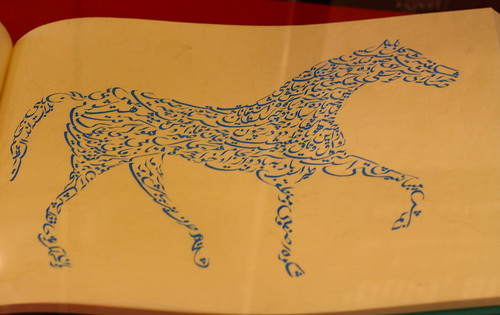
Persian figural calligraphy loops and flutters like the most beautiful artwork, a sort of flowing dance in ink that reminds me of watching flickering flame. Each figure that makes up this horse is a word in the poem found below by the 14th century metaphysical poet Hafez of Shiraz. You can imagine the little spark of pleasure I felt when I saw this gorgeous shape poem in **my library the other day.


The horse was written into life by Iranian-born painter and print maker Jila Peacock. Jila made a pearlescent color silkscreen on Japanese paper of each of the poems in animal form, to create a book called Ten Poems from Hafez. She recreated this painstaking process and bound fifty volumes. The books are large and gorgeous, and the design won the British Book Design Award in 2006.

The rose opens crimson
And the nightingale is drunk with love
Happy news, you reveling Sufis,
For the rock of your resolve is
Shattered by the crystal chalice.

Bring only wine to the throne of Heaven,
For when the time of parting comes
From this tavern of two doors,
Sentry and sultan, wise man and fool,
Lofty or low and without worldly gain,
All must pass through.

Our time of joy comes tied to care,
As bliss was bound to loss at time's dawn.
Even Assef's pomp and splendor,
His horse of the winds,
And the language of birds
Are lost with the wind, a traceless void.

Each shining arrow soars a while
But must return to dust.
So do not waver from the path
Or wrestle with being and nothingness
Love life now,
for oblivion completes all things.

O Hafez, rejoicing in the beauty of your pen,
See how we pass your words from heart to heart!

-- Hafez of Shiraz

Sufism is the inner or mystical dimension of the Islamic faith, and the poet, Hafez of Shiraz, was a 14th century practitioner. I'm probably too much a literal thinker to be a good practitioner of mysticism. I have no idea who the historical Assef might be, nor do I know the significance of a crystal chalice to a Sufi. But there is still so much to take from this poem. The use of the animal shape conveys a poetic ideal of motion and life. Living in the now and rejoicing in the beauty of the present is a single facet of the work; another viewpoint is the transience of the natural world, the "here today, gone tomorrow" nature of every living thing. Somehow, the Sufis -- and the horse -- are happy anyway.

Please take a few minutes to look at all ten of Jila Peacock's animal shape poems, and learn a little more about the process and the artist.

Passing our words from heart to heart this week is Elaine Magliaro who graciously hosts Poetry Friday at Wild Rose Reader.


**Ah, yes, "my" library, with the coffee shop and the art gallery on the top floor and the little theater, and the glass domes and mandolin wielding statuary up top -- sigh! In spite of the fact that the librarians think I'm insane, the Mitchell rejoices in lovely architecture and good funding. Though some days I just scurry in and scurry out, it's a cool place.)

TBR3: A Tale of Two Cities - Ending the First Book

Another lovely jaunt through the Dickensian countryside of dry, witty lines, but the tone of the novel already grows a bit more dark...

Are you reading?


Ch. 4
So many 19th century novels have people striding off to Bath, or to take the water in various places, that this description of Dover really amuses me. "The air among the houses was of so strong a piscatory flavour that one might have supposed sick fish went up to be dipped in it, as sick people went down to be dipped in the sea." p.16 Smells like Pier 39!

So, our Mr. Jarvis Lorry has taken the mail packet to Dover, and is prepared to see a young lady. He relates to her a story -- and continues to say that his connection with it is simply a matter of business, with no feelings involved. "A matter of business -- don't be distressed." Hmm! But the more Mr. Lorry says this phrase, the more distressed both he and Miss M. become!

HEE! The woman has bonnet like a "Grenadier wooden measure" or a great wheel of STILTON!? p. 23 Oh, this is a very bad hat indeed. According to Wikip., 19th c. grenadiers had hats like bishop's mitres. Poor wimpy Mr. Lorry!

(And equally wimpy Miss Manette!)

Oh, all right. Granted, she's just received news that a parent might be alive. It's a little startling when you *thought* you were an orphan.

Ch. 5
The best definition of cobblestones yet: "The rough, irregular stones of the street, pointing every way, and designed, one might have thought, expressly to lame all living creatures that approached them..." p.24 Dickens might have been describing the roads here in Glasgow, I kid you not.

Deepest, darkest foreshadowing: "The time was to come when that wine too would be spilled on the street-stones, and the stain of it would be red upon many there." p. 26

Mr. Lorry and Miss Manette arrive in the dirt poor and starving suburb of Saint Antoine in Paris, and find Monsieur Mamette, who is a broken shadow of a man, in a broken city suffering from hunger and want. His daughter finally comes unglued from her perpetual state of girly fear, and goes straight into being sort of motherly, and they swoop him away... and Madame Defarge knits, and sees nothing.

I remember her. She "sees nothing" a lot.

Meanwhile, it's the end of the first book, and Mr. Lorry has peculiar worries about what all has been lost from Monsieur Manette. What mysterious old life is it to which that poor imprisoned man can't say he cares to be recalled? Mysteries abound.

It's actually really cool to read this in bits like this; I'm getting a much more nuanced version of events, and remembering tiny details -- that will probably come back and give me that "Aha!" feeling later.

Ciao, ciao, 'til next we meet our mysterious benefactor and all other players.

September 04, 2008

The Return of Holden Caulfield!

We have mixed feelings about The Catcher in the Rye here at FW, but regardless of how you feel about young Mr. Caulfield, it's interesting to hear that he's a character who still sparks debate in high school English classrooms. Not so much for younger students, though; and in fact, as one high school English teacher put it in the Washington Post, it's the selection of books that students at particular ages can't relate to that is contributing to the decline of interest in great works of literature (and reading in general) in high-school-aged students. Teaching students to analyze books to death rather than enjoy the words on the page, the images in one's head, can also be a problem.


It's probably why I have Dickens-o-phobia--reading Great Expectations in 9th-grade Honors English may have been required and I may have survived it, but it did not instill in me a lifelong appreciation for Victorian literature. In fact, I thought Pip was a wiener. But I'm still reading A Tale of Two Cities...and you know what? This may sound strange, but I almost couldn't stop laughing the entire first page. There is a very wry, very dry, sardonic sense of humor to this piece, disguised a bit by the long, flowing sentences, the forest of clauses and commas and semicolons. Dickens also seems to be very critical--perhaps satirical--of his characters, who in many ways appear to be character types--the seedy messenger, the coachman with the itchy trigger finger and the almost John-Wayne-like "I don't like your attitude" -attitude, the shifty-eyed coach passenger with the mysterious message. More on Dickens tomorrow.


Just a quick bit of bookish news to end the post with--John Bemelmans Marciano, the grandson of Ludwig Bemelmans, creator of the Madeline children's books, will be releasing the first Madeline book in 50 years, Madeline and the Cats of Rome. I remember being almost scared by one of the Madeline books as a kid, though I adored them. I remember that Miss Clavel, specifically, kind of freaked me out. In the pictures, she was this sort of wispy floating nun-like ghost-woman. When Madeline wakes up in the middle of the night and freaks out, Miss Clavel comes lurching in at an alarming angle. Anyway, Madeline fans, take note--the book comes out this month.

Talk About A Smart B...

Yes, I know. We are all done discussing Mr. Sparkles and the Swan Formerly Known As Bella. However, SB Sarah has done one of the best close readings and most intelligent literary criticisms I've read thus far on the mystery of The Bespangled One. She answers the question "What Is It About Edward?" beautifully.

A single paragraph that just made me want to go back and write more literary criticism for English:

He tames his desire to kill her and eat her, but he still consumes her, which is the point that made me the most uncomfortable, but may also serve as a primary reference as to why Edward is so alluring a character. While Edward and Bella don’t knock boots in Twilight, Edward manages to insert himself figuratively into her life and become the center of every moment of Bella’s life – and she’s all for it. More than one person commented to me privately after reading my review that the manner in which Bella subsumes her identity and becomes absorbed by Edward almost symbiotically made them as readers profoundly uncomfortable, because it echoed abusive relationships they witnessed or experienced. It wasn’t romantic for them, that totalitarian management - it was creepy.


Word.

Doomed to Repeat History

I suppose, as a fan of dystopian novels, it was inevitable that I would eventually get to Walter J. Miller Jr.'s seminal work, A Canticle for Leibowitz. Published in 1959, you'd think that such an early prediction of the future of humanity would become quaintly dated, or at least slightly amusing as well as terrifying, like Aldous Huxley's Brave New World. However, it's a bit more like 1984--perhaps a bit farfetched, but also still frighteningly believable.

Set in the very far distant future, the story opens with a lone would-be monk in the desert. Francis is a novice in Order of Saint Leibowitz--an engineer back in the time of the Flame Deluge. In the centuries since, however, nuclear holocaust has resulted in a new Dark Ages; the wasteland of half-destroyed, picked-over ruins of concrete and steel, of radiation mutants and power-hungry semi-civilized illiterate hordes, punctuated by the occasional bright spots of monastic education overseen by New Rome.

Francis is undergoing his Lenten privations isolated in the desert, when he encounters a mysterious wanderer who (inadvertently? perhaps...) leads him to artifacts left by the venerable Leibowitz--just a few pieces of paper, but still sacred to those preserving the Memorabilia of an ancient past. But this isn't just Francis's story; he's just a small part of it. It's really the story of humanity through the ages. As old scraps of knowledge are gradually pieced back together, can humans take a bite of that proverbial apple without ensuring their own destruction?

This book is fascinating for its interweaving of the structure and beliefs of Catholicism into a science-fiction setting and a philosophical and ethical quandary for the ages. Despite its near-total absence of female characters--I suppose that's because much of it takes place in a monastery--this is a rather chilling and fatalistic imagining of the future of humankind, though that's unsurprising for the time in which it was written. But do we really want to ignore or forget the lessons of WWII and the Cold War? I'm guessing not.

Buy this book from an independent bookstore near you!

September 03, 2008

The Big Read: Starting from Behind...

Let me just start off by saying that I've never read A Tale of Two Cities. I've never read a lot of things. Plus, I'm not the biggest fan of Dickens. Still, it's certainly a denizen of my lengthy list of Books I Ought to Read. Someone mentions it, I say, oh yeah, I should read that someday. But, in the famous words of Creedence Clearwater Revival, someday never comes.


Well, evidently today is my someday. I looked at Leila's blog post a few days ago and considered it idly, but what made me charge ahead was the fact that I'm currently at my mother's house, and, as a Ph.D. in Comparative Literature, she owns just about every classic novel known to man, particularly if it was written in English, French, Spanish, or something obscure and medieval.


You'd think that I'd be much better read by now, having grown up in a house full of great written works. But when you're a kid, your priorities are different. I would often think, I can read these any time. Why bother doing it now? Every so often, I would pick one up from the shelf, a book I'd heard something cool about, attempt to begin reading it, and, several pages in, think to myself "augh!" and put it away again. This happened at age twelve with James Joyce's Portrait of the Artist as a Young Man, thereby proving that just because you can read something, doesn't mean you should, or that you'll get anything out of it.


(Parenthetical aside--you might also think that, growing up with a literary mom, my becoming a writer was inevitable. Actually, though I always enjoyed writing, my early career interests seesawed from baseball player to stand-up comic to ballerina to fashion designer to, ultimately, artist. I did a lot of writing and art as a child, but for quite a while this seemed to manifest in the form of homemade magazines of dubious quality, like Young Cat and Doggie Vogue. Will post pictures one day--I promise.)


Anyway, that's a very long-winded way of saying that I think I ought to read A Tale of Two Cities. After all, my knowledge of classic literature, though fairly extensive on the theoretical level, is rather abysmal on the level of actually having read stuff. Beyond the high school required reading, one college-level freshman English class, and a few more lit classes for the grad degree, I've not taken all that many literature classes. I was an art major as an undergrad. Not so much literature. Lots and lots of dense, self-important, wordy art criticism.


Will post updates as I attempt to stay on track with the schedule.


Oh. And there won't be a toon tomorrow, since I'm at my mom's house and lack my usual set of drawing and computer-y tools, but I will post something. Links and stuff.

I dream a world... Daydreamers will enjoy this piece at The Boston Globe about why kids and adults need time to loll around and look at clouds. When we daydream we think of things that don't exist -- and the result can be something as cool as the Post-It Note! Apparently, great things happen when our brains are at rest.

Meanwhile, Galleycat is uncovering something else about vice-presidential nominee Sarah Palin. Instead of Barracuda, some people might want to call her Book Banner. Ouch.

As always, Sara has something significant and thought-provoking to say about writing. Today's question: is mine necessary? That's actually a pretty heavy question.

TBR3: A Tale of Two Cities

Are you reading?
Chapters 1-3

A Tale of Two Cities even smells classic, which probably has more to do with the age of this paperback, and the length of time since it's been opened than anything else... but, I digress! The book opens with the most famous Dickensian lines, quoted badly by nearly everybody. A lot of people like to wax eloquent on "It was the best of times, it was the worst of times," but few people have actually noticed that Dickens was being fairly ironic. His next few passages indicate that the world was simply not that great, either in France or in England. On the night the Dover mail comes up the hill, in the muck and mire, the passengers on-foot, highwaymen are feared when a message comes for a man named Mr. Lorry of Tellson's bank. The message he receives, and the reply he sends to the soaked and harried courier are confusing, but deliciously mysterious.

Even more confusing is the following chapter, where the message is debated. Could someone really have been buried -- for eighteen years -- and recalled to life?

All of this is couched in Dickens' lyrical prose, sometimes mouthfuls of words, sometimes shorter sentences, which might come as a relief if one is lost in his perambulations. I enjoy the way he plays with words, and the way that the story is furled up tightly and anonymously in this storyteller's cant. You won't know anything -- plot, characters, motivation -- until he's ready to tell you. In the hands of a master storyteller, one can simply enjoy the spooling out the prose as the tale is revealed.

Red Vinegar

Cora Holman is embarrassed by her mother's death. How humiliating is it to live in the crappiest house on the street, and have a junkie for a mom? And then, when she overdoses on her pain meds, and dies in a gushing nosebleed, it's all Cora can do to hold it together while the EMT's take her body away. What's worse is that one of the EMT's is... her neighbor, Scott Eberman, whose younger brother Owen is in her class. He knows all about Mom's drug dependency, and he also remembers her, from when he was a senior, and she had a paralyzing, wordless crush on him.

That would be bad enough, except that Scott's really kind to her. He feels responsible, and doesn't want to leave Cora in the house alone. He decides to come back and check on her, after he checks on his Mom, who's been having awful headaches, and won't make time to go to the doctor. Poor Cora, really. No one should be alone in the house where their mother died, bleeding...

Owen Eberman is coming down with something, and his childhood friend, Rain Steckerman, is also not feeling well. Her father worked for the FBI and has recently been promoted to the United States Intelligence Coalition. Mr. Steckerman is observant -- and strict. If Rain's not up to her swim competition, he'll make sure she doesn't compete, and since the school's counting on her to win, Rain has got to compete. In an effort to avoid her father's eagle eyes, and in hopes of talking Scott into medicating her, Rain bunks down with Owen and Mrs. Eberman in front of the TV, and tries to drink enough water to head off her symptoms.

And then Mrs. Eberman takes a turn for the worse... and dies, with a gushing nosebleed.

One street. Two deaths. Twenty-four hours. What on earth is going on?

This harrowing, fast-paced novel is told from multiple points of view. The voices of faceless adults with their own agendas, a sullen New Jersey computer hacker with a head full of secrets, and an anxious Pakistani virtual spy are skillfully mingled with the voices of the frightened, grieving, panicking teens. Human emotion is tied to science, technology, and faceless bureaucracy. Government agencies are scrambling for answers, but they need more help than they realize. Is it a virus? Is it an act of terrorism? Will anybody figure it out in time?

Buy this book from an independent bookstore near you!

Howl Strikes Again

It might seem selfish to you, but if you had a book you wanted to read, you'd understand. Charmain Baker has a book she wants to read. So, if everyone would leave her alone? That'd be really cool. The one thing Charmain wants to do in the world is work in the King's library. If she can't do that, she'd rather read at home, thanks.

Unfortunately, no one's even consulted Charmain on what she wants. Her mother has been railroaded by an obnoxious aunt into sending her to house-sit for Great Uncle William, who in real life is the Royal Wizard Norland, while he is away dealing with a serious illness. Mrs. Baker thinks magic "is not nice" and isn't at all excited about the prospect of her daughter doing something potentially ...shady as keeping house for Great Uncle William. Charmain, though, is pretty useless for doing anything in the world except for eating and reading, and though this fact has escaped her parents, Charmain's aunt is sure her lazy temperament would be improved if she had to help someone else... so off to the Wizard's house Charmain is sent, and soon the medical Elves come to take her great uncle away. Charmain's on her own... and of course, true to form, everything immediately goes wrong.

On the up side, Charmain braves sending a letter to the palace and applies to be the librarian -- and gets the position! On the down side, the house is apparently miles and miles huge -- and it goes... different places. If you turn left out of one door, you might not ever get back! And kitchen at the wizard's house is a disaster, the laundry is breeding -- literally -- the living room is filling with suds from the fireplace, there's a dog and a boy wandering through, the angry kobolds are on strike, and a MASSIVE insect is threatening to eat her.

Fortunately, the palace library is nice and quiet and orderly... and then everything goes wrong there. Fortunately, the competent sorcerer Sophie and her babies are there to help... or, not, as the case may be. Those babies are totally out of control.

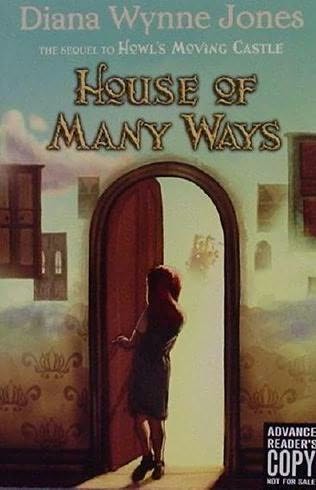
This is the third novel in Diana Wynne Jones' Howl's Moving Castle series, but it's not quite all about Howl as we know and love him. He's up to his usual nonsense, but it takes awhile to figure out where he is -- and why. Charmain Baker may not strike readers as easily lovable as Sophie Baker, but she grows on you. The novel sets up a brisk pace, as a series of calamitous and crazy things happen -- classic for any of the Howl novels -- and you'll have to really pay attention to catch everything! Calcifer, Howl and Sophie are fab, and there's an optimistic ending where just about everyone gets what they want.

Buy this book from an independent bookstore near you!

Mythic Games


Hayley Foss would just like to know what made her Grandmother so mad.

But, it's not like she's going to find out anytime soon. Hayley is hardly let outside, her Grandmother is so strict. Her own parents have died, and so, Hayley is ...stuck.

Grandfather is lovely, but too preoccupied with his work. Sometimes he goes away for a long time to "see his other family" and Hayley is miserable without him. Fortunately, he's really very good about letting her wander in his office when he's home. As long as her hands are clean, he'll explain things or tell her a story, and once he told her about something fabulous -- the Mythosphere. And it got them both in a lot of hot water with Grandmother.

Grandmother hasn't ever really been fond of her, but Hayley's pretty sure that the real trouble between them has something to do with Flute and Fiddle, the two friends of hers that she meets one day when she's out with the maid. Because of them, she's packed up with not a word spoken, and sent to live with a passel of aunts and cousins -- and not one uncle around.

Hmmm.

Browbeaten, meek Hayley, with her prim dresses and shined shoes, is really out of place amongst the welter of cousins (especially nasty Tollie), but Cousin Troy and Cousin Harmony are on her side, and they allow her to play The Game.

NONE of them are supposed to be playing. Wandering the multiverse of the Strands and playing in the Mythosphere is strictly prohibited, but Hayley's a natural. And no wonder -- just about everybody in her family is good at this game -- really, really, really good at it. And along the way, Hayley starts learning some family secrets. One is that Uncle Jolyon has told her the biggest lie in the world. When Hayley finds out the truth - it changes everything.

I can't tell you any more without giving away too much, but I think you'll have as much fun figuring out what's going on in Hayley's world as I did. The Afterword at the close of the book will help clear up any lingering questions. Though I wish the novel had been a little bit longer, and not have tied up so quickly and easily, I find that's my reaction to just about all of Diana Wynne Jones' books. There's never enough story!

Buy this book from an independent bookstore near you!

The Fundamental Things Apply, As Time Goes By...

The title of this book brought to mind Bogey and Bacall movies, soft-filtered camera work and the song "As Time Goes By." The topic of this compassionate, powerful book isn't romantic nostalgia, however; You Must Remember This, by S.T. Underdahl is about memory -- the loss of it, and the things we hold onto when it's gone.

Lucy Kellogg has a good life. She has a nutty best friend named Sukie, and the coolest Nana -- they even share the same name.

Nana Lucy is a world traveler, a well-dressed, hip, funny lady who puts all the other Nanas in the world to shame. She gets Lucy, even though seventeen is years and years behind her. She sends her funny postcards every time she goes away, and her Lucy to Lucy presents are the best. Nana Lucy knows all about Lucy's inner life, and when Lucy falls flat on her butt at the cheer tryouts -- that she didn't really want to do in the first place, Nana knows how bad it feels. And, when Sukie makes the squad, and what was supposed to be a forever kind of friendship starts to fade, Nana Lucy understands. After all, Nana and granddaughter are closer than even Lucy and her Mom. So, it's a horrible shock to hear that Aunt Carol says there's something wrong with Nana Lucy.

When Lucy hears the word "Alzheimer's," she decide she can't take hearing any more.

Not to her Nana. This can't be happening to her.

Then, Lucy breaks one of Sukie's cardinal rules of friendship -- accidentally -- and there's no way to explain. And she's not only losing a friend, she's losing her closest confidant. None of this is supposed to be happening! But it is... and more than just memories are coming loose in Lucy's life. Everything has come undone.

Can Lucy remember the number one thing that she and Nana Lucy -- and once upon a time, she and Sukie -- share? And will it be enough to remind them of what's important?

A heartbreaking, fabulous family novel. Bring your tissues.

Buy this book from an independent bookstore near you!

Random Coolth

You know I have to be down with this: In honor of the late great St. Julia Child, Ananka's Diary is having an original Girl Spy Outfit Contest. How COOL is that!?

And a second bit of coolth -- In my continuing quest to be as cool as Kiki Strike, I'm playing with the idea of taking Russian this fall, and came across this bit of anime goodness via SFSignal:


How fun would it be to be actually able to READ that? (It actually says First Squad and is a Russian-Canadian anime collaboration from Molot Entertainment.)

I'm always a little shy when authors comment on my reviews, but I have utmost respect for people who fearlessly discuss things. Semicolon Blog didn't care for Looking For Alaska, and said so. John Green responded, and it turned into an interesting discussion. It's really nice when intelligent people can agree and disagree without screaming. [Note to politicians.]

September 02, 2008

The Big Read: A Tale of Two Cities


I have to give some respect to the French Revolution.

It was one of those portions of history that scared the crap out of me as a child. Along with the Dark Ages (seriously. The life of a serf? So not good.), the Plague, slavery / the "Reconstruction," and the Holocaust, the French Revolution just seemed like one long, horrific nightmare from which the French, commoners and aristocrats alike, would have dearly loved to awaken.

Of course, I obsess over things that scare me. I read history books and drew pictures of madam guillotine (Why is it Madame? Or the maiden?) Why is it female? I mean, is it just the whole emasculating thing?). I inhaled books about the French Revolution. I struggled through The Scarlet Pimpernel when I was eleven. (I told my parents it was nonfiction [they didn't look too closely]) -- and I read A Tale of Two Cities -- in the 8th grade without having it assigned.

Yes. It was a sickness. And, as with all panicky little obsessions, eventually my French Revolution mania faded, to be replaced by something else -- a 10th grade obsession with evil Mary, who was trying to kill Good Queen Bess, if I recall correctly.

Some of us took our history classes way seriously.

It's time to read A Tale of Two Cities again. Tomorrow, the madness begins anew. A knock at the door! Stitches dropped while heads roll! Mad Frenchmen and blood in the streets!

Are you reading?


Ah, Brockman, Ah, Powells. Snarking on Midnight Sun and Scholastic. Good times.

September 01, 2008

Yours In Exasperation...

Mini-rant:

Do you know how HARD it is to find multicultural middle grade mystery novels? Somehow, most novels that feature multicultural characters stop at the third grade reading level, and let's not talk about mysteries -- Apparently life is entirely straightforward for characters outside of the dominant culture. No mystery at all.

SIGH.

I KNOW these books exist, though they might be few and far in between. Readers, librarians -- I call on you: mysteries featuring multicultural characters for middle grade readers both avid and disinterested readers? Anyone??