June 13, 2017

SURVEYING STORIES: Historical Without History, in REAL FRIENDS by Shannon Hale

While May is indeed National Mental Health month, I'm... behind. I'm choosing to ignore that and the fact that Sarah did the actual review of this book weeks ago. Part of good mental health is accepting our... limitations.

*cough*

This book is actually a 'twofer' for things I don't see often in MG lit: one, it's an American narrative memoir, and two, it's a graphic novel which has a clear depiction of a mental health issue, in this case, anxiety. This is an occasional series which proposes to study elements of children and young adult fiction from a writer's perspective.

Let's survey a story!


Shannon and Adrienne have been best friends ever since they were little. But, on day, Adrienne starts hanging out with Jen, the most popular girl in class, and the leader of a circle of friends called The Group. Everyone in it wants to be Jen's #1, and some girls would do anything to stay on top... even if it means bullying the others.

Now every day is like a roller coaster for Shannon. Will she and Adrienne stay friends? Can she stand up for herself? And is she in The Group - or out?

There's been a lot of praise for this books already, so I'll spare you my recap of the storyline - and how much I cried reading it. (Plus, Sarah already did that. Not the crying, the recap.) Instead, I want to focus on genre.

Memoir can be tricky. In this day and age, we're all amateur memoirists, constantly Instagramming and Pintersting our lives into scrapbooks of who we are, and what we did and what we wanted in our life and times. When a writer doesn't have a historical incident or a larger-than-life world to outline, memoir can seem self-involved and narcissistic. At least, that's how the New York Times criticizes most memoirists. However, memoir is actually a really good way to write for middle grade readers. It's a fun way to come to grips with the talking points of history, and I know that I read a metric TON of memoir in elementary school, as "acceptable" reading in the eyes of my parents. Told generally in the first person, memoir is truthful, without being totally factual. It takes giant bites of history and masticates them into digestible slivers, often taking readers back to a child's-eye-view of incidents, including historical incidents. The fact that memoir is more about episodes in someone's life than the day-to-day details of it make it good for younger readers as well, to read an episode, and set the book aside and think about it, or react to it. There are plenty of middle grade memoir books, but very few of them are quite so painfully personal, wherein the failures of parents, teachers, family, and friends are so clearly displayed. Rather than that casting shadow on the main character, however, or making her the most important character, it sheds life on how other people are living within the moment the main character feels is of utmost importance. More importantly, it turns the question around to the reader: Has this ever happened to you? What would YOU do? These are relatable questions, especially to younger folk.

As I've mentioned, memoir for me meant capital-H-history. It does seem like most of the memoir I've read for middle graders is from both the past, and is international. I've read books about growing up with rice paddies, the Communist Revolution, and the Holocaust. American memoir hasn't had too many huge historical incidents to grapple with in the past seventy years (although I distinctly remember reading We Were There books about the Normandy invasion in the fifth grade). Hale's book is rare in that it's recent history - just a slice-of-life from 1980's Utah. No big historical incidents happened there during that time: just life in elementary and middle school.

And, especially because both the writing and illustrations are brilliant? That's enough.

That's enough to let a kid know that their life has historical context. That's enough to remind them that "now" is not all there is, that someday, they will be 'looking back.'

The best memoir holds, once again, two ideas in tension. One, that life is a big-picture forest, and two, that this one, tiny ant is toiling along through this forest, trying to hang onto its load and keep in line behind its fellows. This keeps the characterization vivid. While this is both a story about one version of ant-Shannon growing up with anxiety and loneliness, it is also a story about the forest of imagination, and how ant-Shannon's lonesomeness was both cause and fuel for her imagination. Would she have had one without the other?

It's something to consider, while you're, as Dame Yolen puts it, telling your true.

Kelly Jensen put together a list of YA/MG non-fiction titles during the Cybils last year, of excellent narrative non-fiction. There's more great memoir out there, writers and readers.


I received my copy of this book courtesy of the public library. You can find REAL FRIENDS by Shannon Hale & LeUyen Pham at an online e-tailer, or at a real life, independent bookstore near you!

June 09, 2017

Turning Pages Reads: WHEN DIMPLE MET RISHI, Sandhya Menon

Welcome to another session of Turning Pages!

It's hard to critically review a book when you want to gush about it, but I'm going to make an effort. If you need a feel-good, Happily Ever After, this book is one you'll want to tuck into your carry-on bag. With your iced coffee in hand, board your plane, knowing you've got the perfect vacation read. You'll want to hug this book, too.

Synopsis: Dimple Shah would like her mother, please, to STEP BACK UP OFF OF HER a little. Just... a little. If she hears one more nattering bit of gossip about who's getting married, about wearing eyeliner and looking more attractive so she can land the Ideal Indian Husband, or growing out her hair, beti, it's beautiful, why don't you do something with it, she. is. going. to. SNAP. It's a miracle and amazing that her very protective mother and soft-spoken father have finally been talked into letting her go to Stanford. She's earned that, and they're proud of her, yay. But, that they are letting her go to SFSU for a summer program for up-and-coming web developers -- is unprecedented! There HAS to be a catch??? Her mother cannot possibly be suddenly behind her coding and computer engineering dreams, can she??? Well... actually... yes? And no.

Rishi Patel is the serious-minded, loving son of two amazing people whose love is the type sung about in Bollywood films. He wants that -- badly. He wants what they have, wants that harmony, that purpose, that ...support. He believes in love, believes in family and tradition. So, when his parents suggest that he go to SFSU's summer coders program and check out the daughter of his parents' very dear friends, he thinks, "Why not?"

The agony, the ecstasy, and the expectations of love are all the things that make us play the game. Dimple and Rishi and their friends just have yet to figure out the score... but, they will.

Observations: This novel brings the funny: we all cheesed at the front cover, but my people, look at the back!! Two steps forward... two steps back...

Yes, I am channeling junior high and Janet Jackson, because we all THINK we love romances with the idea of "opposites attract," but when it comes down to it, often, it feels like if characters are TOO opposite, they're unevenly matched, and SOMEONE will have to make a 180° change in who they are... Things like compromise are too often something that's considered boring and too real life for the fantasy of romance. One thing I adored about this was how hostile Dimple was to the idea of romance - because of that reason. Because there's an expectation that if someone is going to change, it' going to be the woman, and if someone has to sacrifice, society is looking at her expectantly again. It makes her ANGRY - with a baffled fury which she struggles to express. She WANTS the dream. She WANTS the gooey HEA. But, real life doesn't provide a place for anyone to have it all, man or woman. If you want to be in love AND have a career where you kick butt and take names... well... you're going to have to work for it like nothing before. And, we don't see, in Western society, enough of that work in action to believe in it.

I love that Rishi is so... wonderful. He's almost too good, and I feared for him, until he started to act like a butthead, and then I was like, "Oh, good. That Mature And Amazing thing only goes so far. Human nature and emotions cloud his head, too. I love the exploration of his relationship with his brother - *sibling magic!* - and I love that guys can care about each other in tender ways... even while giving THE WORST ADVICE EVER. I love that both Rishi and Dimple were sometimes beyond brave. Their romance felt real and long-lasting, and the type of thing you knew they could look back and tell their grandkids. Too often, teen romances have an element of "we won't tell our parents" and the fact that this is ABOUT their families and their futures, is, in a way, such a great twist. I'd love to see more novels where the parents aren't just invisible.

Conclusion: I generally don't read YA romances, because they disappointed me when I was a teen too much. Romances can leave you feeling a little wistful and lonely, as if you can never have what you've just read about, and that goes double if you've only ever read about majority Western families non-Indian families who don't have parents - or parental expectations - or skin-and-hair and lives like you do. But, this romance is a big-hearted, hilarious, tear-inducing -- wonderful-fest, which can be read by everyone, guys and girls, Hindu and Christians - it's inclusive, yet it's very special in that it's going to be extra special for the South Asian teens who identify with the snacks and the songs and the aunties. I love it like watermelon mint iced tea. (Sorry; cannot DO the iced coffee, people.) I just have an extra-special warmth in my heart to think teen readers LOL-ing at this, and I'm betting someone needs to make it a movie, STAT.


I received my copy of this book courtesy of the public library. You can find WHEN DIMPLE MET RISHI by Sandhya Menon at an online e-tailer, or at a real life, independent bookstore near you!

June 08, 2017

Thursday Review: GIRL, STOLEN by April Henry

Synopsis: Every so often, I really want to go back to the reading tastes of my tween/teen years and pick up something that's a manically fast, suspenseful read with a strong girl protagonist a la Lois Duncan or Joan Lowery Nixon, whose books I used to devour. (I'd walk into the library's YA section—which, in the mid-late 1980s, was not very big—and head straight for the D's and the N's. I have a vivid memory of doing this.)

Girl, Stolen by April Henry (and it's got a sequel, Count All Her Bones) reminds me of those times, and I know I would have loved it. The protagonist, 16-year-old Cheyenne Wilder, is blind, but while her blindness is a critical part of the plot, it isn't used as a gimmick. It is, however, important to the setup. At the beginning of the story, Cheyenne is waiting in the car for her mother to pick up her prescription from the pharmacy: Cheyenne has pneumonia, so, feeling ill, she lies down in the back seat of the car. The next thing she knows, the car is being stolen with her inside of it. The thief, Griffin, didn't mean to kidnap anyone, just to steal a car, but when his dad finds out who Cheyenne is—she's the daughter of a wealthy executive—he decides to take advantage of the situation.

Observations: Cheyenne's blindness is not simply present as a plot device, and I appreciated that. She is a fully rounded character (as she should be) with the skills and smarts to outwit her opponents, and she needs every bit of her moxie in order to succeed against some truly scary baddies. It's also refreshing to have a protagonist with a disability who is placed into an exciting genre plot, rather than a problem novel or issue book or whatever you want to call it. And the sequel was just as exciting as the first book, with a plausible reason for Cheyenne to end up in trouble once again.

Conclusion: Fans of Caroline Cooney will enjoy these, too—you don't have to be someone who was a young adult in the bygone era of the last millennium. I promise.


I received my copy of this book courtesy of my library's ebook collection. You can find GIRL, STOLEN and COUNT ALL HER BONES by April Henry at an online e-tailer, or at a real life, independent bookstore near you!

June 07, 2017

SURVEYING STORIES: The Personal & Political in Rita Williams-Garcia's ONE CRAZY SUMMER trilogy

Middle grade books can run a broad gamut from stories of dead dogs to bridesmaids to adventures on scouting trips. There can be romances, or not, ghosts or not, fear of the dark, braces, or spiders - or not. Middle grade is a great, transitional time. In recent years, there have been a few books about voting for class presidents and such, as tween transition into older, more political thinkers, but I haven't seen as much writing about politics outside of the classroom. In these very odd times, however, I can imagine that's coming. Ask the kid who refused the photo-op with Paul Ryan. "We're not brainwashed," said Jordan McCray-Robinson. "We live in the real world." And indeed, she and her fellow classmates may not know all the issues, but they're old enough to have the outline. Old enough, when paying attention, to have an opinion.

Eleven year old Delphine, at the beginning of this series, is fairly indifferent to the news - it's something Big Ma watches, it's part of the stream-of-consciousness "fussing" with which Big Ma fills the air - with her opinions, prayers, and criticism of the world at large. The personal in this book is immediate -- there are details real and specific only to black people, black girls, black families, in the 1960's or otherwise. Williams-Garcia does not include a glossary, nor does she explain them all. These things are personal to her, as a writer, as a woman who grew up in a black family, and personal to some black people. However, unlike the personal issues of "country" relatives, hot combs, and free breakfast, there are universal themes, too, like bickering siblings, a critical grandparent, and a missing parents. Both the personal and the political stand tall in all three of Rita Williams-Garcia's books, giving writers and readers alike the vocabulary and the scope to enable them to look at their world against a push and pull of different background. This is an occasional series which proposes to study these elements in children and young adult fiction from a writer's perspective.

Let's survey a story!


    "Does anyone know another word for the earth's constant spinning?"

    That was how I knew Sister Mukumbu was a real teacher, aside from her welcoming smile and her blackboard penmanship.She asked a teacher's type of question. The kind that says: Join in.

    Thanks to my time spent with Merriam Webster, I had a few words in mind. Rotating. Orbiting. Turning. Circling. I wanted to join in, but I felt silly, being one of the older kids. Not as silly as Hirohito spinning around, but too old to wave my hand frantically as all the younger kids around me were doing...

    When one of the kids called out "Revolving," Sister Mukumbu clapped her hands. Her bangles jingled. "Yes! All of your words are right, but 'revolving' is right on!"

    ...Sister Mukumbu said, "Revolving. Revolution. Revolutionary. Constant turning. Making things change." - ONE CRAZY SUMMER, Williams-Garcia, p. 71-2

It's hard to think of politics, for some, in terms of children. It's harder for some with privilege to imagine the worlds of childhood as a microcosm of the larger world, but in many ways, it is. What kids hear at home plays out, full script, at times on the playground. The power dynamics, and the beliefs which parents might never have articulated are observed and displayed. The issues which with we grapple (or don't) at home are largely the issues which we explore or neglect in the public sphere. ONE CRAZY SUMMER introduces us to Delphine, Vonetta and Fern, and tells the story of the summer they spent in Oakland with their poet mother, who didn't want to be a parent, hadn't sent for them, and wasn't fussed about feeding them or keeping much track of them, really. Through trial and error - and a whole lot of bossiness on Delphine's part, the girls are herded through the summer, and develop the sprouts of a relationship with their mother. This book was praised for showing a particular facet of a lived experience of some black children in the sixties, contrasted against the swirling of political unrest, the Black Power movement, and the larger story of the Black Panthers of the 1960's. In this first of the trilogy, black families are revealed as both familiar and new, dimensional, and real, and the Panthers are seen less as solely paramilitary protestors, but as teachers and social workers, reminding some of a forgotten piece of their history.

P.S. BE ELEVEN might have seemed, on the surface, less political. After the girls return home for the school year, they're immersed in the business of school, and home. Delphine faces major changes in her classroom, but learns the worth of a "Malcolm X Muslim" student in her classroom. The girls bear up under more of their endless grandmother's fussing, and must make peace with their father getting a girlfriend, and marrying her. Delphine's letters to her mother are filled, not with a little girl's thoughts, but with a growing young woman's questions. I love that her mother's constant refrain is Be Eleven. Be who you are, and where you are, right now. This is, of course, hard for an eleven-year-old to hear.

A more personal political exploration came from Uncle Darnell's storyline. Uncle Darnell, who, since being back from Vietnam, was sleepy-eyed and always sniffling. Uncle Darnell, whose dimpled never showed anymore, and whose protective, uncle ways changed dramatically. Though my story was ten years after this one - the war lasted so long - I was Fern's age with a beloved uncle home from Vietnam, and I remember vast and bitter disappointments of broken promises and zoo trips that never happened. I suspect that children in this generation who are losing beloved family to alcohol and opiates and PTSD in this endless state of war that we're in, might weep in recognition. Though many people expect a second book in a trilogy to be a place-holder or filler, P.S. BE ELEVEN, with its secondary theme of enabling and independence, has a poignancy that once again brought the struggles of families of color - and really, families of any kind - who have stepmothers, on-again-off-again best friends, and the vicious claws of addiction dug into them into painful clarity.

    Turning eight hadn't grown Fern any taller. It had just made her mouthy.

    "Where's my watch?" she repeated.

    "Safe in my drawer, where you won't lose it."

    "Well, I want it," Fern said. "And you can't keep it from me. If you don't cough it up, I'll tell Mrs."

    I shrugged. "Tell Mrs."

    "I'll tell her, and she'll tell you --"

    Then Vonetta, her ally, cleared her throat, fluttered her eyelashes, and finished ina voice as close to our stepmother's as she could mimic, "Delphine. Your sister is capable of wearing a watch." Capable was one of Mrs.'s words. She used it against me to make me stop helping my sisters. Vonetta is capable of doing her own hair Then Vonetta burned her ears with the hot comb, and who had to rub Vaseline on burned ears and finish pulling the hot comb through Vonetta's thick, thick head? Not Mrs.

    "Fine," I told them both. "And when you lose your watch, don't come crying to me."- GONE CRAZY IN ALABAMA, Williams-Garcia, p. 4

As the little sisters grow up, they begin to slip from Delphine's grip. Naturally, Delphine has gotten tired of gripping them - she expressed this in ONE CRAZY SUMMER, when she doesn't break up a fight between her sisters, preferring instead to take the tongue-lashing when her mother has to leave the sanctuary of the kitchen to deal with it, but once you become accustomed to being the one in charge, that position of First has a little you-shaped divot. Now that her father has married Mrs., Delphine is being required to walk back the need to finish all the sentences, do for three little girls and learn to worry about just herself - otherwise she's finding herself cast in the role of the oppressor, trying to keep her sisters down, in Mrs.'s way of thinking. Since Big Ma has moved back to Alabama, and they're spending the summer with she, and Ma Charles and Ma Charles' sister across the creek, Delphine, Vonnetta, and Fern are also having to come to grips with Uncle Darnnell - and Delphine tries to force forgiveness from her sister. As the personal moves to the political, Delphine's eyes are opened to the difference between Oakland, Brooklyn, and small-town Alabama when the Sheriff is both a cousin and a white man, and when an emergency and a hospital stay brings up that "same old story" that both Papa and their cousin JimmyTrotter are familiar with - boundaries, walls, and obstacles put in the road these characters must walk. Racial prejudice, which itself accompanies each book, takes a new form as the girls learn versions of their family history, and how knots in the ties that bind them have also served as ropes keeping her great-grandmother and her sister apart. The history explored in this novel will likely encourage readers to dig into their own pasts for weird little quirks, big family secrets, and places where history intersected with lived experiences.

Multiple layers of emotively personal and political history combine to braid together a narrative that is satisfyingly broad, yet very individually real. I cried tears of rage, grief, and laughter reading these books. Rita Williams-Garcia is a masterful storyteller.


I received my copies of these book courtesy of the Benicia Public Library. You can find ONE CRAZY SUMMER, P.S. BE ELEVEN, and GONE CRAZY IN ALABAMA, by the inestimable Rita Williams-Garcia at an online e-tailer, or at a real life, independent bookstore near you!

June 01, 2017

Thursday Review: AS BRAVE AS YOU by Jason Reynolds

Synopsis: This Coretta Scott King Honor Book is the first one I've read by Jason Reynolds. I've been wanting to read one of his for a while now—he is someone who is clearly well regarded by other authors online. Now I can safely say that, if he's anything like his narrator Genie, he's full of character, curiosity, humor, and heart.

In this middle-grade novel about family, brotherhood, and what it means to be a man, the story is told through the eyes of eleven-year-old Genie. Genie's dominant personality trait is inquisitiveness: he is constantly asking (often inadvertently hilarious) questions, and when he can't ask them or Google them, he writes them down in his notebook for later. These days he has to write down a lot of his questions because his fourteen-year-old brother Ernie has no patience for them, and mom and dad are arguing all the time. And now, while their parents work out their troubles, Genie and Ernie have been sent from their home in Brooklyn to their grandparents' place in rural Virginia for the summer—where there's NO INTERNET.

Of course, a new environment means a whole new set of questions for Genie—questions like, why is Grandpop blind, and how does he navigate the house so well when he can't see? Even more confusing to Genie is, why does Grandpop never leave the house? And why, if he can't see, does he have a gun?

Observations: Of all the questions Genie asks, the meaning of manhood is really the central Big Question in this book. Genie really looks up to his older brother, which is why, when the time comes for Ernie to "be a man" and learn to shoot, he can't understand why Ernie is so reluctant. When Genie looks at the men in his life—his dad, his Grandpop—he realizes that manhood is a lot more complicated than he first thought. And, as Genie himself learns to deal with the problems of his own making, and figures out how to own up and solve them, he gets a few more clues about what it means to be a man and an adult.

Something I really liked about this book is that the problems and obstacles are all realistic and believable, and the issues Genie is faced with are things he can face down because they're…not so much that they're kid-sized problems, but they are issues that any reader can relate to: what to do if you break something with sentimental value to someone else; whether or not to keep a secret. At the same time, these more everyday-sized problems are stand-ins for real, adult-level issues that are being dealt with by the grown-ups in the picture, and so Genie's questions—and his solutions—have weight.

Conclusion: Genie is such an earnest, busy, lively guy, and he's easy to root for (and cringe for, too). This is an outstanding addition to the realm of MG novels about family and trust, as well as MG literature by and about people of color.


I received my copy of this book courtesy of my library's ebook collection. You can find AS BRAVE AS YOU by Jason Reynolds at an online e-tailer, or at a real life, independent bookstore near you!

May 25, 2017

Shelf Help: Are You Organized?

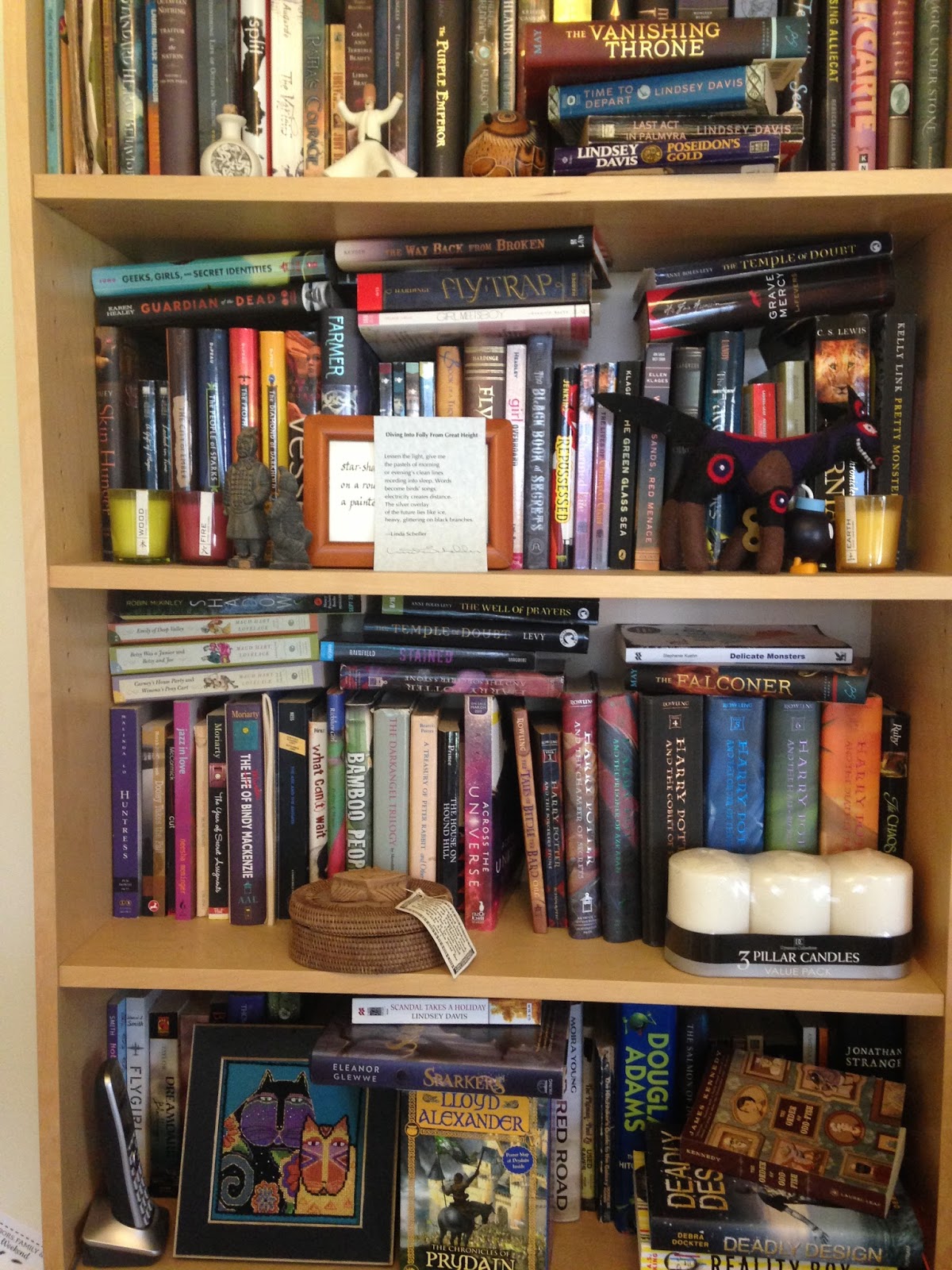
I found this delightful post via Scholastic talking about where and how their bloggers organize their bookshelves: alphabetically, by color (!!!), in a bookcase, in the nightstand, etc. That inspired me to take a picture of one of my bookcases and think about how I generally "organize" (ha ha) my book collection.

When I'm NOT otherwise too swamped to organize (and to be honest, most of the time I'm too swamped to organize--not pictured are the ancillary book piles on the floor), I seem to have come up with a system where I first group the books by overarching category, then within that category I alphabetize them. I have category groups for literary stuff, poetry, plays, old textbooks, children's/MG/YA (all one group), grown-up fiction, nonfiction, writing books, language books, and graphic novels. Within each of those, I usually try to keep them alphabetized by author's last name.

Oh, and I have one special stash of books right by my desk which are Frequently Used Titles such as the AP Stylebook and a Welsh dictionary.

Unfortunately (well, not for me, but unfortunately for anyone else), the groups themselves aren't in any particular order--but I did try to group together categories that make sense together. The children's/MG/YA books are in the same bookcase as the grown-up fiction books. Literary, poetry, and plays are in the same bookcase. And graphic novels and nonfiction are in the same case. Buuuut...old textbooks are crammed in with all the fiction, and writing books actually live in a couple of different spots. And then there's the pile of Books What People Done Lent Me That I Haven't Read Yet and the pile of Review Copies I Was Supposed to Read An Embarrassingly Long Time Ago and the box of Stuff to Donate.

And that's just the stuff in my office. Elsewhere in the house are other groupings for art books and travel books and random crap like old high school yearbooks, and stacks of books my husband bought for the purposes of prepping classes or going to seminars. We're definitely book people!

May 22, 2017

Monday Review: DREAMLAND BURNING by Jennifer Latham

Synopsis: I haven't read Jennifer Latham's first book Scarlett Undercover, about a teen Muslim girl detective, but after reading and enjoying Dreamland Burning, I plan to look for it. Dreamland Burning is really two parallel intertwining stories, one in the past and one in the present (a device which, I'll admit, I tend to really gravitate towards).

The historical narrative in this book concerns the Tulsa Race Riots of 1921, a tragic and horrifying incident which I freely admit I hadn't really known about before in which the prosperous, bustling black side of Tulsa—Greenwood—was burned, its residents rounded up by a white mob, many of them killed. Caught up in the violence is a young man named Will Tillman, trying to figure out right and wrong in a Jim Crow world that largely teaches him black people are to be feared and resented.

In the present, the story is told by teenage mixed-race girl Rowan Chase, who lives in present-day Tulsa. When a building crew doing renovations on their guest house discovers a skeleton under the floor, Rowan launches herself into solving the mystery of the body and how it got there. In the process, she realizes the extent to which the troubled racial history of Tulsa is still an ongoing legacy—one that intertwines with her own family's history.

Observations: With alternating chapters between past and present, both in first person, this is a fast-moving page turner. The often stomach-turning realities of being a black person in the 1920s South are juxtaposed with the still-problematic experience of being mixed race in the present day, with plenty of food for thought as a result. While I thought that part of the story could have been pushed a bit more, the focus on the mystery plot kept things moving forward and probably also kept the book from being obviously didactic. In fact, there were plenty of seeds planted here for readers to think about in terms of social and racial justice, from Rowan's best friend James's tutoring English to immigrants at the library, to the uneasy facts of Rowan's own racial identity and history.

Because so much conversation has been going on about Own Voices, I feel compelled to point out that this is not (to my knowledge) an Own Voices book, but from my personal perspective, it was sensitively written and focused on characters of color and the history of people of color in this country. It's a book that received a lot of positive reviews and starred reviews, and one can only hope that doesn't occur at the cost of any equally well written and researched Own Voices narratives. If you follow our blog, you already know we try to read and review as widely as possible within our areas of interest, so in our little corner of the blogosphere I don't think we're ignoring or slighting Own Voices—in fact, it's always been a focus of ours even before there was a hashtag. So. There you go. Disclaimer-y thing over.

Conclusion: If you enjoyed Ashley Hope Perez's Out of Darkness and other gripping novels that bring to life some of our most troubling historical moments—and leave you with hope as well as the desire to change our world for the better—check this one out.


I received my copy of this book courtesy of my library's ebook collection. You can find DREAMLAND BURNING by Jennifer Latham at an online e-tailer, or at a real life, independent bookstore near you!

May 15, 2017

Monday Review: STRANGE THE DREAMER by Laini Taylor

I LOVE this cover. It's gorgeous.
Synopsis: Lazlo Strange is a librarian, a former monk, and an orphan—his last name, "Strange," is simply the one given to any child of unknown origin, and not necessarily a descriptor. His colleagues at the library think he's a bit odd, though, mainly because of his obsession with the lost, possibly mythical city known only as Weep. He hoards information about Weep; dreams about it and theorizes on its existence and its fate; learns its forgotten language; imagines himself as one of its fabled warriors. He is, indeed, a dreamer.

But Weep lies across an impassable desert, if it exists at all. Most people believe that it's simply a legend—until the day a hero called the Godslayer appears, and Lazlo embarks on the adventure of a lifetime, one that he alone is uniquely poised to inhabit…

Observations: There isn't much more I can share in terms of the plot of this story, lest I ruin the sense of awe and wonder with which it unfolds. Laini Taylor has an affinity for this type of dreamlike story of gods and humans, replete with mystery and imagination and a fully developed mythology of its own. Lush sensory descriptions make Lazlo's world feel real, and the fact of his ordinariness (aside from his unusual scholarly interests) makes him an easy character to relate to and root for. This is the type of story that clutches at your heart, moves in, and subtly changes you—it's Neil Gaiman-esque in that respect, though the storytelling is very much Taylor's own.

Conclusion: Strange the Dreamer is epic and ambitious, and if you're a fan of fantasy and/or magical realism, you should read it now. Also, it appears there will be a sequel, which I'm already excited about. This one's my favorite Laini Taylor book yet!


I received my copy of this book courtesy of my library's ebook collection. You can find STRANGE THE DREAMER by Laini Taylor at an online e-tailer, or at a real life, independent bookstore near you!

May 09, 2017

Turning Pages Reads: MAUD by MELANIE FISHBANE

Welcome to another session of Turning Pages!

Synopsis: Maud has been left behind by her father, who has gone away to make a success of himself after the death of Maud's mother so long ago. Maud has been with her strict grandparents ever since, sweating away the muggy summers, longing to strip off her stockings and run down to the shore. Trouble at school found her sent away from her grandparents to act as live-in nanny and help raise her cousins for a while. Now she's back with her grandparents and meant to prove to them that she can be a good girl.

Unfortunately, trouble seems to find Maud wherever she goes. A friendship with the Baptist minister's son is seen as a signal that her morals are in question; regular girlish hijinks are reported on as being "just like her Mother." Maud has no idea what her mother was like -- she died when Maud was only a toddler, and no one will speak of her. Her grandparents clearly disapprove of Maud's father -- and now rumors are wafting about which confuse her even more. fortunately, Maud's father at long last sends for her. It's a treat to leave behind Price Edward Island and see the rest of the country, but when Maud arrives at her father's household, it's not quite as she expected. Her stepmother doesn't seem to like her very much, and it seems she'll be closest to the maid, instead of her new step-siblings. It seems that at every turn, Maud faces disappointments -- not truly feeling wanted within her own family, feeling tremendous pressure to have a beau, be the perfectly poised and ladylike person expected, to do her "duty" for her family at home and not go to school, to take care of others, and bite her tongue. It's a triumph when Maud finally does get a break, but it's a bittersweet story that a girl whose tales transported others lived such a sad story herself.

Observations: Not every classic stands the test of time. If I go back and read ANNE OF GREEN GABLES, the book is still a lovely memory of childhood, of kindred spirits and bosom friends, but Anne herself isn't as clear a favorite (EMILY OF NEW MOON, published fifteen years after Anne, shows Montgomery's skills to a much better advantage, but for some reason, the rabid fave is still Anne). Her constant imagination-induced scrapes and good-hearted sweetness can be a little much if one is unprepared, and reading now I see some of the narrowness and racism of Edwardian era British life reflected in Anne's eyes. Still, L.M. Montgomery's gifts somehow never lose their appeal, even over a hundred years later.

The voice in this book has a reserved and less immediate feel to it, reminiscent of Montgomery's books, but somehow not quite. I felt that the author had pulled a screen between me and the emotions of Maud as a character, whereas with any of L.M. Montgomery's work, its trademark is that the reader practically weeps and laughs with the character; somehow Montgomery's characterizations are that sharply felt. The story itself is a bit depressing; I knew a bit about Montgomery's life, and knew it had been an unhappy one, but found it difficult to connect this Maud in the historical fiction to the facts about her life. Many readers might find that this novel opens slowly, but it moves more quickly after Anne leaves Cavendish behind and heads to her father's house. Subsequent developments in her life feel a bit more energetic, as the author leaves the focus on Maud alone, instead of writing with more detail on the immense cast of secondary characters. It was fun finding out that Maud had a nickname with also had a particular spelling upon which she insisted ("With An E!") and to discover how much Anne and Maud were a lot alike, in some charming and vexing ways.

Conclusion: While this book is published in the YA/children's lit category, I feel like this book's best audience is adults. Tweens who read L.M. Montgomery books now can find them a little tough to get into the adventures of an Edwardian era orphan, and so a fictionalized biography of the author might not appeal, but for those of us who cut our teeth on Anne's adventures and her big-hearted emoting, this will have crossover appeal, and echo faintly of Anne.


I received my copy of this book courtesy of the publisher. After May 16th, can find MAUD by Melanie Fishbane at an online e-tailer, or at a real life, independent bookstore near you!

May 08, 2017

Monday Review: REAL FRIENDS by Shannon Hale and LeUyen Pham

Synopsis: Shannon Hale is amazing. Just look at the range of YA and MG fantasy she's written, how awesome they all are, how beloved she is. And LeUyen Pham has long been one of our favorite illustrators here at Finding Wonderland. Now they've teamed up (SQUEE) on a heartfelt, hopeful middle-grade graphic novel that also happens to be a memoir of the author's tribulations with sisters and friends throughout elementary school.

Observations: Though some names and identifying details have been changed, at its heart this is still a story about Shannon herself as a girl. Imaginative, anxious, and eager to please, she finds that friendship is a bit more difficult to navigate than it had first appeared: friends move; friends change and grow apart; and sometimes friends become frenemies.

Unfortunately, sometimes bullies aren't only limited to school. This graphic novel tackles the difficult but important topic of bullying by older siblings. Shannon, as the middle sister of five siblings, struggles with finding her place at home as well as school. In the end, though it's not an easy or quick process, she discovers that it is possible to find true friends—and even repair broken relationships that once seemed hopeless. Change, after all, can be for the better.


This story handles tough situations like childhood anxiety and bullying with the gentle touch of someone who is no stranger to these challenges that many children face on a daily basis—but with a minimum of anger and blame. Not that Shannon-the-girl didn't get mad, or sad, or lay blame; but, from a later, wiser perspective, the story shows that patience and self-acceptance and kindness do bear fruit. And, as always, the artwork from LeUyen Pham strikes a perfect tone of charm, humor, and relatability, working seamlessly with the text to tell the story.

Conclusion: This book came out on May 2; this review is based on an advance reader's edition received from the publisher. Any kid who is struggling with friendship and finding their place in the world—and isn't that most kids?—will find a lot to recognize in this story, and hopefully will also find a lot of reasons to take heart, too.


I received my copy of this book courtesy of the publisher, First Second. You can find REAL FRIENDS by Shannon Hale and LeUyen Pham at an online e-tailer, or at a real life, independent bookstore near you!
May 04, 2017

Thursday Review: SPILL ZONE by Scott Westerfeld and Alex Puvilland


Synopsis: If you've ever read Scott Westerfeld's early trilogy The Midnighters, you'll know he does scary really, really well. And actually, he does various kinds of scary really well. Spill Zone seems to collect all those different kinds of scary in one graphic novel (which is only Vol. 1, by the way) designed, apparently, to give me nightmares: Creepy talking doll. Creepy NOT-talking kid. Radioactive-mutant-nano-infected monsters. Floating human meat puppets (which sent me off into a temporary YouTube black hole). Oh, and mysteriously plotting North Koreans.

The Spill Zone is what is left of Poughkeepsie, New York after a bizarre accident has left the town a no-go zone of horrors. But the Spill Zone is also how Addison makes her living, selling anonymous photos of the zone's peculiarities to discerning art collectors so she can support herself and her little sister Lexa. The most important rule she follows is: never step off her motorbike. The day she does leave the safety of her bike…is the day things get REALLY weird.

Observations: This is a suspenseful, edgy post-apocalyptic adventure from an accomplished storyteller in the genre—and I was pleased to see that Westerfeld's ability to convey a truly creepy atmosphere also applies to the graphic novel format. The partnership with artist Alex Puvilland (who is married to the incomparable LeUyen Pham, BTW) is a good one: the art has this scratchy, crackly quality that fits well with the tone of the story, and the important details are highlighted with clarity and simplicity.


Conclusion: The plot of this one is gripping, and I can hardly wait for the next installment (talk about a cliffhanger ending).


SPILL ZONE just came out this week! I received my copy of this book courtesy of the publisher, First Second. You can find SPILL ZONE by Scott Westerfeld and Alex Puvilland at an online e-tailer, or at a real life, independent bookstore near you!

April 25, 2017

Turning Pages Reads: ROAD SIGNS THAT SAY WEST by SYLVIA GUNNERY

Welcome to another session of Turning Pages!

Synopsis: A content warning for suicide and troubling attention from adult men.When their parents depart on their long-planned for trip to Europe, 19-year-old Hanna springs the plan on her sisters, Megan and Claire - to take Mom's car the following day and go on a cross-country drive, from the Atlantic to the Pacific, Nova Scotia to Vancouver. Adventure, in the form of the Trans-Canada Highway is just a breath away - if they'll agree to it. 17-year-old Megan's not interested. She has a job and a life plan, to get fit for swim team tryouts come the fall, and she wants to stick to it. She likes adventure in measured, planned doses, nothing spur-of-the-second, like Hanna seems to always be. Claire, at fifteen, idolizes her older sisters, and only wants peace. If Hanna offers adventure, Claire wants to make sure she gets in on it - and that Megan goes along. And she does -- grudgingly -- briefly helping Claire create the united front of sisterhood. It lasts -- briefly -- until cracks begin to show.

There are other road-trippers along the way, hitchhikers, families, street buskers. Like a friendly butterfly, Hanna seems to alight on each one and engage with them, much to Megan's bitter observation. Aren't the sisters enough? Why does Hanna always have to go? Why can't she be average, like everyone else? She quits everything she starts - first University, then her nannying job in Italy, and now their big sisterhood trip. She talks them into attending the weddings of strangers, of bowling and partying, and she's not paying enough attention to Claire. She's such a sucky big sister.

There's something Hanna and Megan aren't telling Claire - something that happened with Hanna in Italy. Sometimes, Claire hates being the youngest, gets tired of keeping the peace between Megan's acid tongue and Hanna's blithe merriness. Can't Megan see there's something wrong with Hanna? No... of course not. Megan's suddenly got a crush on one of the people they meet along the road - and it's flaring up faster than Claire's ever seen. Hanna keeps disappearing, and Megan doesn't even notice. And, neither of her sisters can quite see that not all is well with Claire, either.

What started out as a lark turns into something deeper and broader, as the last summer three sisters are together ebbs and flows. They share a closeness and silently affirm their love, even as their good time eventually fades, like all things do, into memory.

Observations: This is a quiet book, a literary book, and a difficult story to cram between two plain paper covers. A sisterly Bildungsroman is both vast and deep; it covers the happenings over a summer, but also the tendencies of a lifetime thus far, in a way. The narrative is more a series of observations from inside the mind of each girl, and isn't always seamless. The "head-hopping" can be frustrating for a reader seeking a typical narrative with a rising narrative arc, and this book might be more appropriate to an older reader. I think it crosses over well into being an adult read.

Things happen in this novel, and yet, not much does. It's a road trip; there are long silences, periods of silent anger, spontaneous, giddy parties with strangers, and a lot of examining internal thoughts. Hanna thinks a lot about the terrible job in Italy, and the way it ended, with confusion and accusation of things which didn't happen - but things which, she is ashamed to admit, she dreamed of happening. Are we responsible for our dreams? Because we might want something, does that make us as bad as if we'd reached out and tried to take it? Does that mean we attract more of the same? Is it our fault?

Megan seems merciless; unforgiving, exacting, keeping count of how many times Hanna has disappointed her, to the detriment of her own enjoyment of life, and of her seeing Claire as anything but Hanna's yes-woman. When she finally thaws, her sisters are surprised -- but she freezes up again quickly. The novel unfortunately doesn't spend as much time with Megan, or on expository dialogue to help the reader see her inner mind, and the reader is left wondering what she really wants, except for her sister, Hanna, to stop leaving her behind. Her prickly resentfulness is shown at the end as a held-over childhood resentment, which makes her seem more pathetic than angry.

Claire's loss is recent enough that the shock hasn't finished with her. She's walking wounded, but doesn't know it, until she sits down long enough for the thoughts to filter through. It hits her, on this trip, that the friend she lost is never coming back, ever. She doubts herself, and second-guesses all of the conversations she had. Why hadn't she seen it coming? What does it say about her, that she missed so much pain? What if it happens again? Suddenly, Claire feels like a tiny speck in a massive world that has spun out of control... and her sadness is so great that it's crushing her. Maybe this is how her friend had felt, too...

The novel ends with trailing threads, and for some, the end will seem jarring. But, a road is a constant, just as the narrative of sisterhood and the process of growing, maturing, and separating is a common experience, in many ways. This constantly shifting narrative means that some things aren't resolved in this novel - bitterness remains bitter 'til the end, losses still pain, good times are ephemeral. The road goes on, but the one thing that remains is sisterhood. Despite everything, these girls will always be related.

Conclusion: Definitely not for the common crowd, this novel is made up of the pauses between growing pains, and will find its audience among those who have wished to draw closer to their families and see them as complex and enigmatic human beings, instead of the familiar souls they've always known. Perfect for people transitioning through stages of life, and wondering what more is out there.


I received my copy of this book courtesy of the publishers. After May 1, you can find ROAD SIGNS THAT SAY WEST by Sylvia Gunnery at an online e-tailer, or at a real life, independent bookstore near you!

April 24, 2017

Monday Review: THE HATE U GIVE by Angie Thomas

Synopsis: The Hate U Give has been reviewed, starred, and buzzed about for several weeks and I'm a little late to the party, but it deserves all the attention it has received, and more. The plot is ripped from the headlines: a young black man, Khalil, is shot and killed by the police during a traffic stop—but of course, that isn't the whole story. It never is. The police and media take the all-too-easy, well-trodden route of trying to paint Khalil as a thug, a drug dealer who may have been reaching for a weapon when the cop shot him out of "self-defense."

But there's another side to the story, and that's where our narrator comes in. Starr Carter lives in the same neighborhood as Khalil—a neighborhood she's known all her life, though she attends a suburban prep school; it's the neighborhood where her mother works as a clinic nurse and her father owns a grocery store. She was in the car when Khalil was shot, and is the only one who can give an observer's account of what happened.

Observations: This book does so much to humanize a situation that for many of us is only experienced as words and images coming from our television box. It puts us in the position of those whose communities suffer this type of institutionalized fear every day, and it isn't a comfortable position. Not for us readers, and certainly not for people in socioeconomically marginalized neighborhoods.

I have never felt such a complete understanding before of the complexity of social conditions that might lead to police shooting an unarmed youth—nor the tragedy that underlies these situations. I don't just mean the obvious tragedy of bereaved families or torn-apart communities, but the tragedy of impossible choices that poverty leads to, and the institutionalized prejudice against people of color and the poor that means a snap judgment call will almost inevitably go against them. Then there's our eager-to-jump-on-the-bandwagon media culture that virtually eliminates the idea of benefit of the doubt or opportunity for a fair defense. It's unconscionable and dehumanizing, which is why humanizing stories like this are so, so important.

But the book is not just about those who inhabit disadvantaged neighborhoods or are socioeconomically segregated (and I'm sorry to use that word, but I'm even sorrier that segregation is still a Thing That Happens); it's about ALL the liminal, uncomfortable spaces that people of color often find themselves inhabiting. Starr, the narrator, juggles two worlds: her suburban private school, where she excels but never quite feels like she fits in, and her home neighborhood, where she and her family do their best to stay away from drug deals and gang violence while also putting their all, their heart, into improving their community. There is a lot in this story about Starr finding her place in the world, and without giving too much away, I love how that aspect of the book was resolved, by Starr, her friends, and her family.

Conclusion: Do yourself and the world a favor and read this, please. Society cannot make progress without people understanding one another, but stories help us do that.


I received my copy of this book courtesy of my library's ebook collection. You can find THE HATE U GIVE by Angie Thomas at an online e-tailer, or at a real life, independent bookstore near you!

April 21, 2017

Turning Pages Reads: NOTEWORTHY by RILEY REDGATE

Welcome to another session of Turning Pages!

Synopsis: Junior Jordan Sun wants desperately to fit her square peg into the series of round holes that make up the Kensington-Blaine Academy for the Performing Arts -- but there seems to be no place for her, in theater, film, drama, or dance. In drama, she's not considered dramatic enough. In theater musicals, her voice is "difficult to reconcile with musical theater;" it's low for solo leads and too ...unique for chorus - second altos could quack like ducklings in a forest full of songbirds. Aside from her own insecurities as an artist was being a poor artist at a swanky school, where early admission to Julliard and spendy outfits were just an accepted norm. Jordon feels ashamed of her scrappy ambitiousness, feeling she should be home, being a helpful, useful part of her immediate family -- who really, really, really, really, really cannot afford her taking this chance. Not when her Dad's been injured. Not when her mother's having to apply for aid just to get food on the table. Not when... three years in at Kensington, and she's still not making it into any of the drama groups she's meant to join.

Jordan sees an opportunity to change her fate by auditioning to join the Sharpshooters, Kensington's premier octet. Of course, joining the Sharps means cutting some corners... and auditioning in drag. Soon, Jordon Sun, Tenor 1, is taking some chances; lying to a few people... and then a few more. It's all for a good cause, though, right...?

Observations: Diversity, creativity, ingenuity: YES. While the novel may start slowly for some -- especially those who are not vocal groupies - the novel hit its stride fairly quickly, and steadily gained tension, as so many lies piled up, and so many secrets and competitive little twists were revealed. This novel is my novel in a variety of ways: I went to a private boarding school my parents could NOT afford -- and I worried about it with a brick in my gut every single day of the two years I was there. I love that the author included and examined the difference in classes and the egregious assumptions at times made about those who are wealthy, and those who are on public assistance. Redgate hits hard at some home truths about the secrets we keep - from ourselves and from each other - and the drag that Jordan continues to wear is not the only mask the novel examines.

The voice and characterizations in this novel reeled me in. The description of singing, of what perfection in harmony feels like emotionally, were so. spot. on. Sometimes, when you're singing, it's like you're flying, and the sound buoys you up, and you never want it to stop... The boarding school vibe, a microcosmic universe where suddenly EVERYTHING is super important, and the outside world almost doesn't exist? Also spot on. Music nerds and people who like school stories will really love this. People looking for stories from new voices in the field will really enjoy a fresh take on school and life from a cross-dressing, bi-maybe, Chinese-American perspective.

Conclusion: This was a hotly anticipated novel to come out this year and is basically a love letter to music, choral groups, and high school organizations. I am a BIG OLD CHORAL NERD (and as I write this, we're two days from an a cappella performance this weekend) so this novel truly resonated for me. I am gratified that the hype didn't disappoint.


I received my copy of this book courtesy of the publisher. After MAY 2, 2017 - not long, now! - you can find NOTEWORTHY by Riley Redgate at an online e-tailer, or at a real life, independent bookstore near you!

WRITERS' RITES: Creation In Color


Things have changed, in children's literature. Historically, our posts have been alerting people to what's going on in smaller corners of a small world, and most of our time has been spent in talking about book deals, books, classroom visits, and young readers. Most of our time has been spent in earnestly seeking to understand and communicate both the trends and the ebb and flow of the market, sometimes in personal reference to us, but most often in reference to the whole world of children's lit. More personally, AF and I were both in on the big "multiculturalism" wave of the 90's. [AF: Compared to the limited range of stories available in the 80s, when we were growing up, it was a hopeful trend.] We attended conferences and listened to the talk about expanding stories and being inclusive. We hoped it meant something, that narratives about mixed kids would become more prominent, and that identity and ethnicity wouldn't stand out as hot-button "trend" books, but part of a normalized, homogenized whole. We've both listened in as the conversation has shifted to "diversity" and then away from that to the idea of "writing from the margins" and the use of "own voices" as part of the narrative.

We've mostly been pretty quiet. By nature and personality, neither Sarah nor I are scrappers and thus have been mostly observers in the growing pains of this brave new world of children's lit. But, recently I participated more directly in a Twitter conversation about being both a woman writer and a woman of color writing. A simple comment with a hashtag bloomed into a six+ hour outpouring of snark and pain and rage -- and it shocked a lot of people, galvanized others into trying to make it a "movement," offended a few, and infuriated others.


No one needs to explain to anyone (because if you have to explain it, that person to whom you're speaking likely is predisposed to disagree, and then explanations will not assist) that this country has a problem with institutionalized, ingrained, implicit bias, or more directly with racism. If you're new to this idea, welcome. The rest of us have known for some time. What might have previously been harder to see is that something ingrained infects everything, everything. EVERY. THING. Even children's lit, a place where we previously insisted all was happiness, rainbow unicorns, and fluffy bunnies. "But, it's a happy, close-knit community!" people insisted. Which it is, unless you challenge the status quo and bring in new thinking - and then you'd be surprised by the fury. I know I have been. "All this talk just stirs up bitterness," some have said in response to the conversation. Yes. Not everyone is happy, even though they are in the field, because the field of children's lit is not yet what it could be, what it needs to be. And, that unhappiness is also okay. It's all part of the process.

Stepping aside from the daily misunderstandings, slights, overlooking and misdirecting, there are those in children's lit taking on the work of changing it, and I once again have to give them respect. Reading While White is the first blog I've ever seen written by people who are doing something specific about implicit bias in the children's lit field. And it's not easy for them; there is push-back against their every blog post, even as their stated purpose is to learn for themselves how to listen and hold themselves accountable for how their privileged whiteness impacts the way they see the world. It's as if every thing they write is a personalized rebuke to someone else, and there is a lot of bitterness.

We're mostly observers here, as I've said. I have a raging anxiety which causes me hives at the thought of the constant emotional labor and combat it takes to make inroads in the conversation around visibility and authenticity. This is not work I can do. [AF: And, as a mixed person, visibility and authenticity are huge issues--sometimes, those of us of mixed descent are racially or ethnically ambiguous, and if you aren't recognized as a "something," it's easy to feel like you're a nothing. Invisible. Not enough of one, not enough of the other, and authentic enough for neither.] 

And yet, even as we don't all work directly for this change, we are a part of it. As we usher greater visibility, accommodation, accuracy and accountability into young adult and children's literature, these changes will become a part of the world for those who come after us. AF is more thoughtful and articulate, and neither of us are quick with a comeback - we both prefer to think slowly and write and the conversations have at times been boiling along furiously. We've both stepped back from those -- but yesterday, it was really nice to be heard. It was cathartic to express the stupid things which have been said. It was nice not to feel crazy, exceptional, isolated. It is validating to feel that you are not alone. [AF: It is eye-opening to see certain types of comments in a new light, too--as well as to bear witness to some of the comments that I've been fortunate enough not to experience firsthand. It enhanced MY understanding of what fellow women writers and writers of color experience.] And that's why yesterday's conversation was most important.

It is hard being a woman writing in this day and age. It is hard in different ways being a woman of color writing. In many cases, people hear these sentences and assume the voices which say them are merely angry - that these microaggressions came with rejections, and that these people saying "this is hard, this is what I hear," are just victims lashing out. Not true. Sometimes the slights are said by well-meaning people who work with the women of color in question to produce their work. This is borne out by the fact that some very successful authors popped by to bring things up in these discussions. But, again, I sense a strange, slim thread of comfort in the furor, in the stories held private, and then shared -- we are moving, slowly, a troubled industry, one step at a time, toward what it should be.
Small comfort. But as long as life remains, we are the hope.

April 14, 2017

Turning Pages Reads: VIGILANTE by KADY CROSS

Welcome to another session of Turning Pages!

NB: Content advisory for rape, suicide, and violence.

Synopsis: Junior year, Hadley's best friend, Magda, is assaulted at a party. Hadley doesn't understand why Magda doesn't speak up about it, retaliate against the boys who are catcalling her, and stiffen her spine. Hadley urges Magda to act, but Magda chooses not to, and Hadley is grief-stricken and enraged at the loss of her friend, and most of her rage centers on seeing the perpetrators in class every day. As her senior year goes forward, Hadley looks not to the future, but to the past, which remains to her out of balance. She sets herself as the avenger for Magda's death, encouraging girls to join a self-defense course and learn martial arts while plotting to provide the justice against the four boys that no one else has given them. Along the way, she grows closer to Magda's brother, and begins a wave of pink ski-mask vigilantism to save other women from bad situations. This is the basic narrative, without providing too much detail or spoilers.

Observations: Content advisory again: this novel is pretty violent, and some of the scenes of violence are pretty sustained, and I skipped them. Normally, I wouldn't review a novel I skipped part of, but I picked up this novel because the jacket copy said it was a "brutally honest" look at retribution - and since I'd just read a novel on someone faking being who they were, I thought "honest" was a good thing. I assumed that a female main character taking matters into her own hands would be somewhat empowering - and I know other people may come to this work with that in mind.

The biggest problem that I had with Vigilante - one of many problematic things - is how Hadley implies, in a variety of ways, that Magda is at fault for her rape. I know that's framed in their disagreement in the beginning of the novel as 'a bad thing to say' and the kickoff for the narrative arc and Hadley's vigilantism, but the same is implied elsewhere, later, and the novel doesn't really take it back. For example, as Hadley implies that is doing what Magda should have done, as she learns martial arts and physically empowers herself. Unfortunately, physical power does not guarantee that you can repel a physical attack, and the novel doesn't seem to really take much time to point this out. Hadley is very, very secure in her physical prowess, as if women who are not are somehow taking a chance with their ...safety, and thus somehow doing something wrong. Someone asks Hadley and the detective leading her self-defense course "shouldn't we be teaching men not to rape?" and Hadley says, "Yeah, good luck with that," which... yeah. I'm aware that the character is written in part to be an unreliable narrator, but unfortunately the narrative itself doesn't work through some of her unreliableness.

Early in the novel, Hadley evinces her interest in Magda's brother. Their relationship leaps into reality after Magda's death, and that didn't work as realistic entirely for me - although I do understand how loss can lead people into a physical expression of "we're still alive," but attraction and arousal was a strange third party to a novel about grief, and it seemed to float around just as awkwardly in scenes which would have otherwise been Magda centered. This seemed like the pitfall of All YA Novels Must Have Romance, and... no.

I assumed that the narrative would point out the problems inherent in that ideology. They didn't really. Instead, the novel seemed to glorify actions taken in a white-hot rage, almost identifying Hadley as a superhero, with copycats and a special name, even going so far as to contemplate sexual assault against someone (which she says there's no such thing as sexual assault against a man - oh, yes there is, and the novel doesn't correct her assumption on that, either), in the name of making right her friend's assault - an assault she's allegedly decrying by her actions. She spends inordinate amounts of time in the novel worrying about getting caught, yet her repeated behaviors almost seem as if she's hoping she does -- she wants to talk about This Elephant In The Room -- Magda, whom she feels no one cares about but her, thinks about but her, or talks about as they should - but her. This exaggeratedly centering herself in someone else's story persists throughout the novel. In the end, she's the "heroine" of the piece, which didn't work for me.

Conclusion: This book has a lot of action, a lot of roaring, feel-good kind of anger, and a righteous cause, but I feel like it has more problems than I'm comfortable recommending along with it. Readers who like a riproaring, girls-kick-butt kind of narrative, and don't worry about subtext may enjoy it.


I received my copy of this book courtesy of Harlequin Teen. You can find VIGILANTE by Kady Cross at an online e-tailer, or at a real life, independent bookstore near you!

April 10, 2017

Cybils Finalist Review: TRASHED by Derf Backderf

Synopsis: This is my last Cybils 2016 graphic novel finalist review! Last but not least is Trashed by Derf "Not His Real First Name" Backderf, an edutaining chronicle of the life cycle of garbage, and the trials and tribulations of a garbageman (apparently loosely based on a job the author actually held for a while).

Observations: I enjoyed the blending in of factual sequences describing the job details of a garbage collector and the journey garbage takes from curb to landfill and into the environment. It's bound to make readers think more about the trash they produce and about garbage as a global issue. As an older reader and homeowner, it was eye-opening to see things from the garbageman's perspective, and how we might not think twice about dumping random crap in the trash but it is truly somebody's job to deal with it, and it may have ramifications beyond just the mess in your garbage can.

The comic-strip style of this one was also enjoyable--plenty of humor in both the writing and the images, distinctive character art, and easy-to-understand diagrams in the educational portions. Having said that, because it IS distinctive, it won't be to everyone's taste; I wasn't sure if I'd like it at first because the characters have a weird blockiness to them that was a little off-putting, but it grew on me. (Which, in retrospect, seems like a terrible word choice for a book about garbage...)

Conclusion: There was plenty of hilarity here, in an old-school comic strip kind of style, and it offers an intriguing, humanizing window into the life of a garbageman as well as the life of garbage itself. The combination of educational elements with slice-of-life stories about the protagonist J.B. and his buddies was well done. The characters, of course, of necessity are adult characters, so that part doesn't feel very YA, I suppose, but older young adults might enjoy this one.


I received my copy of this book courtesy of the publisher. You can find TRASHED by Derf Backderf at an online e-tailer, or at a real life, independent bookstore near you!

April 06, 2017

Cybils Finalist Review: MARCH: BOOK THREE

Synopsis: I had been looking forward to reading this one for quite some time, and I was not disappointed. In my opinion, the graphic novel format really lends itself to conveying history in a lively and interesting way, and there are few socio-cultural topics more relevant to the current American psyche than the ongoing discussion of race and civil rights. March: Book Three brings Congressman John Lewis's three-volume memoir of the civil rights movement to a close, but it has opened a much broader discussion--one that will, I hope, increase our understanding of pervasive injustice and our obligation to keep working on ourselves until we get it right.

Observations: The wealth of historical detail in this book--and the entire series--is presented in a way that the reader can readily engage with on a personal level, putting our recent history into context as a country struggling with race and racial identity. It is brilliantly told, both as a memoir of Congressman John Lewis's life and career, and as a story of the broader moment in time beyond his individual experiences. Actually, the unsung heroes, in a way, have just as much of a starring role here, and we can see and marvel at the level of sacrifice and determination put into helping this country adhere to its stated ideals.

click to embiggen
The semi-loose drawing style and monochrome color scheme help add drama and an active feel, making this much more than a static depiction of historical events. History comes alive here, and is interwoven with occasional scenes from the Obama presidency, showing both ends of the timeline and how they relate. The choice of which scenes to depict and how was very effective.

Conclusion: Such a densely informative historical chronicle is going to appeal to some readers and not others, but it is presented in a very engaging way, with its focus on action, emotion, and the earnest dedication of the central figure, John Lewis. This book makes it easy to connect with history on a personal level and SEE why it is so important to know about the events leading up to the Voting Rights Act.


I received my copy of this book courtesy of my library. You can find MARCH: BOOK THREE by John Lewis, Andrew Aydin, and Nate Powell at an online e-tailer, or at a real life, independent bookstore near you!

April 03, 2017

Middle Grade Monday: A Cybils 2016 Graphic Novel Roundup

As you may know, I've been reviewing Cybils graphic novel finalists that I had to remain hush-hush about during the actual judging process in January and February. I thought, since it's Monday, and since I've finished reviewing all the Elementary and Middle Grade finalists, I'd put all the links here in a roundup for your convenience, or in case you missed them!

The Nameless City by Faith Erin Hicks

Lowriders to the Center of the Earth by Cathy Camper and Raul the Third

Princess Princess Ever After by Katie O'Neill

Compass South by Hope Larson and Rebecca Mock

Mighty Jack by Ben Hatke

Bera the One-Headed Troll by Eric Orchard

I also read The Wolves of Currumpaw, which was also a finalist, but I felt it was much more of a picture book/illustrated book than a graphic novel, so I didn't formally review it. However, you can read about it here on Kirkus.